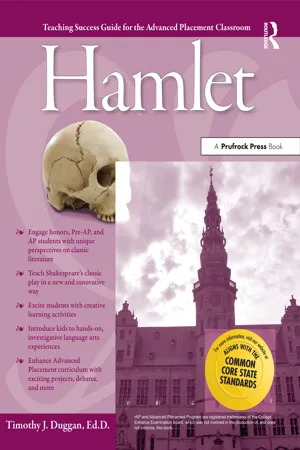
Part of Prufrock's new series for the upper level classroom, Advanced Placement Classroom: Hamlet allows teachers to take a fresh approach on one of Shakespeare's most famous plays, by moving beyond basic history and memorization of quotes. Students will study cultural variations of the Hamlet story, recreate the tale's events in a news show format, rewrite scenes using modern-day perspectives, and create their own blogs to discuss the play's relationship to contemporary life. The author also provides easy-to-use discussions of Shakespeare's life and times and the ways Hamlet can be studied from a critical perspective.
Prufrock's new line of innovative teaching guides is designed to engage students with creative learning activities that ensure Advanced Placement success. The Teaching Success Guide for the Advanced Placement Classroom series helps teachers motivate students above and beyond the norm by introducing investigative, hands-on activities including debates, role-plays, experiments, projects, and more, all based on Advanced Placement and college-level standards for learning.
Grades 7-12
- 248 pages
- English
- ePUB (mobile friendly)
- Available on iOS & Android
eBook - ePub
About this book
Information
CHAPTER
1
"Who's there?": An Introduction
DOI: 10.4324/9781003232810-1
Welcome to the Advanced Placement Classroom: Hamlet.
Virtually everyone who has completed secondary school has had an experience with Shakespeare. His works (three or four of them, anyway) are part of the required curriculum in school districts across the country and in many parts of the world. Recognizing that Shakespeare is a common element in school curriculum is a good place for us to start thinking about how we will teach Shakespeare. We should first examine what our own high school (and perhaps middle school) experience with Shakespeare was like, so that we can start to understand two things: first, why we as individual teachers think and feel the way we do about Shakespeare and second, what information from our own experience of Shakespeare in school will inform our process for designing how our students will experience Shakespeare. Granted, our school experience, such as we are able to remember it, should not be the determining factor in our planning, but if we have had specific negative experiences or specific positive experiences, reflecting on them will allow us to recreate the positive and avoid the negative for our own students.
Unfortunately for many English teachers, their love of Shakespeare, assuming they do love Shakespeare, tends to come later, when they see a dynamic theatrical production or benefit from a stimulating professor in college. Reality for high school teachers is far different from that of college professors on a number of levels. When I addressed Shakespeare with my college students in the 1990s in Nebraska, we started with a conversation about what their knowledge of and experience with Shakespeare had been before coming to college. The stories they told of how Shakespeare was taught to them were sometimes inspiring, and other times they harrowed me with fear and wonder. Teachers, like doctors, should take an oath that contains the Hippocratic maxim to avoid doing harm. In parentheses following that statement should come the phrase "especially when teaching Shakespeare."
Everyone has to start somewhere, Robert Frost once said that poets have to start with insufficient knowledge, or else no one would write a poem until he was 50 years old. The same is true with teachers. We all start with deficits in our preparation, and one or two survey courses in Shakespeare are slim preparation to go into a classroom and teach Hamlet to teenagers.
John Dewey (1938) said that the best type of experience for a learner is that which leads the learner to seek a further, similar experience. Our job in teaching Shakespeare and in teaching Hamlet is to make an introduction and to guide the experience our students have with the text in such a way that will foster their desire to have another experience with Shakespeare. It is important to remember that making it easy or trying to make it fun will not work in this regard.
Your students will not love Shakespeare just because you do, and they certainly will not love his work if you groan through it yourself. On the other hand, they can grow to love the accomplishment that comes through close and often frustrating experiences reading and writing about a difficult text. Every time I hear a speaker or a teacher say that Shakespeare is "not difficult" and that students "can get it if they try," I feel the tug of the millions of students who sit bored and confused in classrooms throughout the country and perhaps around the world. I have been reading, viewing, and enjoying Shakespeare for nearly 30 years, but it still poses difficulties for me when I sit to read it, and I still avail myself of the explanatory notes, even if I sometimes dispute them when they don't make sense to me. As this book will demonstrate, reading the text as a script with clues for performance will help unlock meaning, as will exercising the many skills of analytical reading and writing at the core of language arts standards. Shakespeare is difficult, but rigor and challenge are what schools should be about, and Shakespeare, like certain other authors (Faulkner and Joyce come to mind), rewards our hard work with understanding.
Hamlet is a monolith of literature, and so teaching it can be a little like acting the part—intimidating. As Phillip Franks (1993), an actor who played the part for the Royal Shakespeare Company, said, "The weight of the past of the play is unbearable." That weight can be unbearable for us as teachers, too, unless we look at Shakespeare as a challenge to be met, to prepare for, to invest ourselves in, and above all, to enjoy. At the heart of Hamlet, as in any play, is a story to tell. The play itself is concerned with storytelling. The ghost of Hamlet's father tells Hamlet that, were he not forbidden to do so, he could tell Hamlet a story that would raise the hair on his neck. And yet, the story the ghost does tell Hamlet sets in motion the action of the play. At the end of the story, Horatio, who is the audience's partner in witnessing Hamlet's struggle, is given the task of telling Hamlet's story, and of reporting his cause "aright to the unsatisfied" (V, ii, 371-372). There's a sense of purpose, of getting things right for posterity. As someone who knows the truth, Horatio must tell it to those who don't know it, just as one who has seen the light outside Plato's allegorical cave must be dragged back to enlighten those still in the dark. In a sense, we have the same mission as Horatio, to bring Hamlet's story to our students, to report him and his cause "aright to the unsatisfied."
To say that much has been written about Hamlet is a gross understatement. One cannot possibly sift through the volumes of criticism, analysis, and commentary, nor will doing so add a great deal to your arsenal in the secondary classroom. This is not to say that critical prose should be avoided (see Chapter 7 and Chapter 8 for discussions of critical sources), but I would recommend letting students first encounter the text of Hamlet with a fairly naive stance as readers, unencumbered by predigested interpretations of others. Critical approaches can add to re readings, discussions, and ultimately to performing scenes and writing in response to the play, but frontloading students with piles of information, even background information, can lessen interest and convince them that they are no match for the task of studying Hamlet. Just as GPS takes the adventure out of finding one's way around with a map, so do pretaught interpretations take the adventure out of reading Hamlet. In such a situation, one is only looking for the road signs that the teacher and the critic have pointed out. My hope is that you will find useful and challenging activities here to guide and enhance your experience teaching Hamlet and your students' experience reading the script, performing scenes from the script, and writing in response to the text. Ultimately, when students have arrived at their own interpretations of the script, they will venture into the world of Hamlet criticism, and this book should help you in your efforts to make that journey sensible for them.
For you as the teacher, creating a unit of study covering Hamlet is a little like mounting a production of the play You have a number of decisions to make prior to starting, you hope things will go as planned, and you hope the outcome will be a phenomenal success, I believe teachers should create their own units with whatever tools they see fit to use, because you as teachers know your students, your curriculum standards, and the other pressures on your work life that allow or disallow certain options. As director of your students' experience, you will first need to determine how much time you have to devote to Hamlet, and how you will fit it into your course of study. If you devote 5 weeks to the play, you will be able to take your students places that 3 weeks will not allow. If you are reading Hamlet within the context of an elective Shakespeare course, you will have options that you don't have in a typical British Literature survey or AP class. As this book progresses, I occasionally will make reference to options for those who have less time in the curriculum and those who have more.
How to Use This Book
There are many, many discussion topics and classroom ideas in this book. Activities that involve students in work outside the classroom include a Student Activity Sheet (SAS) at the end of each chapter in the Chapter Materials, which you can modify as you please or give to your students as a set of instructions. Those activities that are teacher directed and that can be done in the classroom are explained in the chapters themselves, with no handouts. I believe that teachers like to design their own units of instruction because they know their students best, so I'm providing a method for addressing the text, and you can provide the schedule you will use, pick the assignments from this book that make sense to you, along with those you create yourself, and design the assessment parameters around the work produced. In descriptions of activities throughout the book, I specify what students may produce as a result of the activity, but it will be up to you to assess student progress based on your own parameters.
Chapters 4-7 form the core of this book. Read Chapter 4 with a text of Hamlet handy for reference, as the chapter will guide you through the reading process, scene by scene. Ideas from Chapters 5, 6, and 7 for discussion, performance, and writing reflect back on the text of Hamlet, assuming that you and your students will reexamine the text often following your initial reading. Use the activities that make sense to you, and pass over the ones you don't feel comfortable with. In a 3-5-week unit on Hamlet, you won't have time for everything here, but you should have a good variety of approaches that challenge your students and produce understanding on a number of levels.
I believe in student involvement, and Shakespeare demands it, through the relationship between a script, which is what we have in our hands, and a play, which is a theatrical experience. If this book makes nothing else clear, it should drive home the point that Shakespeare's works are scripts for actors. Although reading Shakespeare without thinking about performance can be pleasurable, indeed, reading the text as a set of instructions for actors will open up possibilities for you and your students that will bring the work to life. This book is written with the goal of getting you and your students to spend much of your time with Hamlet up on your feet, speaking the lines and moving around. Certainly, no approach to teaching anything is hegemonic, and you will find many alternative activities in this book that don't involve performance. My general method for teaching involves students in individual contemplation, group exploration, and whole-group sharing. I believe that as teachers we need to distribute our students' attention between the text, each other, and ourselves. We should bring something to the mix when we teach Shakespeare, which includes not only what we know of the work, but our willingness to become learners with our students. The kinds of thinking students do should alternate between receiving information, processing information, and transmitting, through speech, writing, or action, their understanding.
Standards and Assessments
The activities in this book address virtually every standard put forth by the National Council of Teachers of English and the International Reading Association (1996), which are listed below
NCTE/IRA Standards
- Students read a wide range of print and nonprint texts to build an understanding of texts, of themselves, and of the cultures of the United States and the world; to acquire new information; to respond to the needs and demands of society and the workplace; and for personal fulfillment. Among these texts are fiction and nonfiction, classic and contemporary works.
- Students read a wide range of literature from many periods in many genres to build an understanding of the many dimensions (e.g., philosophical, ethical, aesthetic) of human experience.
- Students apply a wide range of strategies to comprehend, interpret, evaluate, and appreciate texts. They draw on their prior experience, their interactions with other readers and writers, their knowledge of word meaning and of other texts, their word identification strategies, and their understanding of textual features (e.g., sound-letter correspondence, sentence structure, context, graphics).
- Students adjust their use of spoken, written, and visual language (e.g., conventions, style, vocabulary) to communicate effectively with a variety of audiences and for different purposes.
- Students employ a wide range of strategies as they write and use different writing process elements appropriately to communicate with different audiences for a variety of purposes.
- Students apply knowledge of language structure, language conventions (e.g., spelling and punctuation), media techniques, figurative language, and genre to create, critique, and discuss print and nonprint texts.
- Students conduct research on issues and interests by generating ideas and questions, and by posing problems. They gather, evaluate, and synthesize data from a variety of sources (e.g., print and nonprint texts, artifacts, people) to communicate their discoveries in ways that suit their purpose and audience.
- Students use a variety of technological and information resources (e.g., libraries, databases, computer networks, video) to gather and synthesize information and to create and communicate knowledge.
- Students develop an understanding of and respect for diversity in language use, patterns, and dialects across cultures, ethnic groups, geographic regions, and social roles.
- Students whose first language is not English make use of their first language to develop competency in the English language arts and to develop understanding of content across the curriculum.
- Students participate as knowledgeable, reflective, creative, and critical members of a variety of literacy communities.
- Students use spoken, written, and visual language to accomplish their own purposes (e.g., for learning, enjoyment, persuasion, and the exchange of information).
State standards vary from state to state, but cover the broad areas above in more detail. You will want to design assessment of your students based upon your state standards and your goals. Here is not only a large volume of possible assignments for student learning, but also enough variety in the assignments to provide you with evidence needed to prove student learning. I do not, however, provide a test over Hamlet—only opportunities for active and reflective reading, discussion, group investigations, informal and formal performance, and creative proj ects. Enjoy.
CHAPTER
2
"I shall the effect of this good lesson keep": Teaching Shakespeare
DOI: 10.4324/9781003232810-2
Shakespeare stands at the center of the language arts literature curriculum in high schools for a number of reasons, and we are smart to revisit the reasons why we teach Shakespeare at any level. Especially now, with a multitude of new literacy forms and electronic means of communications, with stories told in contemporary hooks, films, television shows, and online networks, the dusty scripts of a playwright from Elizabethan England can appear a bit distant to the concerns of a 21st-century adolescent. But we do well to consider the permanence of Shakespeare's works through the past 400 years as testament that the works have been questioned before for relevance and found to have continued applicability to modern day. In his survey of the great works of Western literature, Harold Bloom (1994) placed Shakespeare square in the center of the canon, and argued that most of what has been written since owes something to the Bard of Avon.
On the other hand, to say that we should teach Shakespeare just because our predecessors have taught Shakespeare is not going to convince a skeptical student, nor should it. The work must stand on its own and endure the scrutiny of fresh, young eyes in order to survive. As mentioned in my introductory essay, we cannot and will not be able to "make" our students love Shakespeare or see its value just because we love it or see its value. What we can do is give Shakespeare a good chance by teaching his work well, and then let the chips fall where they may.
If you are skeptical about Shakespeare or have had a negative experience in school with Shakespeare's work...
Table of contents
- Cover
- Half Title
- Title Page
- Dedication
- Copyright Page
- Contents
- Acknowledgments
- Chapter 1 "Who's there?": An Introduction
- Chapter 2 "I shall the effect of this good lesson keep": Teaching Shakespeare
- Chapter 3 "What a piece of work": Teaching Hamlet
- Chapter 4 "Words, words, words": Reading Hamlet
- Chapter 5 "Speak the speech, I pray you, trippingly on the tongue": Talking About Hamlet
- Chapter 6 "The play's the thing": Performing Hamlet
- Chapter 7 "That would be scanned": Understanding and Writing About Hamlet
- Chapter 8 "The readiness is all": Resources for Teaching Hamlet
- References
- About the Author
- Common Core State Standards Alignment
Trusted by 375,005 students
Access to over 1.5 million titles for a fair monthly price.
Study more efficiently using our study tools.
Frequently asked questions
Yes, you can cancel anytime from the Subscription tab in your account settings on the Perlego website. Your subscription will stay active until the end of your current billing period. Learn how to cancel your subscription
No, books cannot be downloaded as external files, such as PDFs, for use outside of Perlego. However, you can download books within the Perlego app for offline reading on mobile or tablet. Learn how to download books offline
Perlego offers two plans: Essential and Complete
- Essential is ideal for learners and professionals who enjoy exploring a wide range of subjects. Access the Essential Library with 800,000+ trusted titles and best-sellers across business, personal growth, and the humanities. Includes unlimited reading time and Standard Read Aloud voice.
- Complete: Perfect for advanced learners and researchers needing full, unrestricted access. Unlock 1.5M+ books across hundreds of subjects, including academic and specialized titles. The Complete Plan also includes advanced features like Premium Read Aloud and Research Assistant.
We are an online textbook subscription service, where you can get access to an entire online library for less than the price of a single book per month. With over 1.5 million books across 990+ topics, we’ve got you covered! Learn about our mission
Look out for the read-aloud symbol on your next book to see if you can listen to it. The read-aloud tool reads text aloud for you, highlighting the text as it is being read. You can pause it, speed it up and slow it down. Learn more about Read Aloud
Yes! You can use the Perlego app on both iOS and Android devices to read anytime, anywhere — even offline. Perfect for commutes or when you’re on the go.
Please note we cannot support devices running on iOS 13 and Android 7 or earlier. Learn more about using the app
Please note we cannot support devices running on iOS 13 and Android 7 or earlier. Learn more about using the app
Yes, you can access Advanced Placement Classroom by Timothy J. Duggan in PDF and/or ePUB format, as well as other popular books in Education & Education General. We have over 1.5 million books available in our catalogue for you to explore.