Creativity and Innovation
eBook - ePub
Available until 4 Dec |Learn more

Creativity and Innovation

Theory, Research, and Practice

  1. 330 pages
  2. English
  3. ePUB (mobile friendly)
  4. Available on iOS & Android
eBook - ePub
Available until 4 Dec |Learn more

Creativity and Innovation

Theory, Research, and Practice

About this book

Creativity and innovation are frequently mentioned as key 21st-century skills for career and life success. Indeed, recent research provides evidence that the jobs of the future will increasingly require the ability to bring creative solutions to complex problems. And creativity is often the spice of life, that little extra something that makes the mundane into the interesting, making our routines into fresh new approaches to our daily lives. Over the past quarter century, our understanding of creativity has advanced significantly—we know more about what it is (and isn't), we better understand how to foster it, and we have deeper, more complex knowledge about how it relates to intelligence, leadership, personality, and other constructs. This book brings together some of the world's best thinkers and researchers on creativity, innovation, and entrepreneurship to provide a comprehensive but highly readable overview of these exciting, important topics.

Frequently asked questions

Yes, you can cancel anytime from the Subscription tab in your account settings on the Perlego website. Your subscription will stay active until the end of your current billing period. Learn how to cancel your subscription.
No, books cannot be downloaded as external files, such as PDFs, for use outside of Perlego. However, you can download books within the Perlego app for offline reading on mobile or tablet. Learn more here.
Perlego offers two plans: Essential and Complete
  • Essential is ideal for learners and professionals who enjoy exploring a wide range of subjects. Access the Essential Library with 800,000+ trusted titles and best-sellers across business, personal growth, and the humanities. Includes unlimited reading time and Standard Read Aloud voice.
  • Complete: Perfect for advanced learners and researchers needing full, unrestricted access. Unlock 1.4M+ books across hundreds of subjects, including academic and specialized titles. The Complete Plan also includes advanced features like Premium Read Aloud and Research Assistant.
Both plans are available with monthly, semester, or annual billing cycles.
We are an online textbook subscription service, where you can get access to an entire online library for less than the price of a single book per month. With over 1 million books across 1000+ topics, we’ve got you covered! Learn more here.
Look out for the read-aloud symbol on your next book to see if you can listen to it. The read-aloud tool reads text aloud for you, highlighting the text as it is being read. You can pause it, speed it up and slow it down. Learn more here.
Yes! You can use the Perlego app on both iOS or Android devices to read anytime, anywhere — even offline. Perfect for commutes or when you’re on the go.
Please note we cannot support devices running on iOS 13 and Android 7 or earlier. Learn more about using the app.
Yes, you can access Creativity and Innovation by Jonathan A. Plucker in PDF and/or ePUB format, as well as other popular books in Education & Education General. We have over one million books available in our catalogue for you to explore.

Information

Publisher
Routledge
Year
2021
Print ISBN
9781032144634
eBook ISBN
9781000491401
Edition
1

CHAPTER 1
Defining Creativity

Gayle T. Dow
DOI: 10.4324/9781003233930-2

Key Take-Aways

  • It is a common misconception to believe creativity is notoriously difficult to define. In truth, many researchers, over several hundreds of years, have given extensive thought to the key components of a creative idea or product.
  • Historically, these components include:
    1. Novelty: The idea or product must be original, rare, or statistically infrequent.
    2. Usefulness or appropriateness: The idea or product must have value to either meet a need or be the solution to a problem.
    3. Social context or environment: The novelty and usefulness of the idea or product is established by the surrounding social context. Therefore, the degree of creativity is dictated by the environment.
  • This leads to a consensus that creativity is defined as a product or idea that is novel(or original, unique, or unusual) anduseful(or has value, or fits, or is appropriate), within a specificsocial context.
We are living in a time
When the plural is killing the singular
Nothing has real value
When everything comes in thousands
—Jean Cocteau

Defining Creativity

What is creativity? Everyone implicitly knows what creativity is and most people can provide an example of a creative idea or invention. Nearly everyone also recognizes that creativity is a worthwhile attribute to be welcomed, encouraged, and respected. In fact, the promotion of creativity and the term creative is found in many diverse contexts from classrooms to advertisements to the backs of cereal boxes and even on restaurant menus. Creativity, it seems, falls into every possible domain, which may explain why philosophers and psychologists have devoted much of their time to the theoretical and empirical study of creativity.
Beginning several hundreds of years ago, early Greek philosophers including Socrates, Plato, and Aristotle viewed creativity as a period of spiritual enlightenment that led to intellectual pursuit resulting in inspired poetry, art, and music(Sternberg & Lubart, 1999). While Socrates and Plato favored the idea that the muses were the inspiration behind the creative product, Aristotle opted for a pragmatic approach that believed creators engaged in goal-directed methods when engaged in writing or musical composition (Paul & Kaufman, 2014).
The viewpoint that creativity is primarily associated with the fields of art and music still remains strong today, and as a result, we often witness this within the educational curriculum. The development of creative skills is typically viewed as the responsibility of the classroom teachers but restricted to the limited topics of creative writing, art, and music (Belden, Russonello, & Stewart, 2005). This perspective was recently witnessed in the proceeding from a conference on education focused on promoting creativity in school.
The creative skills children develop through the arts carry them toward new ideas, new experiences and new challenges, as well as offering personal satisfaction ... Schools and society must develop our children to become happy, well-adjusted citizens, rather than pupils who can just pass a test and get through school. We must ensure that our children can think creatively, skillfully, and "outside the box." (Nunan & Craith, 2009, p. 3)
And although it is certainly true that creativity can be developed within the art curriculum, it is vital to understand how that development occurs (Runco, 1996). Furthermore, it is important to understand how creativity impacts and is impacted by a much larger scope of disciplines. But to truly understand the development of creativity, what impacts creativity, and how to promote creativity, we must first start at the beginning and determine an explicit, conceptual definition of creativity. So in this chapter we begin with the basic question, "What is creativity?"
Attention to the methodological inquiry into the study of creativity most notably started with Gestalt psychologists Kohler (1925) and Wallas (1926) as they focused on creative problem solving. Empirical work then continued to midcentury psychometric approaches spearheaded by Guilford (1950) and Torrance (1974). Afterward, it expanded to theoretical models generated by Gardner (1985), Runco (1985), Amabile (1996), and Sternberg (1999). Today, we find contemporary views that define creativity in the work of Plucker, Beghetto, and Dow (2004), Beghetto and Kaufman (2007), and Simonton (2012).
Wolfgang Kohler (1925) assessed creative problem-solving strategies in primates during World War I. After observing apes' problem-solving strategies to reach bananas suspended above their heads in a cage, Kohler noted that after regular approaches to reach the bananas had failed, one by one the apes would often lapse into a period of inactivity (including sitting on an empty crate), which was then followed by a sudden rush to rearrange crates to stand upon. He noted the consistent sudden rush to solve the problem and concluded that creative thinking was defined as the reorganization of elements resulting in a shift of perspective to form new associations or reach a novel solution to new problems.This shift in perception is followed by a sudden flash of insight or knowledge of the correct solution (Dow & Mayer, 2004; Kohler, 1929).
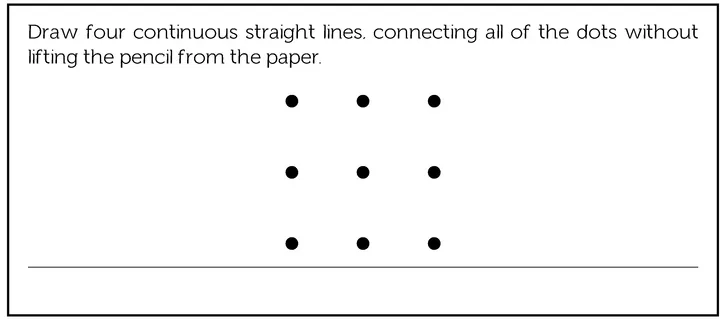
As a result of this definition of creativity, insight problems, such as the nine-dot problem, seen in Figure 1.1, were often employed as a creativity assessment. In this, and other insight problems, the solution requires a shift in perspective that the dots are not final end points and the solver must pass through several dots on the periphery1. It is this sudden shift in perspective that characterizes insight problems from typical routine problems (Davidson, 1995; Metcalf, 1986; Sternberg, 1999).
1 See solution on final page of this chapter.
Elaborating on the period of intense thinking and originality speculated by Kohler, Graham Wallas (1926) developed a Four-Stage Model to define creativity that included: preparation, incubation, illumination, and verification. During preparation, Wallas adopted an approach similar to Aristotle, suggesting we apply goal-directed methods to the creative task, such as determining the goals, defining the problem, and establishing a criterion for verifying the solution's acceptability. During Stage 2, incubation, direct conscious efforts to solve the problem should be abandoned in favor of contemplation at an unconscious level. During this stage, creative problem solving still continues but occurs below conscious awareness. During Stage 3, illumination, the sudden realization of the solution results from the unconscious mind's successful problem solving. Unlike the other stages, illumination is often very brief, involving a tremendous rush of insight within a few seconds. In the final stage of verification, the conscious mind evaluates and refines ideas and solutions that have emerged during the stage of illumination and these ideas are assessed by the criteria defined in the preparation stage. From Wallas's view, creativity would be defined as the process of thinking through preparation, incubation, illumination, and verification that results in creative insight.
Figure 1.1. Nine-dot problem.
Borrowing from the ideas of Socrates and Plato, another view that incorporated conscious and unconscious thinking in the creative process was the Primary-Secondary Process continuum proposed by Kris (1950). Primary processing is the unconscious state of creativity often evoked through lucid dreams, imagery, and fantasy. It is characterized by subsequent elaborate thoughts of concrete images that are typically associated with creative ideas. He viewed creativity as forming new combinations or discovering new associations as a result of primary processing.
It was around this time that interest in creativity, as a topic for scientific study, greatly increased, and was further inspired after Guilford gave his seminal conference address entitled "Creativity" to the American Psychological Association (APA) in 1950. Guilford's previous work on intelligence had sparked his interest in the scientific study of creativity. In his address, he accused the psychological community of neglecting creativity, which he initially defined as "sensitivity to problems, ideational fluency, flexibility of set, ideational novelty, synthesizing ability, analyzing ability, reorganizing or redefining ability, span of ideational structure, and evaluating ability" (Guilford, 1950, p. 453).
Consequently, there was ...

Table of contents

  1. Cover
  2. Half Title
  3. Title Page
  4. Copyright Page
  5. Table of Contents
  6. Dedication
  7. Foreword
  8. Introduction Creativity: It's Not Just for Hippies Anymore
  9. CHAPTER 1 Defining Creativity
  10. Hot Topic 1 Connected but Different: Comparing and Contrasting Creativity, Innovation, and Entrepreneurship
  11. CHAPTER 2 Theories of Creativity
  12. Hot Topic 2 The Dark Side of Creativity: Potential Better Left Unfulfilled
  13. CHAPTER 3 Creative Products: Defining and Measuring Novel Solutions
  14. CHAPTER 4 High-Tech Innovation, Creativity, and Regional Development
  15. CHAPTER 5 Cognition and Creative Thought
  16. Hot Topic 3 Are Creativity and Intelligence Related?
  17. CHAPTER 6 Creative Productivity Across the Life Span
  18. CHAPTER 7 Pretend Play and Creativity
  19. CHAPTER 8 Creative Articulation
  20. CHAPTER 9 Why Do We Create? The Roles of Motivation, Mindset, and Passion in Human Creativity
  21. CHAPTER 10 The Creative Personality: Current Understandings and Debates
  22. Hot Topic 4 Creativity and Mental Illness: So Many Studies, So Many Wrong Conclusions
  23. CHAPTER 11 Investing in Creativity in Students: The Long and Short (Term) of It
  24. Hot Topic 5 Creativity Assessment
  25. CHAPTER 12 Creativity in Business
  26. CHAPTER 13 Leadership and Creativity: What Leaders Can Do to Facilitate Creativity in Organizations
  27. Hot Topic 6 Creativity and Conformity: A Paradoxical Relationship
  28. CHAPTER 14 Technology and Creativity
  29. Hot Topic 7 Creative Leisure
  30. About the Editor
  31. About the Authors
  32. Index