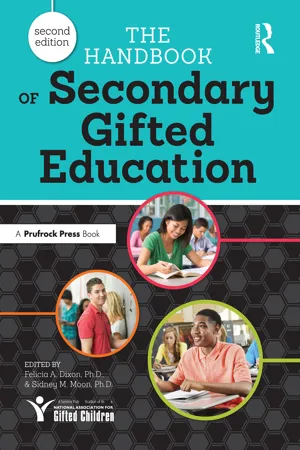
The second edition of this groundbreaking textbook is designed to help education professionals interested in building effective and comprehensive educational opportunities for gifted secondary students. The Handbook of Secondary Gifted Education offers an in-depth, research-based look at ways schools and classrooms can support the development of gifted adolescents. The book is the most comprehensive critical resource on this topic available. Each chapter of this educational resource is written by leading scholars and researchers in the field. The second edition includes sections on STEM, CCSS alignment, and 21st-century skills, along with discussion of working with secondary students in various content areas. The purpose of the book is to provide a research-based handbook that views gifted adolescents and their needs as the starting point for building an effective, integrated educational program.
eBook - ePub
The Handbook of Secondary Gifted Education
- 698 pages
- English
- ePUB (mobile friendly)
- Available on iOS & Android
eBook - ePub
The Handbook of Secondary Gifted Education
About this book
Trusted by 375,005 students
Access to over 1.5 million titles for a fair monthly price.
Study more efficiently using our study tools.
Information
Topic
EducationSubtopic
Education GeneralPART I
On Being Gifted and Adolescent
An Overview
Sidney M. Moon
DOI: 10.4324/9781003238829-1
Historically, much of the research in the field of gifted education has focused on young children, and only a handful of researchers have addressed the needs and characteristics of gifted adolescents. Since the publication of the first edition of The Handbook of Secondary Gifted Education, several trends have turned attention toward gifted adolescents: (a) increased national interest in specialized schools for talented students; (b) mounting evidence from longitudinal studies that characteristics of gifted adolescents predict career paths; and (c) increased competition for high school talent at top colleges and universities.
For gifted students, adolescence is both a time of great potential and special vulnerability. Being gifted and adolescent isn't easy for many reasons. These students must cope with the normal developmental issues of adolescence and with being different because of their giftedness. Some face intense pressure from peers to deny their abilities. Often they do not have the opportunities they need to develop their abilities into demonstrated talents, either because their school does not have the resources to provide advanced coursework in core subject areas, such as physics or British literature, or because they are talented in an area not emphasized in most secondary schools, such as engineering or art.
The first part of the second edition of The Handbook of Secondary Gifted Education focuses on the nature of gifted adolescents—their characteristics, needs, and individual differences. Those characteristics and needs form the foundation for the talent development services that are provided at the secondary level. All of the chapters in Part I have been substantially revised and updated for the second edition. Most of the chapters have some new authors and/or take a new approach to the topic. Part I has three purposes:
- to discuss the relevance of historical conceptions of giftedness and models of gifted programming to the adolescent period and provide a comprehensive framework that schools can use to develop gifted programs at the secondary level (Chapter 1),
- to highlight important general developmental themes affecting all high-ability adolescents (Chapters 2-3), and
- to illuminate the ways in which individual differences can influence the development of gifted and talented adolescents (Chapters 4-7).
In Chapter 1, Moon and Dixon review historical conceptions of giftedness in the published work of five major theorists in the field of gifted, creative, and talented studies: Renzulli, Gagne, Feldhusen, Betts, and Sternberg. They conclude that all of these theorists have something to offer secondary gifted education, but none of them provides a sufficiently comprehensive framework to address all of the needs and characteristics of high-ability adolescents. Hence, they propose a more comprehensive framework for secondary gifted education that builds on existing conceptions of giftedness and suggest that secondary gifted education should place as much stress on personal and social development among high-ability adolescents as it does on academic and cognitive development.
The next two chapters illuminate some of the reasons for Moon and Dixon's stress on personal and social development. Hall and Kelly's Chapter 2 on identity and career development highlights the importance of identity issues for adolescents and some of the unique identity issues facing gifted adolescents. They summarize general theories of identity development and show how those theories relate to gifted adolescents; in addition, they highlight identity development research conducted by scholars in gifted education. They argue that career development is essential in secondary school and needs to be differentiated for gifted adolescents. Because career development is based on interests, secondary gifted educators need to assess the emerging interests of their students and help them understand how those interests can be translated into meaningful careers.
Peterson, Assouline, and Jen's chapter (Chapter 3) on social-emotional development stresses the importance of contextual factors such as family and culture in adolescent development. Because teen culture often emphasizes conformity, adolescence can be a difficult time for high-ability youth, especially those whose talents lie in the academic areas. Peterson and coauthors summarize research on two conflicting perspectives on social-emotional development among high-ability youth and provide an overview of some of the developmental challenges faced by many talented adolescents. Finally, they provide quite specific guidance for counselors working with gifted teens.
The final four chapters in Part I address individual differences within the gifted and talented population. It is important for secondary educators to be aware that gifted and talented students are not a homogeneous population. During adolescence, the interests of high-ability youth become increasingly well defined, their talents more and more specialized, and their levels of expertise increasingly differentiated. In addition, factors such as gender (Chapter 4), ethnicity (Chapter 5), disabilities (Chapter 6), and differences in motivational profiles (Chapter 7) can influence their cognitive, personal, and social development. Hence, secondary gifted educators need to be aware of these individual difference factors and the ways they can influence development among high-ability youth.
Reis and Gaesser's Chapter 4 on gender issues again stresses the importance of identity development in adolescence. Gender influences every aspect of the developmental tasks of talented adolescents. For example, researchers have found that gender influences students' personality type, self-concepts, performance on standardized tests, postsecondary planning, and long-term integration of career and family. Reis and Gaesser provide numerous strategies for parents, counselors, and teachers to use in preventing gender stereotypes from inhibiting the development of high-ability adolescents, encouraging healthy gender role identities, and ensuring positive transitions through adolescence for all high-ability youth.
Stereotypes are also an issue for high-ability youth from ethnically diverse populations. In Chapter 5, Worrell provides a careful and comprehensive review of the literature on diverse groups of high-ability students. First, he reviews studies focused on single populations (e.g. African Americans, Asian Americans, Hispanic Americans, and Native Americans). Then, he looks at studies that included multiple ethnicities to summarize what we know about the differences among them in terms of broad constructs like self-perceptions, aspirations, educational skills, and achievement. As in many of the other chapters in this part, Worrell stresses the importance of identity development. For diverse students, identity development is quite complex because in addition to incorporating issues addressed by other high-ability students, diverse students must also wrestle with their cultural identity. The way that they develop their cultural identities can have dramatic implications for both academic achievement and well-being. Hence, personal, social, and cognitive issues are especially tightly woven in diverse populations of gifted students.
The presence of some type of disability can create challenging individual differences among gifted adolescents of all ethnicities. In Chapter 6, two scholars who are experts on the needs and characteristics of twice-exceptional students, Baum and Rizza, team with a twice-exceptional college student, Sara Renzulli, to provide a poignant summary of the unique challenges faced by these special individuals. The chapter authors define twice-exceptional adolescents as students with coexisting talents and deficits. These students have strengths in specific areas combined with deficits in learning, paying attention, or meeting social and emotional expectations that can impede their overall development. For example, a student who is talented in computer programming but has a concurrent attention deficit disorder would be a twice-exceptional student. Chapter 6 describes the characteristics of these students and provides suggestions on how educators can differentiate curricula for them and support their social-emotional development. Woven throughout the chapter is Saras story—the school experiences of one highly gifted adolescent with a learning disability who eventually learned to focus on her strengths and compensate for her weaknesses so she could succeed in college and life.
The final chapter in Part I focuses on motivation, a neglected area of individual differences in talented adolescents. Most conceptions of giftedness suggest motivation becomes increasingly important as gifted individuals mature and develop their talents (see Chapter 1). In Chapter 7, Patrick, Gentry, Moss, and Mcintosh summarize research with gifted students on the impact of individual differences in selected motivational constructs on student achievement and well-being. They describe the influence of beliefs that explain motivation, beliefs about the value of activities or subjects, and reasons for engaging in activities (e.g. goal orientations). The authors of Chapter 7 also provide guidance on how educators can promote adaptive motivational beliefs and behaviors in all gifted adolescents.
In conclusion, Part I provides the foundation for the second edition of The Handbook of Secondary Gifted Education by focusing attention on the unique characteristics and needs of gifted students in the adolescent period of development. Together, the chapters in Part I suggest that gifted adolescents need interventions that help them develop personally and socially, as well as academically Perhaps the most important nonacademic, developmental issue that gifted students must address in adolescence is identity development. Part I suggests that individual difference variables such as gender, race, and motivational style lend great complexity to the process of identity development among gifted adolescents. Educators and counselors need to forge strong partnerships to ensure that all of the developmental needs of gifted adolescents are met in secondary schools, and that these students have every opportunity to achieve at high levels in college and beyond.
Chapter 1
Conceptions of Giftedness in Adolescence
Sidney M. Moon & Felicia A. Dixon
DOI: 10.4324/9781003238829-2
Adolescence happens to gifted middle and high school students, just as it does to their nongifted peers. In fact, the adolescent period may be more prolonged among high-ability youth, because their career goals may require a longer period of economic dependency during advanced schooling. How well do the conceptions of giftedness previously developed in the field of gifted education pertain to the adolescent years? Do we need conceptions of giftedness that focus specifically on adolescents? In this chapter, we provide a brief overview of the developmental tasks of adolescence. Then we review some of the conceptions of giftedness that have been developed by leaders in the field of gifted education and analyze their relevance to gifted adolescents. Finally, we offer a framework for gifted education at the secondary level that focuses on the developmental tasks facing high-ability students during the adolescent period.
Adolescence
Steinberg (2014) defines adolescence as a period of transitions—biological, psychological, social, and economic. Although once thought to encompass just the teenage years, the adolescent period now has been lengthened considerably; both because young people mature earlier physically, and because so many individuals delay entering into work and marriage until their mid-20s. Often, social scientists refer to the stages of this important period as early adolescence (from about age 10-13), middle adolescence (ages 14-17), and finally, late adolescence (ages 18-22). These terms seem to correspond with the school grades into which these youth fit—middle school, high school, and college. As noted above, late adolescence can extend into the mid to late 20s for youth who are pursuing careers with prolonged training, such as medicine, law, and science.
Pipher (1994) described adolescents as travelers, far from home with no native land, neither children nor adults. They are jet setters who fly from one country to another with amazing speed. Sometimes they are 4-years-old; an hour later they are 25. They don't really fit anywhere. They yearn for a place, a search for solid ground. Adolescence is a time of intense preoccupation with the self, which is growing and ch...
Table of contents
- Cover
- Half Title
- Title Page
- Copyright Page
- Dedication
- Contents
- Introduction
- PART I: On Being Gifted and Adolescent
- PART II: Talent Development in Adolescence
- PART III: What Schools Can Do
- PART IV: What Schools Can Do
- PART V: What Teacher Education Can Do
- About the Authors
- Index
Frequently asked questions
Yes, you can cancel anytime from the Subscription tab in your account settings on the Perlego website. Your subscription will stay active until the end of your current billing period. Learn how to cancel your subscription
No, books cannot be downloaded as external files, such as PDFs, for use outside of Perlego. However, you can download books within the Perlego app for offline reading on mobile or tablet. Learn how to download books offline
Perlego offers two plans: Essential and Complete
- Essential is ideal for learners and professionals who enjoy exploring a wide range of subjects. Access the Essential Library with 800,000+ trusted titles and best-sellers across business, personal growth, and the humanities. Includes unlimited reading time and Standard Read Aloud voice.
- Complete: Perfect for advanced learners and researchers needing full, unrestricted access. Unlock 1.5M+ books across hundreds of subjects, including academic and specialized titles. The Complete Plan also includes advanced features like Premium Read Aloud and Research Assistant.
We are an online textbook subscription service, where you can get access to an entire online library for less than the price of a single book per month. With over 1.5 million books across 990+ topics, we’ve got you covered! Learn about our mission
Look out for the read-aloud symbol on your next book to see if you can listen to it. The read-aloud tool reads text aloud for you, highlighting the text as it is being read. You can pause it, speed it up and slow it down. Learn more about Read Aloud
Yes! You can use the Perlego app on both iOS and Android devices to read anytime, anywhere — even offline. Perfect for commutes or when you’re on the go.
Please note we cannot support devices running on iOS 13 and Android 7 or earlier. Learn more about using the app
Please note we cannot support devices running on iOS 13 and Android 7 or earlier. Learn more about using the app
Yes, you can access The Handbook of Secondary Gifted Education by Felicia A. Dixon, Sidney M. Moon, Felicia A. Dixon,Sidney M. Moon,Felicia Dixon,Todd Kettler in PDF and/or ePUB format, as well as other popular books in Education & Education General. We have over 1.5 million books available in our catalogue for you to explore.