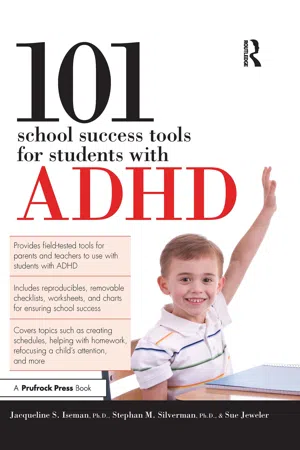
101 School Success Tools for Students With ADHD provides the materials and guidance necessary to assist teachers and parents as they empower students with ADHD to become successful learners. Based on field-tested strategies for use with learners with ADHD, the book provides a brief overview of the specific learning needs of these students, as well as a wide variety of tools that teachers can immediately pull out and use in the classroom and parents can use in the home setting.
Each tool is explained in a brief how-to section that includes specific information on adapting the tool based on the individual student's needs. The book covers topics that include observing and collecting data on students, creating schedules, assessing a child's strengths, refocusing a child's attention, managing difficult behaviors, implementing calming techniques, providing motivation, and improving study and homework skills. A collection of worksheets, forms, checklists, charts, website listings, and other tools are included as reproducible pages.
eBook - ePub
101 School Success Tools for Students With ADHD
- 240 pages
- English
- ePUB (mobile friendly)
- Available on iOS & Android
eBook - ePub
101 School Success Tools for Students With ADHD
About this book
Information
chapter 1
Attention and Planning
DOI: 10.4324/9781003232568-1
NOTHING of value can be accomplished without focus and concentration. The power of concentration characterizes those who truly excel in any field. Achievement requires the ability to sustain attention, to sacrifice other impulses, to resist distraction, to postpone pleasures, and to act with timing and judgment (Silverman et al., 2009).
The problems associated with ADHD are widespread, but especially notable are school performance deficits. It can be overwhelming as a parent or a teacher to know how to help children with ADHD to address difficulties with inattention and planning. In fact, many teachers indicate feeling unprepared to teach children with attention problems and desire more training and strategies to assist them in working more effectively with students with ADHD in the classroom (Silverman et al., 2009). The tools in this chapter will help to address these issues.
Tool 1:
Planning Facilitation
Often children with ADHD have trouble verbalizing their strategies or get stuck using an ineffective strategy repeatedly. Help the student by noting any effective strategies he or she is using, but may not be able to verbalize. Also try to guide the student to develop other strategies if he or she is getting stuck using a strategy that is ineffective or is only effective part of the time.
Tips
Teachers and Parents: Use probes to encourage the child to learn how to plan effectively. The following statements are examples of probes that can be used to encourage children to verbalize their ideas and think about their planning strategies (Naglieri, 1999).
Planning Facilitation
- ✓ How did you do this assignment?
- ✓ What did you notice about the way you completed this assignment?
- ✓ What is a good way to do this assignment?
- ✓ What did this assignment teach you?
- ✓ What seemed to work well for you before?
- ✓ What will you do next time?
- ✓ Can you think of ways to make the assignment easier?
- ✓ Do you think you will do anything differently next time?
Tool 2:
Calming Techniques
The following is a very simple form of meditation, which does not require religious faith, although it may enhance spiritual experience if desired. Although meditation has been demonstrated to provide medical and mental health benefits, the focus of the technique here is calming.
Tips
Teachers and Parents: There are many calming techniques for children including relaxation therapy, yoga, and meditation. The most powerful and simple is meditation.
Calming Techniques
- ✓ Make sure the room is quiet with few distractions.
- ✓ Dim the lights if possible. Ask the children to sit in any position that they can hold for an extended period of time.
- ✓ Each child should feel completely relaxed. There is no need for tension in any part of the body.
- ✓ Ask each child to keep his or her eyes gently closed with the attention focused in the middle of the inside forehead, like a "third eye."
- ✓ Tell the children to repeat any common phrase in the form of a mantra. Examples may include "I believe in myself" or "I am at peace." Continue repeating the calming phrase slowly and in a regular, continuous manner.
- ✓ Soon the nervous system will calm and stabilize. This forms a memory of being calm and can actually help to mitigate primary symptoms of ADHD including inattention, impulsivity, and restlessness and related symptoms such as disorganization and, in many cases, oppositionality.
Tool 3:
Private Speech
Children with ADHD often have difficulty self-monitoring their attention to tasks. Private speech allows these children to quietly self-regulate and keep track of their planning process.
Tips
Teachers and Parents: Teach children to use private speech by first having the child describe his actions aloud and then having the child guide his actions by saying the same thing silently in his head.
Private Speech
Example: To solve the problem 2(4 + 3)2 - 0(6 ÷ 2), the child could say aloud (and later to herself):
I need to remember the order of operations.
It is parentheses, exponents, multiplication and division, addition and subtraction.
First I need to do everything in parentheses.
OK, 4 + 3 is 7 and 6 ÷ 2 is 3.
Now I need to do the exponents.
OK, 7 squared is 49.
Next I need to do multiplication.
OK, 2 times 49 is 98.
I know that is right because it is the same as 50 times two minus two.
Hey, wait a minute, 0 times anything is 0.
So I don't even have to worry about the second half of the equation.
So the answer is just 98.
That wasn't so bad!
Tool 4:
Suggested Breaks
Students with ADHD perform better in environments that allow movement and permit the child to get up when necessary. These breaks allow students to refocus and recharge. It typically takes students with ADHD a great amount of effort to focus. Therefore, frequent breaks help in preventing fatigue. Additionally, permitting students to get up and stretch or move during the allotted break will make the students more likely to refocus effectively following the break.
Tips
Teachers and Parents: Individuals with ADHD require frequent breaks to be able to work efficiently. Help students to learn appropriate ways to take breaks according to the situation (in the classroom or in the home).
Suggested Breaks
- ✓ Getting a drink of water
- ✓ Stretching
- ✓ Walking in the hallway
- ✓ Helping another student or sibling
- ✓ Helping the teacher or the parent
- ✓ Drawing or doodling
- ✓ Running "errands" for the teacher (e.g., getting or giving something to another teacher or the office)
- ✓ Playing with fidget objects (i.e., squishy toy, dry sponge) during break time
Tool 5:
Self-Monitoring Chart
Teach children to self-monitor by having them rate the progress toward their goals.
Tips
Teachers and Parents: Individuals with ADHD struggle to self-regulate. This chart will help these children learn to self-monitor on-task behavior.
Self-Monitoring Chart
Establish up to five desired behaviors and write them on the chart below. Younger or less developmentally mature children may need to begin with only one goal. At the completion of a specific task or a class period have the student evaluate herself on each of the behaviors with either a "✓" for meeting the goal or an "✗" for not meeting the goal. The teacher or parent should then also evaluate the child with either a "✓" for meeting the goal or an "✗" for not meeting the goal. Award 1 point for each match that the student and adult have so that the student is rewarded for accurately self-monitoring. Also award 1 point for each che...
Table of contents
- Cover
- Half Title
- Title Page
- Copyright Page
- Dedication
- Contents
- Introduction
- chapter 1 Attention and Planning
- chapter 2 Time Management and Organization
- chapter 3 Homework and Study Skills
- chapter 4 Encouraging Achievement
- chapter 5 Behavior Modification
- chapter 6 Strategies Used by Successful Teachers
- chapter 7 School Observations
- chapter 8 Preparing for Meetings
- chapter 9 Communication Between Teachers, Parents, and Professionals
- chapter 10 Tools for Parents
- Conclusion
- References
- Authors' Note
- About the Authors
Trusted by 375,005 students
Access to over 1.5 million titles for a fair monthly price.
Study more efficiently using our study tools.
Frequently asked questions
Yes, you can cancel anytime from the Subscription tab in your account settings on the Perlego website. Your subscription will stay active until the end of your current billing period. Learn how to cancel your subscription
No, books cannot be downloaded as external files, such as PDFs, for use outside of Perlego. However, you can download books within the Perlego app for offline reading on mobile or tablet. Learn how to download books offline
Perlego offers two plans: Essential and Complete
- Essential is ideal for learners and professionals who enjoy exploring a wide range of subjects. Access the Essential Library with 800,000+ trusted titles and best-sellers across business, personal growth, and the humanities. Includes unlimited reading time and Standard Read Aloud voice.
- Complete: Perfect for advanced learners and researchers needing full, unrestricted access. Unlock 1.5M+ books across hundreds of subjects, including academic and specialized titles. The Complete Plan also includes advanced features like Premium Read Aloud and Research Assistant.
We are an online textbook subscription service, where you can get access to an entire online library for less than the price of a single book per month. With over 1.5 million books across 990+ topics, we’ve got you covered! Learn about our mission
Look out for the read-aloud symbol on your next book to see if you can listen to it. The read-aloud tool reads text aloud for you, highlighting the text as it is being read. You can pause it, speed it up and slow it down. Learn more about Read Aloud
Yes! You can use the Perlego app on both iOS and Android devices to read anytime, anywhere — even offline. Perfect for commutes or when you’re on the go.
Please note we cannot support devices running on iOS 13 and Android 7 or earlier. Learn more about using the app
Please note we cannot support devices running on iOS 13 and Android 7 or earlier. Learn more about using the app
Yes, you can access 101 School Success Tools for Students With ADHD by Jacqueline S. Iseman,Stephan M. Silverman,Sue Jeweler in PDF and/or ePUB format, as well as other popular books in Education & Education General. We have over 1.5 million books available in our catalogue for you to explore.