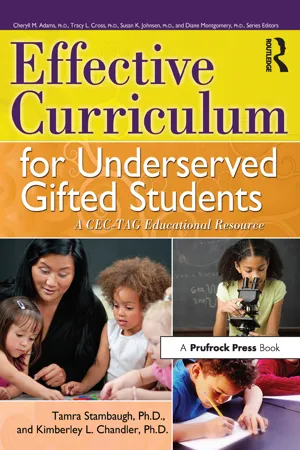
Effective Curriculum for Underserved Gifted Students explains the need for a differentiated curriculum for gifted students typically underrepresented in gifted programs, including children of poverty and those who are from culturally and linguistically diverse populations. Features of research-based curriculum found to be effective in enhancing the academic achievement of these populations are highlighted. In addition, practical, evidence-based strategies for curriculum development and instruction are shared.
eBook - ePub
Effective Curriculum for Underserved Gifted Students
A CEC-TAG Educational Resource
- 102 pages
- English
- ePUB (mobile friendly)
- Available on iOS & Android
eBook - ePub
Effective Curriculum for Underserved Gifted Students
A CEC-TAG Educational Resource
About this book
Information
CHAPTER 1
The Elusive Nature of Defining Terms and Conceptions
DOI: 10.4324/9781003234821-1
"Working together, the school curriculum, families, and communities can enable positive, culturally consonant coping strategies and enhance self-efficacy in ways that acknowledge social realities while building the confidence to overcome them" (Kitano, 2007, p. 34). Curriculum modifications and the related actions that various stakeholders can take to address the needs of underserved gifted students most effectively are examined in this book. Both theoretical and empirical references to these curriculum-based interventions for enhancing the self-efficacy of underserved populations can be found in the literature. We summarize those references and delineate common themes, synthesize the themes in the form of a new model incorporating essential elements of curriculum design and delivery, and then use the information as the basis for a set of recommendations for practice. Although curriculum, instruction, and assessment are inextricably linked, the primary focus of this publication is on curriculum-based interventions targeted toward and found to be effective with underserved gifted populations.
Before examining curriculum interventions, we must establish who these students are, how relevant terms are being defined, and common misconceptions and conceptions about this unique population. Making distinctions about who these students are and what we assume versus what we know about them will help educators better plan curriculum and instructional opportunities suited to their students' needs.
WHO ARE GIFTED CLD LEARNERS?
Culturally and linguistically diverse (CLD) learners are any learners who may be underserved in a gifted program. Although the term CLD learners may have different meanings in different contexts, it is applied in this book as an all-encompassing term that includes any student whose culture and/or language is different from that of the majority culture in his or her school. Culture describes the values and practices of a given society or group, the culture of poverty, or the culture of an ethnic group in the United States. CLD learners comprise a large group of students who, although very different, also share some common characteristics. However, they differ in these characteristics just as much as they are alike. Additionally, CLD populations may demonstrate these characteristics in different ways from the dominant culture, sometimes in such a way that these characteristics may be perceived as negative. Some common characteristics include: high verbal ability in the native language, strong storytelling ability in the native language, strong critical thinking skills in the primary language, long attention span and ability to concentrate intensely, humor displayed through a unique use of language, and richness of imagery in ideas (New Mexico State Department of Education, 1994). It is important to understand that "giftedness, conceptualized as exceptionally high performance capability, is a characteristic of the individual as defined by the particular culture" (Kitano, 2010, p. 14). Therefore, some of the characteristics of CLD students are ones that teachers may not recognize, due to the cultural specificity. In some cultures, for instance, children are taught not to question authority; thus, it may appear that the child is not assertive in presenting his ideas to the teacher. Also, characteristics that we commonly consider traditional of giftedness may not be represented in CLD students in the same way. For example, risk-taking behavior is often considered a common characteristic of gifted students; for the CLD student, the degree of risk-taking will vary depending on the child's comfort with the situation based on her cultural background. School personnel must realize that CLD students will vary in their degree of acculturation to standardized testing and the expectations of schools (Kitano, 2010).
WHO ARE UNDERSERVED/ UNDERREPRESENTED POPULATIONS?
Underserved populations are commonly CLD learners. Specifically, this population includes groups of learners who have not traditionally been served in large numbers by gifted education programs. The underserved populations addressed in this book are CLD learners and children of poverty. Although underachieving and twice-exceptional students (e.g., those who are gifted and have learning disabilities) are considered to be underserved populations, they will not be discussed in this publication, as they are a primary focus of other books in this series. Underserved populations include both wealthy CLD learners of various ethnicities as well as learners of poverty, both in the majority or minority culture. It is difficult to distinguish between CLD learners who are also ethnically and racially diverse and those of poverty, as these conditions may be overlapping.
CLD students of poverty are sometimes referred to as disadvantaged, low-socioeconomic status (SES), or low-income students, and children of poverty. Disadvantaged students are children who qualify for free or reduced lunch according to the regulations of the Title I program, regardless of race or ethnicity. Typically, a Title I school has about 40% or more of its students living with families who qualify as low income under the United States Census's definitions.
KEY TERMS
Diversity refers to a classroom or school in which more than one culture or ethnicity is represented in significant numbers. A diverse gifted education program is one that accurately reflects the overall ethnic composition of the school population. The term diversity is one that is often used in the language of gifted education, in regards to attempting to represent the school population through the identified population.
Promising learners are students who show some evidence of advanced cognitive skills, but whose test scores and class performance need to be enhanced through special interventions in order to qualify for or have access to accelerated opportunities. This term indicates that the children have the potential to display advanced skills. In order to develop this potential, however, additional scaffolding of some type will be needed.
Multicultural education refers to the knowledge, dispositions, and skills that can help school personnel and students to become culturally competent in preparation for their work with diverse populations. Because the school population in many places has numerous cultural groups represented, teachers must begin to learn how to identify student strengths and weaknesses among students whose background may be different than their own. This is a significant and important undertaking, as the lack of a multicultural classroom can affect the achievement of gifted CLD students (Ford, Howard, Harris, & Tyson, 2000).
Gifted and talented children are those who by virtue of outstanding abilities are capable of high performance, as identified by professionally qualified persons. These are children who require differentiated educational programs and services beyond those normally provided by a regular school program in order to realize their contribution to self and society. Children capable of high performance include those with demonstrated achievement and/or potential ability in any one of the following areas:
- ■ general intellectual ability,
- ■ specific academic aptitude,
- ■ creative or productive thinking,
- ∎ leadership ability,
- ■ visual and performing arts, and
- ■ psychomotor ability (Marland, 1972).
One emphasis of the Javits research in recent years has been on the most effective ways to identify CLD learners for gifted programs. Although it is beyond the scope of this book to describe appropriate identification procedures for CLD students in detail, it is essential to note that alternative methods must often be used and barriers to identification must be removed. Another book in this series focuses on this topic, as do various NAGC resources including the monograph, Overlooked Gems, listed in Appendix B and available as a free download at http://www.nagc.org.
Terms related to how to best adjust both curriculum and instruction to CLD learners' needs also need some explanation. First, what is the difference between talent development of all learners versus actual service provisions? Talent development refers to any intervention that seeks to identify the potential in students and help them to become self-actualized so that they can realize their potential and make a contribution to society. Although talent development is an important construct in gifted education, the development of special gifts and talents of all students is also considered; however, for gifted learners—especially underrepresented CLD learners of various minority groups and of poverty—talent development is especially critical, as these learners need more opportunities to develop talent than those without these designations.
The curriculum for gifted CLD learners is critical, as will be discussed later in this book. Curriculum is the "reconstruction of knowledge and experience, systematically developed under the auspices of the school (or university), to enable the learner to increase his or her control of knowledge and experience" (Tanner & Tanner, as cited in Borland, 1989, p. 175). Curriculum materials are often developed with certain standards as a basis or utilize specific books. The curriculum interventions discussed in this book include both specific books that are prescriptive in nature as well as a set of standards and activities used by trained teachers. What then is the difference between curriculum and instruction? Instruction refers to the methods the teacher uses to deliver curriculum. The pedagogical strategies routinely used by teachers are examples of instruction. These may include but are not limited to: goal-setting strategies, grouping placements with differentiation, interest-based learning approaches, scaffolding, graphic organizers, and modeling. Scaffolding is a method of both breaking down accelerated content into lower to higher level thinking skills so that students can gain more knowledge and confidence, and providing more independence as students become comfortable with complex tasks. Scaffolding moves students from lower to higher level thinking and also from lesser to greater levels of independence in the completion of tasks.
Differentiated curriculum is curriculum that has been modified in some way in response to learner needs. For gifted students and for gifted CLD students, there are specific ways that curriculum must be differentiated. The type and degree of differentiation is usually based upon an assessment of the learner's readiness, interest, or learning style (Tomlinson, 2001). However, for gifted CLD learners, we recommend that differentiation be modified based on students' readiness first while taking into account the interests and learning styles of these students. Readiness should be the first consideration for CLD learners who lack access. This is the mechanism that guides differentiation and is used to determine learning goals and outcomes. Interests and learning styles of this unique population are used, not as a way to differentiate, but as a way to engage students in interacting with a curriculum that promotes higher level thinking skills based on ability or readiness.
MISCONCEPTIONS AND CONCEPTIONS ABOUT CLD LEARNERS
Research on the topic of CLD learners, especially those who are gifted, does not have the longevity or quantity of publications as do other topics in gifted education, such as acceleration and grouping. As such, along with the growing research in general education about these learners, there are many misconceptions and conceptions about the students that must be acknowledged in order to move forward with a discussion about curriculum and instruction.
MISCONCEPTIONS
It is important to dispel some of the common misconceptions about CLD students before discussing the major conceptions that will form the basis for this publication. These misconceptions are ones that may be held by teachers, administrators, counselors, and other school personnel. Practitioners must understand why these statements are misconceptions in order to see the strengths of CLD students and make appropriate educational decisions for this group. They are:
- ∎ Misconception 1: CLD students are less intelligent than other students. Although CLD students may show their talent in ways not normally measured by some of the more traditional assessments, they are not less able. Gifted students may be found in every ethnic and socioeconomic group. However, the interplay between environment and genetics may play a critical role in the realization of talent, thus limiting students in various ways.
- ∎ Misconception 2: CLD students are always disadvantaged. Many times the terms poverty, ethnicity, and minority are used in a way that connotes that all CLD students from minority ethnic groups are disadvantaged or poor. This is not the case. Many CLD students are wealthy or advantaged in other ways, such as access to social capital within a community.
- ∎ Misconception 3: Parents of CLD students do not care about their children or school issues. Most parents do care about their children's education and academic success. However, some parents of CLD students do not know how to advocate for their children or may find it culturally inappropriate to question the school faculty. In other instances, the competing obligations of family, school, and work inhibit the parents' visible support of their children at school functions. Additionally, the parents of these children may have had a bad experience in school themselves, and thus are reluctant to interact with school personnel.
- ∎ Misconception 4: Certain ethnic groups tend to be stereotyped as being from low-socioeconomic settings. Some ethnic groups report higher numbers of students who live in poverty than other groups, although not all CLD learners are from poverty. This is an important concept to remember. We cannot assume that just because students are from a certain ethnic group, they come from dire circumstances. However, when this interplay between poverty and ethnicity does exist, it is hard to determine whether poverty or ethnicity is a culprit for achievement or underachievement, thus making it difficult to generalize to specific populations.
- ∎Misconception 5: Curriculum should not be modified for CLD students; they need to adjust to the majority culture in order to succeed. Appropriate education for all students links new content to previously learned ideas or a student's background or schema. Moreover, good teachers typically adjust curriculum and instruction based on students' readiness while considering their interests and learning styles. CLD students may have different interests, backgrounds, or ways of learning that must be accommodated in order for learning to take place. Although readiness varies with all students, appropriate pacing and exposure to higher level thinking skills can be beneficial.
Now that the major misconceptions have been addressed, what are the important conceptions about CLD learners within an educational framework of curriculum and instruction?
CONCEPTIONS
The major conceptions undergirding this book are comprised of two components: (a) the fundamental ideas about how and why curriculum must be differentiated for gifted and talented learners and (b) the major ideas that speak to the need for specialized interventions for underserved populations. The ideas about differentiation for gifted and talented students are commonly accepted in the field of gifted education, but they may not be familiar to teachers in regular education settings. Much of information about the need for and efficacy of specialized interventions for CLD students has been garnered through the Javits research projects described in this book.
Tanner and Tanner's definition of curriculum (as cited in Borland, 1989) emphasized how curriculum serves as a way for students to make sense of and use their knowledge and experience. Borland (1989) defined differentiated curricula as "modified courses of study designed to make the schools more responsive to the educational needs of these exceptional learners"...
Table of contents
- Cover
- Half Title
- Title Page
- Copyright Page
- Table of Contents
- Preface
- Chapter 1: The Elusive Nature of Defining Terms and Conceptions
- Chapter 2: Research-Based Curriculum and Instructional Strategies for CLD Learners
- Chapter 3: Common Features of Effective CLD Curriculum
- Chapter 4: Factors That Impact Gifted CLD Learners' Responses to Curriculum and Instruction
- Chapter 5: Next Steps: An Evidence-Based Model for Curriculum Development and Adaptation
- Chapter 6: Implications for Practice and School Reform
- References
- Appendix A: Websites and Online Resources
- Appendix B: Annotated Bibliography of Selected Readings by Topic
- About the Authors
Trusted by 375,005 students
Access to over 1.5 million titles for a fair monthly price.
Study more efficiently using our study tools.
Frequently asked questions
Yes, you can cancel anytime from the Subscription tab in your account settings on the Perlego website. Your subscription will stay active until the end of your current billing period. Learn how to cancel your subscription
No, books cannot be downloaded as external files, such as PDFs, for use outside of Perlego. However, you can download books within the Perlego app for offline reading on mobile or tablet. Learn how to download books offline
Perlego offers two plans: Essential and Complete
- Essential is ideal for learners and professionals who enjoy exploring a wide range of subjects. Access the Essential Library with 800,000+ trusted titles and best-sellers across business, personal growth, and the humanities. Includes unlimited reading time and Standard Read Aloud voice.
- Complete: Perfect for advanced learners and researchers needing full, unrestricted access. Unlock 1.5M+ books across hundreds of subjects, including academic and specialized titles. The Complete Plan also includes advanced features like Premium Read Aloud and Research Assistant.
We are an online textbook subscription service, where you can get access to an entire online library for less than the price of a single book per month. With over 1.5 million books across 990+ topics, we’ve got you covered! Learn about our mission
Look out for the read-aloud symbol on your next book to see if you can listen to it. The read-aloud tool reads text aloud for you, highlighting the text as it is being read. You can pause it, speed it up and slow it down. Learn more about Read Aloud
Yes! You can use the Perlego app on both iOS and Android devices to read anytime, anywhere — even offline. Perfect for commutes or when you’re on the go.
Please note we cannot support devices running on iOS 13 and Android 7 or earlier. Learn more about using the app
Please note we cannot support devices running on iOS 13 and Android 7 or earlier. Learn more about using the app
Yes, you can access Effective Curriculum for Underserved Gifted Students by Tamra Stambaugh,Kimberley Chandler in PDF and/or ePUB format, as well as other popular books in Education & Education General. We have over 1.5 million books available in our catalogue for you to explore.