Gifted students have the potential to learn material earlier and faster, to handle more abstraction, and to solve complex problems better. This potential, however, needs stimulating experiences from home and school or it will not unfold. These books are designed to help teachers provide the engaging curricula that will nurture this potential in school. The Science book includes a medical simulation in which teams of students work as doctors to diagnose patients' cases, a food science project in which students use a variety of information-gathering techniques to learn how nutrition impacts performance, a hands-on study of human memory and expertise, and a study of the physics of sports.
Grades 6-8
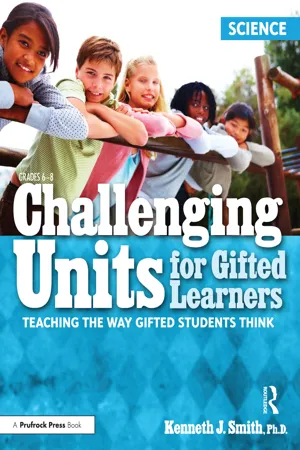
eBook - ePub
Challenging Units for Gifted Learners
Teaching the Way Gifted Students Think (Science, Grades 6-8)
- 242 pages
- English
- ePUB (mobile friendly)
- Available on iOS & Android
eBook - ePub
Challenging Units for Gifted Learners
Teaching the Way Gifted Students Think (Science, Grades 6-8)
About this book
Information
Chapter 1
Introduction: We Are Intellectual Archeologists
DOI: 10.4324/9781003233565-1
The creation of a thousand forests is in one acorn.
—Ralph Waldo Emerson
Three True Stories
A teacher with whom I enjoy working once complained to me that one of her students should not receive gifted services because he was lazy. “He never finishes his math boxes so why provide enrichment activities for him?” Later that day, I asked him why he hadn’t finished his math boxes, the morning math challenges. He told me that he had gotten distracted by trying to calculate mentally the number of cement blocks in one of the classroom walls. Without counting each block, but by extrapolating from the pattern of the first two rows, he had gotten the number right. I had known since he was in second grade that he was much brighter than I am—probably brighter than anyone else in the building.
While I was in New York working on my dissertation, I stopped in one of those ubiquitous Chinese fast food restaurants that lined the lower West side. Ahead of me in line were three very young, very pregnant girls. From their conversation, I guessed that they were taking a summer class for unwed mothers and each had been given a budget by the program with which to buy lunch. Two of the girls were immobile in line trying to figure out from the wall menu what to order and how to divvy up the costs. The third girl rattled off several suggestions that would be divided unevenly as would the costs. She then figured each girl’s contribution and change instantly in her head. I have often wondered if anyone, including her, had valued her rapid-fire math skills.
Not too long ago, I was working with a junior high language arts class on adding mood-evoking pictures to poetry podcasts. I stopped to read the poem of one girl; it was stunning in its imagery and subtle complexity, reminiscent of Emily Dickinson. I had known the student for years and thought that she was a better-than-average writer. However, because I had never engaged her in a poetry project, I had completely missed her true gift.
The point of starting with these stories is that, although there are many children with exceptional gifts who test well, appear precocious before starting school, and earn good grades, there are also extraordinary youngsters in our classrooms whose gifts are not as easily recognized. We therefore need to strive to understand and respond to the giftedness in our students by continually digging until we uncover each child’s strengths. We must be intellectual archeologists. I hope that this book gives teachers additional tools with which to uncover these gifts.
Three factors underlie the projects presented in the following chapters: (a) the unique way gifted students think; (b) the role of content-specific, expert knowledge; and (c) the role of the teacher/mentor in instructing gifted learners. Each of these influences is discussed below.
Qualitatively Different Thinking of Gifted Learners
This book is written from a cognitive psychology perspective. I begin by reviewing current research that offers insight into the distinctions between the thinking of gifted and more typical students. In compiling the research for this discussion, my focus has been on explaining—not just listing—the intellectual processes in which gifted students engage, particularly those that they use in structuring and solving open-ended problems. I detail how these processes operate and how they are observed. Following this review of the research, the remainder of this book offers units that both challenge and develop those cognitive processes.
Hertberg-Davis and Callahan (2008) reported that gifted students often have to wait until Advanced Placement (AP) courses in their final high school years to enjoy the academic challenges that they had found lacking throughout their educational careers. However, research indicates that appropriately serving advanced learners requires an infusion of higher level challenges into the sequences of classes that they encounter throughout all of their school years—beginning in the early grades. Therefore, this book is designed to help you present units that gifted learners will find challenging and that will foster their complex thinking— beginning in the early grades. It is written to appeal to students with a range of intellectual gifts and learning styles, and to help you keep them engaged across grades and content areas.
Domain-Specific Knowledge
Each book in the Challenging Units for Gifted Learners series presents various units based on in-depth, domain-specific knowledge of central principles and content. To develop mastery of this complex, domain-specific knowledge, Bass, Magone, and Glaser (2002) recommended that students demonstrate an understanding of both the principles and the complex problem-solving procedures that are particular to the content area at hand. This is because it is an understanding of domain-specific principles and problem-solving procedures that separates beginners from experts in particular subject areas. In physics, for example, the domain-specific principle may be a law of inertia. For fiction writers, the principle may be that juxtaposing images creates complexity in a character. In each of these examples, principles or cause-and-effect relationships are domain-specific; nevertheless, in both domains, it is a grasp of principle-based, procedural knowledge that characterizes the experts. Thus, in writing each book in the series, I begin by asking what are the core principles and concepts of the domain at hand.
The books also require that students explore this domain-specific knowledge in depth. The National Research Council suggests that in-depth learning occurs not from memorizing material from a text or lecture, but from successfully transferring core, principle-based knowledge from one situation to another (Bransford, Brown, & Cocking, 1999). Yet, it is this former knowledge base that so many equate with high-level understanding. According to Moon (2008), if a teacher believes that knowing facts is what is important rather than big ideas and conceptual understanding, then how could the gifted student be challenged? For example, in a well-known study, Chi, Feltovich, and Glaser (1981) asked beginning and expert physicists to categorize a set of math and science problems into similar categories. Beginners tended to classify the problems according to surface features such as the objects in the problems (e.g., inclined planes). Experts, on the other hand, tended to sort the same set according to principle-based knowledge, such as Newton’s second law, regardless of the objects in the problems. This expert process is much more predictive of the method of solutions and reveals a conceptual understanding of underlying principles that are essential to solving problems presented.
According to Anderson (2005), regardless of the subject area, more successful learners tend to see knowledge as overlapping networks of facts, often related by cause and effect or other procedural insight. This raises the questions, “What does it mean to have expertise in math?” and “How should an understanding of this expertise drive instruction for both gifted students and their more typical counterparts?” We should be aware that these are not new questions in education. For the purpose of this book, then, although students are often asked to learn factual, declarative knowledge, this knowledge is always connected to scientific principles that are essential to solving complex science problems. For me, the answer to these ongoing questions is that we need to gear instruction for all students to these big ideas and conceptual, principled knowledge and guide students to use these principles to drive their academic problem solving. To do this well, we first need to understand how successful learners are thinking when they are solving complex problems and then provide instruction that both challenges and nurtures this kind of thinking in our students.
The Teacher's Role in Fostering Intellectual Gifts
Research suggests that people who reach expert levels of understanding might be highly gifted in the first place, but that they still need training and practice to develop their gifts. There are several specific accounts of genius that show the need for teachers and mentors to guide their development and to maximize their potential.
Being in this role is a huge responsibility. Just think about little Albert Einstein doing poorly in his elementary grades. It was not until his uncle began teaching him number tricks that he became excited about math. What would have happened if his uncle hadn’t intervened when teachers had failed? I wonder what happened to all of the other little Alberts who had the talent but not the teacher? That is part of what motivates us to teach—at least it is for me. Thus, we see that, as teachers, we have a particular obligation to recognize the potential for greatness in our students and to nurture their gifts as they reach expertise—and beyond.
In Bloom’s (1985) work on creative children, he pointed out that although gifted musicians started training early, they also showed a proclivity for their eventual expertise before this training began. The musicians were described as quick to learn the piano and were recognized as gifted by their parents before beginning lessons. What seems equally relevant to the recognition of talent in Bloom’s work is the role of the teacher. “[The prodigies] training began in early childhood with warm and loving teachers who were then supplanted by more demanding and rigorous master teachers” (Winner, 2000, p. 160).
Finally, in considering the teacher’s role in carrying out the projects presented here, I am reminded of Scarr’s (1997; see Feldhusen, 2005) point that nature does not give gifts; it gives genetic potential. In comparison to their age-level peers, some children are fortunate enough to be born with the potential to learn material earlier and faster, to handle more complexity and abstraction, and to solve complex problems better. This potential, however, needs stimulating experiences from home and school or it will not unfold (Feldhusen, 2005). This book is designed to help teachers provide the stimulating curricula that will nurture this potential. The projects presented here are based on research into how these students actually think differently from their peers and how they use their learning styles and potentials not merely to develop intellectual expertise, but to move beyond expertise to the production of new ideas. I am hopeful that through these units, students will develop their superior abilities because we have understood and encouraged their unique way of thinking.
I believe that the core of being intellectually gifted is thinking that is qualitatively different from the way most people think. Giftedness is about processing in a more complex way. The subsequent chapters in this book present units that foster and develop this kind of thinking.
Chapter 2
What Are They Thinking? The Cognitive Processes of Gifted Learners
DOI: 10.4324/9781003233565-2
I like a teacher who gives you something to take home to think about besides homework.
—Edith Ann (Lily Tomlin)
In this chapter, I discuss the ways that gifted learners think. This discussion will extend statements of what these students do intellectually, to explain how they think when facing intellectual challenges. For example, one well-composed list of what gifted learners do included statements such as: they "readily grasp underlying principles and can often make valid generalizations about events, people, or objects" and they "process materials at a much greater depth" (Rhode Island Gifted Association, n.d., para. 3, 6). Rather than simply name these behaviors, I explain the cognition in which gifted learners engage that allows them to grasp the underlying principles or to process at a greater depth.
After this discussion of the research, the subsequent chapters each present a unit for gifted instruction with which you can support and develop these cognitive processes in your gifted students. This chapter presents the theoretical justification for the rest of the book. Each unit is readily adaptable to a variety of small-group and whole-class needs. Moreover, they can be adapted to different junior high grade levels. The human physiology simulation in Chapter 4, for example, is written so that you may either use it with the entire class, selecting the patient case of the appropriate level of difficulty for the group, or with smaller groups, assigning each group a different patient case per its members’ abilities.
The Research
Compared to the research in other areas of cognitive psychology, the research on gifted learners appears to be particularly incomplete. This is due, in part, to the fact that research tends to follow state mandates that are usually funded, and those rarely include gifted education. Besides specific research on gifted learners, however, concomitant areas of psychological research provide insight into how our students think, and I draw on these bodies of research to present a more complete picture of the gifted student. First, I look at the brain scan research. The recent growth of this research (e.g., Eide & Eide, 2004)—studies that record brain activity during cognitive tasks—is providing insight into how gifted brains actually function. This is beginning to fill in some of the gaps in the research on gifted learners.
Second, there is a large body of cognitive research in expertise and problem solving that has implications for gifted instruction. This is particularly relevant because several—but not all—current definitions of giftedness include problem-solving ability (e.g., Sternberg’s and Gardner’s definitions, as discussed later in this chapter). Although the fields of gifted education and cognitive psychology both include studies related to giftedness, the two areas have traditionally stood apart (Hettinger & Carr, 2003, as discussed in Dixon, 2008). By drawing from all of these research areas, I hope to provide a more complete picture of how gifted children think than I could by presenting either area in isolation.
It has been my experience that there is a great deal to be learned about gifted students from the research on expert problem solvers. This must be done cautiously, however, as “expert” and “gifted” are not synonymous. One of the most important differences between the two terms is the belief of some researchers (e.g., Gagné, 1995) that “gifted” is seen as having a significant genetic component, while other researchers (e.g., Ericsson, Krampe, & Tesch-Römer, 1993) believe that with the right experiences, most of us can develop expertise in a particular field. Finally, there is evidence suggesting that people with extremely high IQs do not simply emulate experts but have problem-solving skills unique to their ability group (e.g., Smith, 2004). Still, if we accept these caveats, examining the relationship between experts and gifted thinkers provides a unique insight into gifted students’ cognition.
So, Who Are These Gifted Students?
Precisely defining “gifted thinking” is an onerous task. Traditionally, gifted students have been defined as intellectually advanced. And, intellectually advanced has been defined as scoring in the top few percentiles on standardized IQ assessments or formal tests of school-based knowledge. Hoh (2008) called this method of defining “gifted” as problematic because these tests “will correlate directly with intellectual ability if this is how the gifted have been identified in the first place” (p. 58). That is, the test identifies people who do what the test asks, but that doesn’t mean that the test uses the correct definition of gifted thinking.
In discussing the limitation of definitions based solely on test scores, Sousa (2003) noted that visual-spatial reasoning may be as important as verbal skills in defining intelligence. The latter, however, is clearly more central in both standardized achievement tests and group-administered IQ tests. This predominate focus on verbal intelligence at the expense of other qualities highlights the need to expand traditional test-based definitions of IQ to include students with other talents, such as the ability to solve complex visual-spatial problems. Or perhaps, as discussed below, creativity—the ability to develop new insight or products from existing knowledge—is an integral ingredient in identifying giftedness for some students. For other students, complex analytical thinking may be the defining characteristic of their gifts. For the purposes of this book, gifted thinking is defined as superior in its complexity, and this complexity is explicated in the remainder of this chapter.
From my experiences, students who do well on IQ tests are intellectually exceptional. Children can’t fake a high-IQ score or achieve it by chance. However, the converse is most definitely not true. Doing poorly on the test does not necessarily mean that a student has a lower IQ than those whose score high on an intelligence test. It might just as well mean that the test and the taker were out of sync. A student who scores poorly may be an unmotivated test taker or gifted in nontraditional ways. Precocious children in the younger grades may get fatigued and give up or run out of time. In short, it is a lot easier to identify who is gifted than it is to identify who isn’t.
When it comes to defining gifted students, e...
Table of contents
- Cover
- Half Title
- Title Page
- Copyright Page
- Dedication
- Contents
- Acknowledgements
- Chapter 1 Introduction: We Are Intellectual Archaeologists
- Chapter 2 What Are They Thinking? The Cognitive Processes of Gifted Learners
- Chapter 3 Memories Are Made of This: The Psychology of Human Memory
- Chapter 4 A Human Physiology Role-Play Project: D.O.S.E. (Diagnosis of Symptoms and Experiences)
- Chapter 5 Physics: The Science of Motion
- Chapter 6 An Introduction to Food Science
- References
- About the Author
- Common Core State Standards and Next Generation Science Standards Alignment
Trusted by 375,005 students
Access to over 1.5 million titles for a fair monthly price.
Study more efficiently using our study tools.
Frequently asked questions
Yes, you can cancel anytime from the Subscription tab in your account settings on the Perlego website. Your subscription will stay active until the end of your current billing period. Learn how to cancel your subscription
No, books cannot be downloaded as external files, such as PDFs, for use outside of Perlego. However, you can download books within the Perlego app for offline reading on mobile or tablet. Learn how to download books offline
Perlego offers two plans: Essential and Complete
- Essential is ideal for learners and professionals who enjoy exploring a wide range of subjects. Access the Essential Library with 800,000+ trusted titles and best-sellers across business, personal growth, and the humanities. Includes unlimited reading time and Standard Read Aloud voice.
- Complete: Perfect for advanced learners and researchers needing full, unrestricted access. Unlock 1.5M+ books across hundreds of subjects, including academic and specialized titles. The Complete Plan also includes advanced features like Premium Read Aloud and Research Assistant.
We are an online textbook subscription service, where you can get access to an entire online library for less than the price of a single book per month. With over 1.5 million books across 990+ topics, we’ve got you covered! Learn about our mission
Look out for the read-aloud symbol on your next book to see if you can listen to it. The read-aloud tool reads text aloud for you, highlighting the text as it is being read. You can pause it, speed it up and slow it down. Learn more about Read Aloud
Yes! You can use the Perlego app on both iOS and Android devices to read anytime, anywhere — even offline. Perfect for commutes or when you’re on the go.
Please note we cannot support devices running on iOS 13 and Android 7 or earlier. Learn more about using the app
Please note we cannot support devices running on iOS 13 and Android 7 or earlier. Learn more about using the app
Yes, you can access Challenging Units for Gifted Learners by Kenneth J. Smith in PDF and/or ePUB format, as well as other popular books in Education & Education General. We have over 1.5 million books available in our catalogue for you to explore.