Build student success in math with the only comprehensive guide for developing math talent among advanced learners. The authors, nationally recognized math education experts, offer a focused look at educating gifted and talented students for success in math. More than just a guidebook for educators, this book offers a comprehensive approach to mathematics education for gifted students of elementary or middle school age.
The authors provide concrete suggestions for identifying mathematically talented students, tools for instructional planning, and specific programming approaches. Developing Math Talent features topics such as strategies for identifying mathematically gifted learners, strategies for advocating for gifted children with math talent, how to design a systematic math education program for gifted students, specific curricula and materials that support success, and teaching strategies and approaches that encourage and challenge gifted learners.
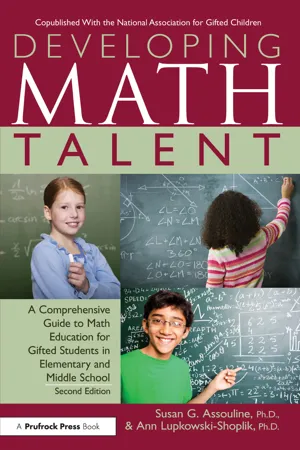
eBook - ePub
Developing Math Talent
A Comprehensive Guide to Math Education for Gifted Students in Elementary and Middle School
- 420 pages
- English
- ePUB (mobile friendly)
- Available on iOS & Android
eBook - ePub
Developing Math Talent
A Comprehensive Guide to Math Education for Gifted Students in Elementary and Middle School
About this book
Information
CHAPTER 1
Excuses for Not Developing Mathematical Talent
DOI: 10.4324/9781003234128-1
An excuse is a reason which you give in order to explain why something has been done or has not been done, or in order to avoid doing something.
—Retrieved from Google Dictionary
In the late 1980s, when we first started working with mathematically talented students, there was limited material available for educators or parents that would assist them in understanding the need to provide academically talented students with appropriate challenges. Over the years, teachers, professors, administrators, and policy-makers have become more concerned about the status of both curriculum and programs for mathematically talented students. Simultaneously, new products and advanced technology have been introduced. New research and reports that have compiled old research (e.g., A Nation Deceived [Colangelo, Assouline, & Gross, 2004a, 2004b] and Foundations for Success [National Mathematics Advisory Panel, 2008]) have made salient the issues that now must be addressed. In this chapter, we take on these issues and, in some cases, the excuses that they have become to explain why some students are kept from progressing through an appropriate curriculum at a pace for which they are ready.
Excuses . . . Excuses
Excuse us. In the previous sentence, we are using excuse as a transitive verb and a pretext for our examination of the variety of excuses or justifications that often are presented as reasons for not doing a certain kind of assessment or for not using specialized curriculum and programming for mathematically talented students. In this chapter, we present some common excuses that we have heard over the years that negatively impact the development of math talent (see Table 1.1). You will see that some of the excuses are diametrically opposed to each other. This inconsistency in reasoning about mathematically talented students is one reason why having a rational response for each excuse is so important. Our goal is to provide the information and research to back up well-informed, balanced responses to any one of these “excuses” for not implementing appropriate programming for mathematically talented students. The responses to these excuses set the stage for the subsequent chapters.
Excuse 1: At the elementary level, the school’s gifted program already meets the needs of all mathematically talented students.
Response: The names of many elementary gifted programs (e.g., ELP, or Extended Learning Programs) reveal their emphasis, which generally is on gifted behaviors and higher order thinking skills. These programs tend to be referred to as pull-out or resource programs because students will leave their regular classroom a couple of times a week for a period of time (45 to 60 minutes is typical) to participate in a preestablished enrichment curriculum. This enrichment can take a variety of forms, including activities unrelated to mathematics, problem-solving activities, or mathematically oriented enrichment activities (Lupkowski & Assouline, 1992). Unfortunately, it is a frequent practice in this country for gifted students to participate in pull-out programs where the topics they study are explicitly designed to be unrelated to the regular curriculum. For example, a mathematically talented student in a gifted program might be studying Shakespeare, growing plants for a science project, or participating in a community service
| 1. At the elementary level, the school's gifted program already meets the needs of all mathematically talented students. |
| 2. We already have a program for mathematically talented students. |
| 3. Specialized programming is not necessary because enrichment is the "safest" way to challenge mathematically talented students and every math class has extension opportunities for students who finish their assignments early. |
| 4. Teachers in our school are trained in differentiating the curriculum and can make adjustments for mathematically talented students within the regular classroom. |
| 5. The National Council of Teachers of Mathematics (NCTM) standards recommend that prealgebra, algebra, and geometry be woven throughout the school years beginning in prekindergarten. This guarantees that mathematically talented students will have a differentiated curriculum and that prealgebra and algebra, in particular, should not be provided as separate courses for middle school students. |
| 6. Mathematically talented students who are allowed to move through the curriculum quickly will run out of classes before they finish high school. |
| 7. Mathematically talented students aren't ready to study algebra until eighth or ninth grade. |
| 8. We shouldn't allow accelerated programming because students who are accelerated in mathematics will burn out before they reach college. |
| 9. Accelerated math programs lead to gaps in students' mathematical foundation. |
| 10. On the pretest, the student didn't earn 100%, so he or she doesn't qualify for advanced programming. |
| 11. A student who makes mistakes in computation doesn't need advanced programming. |
| 12. Too much time is devoted to standardized testing in our schools, so parents or teachers shouldn't ask for additional testing. |
| 13. Our district doesn't accept any outside results; our district uses only nationally standardized grade-level tests to identify students for the gifted program. |
| 14. Our district has stopped administering nationally standardized tests and uses only tests developed by the local district or building. |
| 15. Acceleration in math means taking math with students in the next higher grade and we have a policy against that. |
| 16. The student has already skipped a grade in mathematics. That is sufficient acceleration and no additional changes are needed in the student's mathematics program. |
| 17. There is no reason to do anything at the elementary or middle school level because mathematically talented students cannot be identified until high school. |
| 18. We aren't really sure what to do, so we think the best approach is to do nothing. |
activity. Although these are all valuable enrichment activities, they do not advance the student’s understanding of mathematics.
Sometimes, there are opportunities for math extensions through these enrichment programs, but these are offered in addition to, rather than in place of, the grade-level math curriculum. Although gifted programming provides many opportunities, by its very nature it cannot provide the one thing that is needed to develop the talents of mathematically able students: systematic progression through challenging curriculum, which is part of a predetermined scope and sequence. Few gifted programs provide this type of structured progression through mathematics.
Additionally, the selection criteria for enrichment-based gifted programs are typically intended to identify students based upon their general ability. For example—and despite the recommendations against using composite cut-off scores (Lohman, Gambrell, & Lakin, 2008)— many programs have a set cut-off of 130. Thus, a student with a verbal score of 125, a quantitative score of 129, and a nonverbal score of 120 would never make the cut-off for gifted programming. Nevertheless, students with quantitative scores such as the student in the example above need to have further assessment to determine their readiness for advanced mathematics.
Excuse 2: We already have a program for mathematically talented students.
Response: Mathematically gifted students are a varied group with respect to their interests (Lupkowski-Shoplik & Assouline, 2001) and abilities (Colangelo, Assouline, & Lu, 1994; Lupkowski-Shoplik & Swiatek, 1999). The curriculum for these students should reflect that diversity of talent (Sheffield, 1999a), which is why we do not recommend just one curriculum or one program for all mathematically talented students.
For mathematically talented students, we advocate using resources that are readily available by adapting the school’s mathematics curriculum. For example, we might use the curriculum from a higher grade level with younger talented students. Chapters 6 and 7 provide a range of ideas that will help school personnel devise the right level and pace of curriculum for talented students.
Excuse 3: Specialized programming is not necessary because enrichment is the “safest” way to challenge mathematically talented students and every math class has extension opportunities for students who finish their assignments early.
Response: When using this excuse, “safe” is typically a synonym for “effective.” Fortunately, there is extensive research to dismiss this excuse. The most effective intervention for highly able students is acceleration (Rogers, 2004, 2007). On a broader note, it’s more appropriate to recognize that not all mathematically talented students are alike and demonstrate a variety of needs based upon abilities. Thus, programming should be similarly varied, which would include both enrichment and accelerative opportunities.
A student may have the good fortune to be placed with a teacher who is capable of appropriately enriching the math curriculum. The teacher would assign material that is at a greater depth than what is presented to students in the regular mathematics education program and also would bring in new topics that are not a part of the regular curriculum. The difficulty with this approach is that it depends heavily on having a teacher who is well prepared in mathematics and has the time and inclination to differentiate to a radical degree for the mathematically talented student. Also there is the concern that the student will no longer have the same type of mathematically enriched curriculum once he or she moves to the next grade level.
For mathematics, good acceleration includes much enrichment, and good enrichment is accelerative (J. C. Stanley, personal communication, May 1998). Mathematics builds upon itself so that, in reality, it is extremely difficult to “enrich” a student without actually accelerating his or her study of mathematics. All of these issues are discussed thoroughly in this book, especially in Chapters 4, 6, and 7.
Excuse 4: Teachers in our school are trained in differentiating the curriculum and can make adjustments for mathematically talented students within the regular classroom.
Response: Differentiation of curriculum is synonymous with Vygotsky’s zone of proximal development, which is described by McGrew and Flanagan (1998) as the zone where there is an “optimal match.” An optimal match is that ideal situation where learning opportunities are matched to a learner’s needs and readiness. As a model, differentiation is rich and robust because it recognizes the individual differences inherent in classrooms and focuses on a systematic approach to tailor the curriculum and instruction to meeting the needs of the learner (Tomlinson & Jarvis, 2009). Therefore, it is logical to assume that educators who have received in-service training about differentiation would be able to handily meet the needs of gifted learners. There are two considerations about this assumption. First, “differentiation is just hard work. It requires more preparation, formal and informal assessment, and well-developed classroom-management skills. It cannot become a reality in a school or school district all at once by administrative fiat” (Borland, 2009, p. 115). The second point is aptly made by Hertberg-Davis (2009), “differentiation of instruction. . . like any approach to educating gifted students. . . functions best as a critical component within a spectrum of services provided for high-ability learners” (p. 253).
Excuse 5: The National Council of Teachers of Mathematics (NCTM) standards recommend that prealgebra, algebra, and geometry be woven throughout the school years beginning in prekindergarten. This guarantees that mathematically talented students will have a differentiated curriculum and that prealgebra and algebra, in particular, should not be provided as separate courses for middle school students.
Response: This interpretation of the position of the National Council of Teachers of Mathematics (NCTM) is just that—an interpretation. In fact, in the NCTM Principles and Standards (2000), we found the following statement: “In recent years, the possibility and necessity of students’ gaining facility in algebraic thinking have been widely recognized. Accordingly, these Standards propose a signi ficant amount of algebra for the middle grades” (p. 211). It is also important to remember that NCTM’s recommendations are generally intended for all students. Therefore, it is up to the educator and parent to work together to consider the ways in which the curriculum standards can be used to assist them in addressing the needs of their mathematically talented students.
Advocating that algebra and geometry be introduced to all students beginning with the primary grades is a positive shift. However, there are many students who are ready for actual coursework in algebra and geometry prior to 8th, 9th, or 10th grades when this coursework is typically introduced. Mathematically talented students still need a differentiated curriculum that allows them to move forward within the traditional sequence of courses. Because they are very able in math, they will be ready for an algebra class before eighth grade.
Excuse 6: Mathematically talented students who are allowed to move through the curriculum quickly will run out of classes to take before they finish high school.
Response: This pretext for not implementing advanced programming is usually mentioned when considering the possibility of acceleration, even at a young age. Of course, it is important to think about the long...
Table of contents
- Cover
- Half Title
- Title Page
- Copyright Page
- Contents
- List of Tables
- List of Figures
- Dedication
- Foreword
- Foreword
- Introduction
- Acknowledgements
- CHAPTER 1 Excuses for Not Developing Mathematical Talent
- CHAPTER 2 Advocacy
- CHAPTER 3 Using Academic Assessment to Make Informed Decisions About Mathematically Talented Students
- CHAPTER 4 The Diagnostic Testing→Prescriptive Instruction Model
- CHAPTER 5 Talent Searches
- CHAPTER 6 Programming
- CHAPTER 7 Curricula and Materials
- CHAPTER 8 Teaching Mathematically Talented Students
- CHAPTER 9 Case Studies
- Resources
- Glossary
- References
- About the Authors
- Index
Trusted by 375,005 students
Access to over 1.5 million titles for a fair monthly price.
Study more efficiently using our study tools.
Frequently asked questions
Yes, you can cancel anytime from the Subscription tab in your account settings on the Perlego website. Your subscription will stay active until the end of your current billing period. Learn how to cancel your subscription
No, books cannot be downloaded as external files, such as PDFs, for use outside of Perlego. However, you can download books within the Perlego app for offline reading on mobile or tablet. Learn how to download books offline
Perlego offers two plans: Essential and Complete
- Essential is ideal for learners and professionals who enjoy exploring a wide range of subjects. Access the Essential Library with 800,000+ trusted titles and best-sellers across business, personal growth, and the humanities. Includes unlimited reading time and Standard Read Aloud voice.
- Complete: Perfect for advanced learners and researchers needing full, unrestricted access. Unlock 1.5M+ books across hundreds of subjects, including academic and specialized titles. The Complete Plan also includes advanced features like Premium Read Aloud and Research Assistant.
We are an online textbook subscription service, where you can get access to an entire online library for less than the price of a single book per month. With over 1.5 million books across 990+ topics, we’ve got you covered! Learn about our mission
Look out for the read-aloud symbol on your next book to see if you can listen to it. The read-aloud tool reads text aloud for you, highlighting the text as it is being read. You can pause it, speed it up and slow it down. Learn more about Read Aloud
Yes! You can use the Perlego app on both iOS and Android devices to read anytime, anywhere — even offline. Perfect for commutes or when you’re on the go.
Please note we cannot support devices running on iOS 13 and Android 7 or earlier. Learn more about using the app
Please note we cannot support devices running on iOS 13 and Android 7 or earlier. Learn more about using the app
Yes, you can access Developing Math Talent by Susan G. Assouline,Ann Lupkowski-Shoplik in PDF and/or ePUB format, as well as other popular books in Pedagogía & Enseñanza de matemáticas. We have over 1.5 million books available in our catalogue for you to explore.