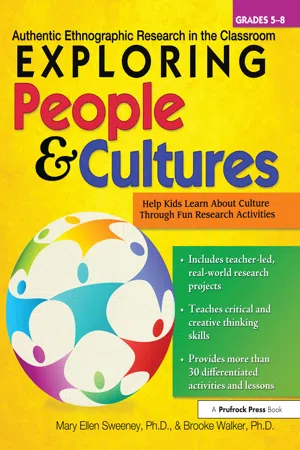
Exploring People and Cultures: Authentic Ethnographic Research in the Classroom provides teachers with tools and activities for conducting a classroom study of ethnic groups and cultures. Through the more than 30 ready-to-use, differentiated lessons, teachers will help students learn how to recognize the elements of culture; think critically; apply real-world research techniques in field experiences; identify behavioral patterns in modern-day cultures; and create, plan, and share their products in a student-led ethnography fair.
Grades 5-8
eBook - ePub
Exploring People and Cultures
Authentic Ethnographic Research in the Classroom (Grades 5-8)
- 124 pages
- English
- ePUB (mobile friendly)
- Available on iOS & Android
eBook - ePub
Exploring People and Cultures
Authentic Ethnographic Research in the Classroom (Grades 5-8)
About this book
Information
Chapter 1
Ethnographic Research Basics
DOI:10.4324/9781003235132-2
Research is a scientific process that assumes that events in the world are lawful and orderly and, furthermore, that the lawfulness is discoverable.
—Anderson (1990, p. 5)
The Research Notebook
Students will keep an ongoing research notebook during this unit. The research notebook will be a collection of items the students gather including field notes, interview transcripts, drafts and final papers, reflections on the process, artifacts, articles, and photos. Students will keep all of their work during this unit in their research notebooks in four sections: Section 1 contains the work from Chapter 1, Ethnographic Research Basics; Section 2 contains the work from Chapter 2, A Student Ethnographer's Understanding of the Elements of Culture; Section 3 contains the work from Chapter 3, Student Mini-Ethnographic Proposal; and Section 4 contains the work from Chapter 4, Completing the Mini-Ethnography. See Figure 2 for a sample table of contents for the student research notebook.
As an ethnographer's data are descriptive, the collected data may be voluminous; therefore, ethnographers need to be very organized. A three-ring binder works best for students' research notebooks. A three-hole punch will be needed to allow students to organize their papers in the binder.

Figure 2. Sample research notebook table of contents.
One way to incorporate technology into this unit is to have the teacher and students create a blog or other electronic information sharing site. Blogs can be set up using template sites like http://www. blogger.com. Blogger offers an easy way for the students to share their thoughts with the teacher and each other. Discussion questions could be asked and answered in a blog.
Data-Gathering Practice
Lesson 1 assesses the knowledge that students already have about ethnography and research through a KWL. If students already have a lot of knowledge about research, then some of the lessons in this first chapter could be eliminated. Lesson 2 introduces students to the vocabulary words they will need to learn as they proceed through the study. Some ideas for practicing these vocabulary words are also included in this lesson.
One of the purposes of research in the social sciences is to obtain knowledge about a defined population (e.g., all brown-eyed LO-year-old girls). It's difficult to collect data from all individuals who make up a population. Researchers often select a certain number of subjects to research, called a sample, and then make generalizations about the population from the results of the sample. Lesson 3 introduces students to the idea of making generalizations from a sample.
A method used by researchers who study people (called social scientists) is the survey. The researcher gathers data from a sample so that inferences may be made about some characteristic, attitude, or behavior of this population (Babbie, 1990). The Gallup Poll is probably the best-known survey used to sample public opinion. Have students provide examples of surveys they have heard about or conducted to open a discussion of surveys. Lesson 4 helps students learn to design and complete their own surveys.
Interviews are another way that social scientists collect data. In interviews, researchers obtain responses to questions orally. Interviews differ from surveys because the researcher may modify the data collection to fit the respondent's replies. For example, additional information can be requested or a question may be rephrased (Hittleman & Simon, 1992). An interview may also be used to elicit more in-depth data about information obtained in a survey. The data obtained in an interview are descriptive. Descriptive research is used to illustrate respondents' attitudes, characteristics, and behaviors; therefore, it adds to the knowledge base about a population. Descriptive data are not generalizable to a larger population, however. Lesson 5 takes students through the process of an interview.
Another way that social scientists gather information is by observation. Rather than trying to look at a large population through a few samples, observational data investigate individuals or subjects. Observational research attempts to get a detailed understanding of the few subjects being studied. This method is called fieldwork. Researchers go out into the field, entering a natural setting where they will observe interactions and behaviors. Similar to the interview, this type of research is descriptive; generalizations about a larger population cannot be made from observations. The students will only be able to describe for others what they observe. Observation is the main method of ethnographic research. Ethnographic accounts are descriptive and interpretive. The researcher records observations with as much detail as possible to provide the reader an accurate presentation of the observation site. After presenting the description, the research explains the significance of the data for the reader.
Initial observation research may be approached in several ways. The class could take a field trip to a museum, the zoo, a park, or any place that students might be able to observe people going about their daily business. Students could observe other classes in the building; alternatively, this assignment could be given as homework and students could observe a coffee shop, skate park, or the mall on the weekend. The type of observation the students will be doing is nonparticipant observation; in other words, the students will not participate in the activities they are observing. Lesson 6 takes students through the steps of collecting observational data.
Practicing Data Analysis
The purpose of observing a cultural group from an ethnographic perspective is to discover the different themes and patterns that underlie the structure and function of a cultural group. One of the authors of this book completed an ethnography of an elementary school classroom as her dissertation research. In observing one third-grade classroom, Walker (2000) identified behavioral patterns that were repeated day after day in the classroom in lieu of a list of posted behavioral expectations or rules. These became the routines of the classroom. For example, the school day was arranged into different activities that called for different types of behaviors. These different activity times included Circle, Work, Story and Relax, Journals, and Silent Reading. During Circle time, the behavior expected of the students was to quietly listen to each other and raise their hands to speak, in contrast to Journals time, which was completed in total silence. As the author further analyzed the patterns, themes emerged that showed that these patterns of behavior were part of the routines that helped the classroom function efficiently. Lesson 7 takes students through the steps of data analysis.
Conclusion
Now is an opportune time to introduce the final project, a mini-ethnography, to the students. Each student will complete a mini-ethnography of a subcultural group he is interested in learning more about through the ethnography research process. The following list includes some ideas for students to start thinking about for a study of their subculture:
- ✦ sports group (e.g., baseball, soccer, karate, track teams),
- ✦ skate park,
- ✦ church youth group,
- ✦ debate team,
- ✦ drama club,
- ✦ chess club, or
- ✦ cultural class/school (e.g., Chinese school).
Students will be thinking about a topic they might want to investigate as the class moves into Chapter 2, a study of culture.
Lesson 1: Assessing Students' Initial Knowledge
Objective: Students will complete a KWL to assess their knowledge of ethnography at the beginning of the unit.
Materials:
- O KWL About Ethnography sheet, p. 20
- O Pencils
Steps:
- Ask students what kinds of things are discovered by research. Have a discussion of how research has impacted our society. The research the students do in this unit involves the social sciences. Research in the social sciences, or research about people, uses different methodology than research about inanimate objects. The students are probably more acquainted with scientific research than they are with social science research. Research in the social sciences, however, has a large impact on our society today. Opinion polls, focus groups, and surveys are often used to gauge people's perceptions, beliefs, and attitudes. Advertisers use this type of research frequently, as do politicians. As students use these research methods and see how they work, they will be able to become more critical evaluators of the research they see published.
- Explain to students that the specific type of social science research they will be studying is ethno...
Table of contents
- Cover
- Half Title
- Title Page
- Copyright Page
- Table of Contents
- Introduction Ethnographic Research
- Chapter 1 Ethnographic Research Basics
- Chapter 2 A Student Ethnographer's Understanding of the Elements of Culture
- Chapter 3 Student Mini-Ethnographic Proposal
- Chapter 4 Completing the Mini-Ethnography
- Chapter 5 Mini-Ethnographic Demonstration Fair
- Conclusion The Importance of Ethnographic Research
- References
- Appendix A Ethnographic Vocabulary
- Appendix Β Differentiated Strategies Defined
- Appendix C Sample Ethnographies
- About the Authors
- Common Core State Standards Alignment
Trusted by 375,005 students
Access to over 1.5 million titles for a fair monthly price.
Study more efficiently using our study tools.
Frequently asked questions
Yes, you can cancel anytime from the Subscription tab in your account settings on the Perlego website. Your subscription will stay active until the end of your current billing period. Learn how to cancel your subscription
No, books cannot be downloaded as external files, such as PDFs, for use outside of Perlego. However, you can download books within the Perlego app for offline reading on mobile or tablet. Learn how to download books offline
Perlego offers two plans: Essential and Complete
- Essential is ideal for learners and professionals who enjoy exploring a wide range of subjects. Access the Essential Library with 800,000+ trusted titles and best-sellers across business, personal growth, and the humanities. Includes unlimited reading time and Standard Read Aloud voice.
- Complete: Perfect for advanced learners and researchers needing full, unrestricted access. Unlock 1.5M+ books across hundreds of subjects, including academic and specialized titles. The Complete Plan also includes advanced features like Premium Read Aloud and Research Assistant.
We are an online textbook subscription service, where you can get access to an entire online library for less than the price of a single book per month. With over 1.5 million books across 990+ topics, we’ve got you covered! Learn about our mission
Look out for the read-aloud symbol on your next book to see if you can listen to it. The read-aloud tool reads text aloud for you, highlighting the text as it is being read. You can pause it, speed it up and slow it down. Learn more about Read Aloud
Yes! You can use the Perlego app on both iOS and Android devices to read anytime, anywhere — even offline. Perfect for commutes or when you’re on the go.
Please note we cannot support devices running on iOS 13 and Android 7 or earlier. Learn more about using the app
Please note we cannot support devices running on iOS 13 and Android 7 or earlier. Learn more about using the app
Yes, you can access Exploring People and Cultures by Mary Ellen Sweeney,Brooke Walker in PDF and/or ePUB format, as well as other popular books in Education & Education General. We have over 1.5 million books available in our catalogue for you to explore.