Students write lots of reports, but how do they turn their hard work into appealing oral reports? Where can they learn to present their research with flair and style? Every student who will ever have to give an oral report needs the surefire techniques in this book. You'll find the basics of public speaking in clear language for children and busy teachers. Some of the topics covered are getting organized, preparing a great opener, using visual aids, involving the audience, and speaking with confidence. Public Speaking is a much needed resource that students, teachers, and parents can flip through or use cover-to-cover.
In this book, students can learn how to organize information into a presentation that will interest and amaze their classmates. They will discover exciting ways to start a speech, and lots of intelligent techniques to use in the middle to keep the audience attentive. Here they will discover tricks to keep from getting nervous, and special, easy ways to remember what to say. Using these new skills, your students will be entertaining, informative, and confident.
For more guidance on verbal presentation, see Speaker's Club.
Grades 4-8
eBook - ePub
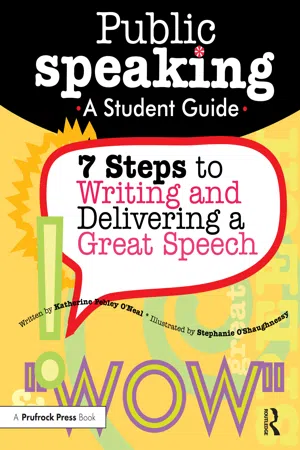
Public Speaking
7 Steps to Writing and Delivering a Great Speech (Grades 4-8)
- 50 pages
- English
- ePUB (mobile friendly)
- Available on iOS & Android
eBook - ePub
Public Speaking
7 Steps to Writing and Delivering a Great Speech (Grades 4-8)
About this book
Information
Chapter 1
Get Organized
DOI: 10.4324/9781003237396-2
A great oral report is full of good information. It gets people’s attention with something they can easily relate to, it holds their interest, and it gives them new knowledge. Your talk will be fun to give and interesting to listen to if you pack it with exciting information. Here’s how to get started.
Choose your topic
First, choose a topic that interests you. The purpose of giving a report is to share information with your class. If you like your topic, planning your report will be more fun.
Next, make sure your topic is the right size. If you choose a huge topic, like “The Amazing Human Body,” your talk could go on for hours or even days. Narrow your topic down to one aspect that interests you, like “The Amazing Human Nose.” Get your topic approved by your teacher.
Ideas for my speech
- human race
- human body
- sensory system
- the nose ☆ ☆

Know what you are trying to accomplish with your presentation. Are you trying to educate, convince, entertain, or demonstrate? Once you know what your goal is, everything you say should be directed toward meeting that goal.

“My goal is to educate you about all the ways your nose helps you sense the world around you.”“By the end of my speech, everyone will be able to identify four birds that live in our area.”“By the time I finish talking, you will be convinced that James Dogood is the best candidate for mayor.”
Make an outline
If your teacher gives you requirements for the information you need to include in your speech, use that list as a basic outline. Gather the required information first. You can add extra details later.
If you have a topic but no specific outline to follow, general reference books can give you a good overall picture of your topic. Reference books to check include an encyclopedia, almanac, atlas, and dictionary.
Use these books to make a list of important things you want to tell the class, and this will be your rough outline. Reference books can help you decide whether your topic is too small to find enough information or too big for one report. You can also get clues about where else to look for information.
Noses
- I. Introduction
- A. Joke
- B. Why it’s important
- II. Anatomy of a nose
- A. Diagram
- B. Main parts
- C. Functions
- III. Relation to other senses
- A.
- B.
Find other sources of information
Now that you have a plan, go to the library. Use your outline to help you find books on your topic. Nonfiction books are arranged by subject in the library, so if you look up your topic on the library computer, it will list all the books on that topic and they will most likely be shelved together. For “The Amazing Human Nose,” you could use the key words nose, nostril, olfactory or smell to find related books. Remember, the librarian would love to help you.
Don’t forget other sources of information. Museums, zoos, and art galleries have lots of information. The Internet is full of facts. Interviewing real people can give you a firsthand perspective. If your topic has information that changes, get the most up-to-date information from current newspapers, periodicals and almanacs.

Take Notes
The easy way to take notes is to use note cards. You will need an adequate supply of cards so you can record all the information you find. The first card should list all your sources, with the author and publication data, like this:
- The World’s Largest Noses by J. Honker, Tissue Publications, Chicago, 2000.
- The Guinness Book of World Records, 1999, Guinness Publishing Ltd., Bantam Books, New York, 1999.
Then skim or read through your reference material. Whenever you find something you want to put in your report, write it in your own words on a new note card, with the source number and page at the top, like this:
2, p. 157
The most famous nose belonged to Jimmy Durante, a Hollywood movie star in the 1930’s.
Nicknamed “Da Schnozz,” his nose was insured for $100,000.


Write Your Rough Draft
When you have finished taking notes, it’s time to put together your rough draft. The great thing about note cards is you can change their order until your information is organized in a way that flows smoothly and makes sense. Organizing and rewriting your notes into a report helps you to use your own words, too, so the report will be yours and not a copy of someone else’s work.
The best way to start writing is to dig right in. This is only a rough draft. You are the author and you can change anything at any time. When you are happy with what you have written, read it out loud. Do you still like it? If so, it’s time to turn it into an oral presentation that will impress your audience.
Chapter 2
Grab Their Attention
DOI: 10.4324/9781003237396-3
A great opening line will grab the attention of your audience. It will help them focus on your topic so they will listen and learn from what you have to say. There are several ways to get this attention.
Ask a question
“How many of you think you could smell the difference between cinnamon and garlic with your eyes closed?”“How many of you have been on a roller coaster before?”“Who knows the difference between an alligator and a crocodile?”
Questions like these will draw your classmates in and create interest for what you have to say next. Ask questions that can be answered with a show of hands so your classmates won’t have to speak out.

Share a story
Stories captu...
Table of contents
- Cover
- Title Page
- Copyright Page
- Contents
- Why Give a Great Oral Report?
- 1. Get Organized
- 2. Grab Their Attention
- 3. End with Style
- 4. Show Off with Visual Aids
- 5. Pull Your Audience In!
- 6. Speak Like a Pro
- 7. Build Your Confidence
- 8. Branch Out - Specific Kinds of Reports
- Conclusion
- Speech Planner
Trusted by 375,005 students
Access to over 1.5 million titles for a fair monthly price.
Study more efficiently using our study tools.
Frequently asked questions
Yes, you can cancel anytime from the Subscription tab in your account settings on the Perlego website. Your subscription will stay active until the end of your current billing period. Learn how to cancel your subscription
No, books cannot be downloaded as external files, such as PDFs, for use outside of Perlego. However, you can download books within the Perlego app for offline reading on mobile or tablet. Learn how to download books offline
Perlego offers two plans: Essential and Complete
- Essential is ideal for learners and professionals who enjoy exploring a wide range of subjects. Access the Essential Library with 800,000+ trusted titles and best-sellers across business, personal growth, and the humanities. Includes unlimited reading time and Standard Read Aloud voice.
- Complete: Perfect for advanced learners and researchers needing full, unrestricted access. Unlock 1.5M+ books across hundreds of subjects, including academic and specialized titles. The Complete Plan also includes advanced features like Premium Read Aloud and Research Assistant.
We are an online textbook subscription service, where you can get access to an entire online library for less than the price of a single book per month. With over 1.5 million books across 990+ topics, we’ve got you covered! Learn about our mission
Look out for the read-aloud symbol on your next book to see if you can listen to it. The read-aloud tool reads text aloud for you, highlighting the text as it is being read. You can pause it, speed it up and slow it down. Learn more about Read Aloud
Yes! You can use the Perlego app on both iOS and Android devices to read anytime, anywhere — even offline. Perfect for commutes or when you’re on the go.
Please note we cannot support devices running on iOS 13 and Android 7 or earlier. Learn more about using the app
Please note we cannot support devices running on iOS 13 and Android 7 or earlier. Learn more about using the app
Yes, you can access Public Speaking by Katherine Pebley O'Neal in PDF and/or ePUB format, as well as other popular books in Education & Teaching Arts & Humanities. We have over 1.5 million books available in our catalogue for you to explore.