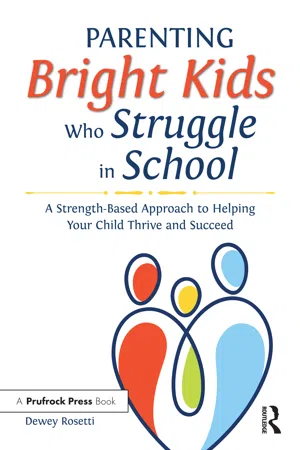
Parenting Bright Kids Who Struggle in School guides parents through the challenging and often unfamiliar landscape of raising kids who have been labeled with learning differences, including dyslexia, ADHD, autism, sensory processing disorder, and more. This book:
Builds upon Harvard professor Todd Rose's groundbreaking research in the "Science of Individuality."
Helps parents target their child's jagged profile of strengths and weaknesses.
Explains a child's context of learning and multiple pathways.
Teaches revolutionary techniques to encourage strengths and mitigate weaknesses.
Helps parents manage the emotional fallout of raising a child who does not conform to the "average" model of learning.
Drawing from her own experience as a parent of a child with learning differences—who is now a highly successful adult—the author outlines clear lessons from a quarter century of advocating for kids who learn differently.
September 10, 1996, seemed like any other Tuesday night at first. Melissa was 6 years old, and I was in the upstairs bathroom trying to wrangle her into the tub. Most nights, it was a struggle to get this little one bathed and in bed at a reasonable hour; she was a spirited, energetic kid. I had hoped that starting kindergarten might wear her out a bit, but we were 5 days into the school year, and she showed no signs of slowing down. That night she futzed around outside the tub, talking to her Barbies and doing anything she could to delay the inevitable.
“Come on, honey. Let’s go,” I called out. “You can bring the Barbies into the bath with you. Let’s get this done.”
I steeled myself for the usual protests, but instead, she burst into tears and yelled, “How can you be so mean to your child?” Hiccup. “A child who has had such a terrible day?”
I started to smile at first; Melissa could be a bit of a kidder at times. But then she literally dropped to a heap on the floor. Through her hiccups and sobs—the kind that make you think your kid may stop breathing at any minute—she blurted out, “The teacher asked us all to sound out a word today and I had no idea what she meant. And all of the other girls knew how to do it. I don’t know what that means: ‘sound it out.’”
I sank down on the floor and faced her squarely, so she would know she had my attention. By nature, Melissa was a willful child, already very competitive, always racing ahead of anyone who tried to walk beside her. Since the age of 2, she had been the personification of “I can do it myself!” In keeping with her independence, she didn’t like to be hugged much either, even by me. Her willingness to come unglued raised a big red flag.
“Honey, can you remember what the word was?” I asked.
“It was ‘cat.’”
I showed her: “First you say ‘ccc’ for ‘C’ and then ‘aaa’ for ‘A’ and then ‘ttt’ for ‘T.’ Cat is spelled C-A-T.” I looked at her wonderfully expressive face, knitted brows, and welling eyes.
“Yes, that’s what they said. But I still don’t know what that means,” she repeated.
“Well, honey, it’s only the second week of school. I’m sure the teacher didn’t expect everyone in the class to understand sounding it out right away.”
This idea didn’t calm her down at all: “No, mommy, everyone really did know how to do it, except me.”
With that, I pulled her up and moved her toward the tub, which I now saw as a calming activity more than a chore. The bath worked as a distraction. She stopped crying and calmed down enough to let me bathe her and help her get into her pajamas. She was definitely still sad but no longer sobbing, and there was no more talk of her day at school.
When I had finally gotten my red-eyed and splotchy little one in bed, my mind flitted briefly back to the letter we had gotten from the school right after Melissa was admitted. The testing that every child went through during the application process did, in fact, show that Melissa might have some trouble with words and letters. But the school had accepted her anyway, probably because our older daughter was now a fifth grader there and our family loved the school.
Warning Signs
As I dropped Melissa off at school the next morning, I thought about how much I loved the atmosphere of the place—so different from the Catholic schools I’d attended as a girl, where there was always the nagging thought that I might be doing or saying something wrong without even knowing it. “Walking on eggshells” was a good descriptor for my school experience. I was delighted with the new age idea that children should be treated and spoken to like little adults, and that they would act accordingly.
I went in search of the lower school head to talk about what had happened the night before. Ms. K was the consummate school administrator, round-faced with snow-white short hair and crystal blue eyes that bored right into you. She was warm and kind but could be firm when the occasion demanded. Her voice had a whispered singsong quality, which always struck me as softening whatever message she needed to deliver to parents about their kids.
I was anxious to hear her reaction to Melissa’s outburst, half hoping she would tell me it was normal for the new kindergartners to get nervous if there was something they didn’t grasp right away. I finally tracked her down as she was herding third graders into assembly.
“Ms. K, I need to talk to you about Melissa,” I said.
“What’s up?” she asked, smiling with those blue eyes.
“She had a meltdown last night—it was totally unlike her. She told me she couldn’t sound out a word the teacher had told the girls to sound out together. She said she didn’t know what that meant, and all of the other girls did. Do you think she may already be having some reading problems?”
I was looking for the smile and response I wanted to hear, something that would reassure me that Melissa was just fine. Instead, Ms. K’s face pinkened, her eyes got bright, and she said, “Good for you, Dewey, for getting on this so quickly. I will talk to her teacher and see what’s up. We’ll ask her to pay special attention to Melissa during the phonics lessons to see if she is getting it.”
She didn’t tell me not to worry. Instead, she ended by saying, “If there’s a problem, we’ll get right on it.”
When I met with Ms. K again later that week, I told myself to relax.
“Dewey,” she started. “Melissa’s teacher agreed that there might be a problem with hearing the sounds of the letters, and she has offered to work with Melissa individually to get her caught up to the class. Can she come in a little early a couple of days a week?”
So, we began a new routine, with Melissa’s school day starting early on Tuesdays and Thursdays so she could “work on her sounds.” Melissa had a little smile on her face, showing how special she felt with this extra attention from her teacher.
But the next week, as Melissa bent over her homework one evening, she blurted, “Mommy, Ms. S made me go to the little house today and work with her. She took me out of class right during my favorite time when Ms. G was reading us a story about Mexico.”
I forced myself to get more facts and to really listen, even though I knew that Ms. S was the learning specialist and was probably just doing periodic screenings to see if there had been any changes in Melissa’s ability to hear simple sounds.
Then, Melissa said what would soon become a familiar refrain: “Why did she take me out and no one else, Mommy? Why don’t the other girls have to go?”
“Maybe some of them will,” I said, trying to sound unconcerned.
“But no one else has had to go! I would have seen them walking over there.” Melissa was not lacking in persistence. Her eyes welled up. “Why am I the only one? Can you tell Ms. S to stop pulling me out of class?”
Self-Esteem and Learning Differences
If parents are blindsided when their kids are confronted with learning challenges, imagine the reaction of small children when they are suddenly aware that they can’t do what their peers can. Self-esteem at any age is fragile. In the early years of school, when children are comparing themselves to their friends, listening to and sensing others’ opinions of them, self-esteem is like brittle candy that can crack at a moment. All it takes is the slightest hint of disapproval or criticism. It is very painful for me, even now, to look back and think of how alone Melissa must have felt. Yet, she bravely got up every day and went to school for 4 long years. Knowing what I do now, I would never put a child through that again.
When Melissa’s learning challenges first became apparent, everyone at the school talked to me about how self-esteem takes a hit when a child is singled out in a classroom for any reason. The message to the child is this: You need special treatment. You can’t keep up. You’re not the same. After a few weeks of this messaging, any child will begin to doubt themselves.
Not being able to read is one of the worst of these situations. It affects all of the other activities during school hours. There was no safe place where Melissa could hide her inability to read consistently—even on the playground, where the girls would use chalk on the blacktop to send each other messages.
Children cope with these challenges in different ways. Some sink into depression or withdraw, refusing to speak at school. For others, the best defense seems to be a bold offense. They begin to act out to distract from their academic difficulties. They may not even be conscious of this behavior, but it makes a kind of sense: If I am being scolded for disrupting the class, no one will notice that I have no idea how to start my essay.
Melissa was one of these kids. We had no idea what we were in for. I thought the academic challenges were tough, but they were just the beginning. Lacking the ability to control her academic destiny, she took control of anything else going on around her … in a negative way.
The social-emotional effects of struggling academically should never be ignored. In fact, many people who grapple with learning difficulties or attention issues are often labeled as depressed or afflicted with anxiety long before their specific learning differences can be explicitly identified. For example, one of the major indicators for an ADHD diagnosis is a history of social difficulties.
Acting Out From Discomfort
Ever since her personality had first begun to assert itself when she was 2, we had called Melissa our “pistol.” This morphed into a special name given to her by her father, “La Pistola,” our charming little weapon. But as the academic difficulties mounted, it seemed that her fiery personality was beginning to turn to trouble. She was impulsive, often writing on any books or papers she found, once even scrawling the word Mom on an antique wooden chest. She was constantly in motion, talking loudly enough to be disruptive most of the time. Her default answer to any plan was to say no, whether the suggestion was going out for a family dinner or playing with her friends.
I was slow to catch on to the pain behind these actions. Melissa was an outgoing and competitive child, so she externalized her fears and anxieties rather that internalizing them in the way other kids might. It’s hard to admit to myself now, but the empathy that she so sorely needed escaped me for too long. Over time, my husband became her go-to person because he was more patient and steady.
Whenever Melissa was throwing a tantrum about the seams on her socks, hiding in the basement, or generally acting out, my reaction was to respond with unhelpful remarks like, “Why did you do that?” Of course, this sometimes led to screaming matches between us—a 50-year-old woman and her 6-year-old daughter. I am embarrassed even now to discuss these arguments, but I know that this situation goes on in other households, too. Talking about it is a helpful way to break the cycle.
Socially, Melissa was becoming stubborn and difficult, especially when playing a game with rules she couldn’t read or follow—and sadly, there were many. Her competitive nature would cause her to cover up her mistakes with outlandish excuses, which basically came off as cheating. Soon, the other girls at her school began to tease and chastise her. This only caused her to ramp up her behavior.
We arranged to have Melissa tested for academic readiness and emotional maturity in December of that first year. The testing required two different sessions, but even the fact that she could skip 2 days of school did nothing to make her more cooperative. When we arrived at the test site, she refused to leave the car, not giving in until the test coordinator came out to extract her. Her obstreperousness was masking a deep fear of trying anything new that could possibly be added to her failures. I see this now, but at the time I thought she was simply being difficult.
One month later, my husband and I arrived at the educational therapist’s office to hear the results of the testing. I was dreading the news. Would we hear that Melissa’s IQ was not high enough to let her continue in this school? However, what we heard was not actually definitive enough to be of any real help.
“She’s not really ready to attend school,” the therapist began. “She is just not interested in learning yet.” This, even though she was a full year older than most of the other girls in her class because the school had delayed her admission.
As for Melissa’s IQ, the therapist said the tests were inconclusive. “She didn’t really finish enough of the sections of the test to get a reliable score,” she said. “But I can tell you she is very clever, obviously very smart. I can see this because of the ways she was able to avoid being tested. For example, in the opposites test, the instructions are to give a word that is the opposite of the word I said. And despite my repetition of this rule, Melissa continued to give me her version of an opposite. For ‘hot,’ she would say ‘unhot.’ She’s a bright girl but needs more school readiness to really thrive.”
I heard all of this and thought, Well, of course. Difficult and obstinate behavior yet again. I wasn’t able to read between the lines: Melissa was stonewalling because she was so deeply sure she’d fail. She already had so little faith in herself.
In first and second grade, Melissa’s self-esteem continued to slide. Her second-grade teacher, Ms. M, who had struggled with learning to read herself, identified and sympathized with Melissa’s school difficulties. But sympathy did not seem to be enough. What Melissa needed at this point was real, authentic success in the classroom.
At that time, Melissa’s teachers, even Ms. M, did not have adequate knowledge or experience in teaching children with dyslexia. In fact, no one was even willing to use the word dyslexia in any way—either as a diagnosis or as an explanation for Melissa’s continued inability to develop reading and math skills despite the constant tutoring. The interventions she received were not adequate to correct the deficits she had in language arts. The adults around Melissa suffered from a lack of knowledge and experience, not a lack of caring. Still, she continued to lose ground to her peers.
On the playground and at soccer practice, Melissa’s athletic talent allowed her to enjoy some success. But it wasn’t enough to compensate for the other 6 hours in the day when she suffered from excruciating failure in the classroom. The disruptive behavior only worsened. The administrators and teachers shared that they were afraid that her self-esteem was getting so low that it might be time to change schools. This moment felt like a major defeat. I began to investigate other schools, but I was hampered by the fact that I didn’t know what kind of school I should be looking for. I was afraid of jumping from the frying pan into the fire, knowing that any move would surely be disruptiv...
Table of contents
Cover
Half Title
Title Page
Copyright Page
Dedication
Table of Contents
Acknowledgments
Foreword
Introduction A Child’s Cry for Help
Part I: From Surviving to Thriving
Part II: Changing the Mindset
Part III: A New Way of Thinking
Part IV: The Way Ahead
Recommended Resources
References
Appendix A Understanding the Psych-Ed Report
Appendix B Sample Psych-Ed Report
About the Author
Trusted by 375,005 students
Access to over 1.5 million titles for a fair monthly price.
Study more efficiently using our study tools.
Frequently asked questions
Yes, you can cancel anytime from the Subscription tab in your account settings on the Perlego website. Your subscription will stay active until the end of your current billing period. Learn how to cancel your subscription
No, books cannot be downloaded as external files, such as PDFs, for use outside of Perlego. However, you can download books within the Perlego app for offline reading on mobile or tablet. Learn how to download books offline
Perlego offers two plans: Essential and Complete
Essential is ideal for learners and professionals who enjoy exploring a wide range of subjects. Access the Essential Library with 800,000+ trusted titles and best-sellers across business, personal growth, and the humanities. Includes unlimited reading time and Standard Read Aloud voice.
Complete: Perfect for advanced learners and researchers needing full, unrestricted access. Unlock 1.5M+ books across hundreds of subjects, including academic and specialized titles. The Complete Plan also includes advanced features like Premium Read Aloud and Research Assistant.
Both plans are available with monthly, semester, or annual billing cycles.
We are an online textbook subscription service, where you can get access to an entire online library for less than the price of a single book per month. With over 1.5 million books across 990+ topics, we’ve got you covered! Learn about our mission
Look out for the read-aloud symbol on your next book to see if you can listen to it. The read-aloud tool reads text aloud for you, highlighting the text as it is being read. You can pause it, speed it up and slow it down. Learn more about Read Aloud
Yes! You can use the Perlego app on both iOS and Android devices to read anytime, anywhere — even offline. Perfect for commutes or when you’re on the go. Please note we cannot support devices running on iOS 13 and Android 7 or earlier. Learn more about using the app
Yes, you can access Parenting Bright Kids Who Struggle in School by Dewey Rosetti in PDF and/or ePUB format, as well as other popular books in Education & Education General. We have over 1.5 million books available in our catalogue for you to explore.