The Math Curriculum for Gifted Students series:
eBook - ePub
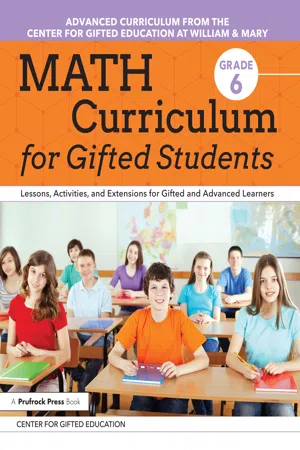
Math Curriculum for Gifted Students
Lessons, Activities, and Extensions for Gifted and Advanced Learners: Grade 6
- 272 pages
- English
- ePUB (mobile friendly)
- Available on iOS & Android
eBook - ePub
Math Curriculum for Gifted Students
Lessons, Activities, and Extensions for Gifted and Advanced Learners: Grade 6
About this book
Information
SECTION III
Expressions and Equations
LESSON 3.1
Working With Exponents and Exponential Expressions
DOI: 10.4324/9781003236429-14
Estimated Time
- 60–90 minutes
Key Terms
- Expression
- Exponent
- Equivalent
Materials
- Lesson 3.1 Activity: Power of a Collage
- Lesson 3.1 Expression Brainstorm Sheet
- Lesson 3.1 Practice: Exponential Expressions
- Lesson 3.1 Assessment Practice
- Old magazines/newspapers or construction paper
- Blank paper (any size is fine; the larger the size, the longer the activity)
Objectives
In this lesson, students will:
- write mathematical expressions using exponents.
Lesson 3.1 Activity: Power of a Collage
This lesson provides a way for students to use exponents in expressions. Students will begin by dividing their blank sheet of paper (it can be as large or as small as you want) into four equal boxes. Students will write a single-digit number, a two-digit number, a three-digit number, and a four-digit number on the paper. Each number goes into the center of one of the four boxes until all four boxes have a number. Then, students will brainstorm ways to write exponential expressions to represent each of the four numbers. Students should record these on the Brainstorm Sheet. Every term in the expressions needs to be written as a whole number exponent, and students should use all four basic operations in their expressions. For example, if one of the numbers in a box is 3, some possible expressions the students could use would be 22 -60 or p2 ÷ 33.
Once students have brainstormed all of their expressions, they should begin forming the expressions and pasting them in the boxes around their numbers. Students can either cut the expressions out of construction paper or cut out the necessary numbers from the magazines or newspapers. Because operation signs might be scarce, encourage students to use key operational words in their expressions or create their own operation signs to add to their expressions. These expressions should be pasted around the numbers in the boxes as a collage. All of the expressions should simplify to the number in the center of each box.
NAME: _____________________________________________________________________ DATE: ____________________
LESSON 3.1 ACTIVITY Power of a Collage
Directions: How many different ways are there to write a number? In this activity, you will represent numbers by writing operations with different bases and exponents.
- Fold your paper so that it is divided into four equal boxes.
- Choose a single-digit number and write it in the middle of one of the rectangles. Do the same for a two-digit, three-digit, and four-digit number.
- Think of different ways you can use exponents in operations to come up with the four numbers that you have written. Brainstorm as many of these ways as possible. For example, the number 1 can be written as 22 -31 or 42 ÷ 24
- After you have brainstormed and have written a number of expressions on the brainstorm sheet, begin cutting out numbers from your magazines or newspapers and construct the expressions using these cutouts. The different operation signs may be difficult to find in magazines and newspapers, so you can find word equivalents. For example, you could find “minus” or “less” to indicate subtraction.
- Paste these expressions into each of the different squares to create a collage of equivalent exponential expressions.
Extend Your Thinking
- Create flash cards for your partner. On each flash card, write three exponential expressions where you are operating with exponents. All three of these expressions, though different, should equal the same integer. Write that integer on the back of your card as the answer. Show the card(s) to your partner and ask them to figure out the answer on the back by solving the three expressions on the front.
- Have a classmate or your teacher give you two different fractions. Your challenge is to write a division and multiplication expression that equal each of the two fractions. The expressions need to use exponents where a fraction is the base of the exponent. For example, if my fraction is , one of my expressions might be . The exponent can be 1.
NAME: _____________________________________________________________________ DATE: ____________________
LESSON 3.1 Expression Brainstorm Sheet
Directions: Write your one-, two-, three-, and four-digit numbers in the correct area and brainstorm different ways to write them using exponents.
| One-digit: ____... |
Table of contents
- Cover
- Half Title
- Title Page
- Copyright Page
- Table of Contents
- Introduction
- Section I: Ratios and Proportional Relationships
- Section II: The Number System
- Section III: Expressions and Equations
- Section IV: Geometry
- Section V: Statistics and Probability
- Answer Key
- About the Authors
- About the Center for Gifted Education
- Common Core State Standards Alignment
Trusted by 375,005 students
Access to over 1.5 million titles for a fair monthly price.
Study more efficiently using our study tools.
Frequently asked questions
Yes, you can cancel anytime from the Subscription tab in your account settings on the Perlego website. Your subscription will stay active until the end of your current billing period. Learn how to cancel your subscription
No, books cannot be downloaded as external files, such as PDFs, for use outside of Perlego. However, you can download books within the Perlego app for offline reading on mobile or tablet. Learn how to download books offline
Perlego offers two plans: Essential and Complete
- Essential is ideal for learners and professionals who enjoy exploring a wide range of subjects. Access the Essential Library with 800,000+ trusted titles and best-sellers across business, personal growth, and the humanities. Includes unlimited reading time and Standard Read Aloud voice.
- Complete: Perfect for advanced learners and researchers needing full, unrestricted access. Unlock 1.5M+ books across hundreds of subjects, including academic and specialized titles. The Complete Plan also includes advanced features like Premium Read Aloud and Research Assistant.
We are an online textbook subscription service, where you can get access to an entire online library for less than the price of a single book per month. With over 1.5 million books across 990+ topics, we’ve got you covered! Learn about our mission
Look out for the read-aloud symbol on your next book to see if you can listen to it. The read-aloud tool reads text aloud for you, highlighting the text as it is being read. You can pause it, speed it up and slow it down. Learn more about Read Aloud
Yes! You can use the Perlego app on both iOS and Android devices to read anytime, anywhere — even offline. Perfect for commutes or when you’re on the go.
Please note we cannot support devices running on iOS 13 and Android 7 or earlier. Learn more about using the app
Please note we cannot support devices running on iOS 13 and Android 7 or earlier. Learn more about using the app
Yes, you can access Math Curriculum for Gifted Students by Center for Gifted Education in PDF and/or ePUB format, as well as other popular books in Education & Teaching Mathematics. We have over 1.5 million books available in our catalogue for you to explore.