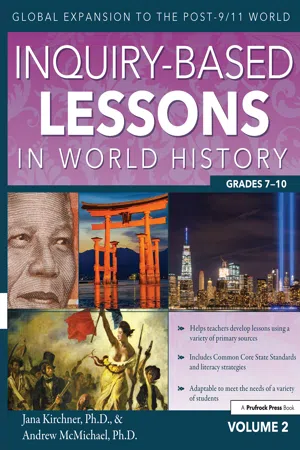
Spanning the time period from 750 CE to the present day, Inquiry-Based Lessons in World History (Vol. 2) focuses on creating global connections between people and places using primary sources in standards-based lessons. With sections on the world in transition, the era of revolutions, imperialism and global war, and the modern world, this book provides teachers with inquiry-based, ready-to-use lessons that can be adapted to any classroom and that encourage students to take part in the learning process by reading and thinking like historians. Each section contains chapters that correspond to the scope and sequence of most world history textbooks. Each inquiry lesson begins with an essential question and connections to content and literacy standards, followed by primary source excerpts or links to those sources. Lessons include step-by-step directions, incorporate a variety of literacy strategies, and require students to make a hypothesis using evidence from the texts they have read.
Grades 7-10
eBook - ePub
Inquiry-Based Lessons in World History
Global Expansion to the Post-9/11 World (Vol. 2, Grades 7-10)
- 268 pages
- English
- ePUB (mobile friendly)
- Available on iOS & Android
eBook - ePub
Inquiry-Based Lessons in World History
Global Expansion to the Post-9/11 World (Vol. 2, Grades 7-10)
About this book
Information
750-1500
PART I
THE WORLD IN TRANSITION
DOI: 10.4324/9781003235804-2
CHAPTER 1
KINGDOMS OF ASIA AND AFRICA
Whenever I can find the time, I read history books and the classics so as to avoid idle living. I constantly remind myself that the world is so vast and state affairs so important that I cannot succumb to laziness and complacency for even a moment. Once one has succumbed to laziness and complacency, everything will become stagnant.
—Yongle Emperor (1360-1424)
HISTORICAL CONTEXT: WHAT DO I NEED TO KNOW?
In 1324, Emperor Mansa Musa of Mali made the pilgrimage to Mecca that is expected of all good Muslims. His caravan left from the east coast and crossed 3,500 miles of Central Africa. Emperor Musa's pilgrimage created quite a stir because of its remarkable size and wealth, and he is still listed as the wealthiest person in history. Not much is known about Musa's life, other than that he succeeded to the throne after his father took a fleet of ships to try to discover the edge of the world and never returned. Musa's journey to Mecca, though, had a massive effect on the economies in Africa and Arabia. He brought some 60,000 people on his journey, including a reported 12,000 slaves who each carried several pounds of gold. Some five dozen camels carried massive bags of gold dust. Musa distributed so much gold to the poor along the way that he single-handedly disrupted the economies of those regions.
DOI: 10.4324/9781003235804-3
The empire that Musa ruled was one of the largest West Africa has ever seen. As in the Babylonian and Roman Empires, the Malian government was decentralized, relying on local villages and districts to collect taxes and supply men for the army. Mali's wealth was established through a combination of gold mining and tribute collected from Musa's large empire, as well as connections to Middle Eastern and African trade networks, including trade in slaves. The majority of the wealth in the kingdom came from its position as a center of trade, and from taxing the cross-Sahara trade that ended at Timbuktu. Likewise, gold was common in Mali—so much so that gold dust was a standard currency. Salt also served as currency.
Emperor Musa's effect on Europe was just as profound as his pilgrimage was to Africa. Stories about African riches spread throughout the Mediterranean, and pictures in maps and atlases illustrate their impact. One map, called the Catalan Atlas of 1375, left most of Africa undefined but gave the Mali Empire a prominent position, showing Emperor Musa himself seated on an ornate throne, holding a scepter in one hand and a huge gold nugget in the other. By the 14th century, European merchants' manuals often included more information about Africa than about Europe.
In China, the Ming Dynasty succeeded the Yuan Dynasty in 1368. Under the Ming Dynasty, China saw, if not a golden age, then certainly a series of cultural achievements that have lasted well into the modern era. Born out of what might be considered an ethnic rebellion, the Han-dominated Ming overthrew the Mongol Yuan in 1368 and immediately consolidated rule by securing borders and towns, as well as through a purging of non-Han ethnic peoples in the government. The reorganization outlasted the Ming Empire itself as the administration of 13 provinces with prefectures, subprefectures, and counties became much more stable and efficient. This became the model for modern- day Chinese governmental organization.
The Ming Dynasty saw a number of long-lasting contributions to Chinese and world history, including a resurgence of art that remains culturally significant to this day. Artists known as the "Four Masters of the Ming Dynasty" created works of varied styles, from unadorned landscapes, to landscapes coupled with lyrical poetry, to calligraphy, to images of gardens, flowers, and religious figures. Art during the Ming period was considered so culturally relevant that artists could earn a living through patronage or by selling their pieces at very high prices. The greatest extent of the Great Wall of China, with more than 5,000 miles and around 25,000 watchtowers, was built between 1368 and 1644. The Yongle Emperor (1402-1424) also established Beijing as the capital of China, and constructed China's famous Forbidden City, which served as the imperial palace from 1420-1912. The Yongle Emperor sent the admiral Zheng He and a fleet of ships on a series of voyages around the Indian Ocean, the coast of Africa, and the coasts of Thailand, Java, and Arabia.
In 1578, Li Zhizhen finished work on Bencao Gangmu, or the Compendium of Materia Medica. Considered the most complete and authoritative book on traditional Chinese medicine, the Compendium describes almost anything found in nature that could have medicinal properties. It also contains instructions, with colorized illustrations, for mixing and administering herbal cures. The greater value of the tome, which is still in use, is as a resource for insight into Ming-era understandings of the natural world. Color illustrations were made possible by important advances in Chinese woodblock printing techniques during this period. The scholar Hua Sui developed China's first metal movable type printing in 1490, seemingly independent of a similar Korean invention in the 1200s, and the European invention in 1450. Metal type greatly facilitated the spread of literature throughout the dynasty. In 1408, some 2,000 scholars completed the more than 11,000-page volume Yongle Encyclopedia, the largest print encyclopedia in the world. Unlike the Compendium, the encyclopedia was handwritten and not widely distributed, and only a small portion survives.
Japan had been undergoing a similar transformation. The year 1185 saw the beginning of what is known as the Kamakura Period of Japanese history. Although important for the development of a more complex and diverse form of Buddhism, known as "New Buddhism," the Kamakura period is more well-known for the Kamakura Shogunate, a time when the government was characterized by a feudal system headed by a shogun, or military dictator who replaced the emperor and local administrators. Under the shogunate, a single military ruler, or shogun, used de facto military occupation to enforce the law. The emperor remained but had little more than symbolic authority. The shogun usually delegated regional authority—including taxation, law enforcement, judicial affairs, and defense—to local lords called daimyō in return for loyalty and service. The shogun class, a military class made up of local nobility trained as officers in the local armies, sat underneath the shogun and the daimyō in this hierarchy.
There had been a samurai class since the 700s, and as their numbers grew, they formed into larger groups, and eventually began to elect a head of their group. The Kamakura Shogunate saw the consolidation of power for samurai and shoguns, and the political and cultural dominance of the samurai. Under the influence of Zen Buddhism and Shinto, the samurai developed a code of conduct and system of beliefs that focused on warrior ideals, ritual, and bravery. Above all, the warrior was to be completely devoted to, and to be willing to sacrifice his life for, his master. Although the Kamakura period would come to an end in 1333, the feudal shogun system would endure until 1868, when it was replaced with a government ruled by the Emperor and deliberative assemblies as well as an expansion of the empire.
STANDARDS ADDRESSED IN THE CHAPTER
NCHS World History Content Standards, Grades 5-12:
- ■ Era 4—Standard 3B: The student understands developments in Japan, Korea, and Southeast Asia in an era of Chinese ascendancy.
- ■ Era 5—Standard 1A: The student understands China's extensive urbanization and commercial expansion between the 10th and 13th centuries.
- ■ Era 5—Standard IB: The student understands developments in Japanese and Southeast Asian civilization.
- ■ Era 5—Standard ID: The student understands how interregional communication and trade led to intensified cultural exchanges among diverse peoples of Eurasia and Africa.
- ■ Era 5—Standard 4A: The student understands the growth of imperial states in West Africa and Ethiopia.
CCSS for Literacy in History/Social Studies, Grades 6-8 and 9-10:
- ■ 6-8: Cite specific textual evidence to support analysis of primary and secondary sources; Determine the central ideas or information of a primary or secondary source; Integrate visual information (e.g., in charts, graphs, photographs, videos, or maps) with other information in print and digital texts; Conduct short research projects to answer a question (including a self-generated question); Draw evidence from informational texts to support analysis, reflection, and research.
- ■ 9-10: Determine the central ideas or information of a primary or secondary source; Cite specific textual evidence to support analysis of primary and secondary sources, attending to such features as the date and origin of the information; Conduct short as well as more sustained research projects to answer a question (including a self-generated question) or solve a problem; Draw evidence from informational texts to support analysis, reflection, and research.

LESSON 1
ORGANIZING QUESTION
How did Mansa Musa build a powerful kingdom in Mali during the 14th century?
STRATEGIES USED
Brainstorming, Clue Stations
MATERIALS NEEDED
- Handout 1.1: Clue Stations
- The following clues placed around the room in clue stations (Note: Depending on the number of students in your class, you may set up two of each station to allow easier access and keep students on task):
- ✓ Station 1—Atlas: Two versions of Abraham Cresques's Catalan Atlas: the entire atlas picture (available at https://upload.wikimedia.org/wikipedia/commons/3/35/1375_Atlas_Catalan_Abraham_Cresques.webp) and a close image of West Africa and Mansa Musa (available at https://commons.wikimedia.org/wiki/File:Catalan_Atlas_BNF_Sheet_6_Mansa_Musa.webp)
- ✓ Station 2—Travel account: Arab historian Chihab Al-Umari's account of Mansa Musa's visit to Cairo, available at http://www.digitalhistory.uh.edu/active_learning/explorations/1492/mansa_musa_visit.cfm
- ✓ Station 3—Map: Timbuktu: A Center for Trade, available at https://malitradevseuropeantrade.weebly.com/uploads/1/5/2/2/15224772/709840085_orig.webp
- ✓ Station 4—Photographs: The Djinguereber Mosque in Timbuktu and the University of Sankore, available from several websites
- ✓ Station 5—Textbooks, encyclopedias, or computers for student research on Mali and Mansa Musa
LESSON PLAN
Lesson Hook: Brainstorming—Ask students to image that they are a king in the 14th century and want to build a powerful kingdom that is respected by other countries. Give them 2 minutes to brainstorm any strategies they can think of for creating this empire. You may need to prompt them to think about government, economics, a military, or other important elements. Ask them to share their ideas and look for patterns or themes that may emerge. Write these ideas on the board to use at the end of the lesson.
The Organizing Question: Explain to students that they are going to look at a variety of primary and secondary sources (clues) around the room to learn about Mansa Musa, a 14th-century African king, to determine answers to the organizing question: How did Mansa Musa build a powerful kingdom in Mali during the 14th century?
Examine the Sources: Clue Stations—Divide the class into groups of 3-4 students and distribute Handout 1.1:Clue Stations. If students are not used to independently analyzing source...
Table of contents
- Cover
- Half Title
- Title Page
- Copyright Page
- TABLE OF CONTENTS
- INTRODUCTION
- PART I: THE WORLD IN TRANSITION: 750-1500
- PART II: AN ERA OF REVOLUTIONS: 1500-1860
- PART III: IMPERIALISM AND GLOBAL WAR: 1860-1945
- PART IV: THE MODERN WORLD: 1945-PRESENT
- REFERENCES
- STUDENT HANDOUT RESOURCES
- ABOUT THE AUTHORS
- COMMON CORE STATE STANDARDS ALIGNMENT
Trusted by 375,005 students
Access to over 1.5 million titles for a fair monthly price.
Study more efficiently using our study tools.
Frequently asked questions
Yes, you can cancel anytime from the Subscription tab in your account settings on the Perlego website. Your subscription will stay active until the end of your current billing period. Learn how to cancel your subscription
No, books cannot be downloaded as external files, such as PDFs, for use outside of Perlego. However, you can download books within the Perlego app for offline reading on mobile or tablet. Learn how to download books offline
Perlego offers two plans: Essential and Complete
- Essential is ideal for learners and professionals who enjoy exploring a wide range of subjects. Access the Essential Library with 800,000+ trusted titles and best-sellers across business, personal growth, and the humanities. Includes unlimited reading time and Standard Read Aloud voice.
- Complete: Perfect for advanced learners and researchers needing full, unrestricted access. Unlock 1.5M+ books across hundreds of subjects, including academic and specialized titles. The Complete Plan also includes advanced features like Premium Read Aloud and Research Assistant.
We are an online textbook subscription service, where you can get access to an entire online library for less than the price of a single book per month. With over 1.5 million books across 990+ topics, we’ve got you covered! Learn about our mission
Look out for the read-aloud symbol on your next book to see if you can listen to it. The read-aloud tool reads text aloud for you, highlighting the text as it is being read. You can pause it, speed it up and slow it down. Learn more about Read Aloud
Yes! You can use the Perlego app on both iOS and Android devices to read anytime, anywhere — even offline. Perfect for commutes or when you’re on the go.
Please note we cannot support devices running on iOS 13 and Android 7 or earlier. Learn more about using the app
Please note we cannot support devices running on iOS 13 and Android 7 or earlier. Learn more about using the app
Yes, you can access Inquiry-Based Lessons in World History by Jana Kirchner,Andrew McMichael in PDF and/or ePUB format, as well as other popular books in Education & Education General. We have over 1.5 million books available in our catalogue for you to explore.