Even with increased pressure to involve more girls in STEM areas in education, parents are often left wondering what they can do to keep their daughter's love of science, math, and technology from fading. In Breaking Through! Helping Girls Succeed in Science, Technology, Engineering, and Math, topics ranging from how role models can make a difference to finding nonstereotypical toys and taking trips that inspire STEM discovery and engagement are illustrated with research evidence and real-life examples from girls and women. Regardless of a daughter's age (from birth to young adulthood), parents will find tips they can immediately use to help combat the gender imbalance in STEM areas. Whether they need to advocate for gender-neutral, STEM-enriched classrooms or want to encourage creative problem solving and persistence in their daughters, readers will find ideas to take action to help the girls in their lives break through the barriers and achieve success in STEM.
2017 NAGC Book of the Year Award Winner
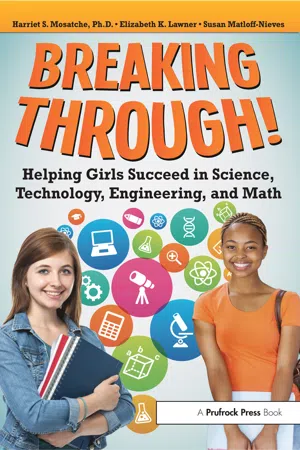
eBook - ePub
Breaking Through!
Helping Girls Succeed in Science, Technology, Engineering, and Math
- 290 pages
- English
- ePUB (mobile friendly)
- Available on iOS & Android
eBook - ePub
Breaking Through!
Helping Girls Succeed in Science, Technology, Engineering, and Math
About this book
Information
SECTION I
Introduction
DOI: 10.4324/9781003233374-1
Just a few years ago, if the acronym STEM had appeared in the title of a newspaper article, some might have speculated that a new government agency had just been established. And if the term STEM had been used in conversation, many people would have been puzzled, wondering why the discussion suddenly included a reference to the stalk of a plant. Today, however, STEM is widely used and understood, a reflection of the growing recognition of the critical importance of science, technology, engineering, and math for dealing with the complex issues that face us.
We hear about STEM breakthroughs almost every day. Yet women face obstacles in breaking through in certain STEM fields and in reaching leadership positions. This book describes the obstacles that have prevented females’ full participation in STEM, but also focuses on the actions we can all take to make sure that girls have opportunities to be successful. Not only do an increasing number of jobs require knowledge of and experience with STEM fields and methods, but most aspects of everyday life rely on some degree of competence in those same areas. STEM provides us with a framework for understanding and interpreting the world and offers the opportunity for lifelong enrichment and engagement with learning, cultivating an attitude of curiosity and a sense of wonder.
"STEM is important for every person, not just girls, because so much of our society is based on STEM principles and ideas. There's so much technology in our world. There are issues that we vote on, even hearing the news, that require an understanding of science and engineering."
—Stacy Klein-Gardner, Ph.D., director of the Center for STEM Education for Girls at the Harpeth Hall School and faculty member in biomedical engineering and radiology at Vanderbilt University
CHAPTER 1
STEM—Critical to the World, Crucial to Your Daughter's Future
DOI: 10.4324/9781003233374-2
"I love that I can take a property that was completely derelict and return it to function. I do the construction draws for all of our projects. I love seeing new homeowners walk into their house for the first time after it has been completed."
—Nancy Hohmann, construction engineer, Director of Development for Lemay Housing Partnership, Missouri
On a typical day, you may use your smartphone to set an alarm, calculate a tip at a restaurant, and send a text to your best friend. Using your laptop computer or tablet, you might keep a budget on a spreadsheet, pay your bills online, and check out the latest photos posted by your cousin. You may not understand all aspects of the technology you’re using, but they have become an integral part of your everyday life.
When the news covers climate change, an oil spill, the dangerous condition of a local bridge, or the beginning of clinical trials for a new drug, your knowledge of STEM allows you to understand the information and to make educated decisions about your actions. You use math skills to decide which size breakfast cereal is the best buy at the grocery store, and your engineering know-how empowers you to fix a leaking toilet. When you integrate STEM experiences into your child’s life, you will find your own life enriched by being exposed to discoveries that have pushed the frontiers of knowledge.
The Broad Reach of STEM
More and more people are working for companies that are directly related to science, technology, engineering, and math. In 2015, General Electric employed 307,000 people in 170 countries around the world, while 55,000 people were working at Google and 98,000 at Apple. Pharmaceutical companies employ more than 800,000 people; in 2015, Johnson & Johnson and Novartis each employed more than 120,000 individuals. Companies such as Estee Lauder, Avon, and L’Oreal, which focus on the development of beauty products and cosmetics, employ thousands of chemists to create and test their products.
"I was ambitious and created drawings for the construction of chemical plants. Because I was involved in manufacturing, I had the opportunity to visit other countries. At one point, I was the chief negotiator and spent a lot of time as a project manager. What I really enjoyed about my work was the opportunity to keep learning new things, to be challenged, to keep thinking. That made life more colorful."
—Zihui Feng, retired chemical engineer from Shanghai
Numerous federal government agencies focus on STEM-related endeavors. One of the largest is the National Institutes of Health (NIH), which is made up of 27 institutes and centers, each focusing on particular diseases or body systems. NIH employs 6,000 scientists at its main campus in Bethesda, MD, and also funds the research of an additional 300,000 people at more than 2,500 universities. For example, scientist Nina Papavasiliou of Rockefeller University received an NIH grant in 2014 to create vaccines that act by stimulating a strong antibody response against specific targets, such as protein aggregates in Alzheimer’s disease.
The National Science Foundation (NSF) is made up of seven research directorates and four research offices. While about 1,700 people work directly for NSF, about 2,000 universities, nonprofit organizations, schools, and businesses receive research grants from NSF annually. NSF uses the term STEM to include the fields of biology, computer and information science, mathematics, chemistry, physics, environmental science, psychology, social science (economics, sociology, anthropology, and political science), and engineering (NSF, 2015). That is the definition we use in this book.
With funding from NSF starting in 2009, industrial and systems engineers Julie Ivy, Irem Sengul, and Reha Uzsoy from North Carolina State University and Lauren Davis from North Carolina A&T State University teamed up with two major food banks to develop more effective processes for serving more than a half million people (meaning less waste and greater ability to reach those in more secluded areas). Researcher Lara Estroff, who received an NSF Faculty Early Career Development award, studies the role of crystals in gel formation in her lab at Cornell University. Applications for her work include the manufacturing of improved drugs and the production of biomaterials for bone and tooth repair.
Start-up tech companies and new technologies emerge almost every day. Facebook didn’t make its appearance until 2004, Twitter in 2006, the global app-based taxi company Uber in 2009, and transportation network company Lyft in 2012. But these companies and others like them are already having a profound impact on the way we work, communicate, travel, and play. People who work in STEM-related jobs make all of the following possible: new drugs to fight debilitating illnesses; innovative processes to aid those with disabilities; ingenious discoveries to make driving, flying, and even playing sports safer; apps that make businesses run more efficiently; and medical devices and procedures to more effectively prevent, screen, and treat diseases.
"Throughout my career, I have been involved in executive education programs helping executives understand technology trends and how the effective use of technology can help improve the bottom line. What I loved most was exposing students and clients to prototypic technology that was just being developed."
—Michele W., executive consultant, New York
The Importance of Diversity
As far back as 1999, William Wulf, then president of the National Academy of Engineering, noted that increasing diversity in that field was not just a matter of increasing fairness (although that is always an important consideration), but also a matter of increasing the understanding of problems and the development of creative solutions (Lazowska, 2014). Fields in STEM, such as engineering and computer science, in which females are underrepresented, would benefit by bringing more diversity of thinking into the workplace. An analysis by Dezso and Ross (2012), using 15 years of data of management teams from top companies, revealed that gender diversity increased managerial performance when the companies focused on innovation. In reviewing decades of research, Phillips (2014) noted that diversity of all kinds (including gender and ethnic background) is an important ingredient in the quality of decision making and problem solving because people from different groups contribute varying perspectives.
"Not many women want to take a job where they are the only female employed. Not balancing sadly means a company will miss out on hiring some incredible women, and the world will miss out onsome awesome scientific developments as great women's minds turn to other fields."
—Patty Laughlin, retired medical technologist and Microsoft-certified engineer, Missouri
Tragic examples abound of mistakes made when females were not part of teams in science and engineering. For decades, women were underrepresented as subjects in important medical studies, such as those done on heart disease, because male scientists didn’t consider that diseases might manifest themselves differently in women and that treatments developed for male patients might not work the same way for women. Generations of doctors were trained to look for symptoms that applied more to men than to women, and treatments were typically designed for men but used by women, too. The outcome of this inequity was that, for many years, women’s heart disease was likely to be inadequately diagnosed and treated. Another example was described by the American Association of University Women (Hill, Corbett, & Rose, 2010): A largely male engineering team designed the first car air bags but did not take into account the smaller stature of children and females, resulting in unnecessary injuries and even deaths.
"If we have different viewpoints, not just men and women, but also different races and sexual orientations, you're ultimately going to make a better product. That is especially true if you're going to market that product to a wide range of people—sales will definitely increase."
—Christine Doherty, physiology and neurobiology major at the University of Connecticut.
When women are not fully represented and engaged in STEM workplaces, progress cannot possibly happen as quickly or as well. Questions that women might ask are not raised. Analyses that women might suggest are not conducted. It is not just women who lose out. Everyone does.
Where the Opportunities Are
In certain areas of STEM, such as computer science, job growth is occurring at such a high rate that the United States is unable to keep up with the demand, and filling those jobs often means outsourcing to skilled individuals from other countries. In fact, according to a 2012 report by the President’s Council of Advisors on Science and Technology, economic projections indicate that over a 10-year period, the United States will fall short of meeting its need for STEM professionals by one million, and in order to meet that need, the number of undergraduates earning degrees in STEM would need to increase by 34%. That means that if your daughter decides to major in a STEM field, she will have many job opportunities to choose from. Moreover, because STEM professions often provide higher salaries than other jobs requiring the same degree of experience and education, when women enter those jobs they and their families are able to enjoy greater financial well-being. In addition, one study found that women in STEM fields actually had more flexible work hours and worked less over the typical 40 hours per week than women in non-STEM professional and managerial jobs (Glass, Sassler, Levitte, & Michelmore, 2013).
But the higher compensation for women pursuing STEM careers and the improved strategic benefits for companies that are more gender balanced do not tell the full story. Ensuring full participation in STEM is urgent for all girls, not just those who will pursue higher education and careers focused primarily in a STEM field. STEM provides us with essential tools to understand our world. Consider how important it is for girls to develop the following skills: thinking critically, revising processes when results are not achieved, interpreting and analyzing data, and using scientific inquiry to systematically weigh options when making decisions. These are all aspects of STEM learning that will allow girls to more effectively navigate through the decisions and actions that are part of growing up.
Beyond the practical applications, engaging in STEM activities can enrich our daughters’ lives by providing them with creative outlets (ranging from making an animated movie to creating a garden with the kinds of flowers and plants that attract certain birds or butterflies), giving them access to a community of interesting people (whether they’re attending a summer camp or participating in a virtual event), and discovering the answers to questions about the world (encompassing activities from researching the weather to using statistics to predict which team will win a basketball championship).
"There are few careers today that don’t require the basics of STEM. We need to encourage our daughters to stay in these classes at least through high school by helping them deal with any adverse social repercussions of doing so to make sure their world is not limited. My career has focused on the intersection of customers, marketing, and technology. STEM taught me critical, logical thinking, which is the core transferable skill. The scientific method is a great foundation for any analytically driven pursuit. In the war for talent, we need to embrace diversity of thinking of all kinds to get the best possible answers."
—Katrina Lane, Ph.D. in experimental physics, vice-president of Global Delivery Experience, Amazon
This book invites you, as a parent (or a girl’s primary caregiver or another adult important in a child’s life) to play a role in not just influencing your daughter’s school and career path, but in transforming the broader world of education, business, healthcare, and the media in a way that will improve the lives of all of our daughters—and sons. Use the quotations, profiles, and activities in Breaking Through! to strengthen your advocacy for girls as well as your daughter’s excitement about STEM. Share the information about programs, services, and other resources with your friends and your daughter’s teachers. Transforming girls’ participation in STEM is not a short-term endeavor; it requires a strong and lengthy commitment, which we hope you are ready to make. It is also a joyous journey that will expand your own horizons.
CHAPTER 2
Gender Diversity in STEM
The Changing Landscape
DOI: 10.4324/9781003233374-3
"I knew that engineering was a male dominated and very demanding field. It wasn’t until I started college that I realized how true this is. There have been times when I have been working with males on projects and have been questioned about whether I was sure I was right. It’s tough when they’re basically questioning you just because you’re a female."
—Amanda McKnight, student majoring in chemical engineering and chemistry at College of New Haven
Historically, women have made significant contributions and discoveries in STEM fields. Women have persisted in spite of obstacles, sustained by their love of the work and the excitement of discovery. Although her name may not ring a bell for most people, British mathematician Ada Lovelace created the first computer algorithm way back in 1842. In the 1950s, Rosalind Franklin made the si...
Table of contents
- Cover
- Half Title
- Title Page
- Copyright Page
- Table of Contents
- Acknowledgments
- Section 1 Introduction
- Section II What the Research Tells Us About Obstacles and Opportunities
- Section III How Can We Transform the Picture of Girls and Women in STEM?
- Section IV Time for Action: Activities and Guidelines
- Section V Advocating in the Educational System
- Section VI Advising Your Daughter in College and Beyond
- References
- About the Authors
Trusted by 375,005 students
Access to over 1.5 million titles for a fair monthly price.
Study more efficiently using our study tools.
Frequently asked questions
Yes, you can cancel anytime from the Subscription tab in your account settings on the Perlego website. Your subscription will stay active until the end of your current billing period. Learn how to cancel your subscription
No, books cannot be downloaded as external files, such as PDFs, for use outside of Perlego. However, you can download books within the Perlego app for offline reading on mobile or tablet. Learn how to download books offline
Perlego offers two plans: Essential and Complete
- Essential is ideal for learners and professionals who enjoy exploring a wide range of subjects. Access the Essential Library with 800,000+ trusted titles and best-sellers across business, personal growth, and the humanities. Includes unlimited reading time and Standard Read Aloud voice.
- Complete: Perfect for advanced learners and researchers needing full, unrestricted access. Unlock 1.5M+ books across hundreds of subjects, including academic and specialized titles. The Complete Plan also includes advanced features like Premium Read Aloud and Research Assistant.
We are an online textbook subscription service, where you can get access to an entire online library for less than the price of a single book per month. With over 1.5 million books across 990+ topics, we’ve got you covered! Learn about our mission
Look out for the read-aloud symbol on your next book to see if you can listen to it. The read-aloud tool reads text aloud for you, highlighting the text as it is being read. You can pause it, speed it up and slow it down. Learn more about Read Aloud
Yes! You can use the Perlego app on both iOS and Android devices to read anytime, anywhere — even offline. Perfect for commutes or when you’re on the go.
Please note we cannot support devices running on iOS 13 and Android 7 or earlier. Learn more about using the app
Please note we cannot support devices running on iOS 13 and Android 7 or earlier. Learn more about using the app
Yes, you can access Breaking Through! by Harriet S. Mosatche,Elizabeth Lawner,Susan Matloff-Nieves in PDF and/or ePUB format, as well as other popular books in Education & Education General. We have over 1.5 million books available in our catalogue for you to explore.