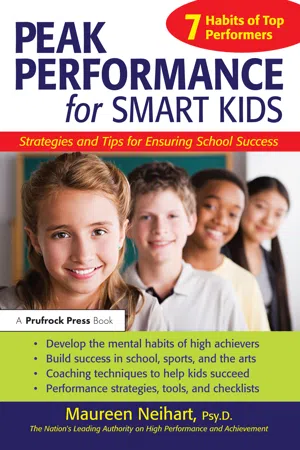
Peak Performance for Smart Kids provides success strategies, activities, tools, real-life examples, and checklists for parents to employ to help their kids to achieve their highest potential. Even the most talented child will not succeed if he or she has not developed the mental, psychological, and emotional skills to face the heavy demands of high performance. Maureen Neihart, a psychologist and leading authority on talent development in children, examines seven mental habits of successful kids, providing practical approaches for developing them in talented children of all ages in this easy-to-read guide for parents and teachers.
By working with parents to complete the activities included in this book, high-ability kids will learn to manage stress and anxiety, set and achieve goals, use mental rehearsal to improve performance, manage their moods and emotions, practice optimistic thinking, and resolve their frustrations of needing to belong while needing to achieve. With its research-based strategies and unique approach to maximizing potential, this is a book from which every parent of smart kids can benefit!
Educational Resource
eBook - ePub
Peak Performance for Smart Kids
Strategies and Tips for Ensuring School Success
- 198 pages
- English
- ePUB (mobile friendly)
- Available on iOS & Android
eBook - ePub
About this book
Information
1
What Do Coaches, Athletes, and Performing Artists Know That We Don’t?
DOI: 10.4324/9781003237068-1
IN my 30 years of working with talented children and their families, I have met many capable children who struggled to realize their promise. The challenges they faced often were not due to their lack of motivation or to lack of support from their parents. The difficulties they had were common to every child who pursues a passion. They didn’t have the mental skills to stay at the top of their game. They didn’t know how to play the inner game of high achievement.
No one taught them.
I suspect that there are many more children out there just like them, kids who are talented, eager, and in love with something. Perhaps you’re the parent of one. The challenges I’ve seen other children face may be similar to those you’re facing with your children:
She used to really enjoy ice skating, but now … there’s so much pressure. She can’t handle it. It’s not fun anymore. She says she wants to do other things.We’ve seen big changes since she hit puberty. She’s really torn between doing what she loves and doing the things her friends are doing. We hate to see her give up on her dreams.There’s a lot of pressure on boys in our neighborhood. Pressure not to study, to not take school seriously. It’s getting harder for him to stay in the accelerated classes. He gets teased a lot.He does well, but he gets terribly frustrated when things don’t come easily. He cries and wants to give up. There are lots of things in life that don’t come easily. How can we help him learn to persevere?His anger gets the best of him when he’s stressed. He hasn’t learned how to keep his cool.All of our kids are very motivated to work hard. We’re thankful! But it is tough at times to keep up with them all. It’s stressful on our family. We don’t want to lose our focus on the most important things.
There is a level of achievement at which further talent development takes more than ability and hard work. It requires psychological preparedness—mental and emotional skills that drive performance. Many of the most capable children will eventually fail to realize their potential if no one teaches them the inner game of high achievement.
Psychological preparedness may be the single most neglected component of talent development, even though you and I, and your children’s teachers and coaches, would all agree it’s a pivotal factor in any achievement.
There are seven mental competencies that drive performance:
- a tolerance for stress or anxiety,
- a willingness to work at the edge of one’s competence (risk-taking),
- SMART goal setting,
- mental rehearsal,
- optimism,
- mood management, and
- an ability to resolve the need to belong with the need to achieve.
These are the skills that keep our focus sharp, order our attention, and keep us engaged in the learning process. I call these the seven psychological skills of high performance, or the inner game of high achievement.
They are not innate, but can be trained. If we want to help children realize their potential, we need to be intentional in our efforts to help them learn these mental skills for high performance.
It doesn’t matter if your children are 6 or 16, if they love sports or art. Helping them master these seven skills will prepare them to cope with the emotional and mental demands of higher achievement. Mastering these skills for one effort also will help them master them for other challenges ahead.
In the pages that follow we’ll examine each of these skills. We’ll explore how they contribute to high performance, and we’ll have fun doing exercises you can use with your kids. If your children are struggling, this information will provide a detailed blueprint for boosting their performance. If they already are doing very well, this material will help them be able to repeat the best day they’ve ever had.
Let’s take a quick look at each of the seven competencies needed to play the inner game of high achievement. Then, in subsequent chapters, we’ll explore each one in more detail, outlining strategies and supports designed to develop them in children.
Competency #1: An Ability to Manage Stress and Anxiety
Fear often gets in the way of high achievement. As competition intensifies and stakes rise, so do stress and anxiety. Children who have no strategies for keeping a lid on their anxiety will not be able to do their best.
Perhaps you believe that America’s increased emphasis on high-stakes testing and accountability for academic outcomes has increased children’s stress. Whether it has or not, one thing is clear, children who are able to effectively manage their stress, those who can make their stress work for them, are going to achieve more.
The relationship between performance and anxiety has many variations within and across individuals. Some people have a very high tolerance for stress, whereas low levels of stress negatively impact others. Stress motivates some people and paralyzes others. Fear causes some people to step back, while for others it interferes with concentration, attention, or motor control.
It doesn’t matter how much stress a child feels, or how that stress affects him or her, the steps for learning to keep a lid on anxiety and to maintain it at levels that keep you working hard are the same. It’s easy to learn to manage anxiety. It just takes practice. Children simply have to learn how to
- breathe,
- relax, and
- keep moving toward the things that scare them.
These are easy to teach, easy to learn, and with practice, can make an enormous difference in a child’s capacity to work hard toward high goals. I’ll show you how in Chapter 2.
Competency #2: A Willingness to Work at the Edge of One’s Competence
High achievement also requires a willingness to get out of your comfort zone and work at the edge of your competence. A common frustration among parents is children who can but won’t. We know that the best learning takes place when children have to reach for their goals and have the supports in place to accomplish their goals. To improve, children must work at a level that requires them to make an effort, and they must work with others who have similar interests, ability, and drive.
This requires risk.
The further a child moves along the trajectory of achievement, the more uncertain outcomes become. It is impossible to go from good to great without taking realistic risks, without a willingness to move out of one’s comfort zone toward the edge of competence.
Understanding the relationship between risk taking and achievement, and evaluating one’s willingness to work at the edge of competence are the starting points for moving out of one’s comfort zone onto the edge of competence. Children can learn a process that will have them systematically taking realistic risks as part of their learning.
Competency #3: SMART Goal Setting
Because we know that motivation and achievement are affected by goal setting, isn’t it surprising that most of us do little more than give it lip service? Goals affect performance and motivation in three ways. They:
- focus attention,
- influence persistence, and
- energize people.
More difficult goals tend to increase persistence, provided that children have some control over the amount of time they have available to work. More challenging goals tend to lead to higher performance than less challenging goals. That’s one of the reasons why it’s very important to keep your expectations high for your children.
Long-term goals must be broken down so that it’s possible to attain goals fairly quickly and get regular feedback. Children need frequent feedback about their performance toward specific goals in order to adjust their effort or strategy. Without feedback, they have no way of knowing how they are doing.
Goals are most effective when they’re challenging but attainable. Goals that are not accepted by your children probably will not influence their performance positively and may influence it negatively. In some cases, simply assigning a challenging goal can raise a child’s belief in his abilities because it communicates a confidence that he has the ability to accomplish the task.
The acronym SMART stands for specific, measurable, attainable, realistic, and timely. In Chapter 4, we’ll see how you can use it on a daily basis to focus your children on their highest priorities. When children feel excited and empowered to take charge of their learning and their lives, they become much more engaged in the learning process.
Competency #4: Mental Rehearsal
Terry Orlick, a well-known sports psychologist, says that when your performance falls apart, it usually falls apart in your head first. Mental rehearsal means to practice in your mind. Research on mental rehearsal draws three strong conclusions:
- mental rehearsal is better than no practice at all,
- mental rehearsal in combination with physical practice is more effective than either in isolation, and
- mental rehearsal enhances confidence and self-control more than motor tasks.
How many children do you know who would achieve more if they had strong beliefs in themselves and their abilities?
Given the strength of the research findings regarding the benefits of mental rehearsal in some domains, it’s surprising that this skill is not promoted more. The potential benefits for relatively simple, but high-stakes performance tasks such as standardized tests, auditions, or competitions, are obvious.
Mental rehearsal also can help with relatively simple but challenging tasks, like giving an oral presentation or having a difficult conversation. The ability to visualize a desired performance in one’s head improves performance.
Competency #5: Optimism
Why do some talented people persevere through challenges while others give up easily? A key factor is their explanatory style, or how they explain their success and failure. Children who blame themselves for their losses, who catastrophize setbacks, and who think that the causes of disappointments will last forever achieve much less than children who attribute losses to external factors, who limit the effects of setbacks, and who view a disappointment as a challenge to be conquered.
Researchers agree that explanatory style can be shaped. It’s possible to become more optimistic, to learn to bounce back more easily after experiences of failure. To build optimism in our children, we must understand its three dimensions, evaluate our children’s explanatory styles, and use language and exercises that coach kids toward greater optimism.
We begin by introducing the concepts of optimism and pessimism and raising children’s awareness that, just as they have personal preferences for clothing, music, and hair, they also have style preferences for how they think about circumstances in their lives. We teach them how to shape that style with feedback, questions, and activities that provide practice with greater optimism and hope. We show them how to play detective and search for evidence that supports their conclusions or proves them wrong, so that they learn to be more accurate in their perspectives. Most importantly, we evaluate our own explanatory style and adapt our feedback to children so that our comments influence them to think positively about their success and failure experiences.
Competency #6: Mood Management
Did you know that emotions are some of the best predictors of achievement? Mood directly impacts our attention and our ability to control our minds. It shapes our thoughts and our focus. Consistent performance at high levels requires the ability to keep arousal within an optimal zone of functioning for the task.
Elite performers understand their mood very well. They master strategies that enable them to efficiently enter and exit their best mood states in order to give an outstanding performance every time. They typically stick to a strict daily regimen of diet, practice, exercise, rest, and self-talk in order to keep themselves in this zone of optimal functioning. They can’t afford not to.
The role of mood management in achievement has been especially well investigated among athletes and creative achievers. Studies find that people who are consistently highly productive over the long term generally are people who keep themselves free from troubling mood states. They keep themselves in the zone—the zone of optimal functioning.
There is almost as wide of a range of tools for mood management as there are individuals. In minutes you can pass along to your children simple strategies that will help keep them in the mood for work. You can raise your children’s awareness of their own mood patterns and how they relate to their achievement. You can teach them strategies that will maintain their energy and manage their zeal. You can demonstrate simple steps that will sharpen their focus and extend their concentration. You can coach them through small steps that eventually lead to big...
Table of contents
- Cover
- Half Title
- Title Page
- Copyright Page
- Contents
- Foreword
- Chapter 1 What Do Coaches, Athletes, and Performing Artists Know That We Don’t?
- Chapter 2 Learning to Tolerate Stress and Anxiety
- Chapter 3 Out of the Comfort Zone: Moving Your Children to Their Edge of Competence
- Chapter 4 Getting SMARTer About Goal Setting
- Chapter 5 Every Dream Begins With a Picture: Improving Performance With Mental Rehearsal
- Chapter 6 In the Zone: Using Mood Management to Improve Achievement
- Chapter 7 Learning Hope and Optimism
- Chapter 8 Reconciling the Need to Belong With the Need to Achieve
- Chapter 9 The Most Important Thing
- Answer Key
- References
- Selected Research on Peak Performance
- About the Author
Trusted by 375,005 students
Access to over 1.5 million titles for a fair monthly price.
Study more efficiently using our study tools.
Frequently asked questions
Yes, you can cancel anytime from the Subscription tab in your account settings on the Perlego website. Your subscription will stay active until the end of your current billing period. Learn how to cancel your subscription
No, books cannot be downloaded as external files, such as PDFs, for use outside of Perlego. However, you can download books within the Perlego app for offline reading on mobile or tablet. Learn how to download books offline
Perlego offers two plans: Essential and Complete
- Essential is ideal for learners and professionals who enjoy exploring a wide range of subjects. Access the Essential Library with 800,000+ trusted titles and best-sellers across business, personal growth, and the humanities. Includes unlimited reading time and Standard Read Aloud voice.
- Complete: Perfect for advanced learners and researchers needing full, unrestricted access. Unlock 1.5M+ books across hundreds of subjects, including academic and specialized titles. The Complete Plan also includes advanced features like Premium Read Aloud and Research Assistant.
We are an online textbook subscription service, where you can get access to an entire online library for less than the price of a single book per month. With over 1.5 million books across 990+ topics, we’ve got you covered! Learn about our mission
Look out for the read-aloud symbol on your next book to see if you can listen to it. The read-aloud tool reads text aloud for you, highlighting the text as it is being read. You can pause it, speed it up and slow it down. Learn more about Read Aloud
Yes! You can use the Perlego app on both iOS and Android devices to read anytime, anywhere — even offline. Perfect for commutes or when you’re on the go.
Please note we cannot support devices running on iOS 13 and Android 7 or earlier. Learn more about using the app
Please note we cannot support devices running on iOS 13 and Android 7 or earlier. Learn more about using the app
Yes, you can access Peak Performance for Smart Kids by Maureen Neihart in PDF and/or ePUB format, as well as other popular books in Education & Education General. We have over 1.5 million books available in our catalogue for you to explore.