When parents need the most authoritative information on raising gifted kids, they can turn to Parenting Gifted Children: The Authoritative Guide From the National Association for Gifted Children, a gifted education Legacy Award winner. This comprehensive guide covers topics such as working with high achievers and young gifted children, acceleration, advocating for talented students, serving as role models and mentors for gifted kids, homeschooling, underachievement, twice-exceptional students, and postsecondary opportunities.
The only book of its kind, this guidebook will allow parents to find the support and resources they need to help their children find success in school and beyond. Written by experts in the field of gifted education and sponsored by the leading organization supporting the education of gifted and advanced learners, this book is sure to provide guidance, advice, and support for any parent of gifted children.
Texas Association for the Gifted and Talented 2011 Legacy Book Award Winner - Parenting
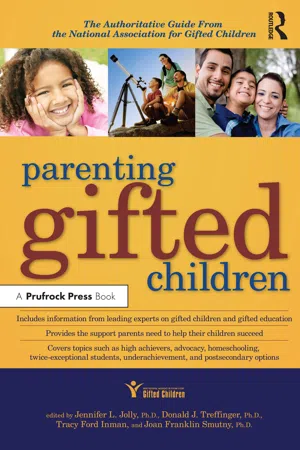
eBook - ePub
Parenting Gifted Children
The Authoritative Guide From the National Association for Gifted Children
- 592 pages
- English
- ePUB (mobile friendly)
- Available on iOS & Android
eBook - ePub
Parenting Gifted Children
The Authoritative Guide From the National Association for Gifted Children
About this book
Information
PART I
Nature and Assessment
DOI: 10.4324/9781003237020-1
THIS section of the text addresses some of the most central questions of importance to parents of gifted children:
- What is the nature of giftedness and talent?
- How can tests reveal (or inadvertently conceal) it?
- What can parents and educators do to maximize gifted potential?
A range of authors offer a variety of insights on these and other related questions and suggest concrete ways that parents and educators can play an active and informed role in the process of nurturing and advocating for gifted children. A brief glimpse into what to expect in the chapters that follow is offered. In each piece, note how the authors make the assumption that parents are partners with educators in the conversations about giftedness and talent. Authors also recommend that parents use this information to become better advocates for their children.
In the first chapter, Barbara Clark reminds us about the importance of keeping our own beliefs and assumptions about children’s potential in check. In the discussion of how giftedness and talent is manifested, Clark offers some consideration for the genetic background of the child; however she makes a stronger case for a stimulating and nurturing environment as a more powerful force in the talent development process. She then offers specific ways in which parents and teachers can optimize the development and learning of young children.
Psychologist Robert J. Sternberg provides an alternative to the over-reliance upon traditional intelligence testing or using only an IQ score as the primary indicator of giftedness. Rather, he offers his theory of successful intelligence, whereby individuals identify and cultivate their strengths and figure out ways to compensate or correct for their relative weaknesses. Sternberg punctuates the explanation of his theory with a call to action for parents and teachers; research findings suggest that students who are offered instruction in ways that allow them to play to their strengths and minimize their weaknesses outperform those who were not offered such flexibility. In short, not scoring high on a traditional intelligence test can be overcome by considering strengths more broadly and playing to those strengths.
In the chapter, “Why Gifted Children May Not Test Well,” Ben Paris examines issues surrounding testing and, in particular, the specific ways in which some children’s scores may be negatively impacted. He identifies and describes seven major problems—lack of motivation, “overthinking” test items, perfectionism, overconfidence, sloppiness, excessive test anxiety, and the mismatch between a child’s area of giftedness and the test being administered. While the path beyond these common pitfalls is often complex and requires specific time and attention to improve, he makes clear that “not testing well” is a challenge that can be overcome. As readers progress through the previous chapter, they may find the “Glossary of Terms Used in Educational Assessment” by Michael Freedman and John Houtz useful as a companion tool. This glossary outlines key terms used in the discussion of intelligence and assessment in a concise and readable manner.
As a set, these three pieces share several common themes. First, in each piece the authors make the explicit point that knowledge is power and this knowledge can make parents more effective advocates for their children. For example, Paris offers strategies for parents (and ultimately for the student) to move beyond the self-defeating belief that “I just don’t test well,” translate it into self-awareness of the problem, and use that knowledge to optimize his or her performance on a test. The glossary offered by Freedman and Houtz is a tool for parents to employ as they become acquainted with terminology and jargon associated with the testing and evaluation process. Again, knowledge is power and, in sum, can translate into more effective communication between the family and the school when testing is undertaken.
A second theme surrounds the difference between giftedness and talent as an educational label and how this impacts a learner’s future. While Paris focuses on the immediate process of acquiring the gifted and talented identification, other authors approach this differently. Sternberg suggests that successful intelligence is a broader way to view a child’s potential contributions and that it is the responsibility of parents and educators to help children find their areas of strength and figure out ways around their weaknesses. Parents can convey this by providing enriched environments in a variety of ways as described by Clark. The Sternberg and Clark pieces suggest that parents have important responsibilities to help children see talents as more than just a score on a test.
Third, in various ways, these authors make clear that the process of testing is an imperfect science. For example, Paris reminds us that there is no universal definition of giftedness and, as a result, tests may not be designed to test for the specific area(s) that are of interest to the family or school. Second, there may be a mismatch between the purpose of the test and the services delivered in the program.
Questions to consider as you read each of the pieces include:
- What do I need to know to be the best advocate for my child?
- What questions can I ask to become even more educated?
- How can I use the suggested resources to help further my knowledge base?
- Does my child’s school district/school/classroom take a short-term (e.g., prioritizing identification) or long-term (e.g., testing concerns) view of giftedness and talent?
- How are my child’s strengths (areas of giftedness) measured?
- What tests are being used to assess my child’s abilities?
- If the test used is norm-referenced, what was the norming group for this test?
Chapter 1
No Child Is Just Born Gifted: Creating and Developing Unlimited Potential
DOI: 10.4324/9781003237020-2
I listened carefully as my graduate student described the activity he wanted to do for one of his term projects. He was very excited as he told about the research he planned using his baby son as the object of his study. “I have already put pictures of cats around his crib and he looks at them a lot,” he said. “Yesterday I held the family cat where he could see it and he enjoyed that even more. Today I will print some large cards with ‘CAT’ on them and show them to him before I hold up the cat, then I’ll show the cat, then the card again. Maybe I’ll try to paste some of the printed cards next to the cat pictures in the crib. Oh, I got a very colorful book with pictures and words about cats I can read to him too. What do you think? Does that sound like an interesting way to build his visual/language connections?”
Observing what a little child is capable of is always exciting. Many of the limits we thought children had do not seem to be as absolute as we once believed. The more we study children, the more we discover that what is limited are our beliefs, not the children.
I agreed that my student could work with his son and report on anything that he observed that was interesting in the process he was planning to follow. From his explanation I assumed the boy was 12 to 18 months old. Although some early learning data was becoming available (then in the early 1970s), there was a lot to learn, and it was obvious that the baby and his father were enjoying the interactions. At the end of his project he presented it to the class. Some of the results included tape recordings of his son saying some of the words he had introduced by cards, pictures, and books. Not until the end of the report was it that the stunning conclusion caught everyone by surprise. The baby, who I had thought would be 15 to 21 months old by the end of the study and who was so successfully engaged in early learning, was actually only 6 months old. He was only 3 months old at the beginning of the study. Had I known his age I would have been sure that what occurred would have been impossible. My beliefs would have limited this student and, more importantly, his son.
What are the limits we should expect in regard to learning and our children? What do we believe they could or should learn and when should they learn it? Is their potential dictated by their genes? Is this advanced and accelerated development we refer to as giftedness the result of rich experiences and good parenting, or are some children born that way? How can we know? What can we use for a guide?
Are Children Born Gifted?
The potential for giftedness or a high level of intellectual development begins very early in a child’s life. Studies since the early 1970s consistently show that such development is the result of an interaction between the child’s genetic endowment and a rich and appropriate environment in which the child grows. No child is born gifted—only with the potential for giftedness. Although all children have amazing potential, only those who are fortunate enough to have opportunities to develop their uniqueness in an environment that responds to their particular patterns and needs will be able to actualize their abilities to high levels. Research in psychology, neuroscience, linguistics, and early learning can help parents create responsive environments that allow their children to develop their potential to the fullest—that is, to create giftedness.
Giftedness Is a Changing Concept
Giftedness can now be seen as a biologically rooted label for a high level of intelligence, which indicates an advanced and accelerated development of functions within the brain that allow its more efficient and effective use. While old ideas of intelligence and giftedness generally were limited to analytical and rational thinking, giftedness really includes an interaction of all of the areas of brain function—physical sensing, emotions, cognition, and intuition. Broader concepts of intelligence and giftedness may be expressed through problem solving, creative behavior, academic aptitude, leadership, performance in the visual and performing arts, invention, or a myriad of other human abilities. High intelligence, whether expressed in cognitive abilities such as the capacity to generalize, conceptualize, or reason abstractly, or in specific abilities such as creative behavior, results from the interaction between inherited and acquired characteristics. This interaction encompasses all of the physical, mental, and emotional characteristics of the person and all of the people, events, and objects entering the person’s awareness. Our reality is unique to each of us.
What Is More Important, Nature or Nurture?
An endless interaction between the environment and our genetic framework creates our intelligence, even our perception of reality. This process begins very early, as soon as the fertilized egg attaches to the wall of the uterus. As the cells divide and the fetus begins to grow, the environment already begins to exert a determining influence. One could not say from this interactive point of view which is more important—the inherited abilities or the environmental opportunities to develop them. Restriction on either nature (genes) or nurture (environment) would inhibit the high levels of actualized intellectual ability we call giftedness.
Our genes are not a limit, but provide a rough outline of the possibilities for our life. While genes provide us with our own unique menu, the environment makes the actual selection within that range of choice. Any reference to “high-IQ genes” must be seen as a misnomer because the discernible characteristics of an organism always depend on its particular environmental history.
Environmental interaction with the genetic program of the individual occurs whether planned or left to chance. By conservative estimates, this interaction can result in a 20- to 40-point difference in measured intelligence. Teachers and parents must be aware that how we structure the environment for children changes them neurologically and biologically. Without opportunities for appropriate challenge, talent and ability may be lost. From an overwhelming body of research, we must conclude that the development of intelligence includes both nature and nurture.
Who Are Gifted Learners?
At birth the human brain contains some 100 to 200 billion brain cells. Each neural cell is in place and ready to be developed, ready to be used for actualizing the highest levels of human potential. With a very small number of exceptions, all human infants come equipped with this marvelous complex heritage.
For example, two individuals with approximately the same genetic capacity for developing intelligence could be regarded as potentially gifted or as intellectually disabled as a result of the environment with which they interact. Although we never develop more neural cells, it is estimated that we actually use less than 5 percent of our brain capability. How we use this complex system becomes critical to our development of intelligence and personality and to the very quality of life we experience as we grow. Those who work with gifted children must acquire an understanding of the power of the interaction between the organism and its environment.
When the brain becomes more accelerated and advanced in its function through this interaction, the individual shows characteristics that can be identified with high intelligence. Some of those characteristics can be seen as the direct result of changes in brain structures. These changes continue to occur as long as appropriate stimulation is available. Over and over, brain research points to the dynamic nature of the brain’s growth and the need to challenge the individual at that individual’s level of development for growth to continue. Unchallenged, the individual will lose brain power.
Although each child will express giftedness in his or her unique way, behaviors often observed among these children include intense curiosity, frequent and sophisticated questions, an accelerated pace of thought and learning, complex thinking, often connecting seemingly disparate ideas, persistence in pursuing interests, and early development of language and mathematical skills.
Emotionally gifted children may show a heightened awareness of “being different,” unusual sensitivity to the expressed feelings and problems of others, early concern for global and abstract issues, idealism and concern for fairness and justice, and high expectations for self and others. Gifted children often show an unusual asynchrony or gap between physical and intellectual development and a low tolerance for a lag between personal vision and physical abilities. Most interesting is the gifted child’s early awareness and expression of heightened perceptions, preference for creative solutions and actions over predictable ones, and early use of hunches and best guesses.
The best way to identify high levels of intellectual development, or what we call giftedness, is to observe the child at play in a rich, responsive environment. During the early years, it is important to provide many opportunities for children to interact with interesting, novel, and unusual experiences that allow them to stretch just beyond their current ability level. All children must have experiences at their level of development because it is during early childhood that intelligence is nurtured and giftedness is developed. The most important challenge for teachers at home and at school is to stay just ahead of the child in presenting materials and experiences—not too far ahead and yet not too much repetition. Creating an environment and experiences that respond to the child with an appropriate balance of the familiar and new is the best way to provide for optimal development.
Provide for Early Learning
Parents are their children’s first teachers, and they need to provide a rich, responsive environment and guidance based on the unique needs and interests of their children. You will be most effective when you create the appropriate emotional and social climate and are sensitive to your infant’s unique personality and development.
Following are some activities to optimize development and learning based on observing your child’s rhythms, abilities, and interests.
Beginnin...
Table of contents
- Cover
- Half Title
- Title Page
- Copyright Page
- Contents
- Preface
- Editors’ Note
- Part I: Nature and Assessment
- Part II: Characteristics and Development
- Part III: Diversity
- Part IV: Programming Options
- Part V: Family Dynamics
- Part VI: Advocacy
- Part VII: Twice-Exceptional Students
- Part VIII: Social and Emotional Needs
- About the Editors
- About the Authors
- List of Article Publication Dates
Trusted by 375,005 students
Access to over 1.5 million titles for a fair monthly price.
Study more efficiently using our study tools.
Frequently asked questions
Yes, you can cancel anytime from the Subscription tab in your account settings on the Perlego website. Your subscription will stay active until the end of your current billing period. Learn how to cancel your subscription
No, books cannot be downloaded as external files, such as PDFs, for use outside of Perlego. However, you can download books within the Perlego app for offline reading on mobile or tablet. Learn how to download books offline
Perlego offers two plans: Essential and Complete
- Essential is ideal for learners and professionals who enjoy exploring a wide range of subjects. Access the Essential Library with 800,000+ trusted titles and best-sellers across business, personal growth, and the humanities. Includes unlimited reading time and Standard Read Aloud voice.
- Complete: Perfect for advanced learners and researchers needing full, unrestricted access. Unlock 1.5M+ books across hundreds of subjects, including academic and specialized titles. The Complete Plan also includes advanced features like Premium Read Aloud and Research Assistant.
We are an online textbook subscription service, where you can get access to an entire online library for less than the price of a single book per month. With over 1.5 million books across 990+ topics, we’ve got you covered! Learn about our mission
Look out for the read-aloud symbol on your next book to see if you can listen to it. The read-aloud tool reads text aloud for you, highlighting the text as it is being read. You can pause it, speed it up and slow it down. Learn more about Read Aloud
Yes! You can use the Perlego app on both iOS and Android devices to read anytime, anywhere — even offline. Perfect for commutes or when you’re on the go.
Please note we cannot support devices running on iOS 13 and Android 7 or earlier. Learn more about using the app
Please note we cannot support devices running on iOS 13 and Android 7 or earlier. Learn more about using the app
Yes, you can access Parenting Gifted Children by Jennifer L. Jolly,Donald J. Treffinger,Tracy Ford Inman in PDF and/or ePUB format, as well as other popular books in Education & Education General. We have over 1.5 million books available in our catalogue for you to explore.