Conceptual Frameworks for Giftedness and Talent Development explores current and enduring theories and comprehensive models of giftedness and talent development. Each chapter:
Includes a description of the model, theory, or framework.
Shares the most important implications of each model, including underrepresentation and social justice issues.
Includes discussion questions for use with students and professionals.
The editors also consider common issues across conceptual frameworks, such as the degree to which achievement defines giftedness, the goal of gifted education, and the role of psychosocial factors. This is a comprehensive reference for scholars and practitioners in the field, as well as those studying at the graduate level.
CHAPTER 1 Evolving Complexity Theory of Talent Development
A Developmental Systems Approach
DOI: 10.4324/9781003233787-1
DAVID YUN DAI
The stimulations which the organism tends toward are those which heighten its vitality, which give it pleasure, and those from which it draws back are those whose effect upon it is the contrary—the damaging, the painful ones.
—James Baldwin
Cognitive functions come into existence and differentiate due to the constant challenges and adaptation tasks that the social world entails . . . human cognition (including its highest form, creativity) is fundamentally culturally and symbolically mediated.
—Jaan Valsiner
This chapter presents a new theory of talent development, Evolving Complexity Theory (ECT), in the context of the changing theoretical directions as well as the landscape of gifted education. I argue that talent development provides a broader psychosocial basis for gifted and talented education than the concept of giftedness can afford. In this chapter, I first offer rationale for developing a developmental systems theory of talent development. I then discuss three essential dimensions of a developmental system and explicate how structural and functional changes in talent development (structural regularities) occur as the result of person-environmental interaction (process regularities) and are manifested as contextual-contextual emergence of new properties and new organizational principles. Finally, I discuss the policy and practical implications of ECT, and compare it with existing talent development models to demonstrate how a developmental systems theory can help solve some critical issues regarding the nature and nurture of human potential.
Talent development is a theoretical movement in the field of giftedness and gifted education. It is not new and can be traced back as early as the 1950s (e.g., Witty, 1958; see also Borland, 2014, on the Talented Youth Project), but it is gaining momentum at the policy and practical level worldwide (e.g., the Talent Support model in Europe; Csermely, 2015). It poses challenges to a long-standing tradition in gifted education, the Gifted Child Paradigm (Dai, 2011; Dai & Chen, 2013; Subotnik et al., 2011). The ongoing “paradigm shift” is predicated on a profound change in the understanding of human potential and ability. First, the field of gifted education no longer espouses a static, fixed capacity view of human potential in general and intelligence in particular. Instead, it now sees human exceptional competence as diverse and pluralistic, dynamically shaped through developmental interaction with environmental opportunities and challenges (Dai, 2016). Second, the field has gone beyond a purely cognitive view of “giftedness” in espousing a broader scope of what constitutes giftedness, encompassing a range of endogenous and exogenous forces (Dai & Renzulli, 2008; Dai & Sternberg, 2004). Talent development, in this sense, provides a broader psychosocial basis for gifted education than what the notion of “giftedness” can afford. Evolving Complexity Theory is developed in this context to provide a new theoretical model of talent development that reflects this trend and can be used to guide educational policy and practice.
Motivation for a New Theory of Talent Development
More than 10 years ago, I started to think of giftedness not as a static quality but as contextually bound, dynamically shaped through person-environment interaction, and temporally emergent—hence the Contextual, Emergent, Dynamic Model of Giftedness and Talent Development (Dai & Renzulli, 2008), which I dubbed “giftedness in the making” (Dai, 2010, p. 196). At the core of this conceptualization is the assumption of exceptional competence as part of a relational developmental system, which is by nature interactive, dynamic, and complex (Overton, 2014; Molenaar et al., 2014). Over the years, my work has been guided by this developmental perspective, now better articulated as a developmental science framework (Cairns et al., 1996), featuring prominently developmental systems theory. The result is a theory of talent development that specifies the process of talent development from its initially more or less nebulous state to an increasingly differentiated and integrated state with emergent new properties and organizational principles for its further development—a process that can best be described as that of evolving complexity, hence Evolving Complexity Theory (Dai, 2017).
There are strategic and methodological considerations for theorizing about talent development. One can use the traditional, reductionist approach, tracing development of exceptional human competence back to basic components, endogenous as well as exogenous (e.g., Gagné, 1985, 2005; Tannenbaum, 1983). However, a component theory, in its way of simplifying the realities, does not explicate how these components interact at the system level and how the developing system evolves over time as a whole (see Ziegler & Phillipson, 2012, for a critique). In addition, component models take a reductionist approach that lends itself easily to dichotomizing the role of nature and nurture, even polarizing debates on their respective role (e.g., Ericsson et al., 2005, vs. Gagné, 2009), when, as a matter of fact, nature and nurture never work alone developmentally without some interaction and reciprocation of each other (Gottlieb, 1998; Horowitz, 2000).
A developmental systems approach takes a more integrative approach to the nature-nurture problem: how nature is nurtured (i.e., epigenesis, bidirectional interaction; Gottlieb, 1998), how nurture reveals nature (e.g., gene-environment interactions and differential intervention outcomes; Baltes, 1998), and how nurture surpasses or transcends nature (e.g., structural and functional changes at neural, cognitive, and behavioral levels as a result of systematic training; Schlaug, 2001). The developmental systems approach treats emergence (i.e., the emergence of new structural and functional properties, including competence, through development) as a fundamental tenet of human development, avoiding any radical reductionist explanation of gifts and talents as static and genetically predetermined (Dai, 2005). In short, a truly developmental theory of talent is by nature nonreductionist and organismic; that is, treating the organization of the person as a whole with higher order organizational properties (e.g., increasingly purposive, self-directed behavior) and principles (e.g., adaptive value, cultural distinction) not reducible to lower level components and operational rules. The notion of evolving complexity reflects this fundamental organization principle in human development. More specifically, ECT adheres to the following four tenets of dynamic systems (Lewis, 2000): (a) producing true novelty such that new forms or structures (e.g., giftedness, talent, creativity) spontaneously appear; (b) becoming more complex (differentiated and integrated) over time, fine-tuned to environments and transformed via “proximal processes”; (c) going through phase transitions in which new properties emerge, creating new dynamics and new levels of organized complexity, resulting in a more effective system; and (d) extrinsically sensitive (adaptive) and intrinsically robust (stable). Thus talent development is indeterminate but principled.
How ECT Explicates Structural, Process, and Temporal Regularities
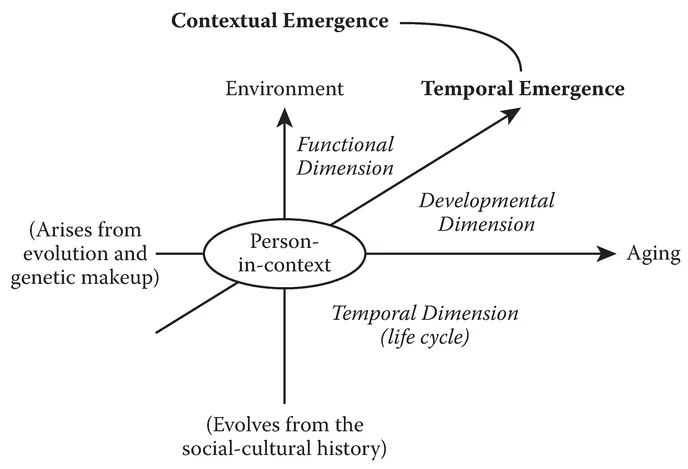
Originally conceptualized as contextual, emergent, and dynamic (Dai & Renzulli, 2008), talent development is cast in a three-dimensional conceptual framework shown in Figure 1.1. The vertical dimension represents the person-environment interface, the horizontal dimension represents a life-span temporal progression, and the diagonal dimension represents the increasingly differentiated and integrated personhood (i.e., individuality) contextually and temporally emergent from the person-environment transactions at particularly developmental junctures. The three dimensions intersect to form a basic unit of analysis: person-in-context, meaning that the person is investigated and understood as a developing agent interacting with specific social-cultural contexts at a specific developmental juncture, with a particular timescale of the course of action. Based on this three-dimensional conceptual foundation, a theory of talent development needs to explicate:
FIGURE 1.1 A Schematic Representation of Three Critical Dimensions of Human Functioning and Development Note. The oval indicates a unit of analysis that intersects the three dimensions. The arrows signify the dynamic nature and directionality of the three dimensions. Adapted from “Snowflakes, Living Systems, and the Mystery of Giftedness,” by D. Y. Dai and J. S. Renzulli, 2008, Gifted Child Quarterly, 52(2), p. 115 (https://doi.org/10.1177/0016986208315732). Copyright 2008 by SAGE.
what develops or evolves in terms of structural and functional changes of the person in competence and selfhood (i.e., structural regularities);
how the person evolves as the result of specific ways of interacting with a particular task and social environments (process regularities); and
when and for how long these processes take place (i.e., the developmental timing and duration of specific processes; temporal regularities).
In short, the three regularities address the issue of what, how, and when in an integrated manner. Methods of empirical observations have to honor the contextual, dynamic, and emergent principle reflected in Figure 1.1 (e.g., observations of proximal processes with time-intensive and relation-intensive methods; Hilpert & Marchand, 2018). Through this developmental lens, one can simply see talent development as a prolonged process of human adaptation resulting in outstanding human accomplishments, which either stretches human limits in terms of extraordinary skilled performance (e.g., in sports and performing arts) or makes eminent creative contributions that significantly improve human conditions (e.g., philosophy, science, literature, art, and technology). In short, talent development represents the highest form of human development in terms of demonstrating what humans can accomplish at the individual (ontogenetic) as well as species (phylogenetic) level. In the following section, structural, process, and temporal regularities of talent development is discussed, respectively, against the framework presented in Figure 1.1.
Structural Regularities: Evolving Complexity of the Developing Person Over Time
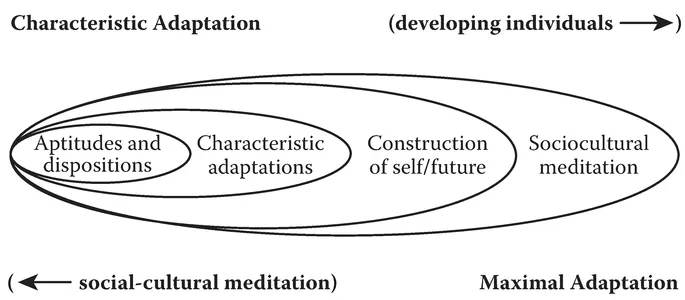
A major assumption underlying ECT is that the person is an open, dynamic, and adaptive system, undergoing changes in oneself in multiple ways while interacting with the world and exercising agency. Developmental changes occur in a structurally predictable manner, “from a state of relative globality and lack of differentiation to a state of increasing differentiation, articulation, and hierarchical integration” (Werner, 1957, p. 126). For ECT, this “increasing differentiation and hierarchical integration” is captured through a multilevel analytic framework presented in Figure 1.2, which shows how the evolving complexity of the developing person builds up through development (Dai, 2010).
At Level I are aptitudes and dispositions in foundational domains. Aptitudes are more of an ability construct, and dispositions more of a personality one. They are stable traits developed and calibrated in early years of life with certain facilitative social-cultural environments (e.g., exposure
FIGURE 1.2 The Developing Person Driven by Both Endogenous and Exogenous Forces From a Multilevel Analytic Point of View Note. Adapted from The Nature and Nurture of Giftedness: A New Framework for Understanding Gifted Education (p. 211), by D. Y. Dai, 2010, Teachers College Press. Copyright 2010 by Teachers College.
to chess, or early musical experiences). ECT identifies five basic functional domains of human activity: expressive (expressing oneself through imaginative play and artistic means, such as writing, drawing, acting, singing, and dancing), technical (making tools and gadgets to enhance effectiveness and efficiency), intellectual (reasoning, understanding, explaining, and theorizing using mathematics, logic, visual-spatial imaging, or literary means), social (achieving practical purposes through effective communication, negotiation, collaboration, and leadership), and psychomotor (executing and coordinating body movements to accomplish complex physical tasks as in the case of most competitive and extreme sports and complex surgical operations). These foundational effectivities help human beings survive and thrive, and thus hold a fundamental adaptive value. Aptitudes and dispositions facilitate development of effectivities in these foundational domains. Thus, one might identify a child or adolescent’s profile of aptitudes and dispositions vis-à-vis affordances and constraints of a wide range of cultural activities, including but not confined to formal education (Lohman, 2005). ECT also identifies aptitudes that mainly exert regulatory power, similar to the metacomponent in the triarchic theory of intelligence (Sternberg, 1985). For example, one exercises metacognitive control to backtrack and fine-tune one’s performance (Feltovich et al., 2006). In addition, dispositions refer to a set of “nonintellective” personal characteristics that have action potency, such as openness to experience,...
Table of contents
Cover
Half Title
Title Page
Copyright Page
Table of Contents
FOREWORD
CHAPTER 1 Evolving Complexity Theory of Talent Development
CHAPTER 2 The Talent Development Megamodel
CHAPTER 3 Toward a Science of Expertise Obstacles, Implications, and Applications
CHAPTER 4 Tannenbaum's Psychosocial Conception of Giftedness
CHAPTER 5 The Three-Ring Conception of Giftedness and the Schoolwide Enrichment Model
CHAPTER 6 Nonuniversal Theory and the Development of Gifts and Talents
CHAPTER 7 Transformational Giftedness
CHAPTER 8 The Talent Search Model for Identifying and Developing Academic Talent
CHAPTER 9 An Enhanced School-Based Conception of Giftednes
CHAPTER 10 Advanced Academics
CHAPTER 11 Giftedness as IQ
CHAPTER 12 Charting a Course for the Future
ABOUT THE EDITORS
ABOUT THE AUTHORS
Trusted by 375,005 students
Access to over 1.5 million titles for a fair monthly price.
Study more efficiently using our study tools.
Frequently asked questions
Yes, you can cancel anytime from the Subscription tab in your account settings on the Perlego website. Your subscription will stay active until the end of your current billing period. Learn how to cancel your subscription
No, books cannot be downloaded as external files, such as PDFs, for use outside of Perlego. However, you can download books within the Perlego app for offline reading on mobile or tablet. Learn how to download books offline
Perlego offers two plans: Essential and Complete
Essential is ideal for learners and professionals who enjoy exploring a wide range of subjects. Access the Essential Library with 800,000+ trusted titles and best-sellers across business, personal growth, and the humanities. Includes unlimited reading time and Standard Read Aloud voice.
Complete: Perfect for advanced learners and researchers needing full, unrestricted access. Unlock 1.5M+ books across hundreds of subjects, including academic and specialized titles. The Complete Plan also includes advanced features like Premium Read Aloud and Research Assistant.
Both plans are available with monthly, semester, or annual billing cycles.
We are an online textbook subscription service, where you can get access to an entire online library for less than the price of a single book per month. With over 1.5 million books across 990+ topics, we’ve got you covered! Learn about our mission
Look out for the read-aloud symbol on your next book to see if you can listen to it. The read-aloud tool reads text aloud for you, highlighting the text as it is being read. You can pause it, speed it up and slow it down. Learn more about Read Aloud
Yes! You can use the Perlego app on both iOS and Android devices to read anytime, anywhere — even offline. Perfect for commutes or when you’re on the go. Please note we cannot support devices running on iOS 13 and Android 7 or earlier. Learn more about using the app
Yes, you can access Conceptual Frameworks for Giftedness and Talent Development by Tracy L. Cross, Paula Olszewski-Kubilius, Tracy L. Cross,Paula Olszewski-Kubilius in PDF and/or ePUB format, as well as other popular books in Education & Inclusive Education. We have over 1.5 million books available in our catalogue for you to explore.