Equipped with the #1 guide to help kids with math homework, children will be able to quickly find the definitions and illustrated examples that will enable them to solve many of the math challenges they face. Covering everything from "addend" to "zero," the fifth edition of the best-selling Math Dictionary for Kids gives students in grades 4-9 more than 400 definitions, full-color illustrations, and examples that can help them solve math problems.This handbook includes illustrated, concise explanations of the most common terms used in general math classes, categorized by subjects that include measurement, algebra, geometry, fractions and decimals, statistics and probability, and problem solving. This edition also discusses how students can use manipulatives and basic math tools to improve their understanding and includes handy measurement conversion tables. Each term has a concise definition and an example or illustration. Perfect for both kids and their parents looking to help them with math homework!
- 272 pages
- English
- ePUB (mobile friendly)
- Available on iOS & Android
eBook - ePub
About this book
Information
QUICK REFERENCE GUIDES
DOI: 10.4324/9781003236443-9
QUICK REFERENCE GUIDE: DECIMALS
DOI: 10.4324/9781003236443-10
Adding Decimals
- Line up the decimal points so that the place value is in line.
- Add as normal. Zeros can be added after the decimal point in order to make adding easier, and it won’t change the answer.
- Bring the decimal point straight down into the answer.
Comparing Decimals
To determine which decimal is larger or smaller, place value must be compared.
- Line up the decimal points.
- Compare tenths, then hundredths, and then thousandths.

- Line up decimal points.
- Look at place value: 5 tenths is larger than 3 tenths, so 0.56 is larger than 0.324.
Converting Decimals
✪ Decimal to Fraction
To change a decimal to a fraction, use place value.
- Decide whether the decimal represents tenths, hundredths, thousandths, etc.
- Write the numerical part of the decimal over the appropriate power of 10—over 10 if the decimal was in the tenths place, over 100 if the decimal was in the hundredths place, and so on.
- Reduce the fraction.
Example:
.05 is 5 hundredths.
✪ Decimal to Percent
To change a decimal to a percent, move the decimal point.
- Move the decimal point two places to the right.
- Add a percent sign (%).
- Add zeros for placeholders if necessary.
Examples:
| .72 = 72% | .8 = 80% |
| .523 = 52.3% | .09 = 9% |
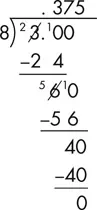
✪ Fraction to Decimal
To find the decimal for a fraction: ⅜
- Divide the numerator by the denominator.
- Add a decimal point and zeros to the dividend. Bring the decimal point straight up to the quotient.
- Divide as normal; write the answer with the decimal point.
Dividing Decimals
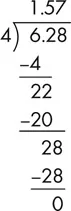
- Write the problem as normal.
- Bring the decimal point straight up.
- Divide as normal.
Multiplying Decimals
- Write and solve the problem as normal.
- Count the total number of places after each decimal in the numbers being multiplied.
- Position the decimal the same number of places in the answer.
Subtracting Decimals
- Line up the decimal points so that the place value is in line.
- Subtract as normal. Zeros can be added after the decimal point in order to make subtracting easier, and it won’t change the answer.
- Bring the decimal point straight down into the answer.
Table of contents
- Cover
- Half Title
- Title Page
- Copyright Page
- Dedication Page
- Table of Contents
- Introduction
- Whole Numbers and Operations
- Measurement
- Algebraic Ideas
- Geometry
- Decimals, Fractions, Percents, and Ratios
- Statistics and Probability
- Problem Solving
- Quick Reference Guides
- Learning with Manipulatives
- Formulas
- Tables and Charts
- Measurement Conversion Tables
- Basic Math Tools and Equipment
- Index
- About the Author
- Standards Alignment
Trusted by 375,005 students
Access to over 1.5 million titles for a fair monthly price.
Study more efficiently using our study tools.
Frequently asked questions
Yes, you can cancel anytime from the Subscription tab in your account settings on the Perlego website. Your subscription will stay active until the end of your current billing period. Learn how to cancel your subscription
No, books cannot be downloaded as external files, such as PDFs, for use outside of Perlego. However, you can download books within the Perlego app for offline reading on mobile or tablet. Learn how to download books offline
We are an online textbook subscription service, where you can get access to an entire online library for less than the price of a single book per month. With over 1.5 million books across 990+ topics, we’ve got you covered! Learn about our mission
Look out for the read-aloud symbol on your next book to see if you can listen to it. The read-aloud tool reads text aloud for you, highlighting the text as it is being read. You can pause it, speed it up and slow it down. Learn more about Read Aloud
Yes! You can use the Perlego app on both iOS and Android devices to read anytime, anywhere — even offline. Perfect for commutes or when you’re on the go.
Please note we cannot support devices running on iOS 13 and Android 7 or earlier. Learn more about using the app
Please note we cannot support devices running on iOS 13 and Android 7 or earlier. Learn more about using the app
Yes, you can access Math Dictionary for Kids by Theresa R. Fitzgerald in PDF and/or ePUB format, as well as other popular books in Education & Education General. We have over 1.5 million books available in our catalogue for you to explore.