Stretch your students' mathematical imaginations to their limits as they solve challenging real-world and mathematical problems that extend concepts from the Common Core State Standards for Mathematics in Advanced Common Core Math Explorations: Probability and Statistics. Students will learn powerful mathematical ideas about data and chance as they make sense of real-world situations from science, sports, and everyday life. Each activity comes with extensive teacher support, including student handouts, discussion guides, detailed solutions, and suggestions for extending the investigations.
Grades 5-8
eBook - ePub
Advanced Common Core Math Explorations
Probability and Statistics (Grades 5-8)
- 272 pages
- English
- ePUB (mobile friendly)
- Available on iOS & Android
eBook - ePub
About this book
Trusted by 375,005 students
Access to over 1 million titles for a fair monthly price.
Study more efficiently using our study tools.
Information
Topic
EducationSubtopic
Teaching MathematicsExploration 1
Playing With Data
DOI: 10.4324/9781003232780-4
Playing With Data is the only activity in this book in which students study number relationships in data without focusing on real-world questions or making real-world decisions. (And even here they imagine a realistic context for the numbers.) However, rather than simply learn definitions and perform calculations, students create their own examples of data sets and explore relationships between the mean, median, range, mode, and other statistical measures.
BACKGROUND
The mean, median, and mode are measures of central tendency, they describe a "typical value" in a data set. The range is a measure of variability, it tells you something about how "spread out" the data are. In this exploration, students solve challenging problems related to central tendency and variability. They also begin to explore more precise ways to measure variability. By solving problems and thinking about relationships between quantities rather than simply doing calculations, students develop a deeper, more flexible understanding of the ideas and are better prepared to apply their knowledge to real-world situations in the later explorations.
STAGE 1
Before beginning Problem #1, discuss the concepts of central tendency and variability with your students. (See the Introduction to this exploration for more information.) Ensure that the students understand how to calculate the mean, median, range, and mode.
I like to show students the problem's "opener" (the part at the top of page) before I let them see the directions. I show them the four numbers and ask them what they notice and what they wonder. More often than not, they come up with the tasks in the directions on their own! The conversation gives me a better understanding of questions, misconceptions, or insights they may have. Additionally, the students become more engaged in the problem and often create their own interesting questions to explore.
What You Will Need
- » Calculators
What Students Should Know
- » Calculate the mean, median, range, and mode of a data set.
What Students Will Learn
- » Understand the meanings of central tendency and variability.
- » Explore relationships between measures of central tendency and variability.
- » Solve challenging problems related to statistical measures.
NAME:──────────DATE:─────
Problem #1
Mean: 73.9
Mode: 26
Median: 86.5
Range: 70
Directions
- ■ Describe a real-world situation that these numbers could represent.
- ■ Find a set of 10 whole numbers that will produce these summary statistics.
- ■ Justify your answer. (Discuss each summary statistic.)
- ■ Find more solutions. Describe your thinking strategies.
Testing the Waters
Solve Problem #1 for five whole numbers that have a mean of 80, a median of 75, a mode of 70, and a range of 30.
CONVERSATION STARTERS FOR #1
What do yon notice? What do you wonder?
I notice that the mode is much lower than both the mean and the median.
I notice that the range seems very large.
I notice that the mean is quite a bit less than the median.
I wonder what causes the mean to be less than the median?
I notice that I can predict the sum of the 10 numbers.
After Students have found a solution
I notice that I can use my first solution to find more.
I wonder if I can change the two middle numbers without changing the median?
I notice that whenever I change the two middle numbers without changing the median, the mean remains unchanged as well.
I wonder how information about the mean, median, mode, and range would be useful in the real-life situation that I created?
I wonder how many solutions this problem has?
For students who are familiar with box-and-whisker plots:
I wonder what are the smallest and largest boxes possible for box-and-whisker plots of data sets that have these same statistics?
For students who are familiar with outliers
I wonder if the number 26 is an outlier for my data sets?
SOLUTIONS FOR #1
Sample real-world situation-. The numbers could represent scores on a 100-point test.
Sample solution: 26, 26, 66, 74, 86, 87, 90, 93, 95, 96
Justification:
- » The mean is 73.9, because the sum of the 10 numbers is 739, and 739 ÷ 10 = 73.9.
- » The median is 86.5, because the two middle numbers in my ordered list are 86 and 87, and 86.5 is halfway between these numbers.
- » The mode is 26, because the number 26 appears most often in the list.
- » The range is 70, because the difference between the maximum and the minimum is 96 — 26 = 70.
More sample solutions:
- (1) 26, 26, 67, 74, 86, 87, 89, 93, 95, 96
- (2) 26, 26, 66, 73, 86, 87, 92, 93, 94, 96
- (3) 26, 26, 66, 74, 85, 88, 90, 93, 95, 96
There are many other solutions!
Thinking strategies: Leave 26,26, 86, 87, and 96 the same so that the median, mode, and range do not change. Increase one of the other numbers by some value, and compensate by decreasing a different number by the same amount, being careful not to repeat any values (in order not to affect the mode) and ensuring that the third and fourth numbers remain between 26 and 86 and that the seventh, eighth, and ninth numbers remain between 87 and 96. For example, increase 66 to 67 and decrease 90 to 89 as shown in solution (1). Solution (3) shows that the two middle numbers may also change as long as they maintain a sum of 173.
STAGE 2
Like many of the ideas in this book, Problem #2 came directly from questions and observations made by my students. Before sharing the directions, collect your students' ideas for new questions to ask. You may want to follow up on some of their questions.
Before students begin working independently on Problem #3, ensure that they understand the meanings of deviation and absolute deviation from the mean.
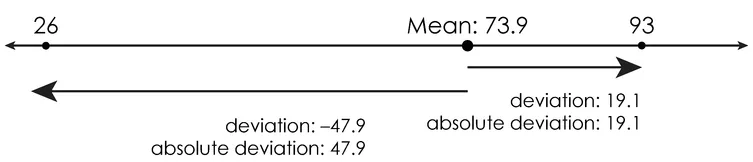
Rather than simply telling students the definitions, give them a chance to use context clues and the everyday meanings of the words to predict as much as they can. The deviation of a data point from the mean is its distance from the mean, using negative values to account for numbers less than the mean. The absolute deviation is always positive, because it takes account of the distance only. (Some students may notice a connection to the term absolute value.)
In Problem #4, students take...
Table of contents
- Cover
- Half Title
- Title Page
- Copyright Page
- Table of Contents
- Preface
- A Note to Students
- A Note to Teachers
- Introduction
- Connections to the Common Core State Standards
- Teacher's Guide
- Exploration 1: Playing With Data
- Exploration 2: A Day at the Races
- Exploration 3: Simulation Station
- Exploration 4: Comparing Populations
- Exploration 5: One More Time!
- Exploration 6: What Are the Chances?
- Exploration 7: Paths and Pascal
- Exploration 8: Sports Correlations
- Exploration 9: Triangle Trials
- Appendix
- References
- About the Author
- Common Core State Standards Alignment
Frequently asked questions
Yes, you can cancel anytime from the Subscription tab in your account settings on the Perlego website. Your subscription will stay active until the end of your current billing period. Learn how to cancel your subscription
No, books cannot be downloaded as external files, such as PDFs, for use outside of Perlego. However, you can download books within the Perlego app for offline reading on mobile or tablet. Learn how to download books offline
Perlego offers two plans: Essential and Complete
- Essential is ideal for learners and professionals who enjoy exploring a wide range of subjects. Access the Essential Library with 800,000+ trusted titles and best-sellers across business, personal growth, and the humanities. Includes unlimited reading time and Standard Read Aloud voice.
- Complete: Perfect for advanced learners and researchers needing full, unrestricted access. Unlock 1.4M+ books across hundreds of subjects, including academic and specialized titles. The Complete Plan also includes advanced features like Premium Read Aloud and Research Assistant.
We are an online textbook subscription service, where you can get access to an entire online library for less than the price of a single book per month. With over 1 million books across 990+ topics, we’ve got you covered! Learn about our mission
Look out for the read-aloud symbol on your next book to see if you can listen to it. The read-aloud tool reads text aloud for you, highlighting the text as it is being read. You can pause it, speed it up and slow it down. Learn more about Read Aloud
Yes! You can use the Perlego app on both iOS and Android devices to read anytime, anywhere — even offline. Perfect for commutes or when you’re on the go.
Please note we cannot support devices running on iOS 13 and Android 7 or earlier. Learn more about using the app
Please note we cannot support devices running on iOS 13 and Android 7 or earlier. Learn more about using the app
Yes, you can access Advanced Common Core Math Explorations by Jerry Burkhart in PDF and/or ePUB format, as well as other popular books in Education & Teaching Mathematics. We have over one million books available in our catalogue for you to explore.