Creativity can be taught and nurtured, and we can build classrooms in which creativity thrives. This philosophy acts as a central thesis in a new book, Organic Creativity in the Classroom, edited by award-winning author Jane Piirto, Ph.D.
This innovative collection of essays explores approaches to teaching creativity from the perspective of experienced educators and artists. The 23 authors have taught for more than 500 years combined, and in this book they share teaching stories and helpful strategies that can be used to encourage students to become more creative within specific domains.
The authors include master teachers, curriculum theorists, holistic educators, and award-winning practitioners of writing, mathematics, science, social science, literature, foreign language, theater, songwriting, dance, music, and arts education, among other domains, who incorporate creativity and intuition into their classrooms. In this readable and lively book, they share their personal stories and practical advice for infusing creativity into the lives of students.
eBook - ePub
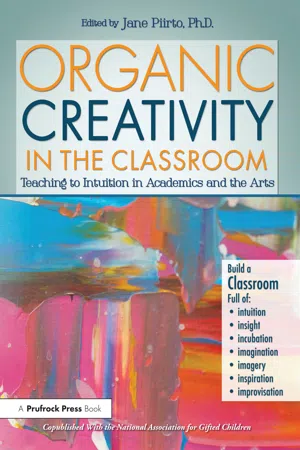
Organic Creativity in the Classroom
Teaching to Intuition in Academics and the Arts
- 392 pages
- English
- ePUB (mobile friendly)
- Available on iOS & Android
eBook - ePub
About this book
Information
Part I
ORGANIC CREATIVITY IN ACADEMIC DOMAINS

Figure I.1. Rodney Michael gives a physics master class.
Chapter 1
NAÏVETÉ, IMAGINATION, AND A GLIMPSE OF THE SUBLIME
Organic Creativity in Teaching Literature
DOI: 10.4324/9781003236962-2

Todd Kettler, Ph.D., is an assistant professor in the Department of Educational Psychology at the University of North Texas. He teaches courses in gifted education and creativity. Dr. Kettler was a contributing author on Using the Common Core State Standards for English Language Arts With Gifted and Advanced Learners (Prufrock Press, 2013), and in the fall of 2012, he was honored with the Advocate of the Year award by the Texas Association for the Gifted and Talented. In addition to his work as a teacher and researcher at the University of North Texas, Dr. Kettler spent 17 years as an English teacher and gifted and talented program administrator.

Laila Sanguras has been an English/language arts teacher for 14 years. She taught in Oregon at the beginning of her career and then moved to Coppell, TX, where she currently teaches language arts to gifted eighth graders and was awarded Teacher of the Year. She is also an instructor for the Gifted Students Institute and the Girls Talk Back program at Southern Methodist University. Laila is a regular presenter for the National Association for Gifted Children and Texas Association for the Gifted and Talented conferences and is working toward her Ph.D. in research, measurement, and statistics at the University of North Texas.
The reader became the book; and summer night
Was like the conscious being of the book.—Wallace Stevens14
I stole my first book when I was 8. Mrs. Booth lent it to me, and I read it. The story took hold of me, wrapped itself around my mind, and whispered its siren song softly to my soul. It was the first time I fell captive to a book, the first time a story in my mind hummed the soft harmony of truth. To return it would have been like losing a part of who I was. I don’t even remember the name of the book, but I remember Mrs. Booth’s name written in ballpoint pen across the cover to remind me of my juvenile crime. I apologized 34 years later when our paths crossed at a funeral. I told her the book was still on a shelf at my mother’s house, her name still inscribed on the cover. And I told her I had since accumulated about 1,500 others just like it, most of which I respectfully paid for.—Todd
Not to give you the impression that we are a literary version of Bonnie and Clyde, but I feel compelled to confess that I, too, was once involved with stolen books. As a child, my mom took me to two kinds of swap meets in southern California: One sold new, shabby-chic items to women looking for a good deal—furniture, clothing, and a fresh Farmer’s market. The other kind boasted flea market items—used tires, mismatched dishes, and books … overflowing stacks of coverless books with stamps on the front pages labeling them as stolen, warning the person holding them that neither the publishers nor the authors had received any payment for them. They were cheap, as most stolen goods are, and I couldn’t wait to see how many my allowance would buy me.—Laila
Literature is quirky. It’s art. It’s history. It’s philosophy and psychology. We learn about love through literature before we have our first date. We learn temperance and restraint. We confront injustice, mystery, and wonder. We open doors we have never seen, and we stand in landscapes of our own imaginations. Books, stories, poems, and lyrics shape us. Across our lifespan, from childhood through adulthood, literature is a source through which we continue to find meaning in our lives and our worlds.
School curriculum has reserved a place for literature study for as long as most of us can remember, and perhaps longer. But time marches on, and things change. It seems unlikely that we study the same works today as our parents did, or our grandparents did, but it turns out things have not changed much. It seems reasonable that we still read those great texts today. Perhaps the way we teach them has changed; perhaps the why and the how we teach literature has evolved as we’ve put almost half a millennium between Shakespeare and ourselves.
We find ourselves in a 21st-century world focused on the production and distribution of knowledge and information. The knowledge economy is vastly different from an industrial economy and has distinctly been considered a creative economy;15 yet, very few schools actually teach students how to be creators of knowledge. The task of teaching students to be creators of knowledge seems buried under the politics of 21st-century education—scripted curriculum and standardized accountability testing. Many of the current features of school seem obsolete given that they were features designed to prepare students for an industrial economy.
Although literature’s long-secured position in the standard curriculum received a contract extension with the Common Core State Standards for English Language Arts16, it’s time to ask the critical question. How do we teach literature in a way that helps students become creators of knowledge? How do teachers of literature work as creators of knowledge? In what ways does the literature curriculum remain viable as preparation for a knowledge economy driven by creativity and innovation?
Sometimes in sincere efforts to teach literature, teachers fill students with knowledge of genres, definitions of literary forms and devices, and background on authors. Although those may be well and good, they can become baggage standing in the way of the reader’s personal experience with the text. Today, when a simple Google search can turn up thousands of summaries and criticisms on any literary work in a matter of seconds, more than one of our students have asked, “Why do I need to read the book? I read several commentaries about the book.”
In our work as teachers of literature, we have been carving out a creative pedagogy of literature—a model of teaching that places priority on the reader’s personal experience with the text as a starting point for the generation of ideas. We want to make a distinction between analyzing literature and responding to literature. Responding to literature nurtures the creative self while analyzing literature appeals to the rational self. Ask any group of students to talk about their favorite song or their favorite movie, and you may have to interrupt the conversation just to bring it to closure. “Why do you like that song? What does it make you think of?” But suppose you asked students to describe the meter of the song or its harmonic function. There is a good chance silence would follow. Certainly meter and harmony are worthy of study by those pursuing music theory, but that’s a small segment of the population. The vast majority of people enjoy responding to music. It enhances their happy times, and it gets them through struggling times.
Too often, literature is studied in school as if our goal were to train the next generation of literary critics or prepare students for a TV game show of interesting but trivial details. Students are told to analyze theme, tone, and mood. They write papers on plot structure and irony. They memorize definitions of limerick, sonnet, and haiku. They Google the theme of To Kill a Mockingbird on their smartphones minutes before class and walk in with the persona of the well-prepared student.
A Different Approach
Jesse was a mediocre student in my ninth-grade English class for academically talented students. In his unorganized backpack he carried several spiral notebooks, well-worn and tattered around the edges. He wrote in them regularly, even if he was supposed to be doing class assignments related to daily objectives on literary elements or genre characteristics. One day, he finally agreed to let me read from the stack of notebooks he carried. After several minutes, I commented to Jesse that he’d been writing poems and stories all this time. He said, “No, those are songs.”
“What’s the difference?” I asked.
Jesse said that poems and stories are all about metaphors and allusions, or irony and imagery, boring stuff like that. “But songs,” he said, “mean something when you hear them.”
Like any well-trained English teacher I quickly replied, “Oh, but stories and poems have wonderful meanings too. Don’t you remember when we talked about theme back in September?”
“Sort of,” he frowned. “I just remembering you telling us what the theme was while we wrote it down.”—Todd
It may have been the most disappointing moment of my teaching career. I knew that Jesse was right. He called me out for teaching literature as if it were dead. I had become the enemy of intellect, the Green Knight of imagination. I blamed the standards movement, the California Achievement Test, and even Shakespeare himself. How did I get here? How did I not remember how my own eyes had frequently drifted out the window when I sat through English classes in high school? Had I really become the teacher determined to beat the theme of “The Rocking-Horse Winner”17 into my students whether they liked it or not? Jesse’s comment was an existential moment to this teacher of literature.
I reflected on why I loved literature. I thought about my favorite stories: Oates’s “Where Are You Going, Where Have You Been?”, Carver’s “Where I’m Calling From,” O’Brien’s “Sweetheart of the Song Tra Bong.”18 I recalled the marvel I sensed the first time I read Who’s Afraid of Virginia Woolf19, and I remembered how as adolescent boys we loved reading The Hobbit, until the teacher ruined it by lecturing on its pseudogenre plot structure. There had to be a better way. Surely John Keating (Dead Poets Society20) was right when he said, “We don’t read and write poetry because it’s cute. We read and write poetry because we are members of the human race.” Thus began the journey to a creative pedagogy of literature.
Creative Pedagogy of Literature
At its heart, a creative pedagogy of literature is one that asks students to be creators of knowledge as a result of meaningful interactions with literary texts. It is a constructivist pedagogy taking seriously the idea that learning and creating are similar processes.21 To learn is to generate and construct ideas and then to defend those ideas with argumentation, reason, and evidence. The creative pedagogy of literature sees creating as one of the fundamental acts of learning as opposed to a nonessential activity completed after learning.
To create is to make something new and novel. The ability to create is not limited to the mad scientist, or the genius, or the artist in his studio. Rather, creativity is developed skills that can be nurtured and taught to all students and adults—and creativity is fundamental to success in the knowledge economy. Thinking creatively and developing new ideas or improving existing ideas occurs in the kitchen, in the garage, in corporate boardrooms, and certainly in classrooms. The creative pedagogy of literature uses the literary text as the launching point for the generation of ideas. The reader is taught to respond to literature in an attempt to make meanings about life and our place in the human narrative. Responses to text are oral and written, both personal and collective, imaginative and insightful; responses make connections between the ideas of the author and the experiences of the reader.
We have identified four facets of the creative pedagogy of literature: (1) teaching as disciplined improvisation, (2) centrality of imagination, (3) modeling and developing creative dispositions, and (4) problem solving. These four facets have implications for instruction, curriculum, and feedback/assessment. They do not replace curriculum standards such as the Common Core State Standards for English Language Arts; rather, they complement standards and provide direction on how a teacher can teach students to create knowledge.
Disciplined Improvisation
Improvisation is a natural aspect of childhood play, an authentic feature of jazz music, and an emerging business practice in some of the most successful and innovative companies in the United States. Improvisation implies freedom. Children play freely without restriction or convention. Peanuts become boulders along a rugged terrain; plastic fruits become baseballs in the backyard. Rules are vague and adaptable and rarely discussed, if at all. Jazz musicians famously make up the music as they go; they do it with such amazing skill that improvisation is a hallmark trait of jazz performance.
But what might improvisation look like in the act of teaching? When we improvise as teachers, we are sensitive to teachable moments while maintaining the overall focus on our learning goals. We enter the learning space of the classroom with a broad idea of where we are headed, but retain the flexibility to emphasize ambiguity and possibility. Do not take improvisation to represent poor preparation or lack of skill as a teacher. The jazz musician must practice his craft for years before he is ready to improvise on stage. The teacher must know the stories of the literature curriculum deeply to be able to improvise. Those who are ill-prepared try to hide it by reading from PowerPoints or lecture notes. The committed improvisational teacher creates open-ended inquiry and an environment of exploration. To the improvisational teacher, the learning is in the process, not the predetermined answers. The improvisational teacher hopes that in the middle of the learning, there is serious debate on whether Billy Budd was a hero or a scapegoat.22 Then in the midst of the debate, she pushes students to clarify, retell, and extend their thinking about Billy Budd to a person facing similar circumstances in real life. That’s improvisation. The opposite of improvisational teaching is ending the debate to finish the slideshow before the bell rings.
Disciplined improvisation requires the teacher to be prepared to explore the literature of study but intentionally flexible to various interpretations. The discipline qualifier is a commitment to see where learning is headed and contributes to the flow in a supporting role. The archetypal example is the piano player at the jazz club on Monday night’s improvisational session. The piano player sets the tone, then lightly fades into the background while the other players take turns leading the music. The piano player ac...
Table of contents
- Cover
- Half Title
- Title Page
- Dedication Page
- Copyright Page
- Table of Contents
- Preface: What Is Organic Creativity?
- Part I: Organic Creativity in Academic Domains
- Part II: Organic Creativity in the Arts
- Part III: Organic Creativity in the Teacher, the Classroom, and the School
- Final Thoughts
- Endnotes
- References
- About the Editor
- Index
Trusted by 375,005 students
Access to over 1.5 million titles for a fair monthly price.
Study more efficiently using our study tools.
Frequently asked questions
Yes, you can cancel anytime from the Subscription tab in your account settings on the Perlego website. Your subscription will stay active until the end of your current billing period. Learn how to cancel your subscription
No, books cannot be downloaded as external files, such as PDFs, for use outside of Perlego. However, you can download books within the Perlego app for offline reading on mobile or tablet. Learn how to download books offline
Perlego offers two plans: Essential and Complete
- Essential is ideal for learners and professionals who enjoy exploring a wide range of subjects. Access the Essential Library with 800,000+ trusted titles and best-sellers across business, personal growth, and the humanities. Includes unlimited reading time and Standard Read Aloud voice.
- Complete: Perfect for advanced learners and researchers needing full, unrestricted access. Unlock 1.5M+ books across hundreds of subjects, including academic and specialized titles. The Complete Plan also includes advanced features like Premium Read Aloud and Research Assistant.
We are an online textbook subscription service, where you can get access to an entire online library for less than the price of a single book per month. With over 1.5 million books across 990+ topics, we’ve got you covered! Learn about our mission
Look out for the read-aloud symbol on your next book to see if you can listen to it. The read-aloud tool reads text aloud for you, highlighting the text as it is being read. You can pause it, speed it up and slow it down. Learn more about Read Aloud
Yes! You can use the Perlego app on both iOS and Android devices to read anytime, anywhere — even offline. Perfect for commutes or when you’re on the go.
Please note we cannot support devices running on iOS 13 and Android 7 or earlier. Learn more about using the app
Please note we cannot support devices running on iOS 13 and Android 7 or earlier. Learn more about using the app
Yes, you can access Organic Creativity in the Classroom by Jane Piirto in PDF and/or ePUB format, as well as other popular books in Education & Education General. We have over 1.5 million books available in our catalogue for you to explore.