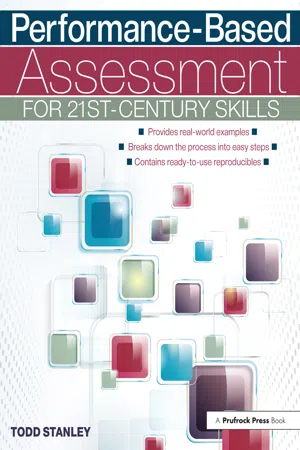
Performance-based assessments allow classroom teachers an alternative to traditional multiple-choice tests. We often use fill-in-the bubble assessments in education to determine the readiness of students. However, in the 21st-century workplace, these types of tests fail to truly prepare students. How many times in the real world are we called upon to take a multiple-choice test? In the real world, we are called upon to prove our merit through performance-based assessments, displaying our 21st-century skills. We should be preparing students for this in the classroom. Performance-Based Assessment for 21st-Century Skills makes the argument that teachers should use performance-based assessments in the classroom. It guides the educator step by step to show how he or she can create performance-based assessments for students, including what they look like, teaching students how to create them, setting the proper classroom environment, and how to evaluate them.
- 214 pages
- English
- ePUB (mobile friendly)
- Available on iOS & Android
eBook - ePub
Performance-Based Assessment for 21st-Century Skills
About this book
Information
CHAPTER 1
A Case for Performance-Based Assessment
DOI: 10.4324/9781003237129-2
It seems there is an objective multiple-choice test for everything. If you want to get into college, you have to take the SAT or ACT, often both. If you want to be a doctor or lawyer, you have to pass the MCAT or pass the bar exam. Even if you want to drive, you must first take a pencil-to-paper test in which you essentially determine which of four letters is more attractive than the others. The interesting aspect about all of these is that in order to show success in the field in which you take a test to get into, it always comes down to performance. You can score very high on the SAT or ACT, but in college you have to show up to classes and perform in order to succeed. As a doctor or lawyer, you may pass the MCAT or the bar, but the true merit of a successful doctor or lawyer is how well she performs in the field. Even passing the writing portion of your driver’s test does not necessarily correlate with how well you will perform once you get in the car and have to maneuver the vehicle on the road. With this logic, would we not be better off having people take tests that evaluate the performance rather than a multiple-choice assessment that evaluates memorization? Would this not be a better indicator of the success a person might have once he or she actually gets in the field and has to perform in the real world?
School systems spend nearly the entire year evaluating the performance of students. How well do they participate in class? How often do they get their homework completed? Do they show a deep understanding of the material and concepts being taught? And yet at the end of the year, we have it all boil down to an objective multiple-choice test that the state has dictated must be given to all students. Since the No Child Left Behind Act came out in 2001, we have been pushing students to tell us what they have learned on pencil-to-paper tests with a lot of accountability tied to the results. School districts are evaluated based on these scores, principals are held accountable when their schools do not perform well, and teachers feel the pressure for students to do well. Because of this, we have developed strategies for students to do better on these types of tests. One of those strategies involves modeling all assessments in the classroom so that students are familiar with both the format and the way the content is delivered. As a result, students are getting really good at filling in little bubbles. The problem is that they are losing those valuable performance-based abilities, many of which are 21st-century skills.
The powers that be in education are starting to realize the value in performance-based assessment. That is why a new state testing system, the PARCC (Partnership for Assessment of Readiness for College and Careers), will incorporate a performance aspect to it. Unlike the state tests of the past, which focus only on multiple-choice questions with some written responses, this test will be broken down into two parts. There will be the traditional end-of-year assessment in which students demonstrate their reading comprehension and mathematical problem-solving skills. The second part will be a performance assessment aspect that will look at students’ ability to analyze and understand how a problem is solved. There are 20 states already planning on using the PARCC Assessment with more sure to follow.
In addition, many states are employing the Common Core State Standards (CCSS). These are learning objectives that many states are using to add rigor in the classroom and ensure we are producing 21st-century students who are ready to use these skills in a global work force. Many of the standards have the term “real world” in them just to make sure students get the point of how important being able to apply these skills in the real world is. Many of these CCSS are also written in a way that lends them to performance-based assessment. Take these examples of Common Core State Standards (National Governors Association Center for Best Practices & Council of Chief State School Officers, 2010a; 2010b):
CCSS ELA.Literacy.W.6.7: Conduct short research projects to answer a question, drawing on several sources and refocusing the inquiry when appropriate.CCSS Math.Content.2.MD.D.10: Draw a picture graph and a bar graph to represent a data set with up to four categories. Solve simple put-together, take-apart, and compare problems using information presented in the bar graph.
How could a student conduct a short research project without producing a performance-based assessment, whether it is via a research paper or a presentation? Drawing picture and bar graphs are examples of PBAs in that students actually have to create something. The direction of education naturally takes us toward performance-based assessment. Wouldn’t you rather be on the rising tide of this movement rather than on the end of the crashing wave?
The reason for these changes is the realization that objective testing is not necessarily causing our students to have enduring understanding. Asian schools consistently score well on international academic tests and match this assessment practice by placing a heavy emphasis on rote memorization. The problem with this is that these very same students who score so well retain the information for the least amount of time, meaning they cannot apply what they have supposedly learned (Robbins, 2006). Is our goal as educators for students to know information just long enough to score well on the test, or is the goal for students to learn the content for life? If you think our goal is to provide an enduring understanding, PBA is the method that will best produce this:
An alternative method of evaluating students is “performance assessment,” which appraises students on items such as portfolios, projects, and writing samples. Students will be more prone to “deep approach” learning rather than superficial, temporary memorization of facts, and teachers will have the chance to spend semesters actually teaching rather than reviewing for an exam. (Robbins, 2006, p. 391)
What we should be teaching our students are life-long skills they can use when needed. We could view this building of skills as creating a Swiss Army knife. Swiss Army knives have several different tools that can be utilized depending on the situation. If you need to unscrew something, pull out the screwdriver blade. If you need to open a bottle of pop, flip out the bottle opener. If you have to cut out a coupon, deploy the little pair of scissors. Even if you have a piece of corn stuck in your teeth, you can use the little toothpick attachment. You do not pull out the single large blade to try to accomplish all of these tasks because you would end up severely limited in what you could do and how well it could be done (and you would probably hurt yourself). Similarly in education, rather than teaching students one way to learn, or equipping them with only the one blade, we should be teaching them various ways to learn so that they can use the appropriate tool for the appropriate task. Performance-based assessment gives students these tools to develop their Swiss Army knives. The question is: What tools should students have in their Swiss Army knives?
The most compelling case for PBA is that it utilizes real-world skills—also known as 21st-century skills—that are valuable no matter what a student envisions her future to be. These are the skills students should be developing as their Swiss Army knives. Think of the ancient Confucian proverb: “If you give a person a fish, he eats for one day. If you teach that person to fish, he can eat for the rest of his life.” In other words, if you simply give students the answers, they only know the answers and are very limited in their education. If you teach them how to learn, they can find the answers themselves and the sky is the limit. As a caveat to this proverb, though, you might have to teach students a few different ways to fish. In other words, if students learn only one way to fish, they may catch only one type of fish. If the stock for that fish runs out, or the students are just getting tired of having the same kind of fish over and over, or if it is just not the students’ strength to fish in that way, it is good to have multiple ways to accomplish the task. The students can choose the method that best plays to their strengths. This is why teaching students multiple methods of PBA is very valuable. If you focus on a single method, you limit learning. You want your students’ Swiss Army knives to have multiple blades for multiple situations.
In the book, 21st-Century Skills: Learning for Life in Our Times by Bernie Trilling and Charles Fadel (2012), the authors mention among valuable 21st-century skills eight specific skills that PBA can teach very effectively:
- public speaking,
- problem solving,
- collaboration,
- critical thinking,
- information literacy,
- creativity,
- adaptability, and
- self-direction (p. viii).
Let us take a closer look at each of these, what the skill involves, how performance-based assessment can successfully teach it, and why it will be important to your students.
PUBLIC SPEAKING
Public speaking is an invaluable skill for any person to have. One of the major reasons for this is that not everyone is able to do it. If you are someone who can speak in public and do it well, you have an advantage over others. Many people have a fear of speaking in public. The National Institute of Mental Health indicated that 74% of Americans suffer from a fear of public speaking (Statistic Brain, 2013). That is three out of every four people. This fear of public speaking, known as glossophobia, is something that can be overcome, especially if you start the process before it becomes a deep-rooted fear. Experience tends to be the best coping mechanism. The more experience someone has at something, the less likely she is going to panic. An extreme example of this would be how some police departments train their officers to deal with a dog attack. They put their officers in a padded suit and then turn an attack dog loose on them. The officer, of course, initially panics, not knowing exactly what to do, but because he is in the padded suit, he is not harmed. The next time, the officer has a better idea of what to do, learning from mistakes he made the first time. By the sixth time the dog has been allowed to attack, the officer’s first instinct is not to panic, but rather to remember the training he has had so far and to recall his past experiences. Eventually, if the officer is attacked in the field without the padded suit, the officer can draw off of his experiences and handle the situation in a calmer manner than if he had had no previous experience.
The point of this example is that you need to give your students the chance to gain experience without the fear of getting hurt. In short, you have to provide opportunities for your students to speak in class. Every experience you give them will provide that much more confidence in their ability to publically speak. And just like the police department training, you have to make sure they feel safe. Your classroom needs to feel like a place where mistakes can be made and where students do not have to be perfect. Mistakes are how some of the best lessons are learned.
One way to provide an opportunity for students to speak is to make public speaking a normal part of the class routine. For instance, when running a gifted resource elementary pull-out program, I provided an opportunity every class for a student to speak in public in what was called a “literature circle.” During the literature circle, a student presents to the class a book she has read and enjoyed. We set a casual setting with the students putting their chairs in a circle. This way, the speakers did not feel the pressure of the spotlight and were more at ease to present their information. Students were also given guided discussion questions, which they used to create their responses. This way, the presenting students had something to base their performance on. The guided questions made them feel as though they had a support to stand on. The questions were also fairly open-ended and require higher level thinking, so there was not a correct answer per se. (Note: The guided questions I used for the literature circle can be found in Appendix A in the back of the book.) The responses were based mostly on the opinions of the students. They just needed to be sure to back up their points of view with examples from the text. This was done to allow students to think at a higher level but also to provide the safety to share opinions and not make the setting too stressful by having a right or wrong answer. Making the setting more relaxed and giving students guidance made the act of public speaking easier to experience.
There are several reasons why the ability to publically speak is so important, but here are a few:
- Public speaking increases self-confidence.
- Public speaking makes you more comfortable around other people.
- Public speaking is one of the most effective ways to get your message across.
- Skills learned through public speaking can boost performance in other areas in life.
- Public speaking allows you to demonstrate your knowledge.
- Public speaking allows you to improve upon your knowledge.
- Public speaking differentiates you in the workplace.
- Public speaking prepares you to be a leader. (Ryan, 2013, para. 5)
When students get out in the real world and are looking for a job, they will likely be competing with thousands of other graduates. What will make someone stand out from all of these people? What will allow potential employers to notice him over the others? The ability to effectively speak in public is an obvious answer.
Using PBA in your classroom will give your students the experience to become more comfortable with public speaking. The more confidence they gain, the better they are going to be at it.
PROBLEM SOLVING
The ability to problem solve is a skill students will use for the rest of their lives. What employer would not want someone who is adept at solving problems? So...
Table of contents
- Cover
- Half Title
- Title Page
- Copyright Page
- Table of Contents
- Introduction What Is Performance-Based Assessment?
- Chapter 1 A Case for Performance-Based Assessment
- Chapter 2 Advantages of Performance-Based Assessment
- Chapter 3 Types of Performance-Based Assessment
- Chapter 4 How To Teach Performance-Based Assessment
- Chapter 5 How To Evaluate Performance-Based Assessment With Rubrics
- Chapter 6 How to Make the Performance-Based Assessment Authentic
- Conclusion
- References
- Appendix A Reproducibles
- Appendix B Mock Trial Sample Lesson
- Appendix C Additional Examples of Performance-Based Assessment Lessons
- About The Author
Trusted by 375,005 students
Access to over 1.5 million titles for a fair monthly price.
Study more efficiently using our study tools.
Frequently asked questions
Yes, you can cancel anytime from the Subscription tab in your account settings on the Perlego website. Your subscription will stay active until the end of your current billing period. Learn how to cancel your subscription
No, books cannot be downloaded as external files, such as PDFs, for use outside of Perlego. However, you can download books within the Perlego app for offline reading on mobile or tablet. Learn how to download books offline
Perlego offers two plans: Essential and Complete
- Essential is ideal for learners and professionals who enjoy exploring a wide range of subjects. Access the Essential Library with 800,000+ trusted titles and best-sellers across business, personal growth, and the humanities. Includes unlimited reading time and Standard Read Aloud voice.
- Complete: Perfect for advanced learners and researchers needing full, unrestricted access. Unlock 1.5M+ books across hundreds of subjects, including academic and specialized titles. The Complete Plan also includes advanced features like Premium Read Aloud and Research Assistant.
We are an online textbook subscription service, where you can get access to an entire online library for less than the price of a single book per month. With over 1.5 million books across 990+ topics, we’ve got you covered! Learn about our mission
Look out for the read-aloud symbol on your next book to see if you can listen to it. The read-aloud tool reads text aloud for you, highlighting the text as it is being read. You can pause it, speed it up and slow it down. Learn more about Read Aloud
Yes! You can use the Perlego app on both iOS and Android devices to read anytime, anywhere — even offline. Perfect for commutes or when you’re on the go.
Please note we cannot support devices running on iOS 13 and Android 7 or earlier. Learn more about using the app
Please note we cannot support devices running on iOS 13 and Android 7 or earlier. Learn more about using the app
Yes, you can access Performance-Based Assessment for 21st-Century Skills by Todd Stanley in PDF and/or ePUB format, as well as other popular books in Education & Education Teaching Methods. We have over 1.5 million books available in our catalogue for you to explore.