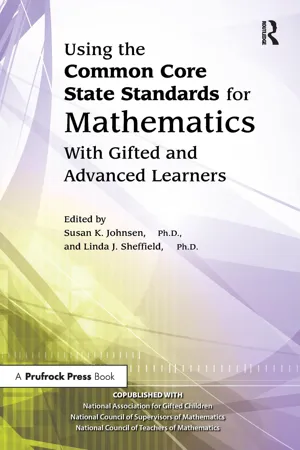
Using the Common Core State Standards for Mathematics With Gifted and Advanced Learners provides teachers and administrators examples and strategies to implement the new Common Core State Standards (CCSS) with advanced learners at all stages of development in K-12 schools. The book describes—and demonstrates with specific examples from the CCSS—what effective differentiated activities in mathematics look like for top learners. It shares how educators can provide rigor within the new standards to allow students to demonstrate higher level thinking, reasoning, problem solving, passion, and inventiveness in mathematics. By doing so, students will develop the skills, habits of mind, and attitudes toward learning needed to reach high levels of competency and creative production in mathematics fields.
eBook - ePub
Using the Common Core State Standards for Mathematics With Gifted and Advanced Learners
- 136 pages
- English
- ePUB (mobile friendly)
- Available on iOS & Android
eBook - ePub
Using the Common Core State Standards for Mathematics With Gifted and Advanced Learners
About this book
Information
Differentiating the Common Core State Standards for Gifted and Advanced Students
DOI: 10.4324/9781003239413-5
All differentiation is based on an understanding of the characteristics of gifted and high-potential students and the content standards within a domain. The new Common Core State Standards provide an opportunity for the field of gifted education to examine its practices and align them more fully to the 2010 NAGC Pre-K—Grade 12 Gifted Programming Standards for curriculum, instruction, and assessment. For example, similar to the NAGC Gifted Programming Standards, the CCSS emphasize problem solving (see Evidence-Based Practices 3.4.1-3.4.4, NAGC, 2010, p. 10, and Standards for Mathematical Practice 1, NGA & CCSSO, 2010a, p. 6). Because the Gifted Programming Standards in curriculum require educators to engage in two major tasks in curriculum planning—alignment to standards in the content areas and the development of a scope and sequence—using the CCSS is a natural point of departure. The effort must occur in vertical planning teams within districts and states in order to increase the likelihood of consistency and coherence in the process. There are three major strategies that may be employed to accomplish the task for gifted education:
- Provide pathways with appropriate pacing of the CCSS for gifted learners. Some of the CCSS address higher level skills and concepts that should receive focus throughout the years of schooling, such as a major emphasis on reasoning and sense-making. However, there are also discrete skills that may be clustered across grade levels and compressed around higher level skills and concepts for more efficient mastery by gifted students. Teachers might use preassessments in determining which students require more accelerated pacing. For example, within the CCSS domain of Measurement and Data, some students in first grade might be estimating lengths in standard units, while others might be solving problems involving measurement and estimation ofliquid, volumes, and/or masses of objects (grade 3) or converting like measurement units within a given measurement system (grade 5).
- Provide examples of differentiated task demands to address specific standards. Standards like problem solving in mathematics lend themselves to differentiated interpretation through demonstrating what a typical learner on grade level might be able to do at a given stage of development versus what a gifted learner might be able to do. The differentiated examples should show greater complexity and creativity using a more advanced curriculum base. In mathematics, whereas typical learners might solve multistep word problems using a variety of models and strategies throughout grades K-12, gifted learners might pose and solve new, related problems of their own at an earlier stage of development. Other degrees of differentiation may take place by adding complexity to the task and using enrichment techniques that address student needs and district demographics, such as using mathematical equations and modeling to solve community problems.
- Create in terdisciplinary product demands to elevate learning for gifted students and to efficiently address multiple standards at once. Because English language arts and mathematics standards can be grouped together in application, much of the project work that gifted educators might already use could be revised to connect to the new CCSS and to show how multiple standards could be addressed across content areas. For example, research projects could be designed that address the research standard in English language arts and the data representation standard in mathematics by (a) delineating a product demand for research on an issue, (b) asking researchable questions that require quantitative approaches, (c) using multiple sources to answer them, (d) collecting data, (e) interpreting data (e.g., by creating a scatterplot and deciding if there is a line of best fit and describing the related variables), and then (f) representing findings in tables, graphs, and other visual displays that are explained in text and presented to an audience with implications for a plan of action. Such a project might be possible for the gifted learner at an earlier grade than for a typical learner.
To differentiate the Common Core State Standards for Mathematics, educators need to be aware of the eight Standards for Mathematical Practice and additional standards that should be considered for promising mathematics students before differentiating the curriculum. This section will address these needs and provide specific examples of differentiation that examine learning progressions in operations and algebraic thinking, fractions and the number system, geometry, and statistics and probability.
The Common Core State Standards for Mathematical Practice
When considering the implications of the CCSS for the development of mathematical talent, it is important to take into account the eight Standards for Mathematical Practice that educators should seek to develop in their students in addition to the individual mathematics content standards. These Standards for Mathematical Practice are an integral part of the Common Core State Standards for Mathematics and are described in detail (NGA & CCSSO, 2010a, pp. 6-8). These build on the NCTM (2000) process standards of problem solving, reasoning and proof, communication, representation, and connections, and include the strands of mathematical proficiency specified in the National Research Council’s report Adding It Up (Kilpatrick, Swafford, & Findell, 2001): adaptive reasoning, strategic competence, conceptual understanding (comprehension of mathematical concepts, operations, and relations), procedural fluency (skill in carrying out procedures flexibly, accurately, efficiently, and appropriately), and productive disposition (habitual inclination to see mathematics as sensible, useful, and worthwhile, coupled with a belief in diligence and one’s own efficacy). The eight Standards for Mathematical Practice for all students from kindergarten through college and careers are:
- Make sense of problems and persevere in solving them.
- Reason abstractly and quantitatively.
- Construct viable arguments and critique the reasoning of others.
- Model with mathematics.
- Use appropriate tools strategically.
- Attend to precision.
- Look for and make use of structure.
- Look for and express regularity in repeated reasoning.
It is important that students actively engage in these practices daily in their mathematics classes. Students need ongoing opportunities to experience the joy of investigating rich concepts in depth and applying mathematical reasoning and justification to a variety of scientific, engineering, and other problems.
In order to support mathematically advanced students and to develop students who have the expertise, perseverance, creativity, and willingness to take risks and recover from failure, which is necessary for them to become mathematics innovators, we propose that a ninth Standard for Mathematical Practice be added for the development of promising mathematics students—a standard on mathematical creativity and innovation: Solve problems in novel ways and pose new mathematical questions of interest to investigate.
The characteristics of the new proposed standard would be that students are encouraged and supported in taking risks, embracing challenge, solving problems in a variety of ways, posing new mathematical questions of interest to investigate, and being passionate about mathematical investigations.
Developing Innovative and Creative Mathematicians
To aid in the development of passionate, innovative, and creative mathematicians, teachers might use a heuristic such as the one shown in Figure 2. Using this heuristic, students may start at any point on the diagram and proceed in any order. One possible order might be:
- Relate the problem to other problems that you have solved. How is this similar to other mathematical ideas that you have seen? How is it different?
- Investigate the problem. Think deeply and ask quest...
Table of contents
- Cover
- Half Title
- Title Page
- Copyright Page
- Table of Contents
- Foreword
- Preface
- Acknowledgments
- Introduction
- The Common Core State Standards
- Rationale for the Work
- Alignment to 21st Century Skills
- Research Support for the Effort
- Differentiating the Common Core State Standards for Gifted and Advanced Students
- Linking Mathematics and English Language Arts Standards
- Differentiating Assessments to Encourage Higher Level Reasoning and Creativity
- Talent Trajectory: Creating Pathways to Excellence in Mathematics
- Implementing the Common Core State Standards With Various Program Models in Gifted Education
- Alignment of the Common Core State Standards With the Gifted Education Programming Standards
- Implications for Professional Learning When Implementing the Common Core State Standards
- Collaboration With General and Special Education
- A Possible Timeline for Implementing the Common Core State Standards Locally
- Resources to Assist With the Implementation Process
- References
- Appendix A: Definitions of Key Terms
- Appendix B: Evidence-Based Practices in Gifted Education
- Appendix C: Annotated References on Mathematical Creativity and Giftedness
- Appendix D: Additional Mathematics Resources
- About the Editors
- About the Contributors
- About the Copublishers
Trusted by 375,005 students
Access to over 1.5 million titles for a fair monthly price.
Study more efficiently using our study tools.
Frequently asked questions
Yes, you can cancel anytime from the Subscription tab in your account settings on the Perlego website. Your subscription will stay active until the end of your current billing period. Learn how to cancel your subscription
No, books cannot be downloaded as external files, such as PDFs, for use outside of Perlego. However, you can download books within the Perlego app for offline reading on mobile or tablet. Learn how to download books offline
Perlego offers two plans: Essential and Complete
- Essential is ideal for learners and professionals who enjoy exploring a wide range of subjects. Access the Essential Library with 800,000+ trusted titles and best-sellers across business, personal growth, and the humanities. Includes unlimited reading time and Standard Read Aloud voice.
- Complete: Perfect for advanced learners and researchers needing full, unrestricted access. Unlock 1.5M+ books across hundreds of subjects, including academic and specialized titles. The Complete Plan also includes advanced features like Premium Read Aloud and Research Assistant.
We are an online textbook subscription service, where you can get access to an entire online library for less than the price of a single book per month. With over 1.5 million books across 990+ topics, we’ve got you covered! Learn about our mission
Look out for the read-aloud symbol on your next book to see if you can listen to it. The read-aloud tool reads text aloud for you, highlighting the text as it is being read. You can pause it, speed it up and slow it down. Learn more about Read Aloud
Yes! You can use the Perlego app on both iOS and Android devices to read anytime, anywhere — even offline. Perfect for commutes or when you’re on the go.
Please note we cannot support devices running on iOS 13 and Android 7 or earlier. Learn more about using the app
Please note we cannot support devices running on iOS 13 and Android 7 or earlier. Learn more about using the app
Yes, you can access Using the Common Core State Standards for Mathematics With Gifted and Advanced Learners by National Assoc For Gifted Children,Linda J. Sheffield in PDF and/or ePUB format, as well as other popular books in Education & Education General. We have over 1.5 million books available in our catalogue for you to explore.