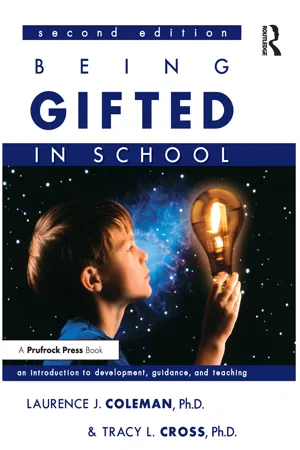
In this fully revised and expanded second edition, Being Gifted in School: An Introduction to Development, Guidance, and Teaching reviews the past developments within the field of gifted education and identifies the current trends, issues, and beliefs in the field.
This book offers the most comprehensive, up-to-date introduction to the field of gifted education available. The authors, who are nationally recognized leaders in the field, discuss definitions and models of giftedness, identification of the gifted, teaching methods and best practices, creativity, counseling and guidance, administrative arrangements, and program prototypes and evaluation.
The book is geared toward educators with questions regarding curricular and instructional implementation, administrators facing program planning, parents with an interest in their child's educational opportunities, and advanced undergraduate and graduate students curious about trends within gifted education.
By recognizing both typical and atypical gifted students, the authors enourage readers to defy traditional assumptions about gifted children and their education.
eBook - ePub
Being Gifted in School
An Introduction to Development, Guidance, and Teaching
- 470 pages
- English
- ePUB (mobile friendly)
- Available on iOS & Android
eBook - ePub
Being Gifted in School
An Introduction to Development, Guidance, and Teaching
About this book
Information
Chapter One
DEFINITIONS AND MODELS OF GIFTEDNESS
KEY CONCEPTS
- • The basic concept of giftedness has existed in different societies throughout the world for thousands of years.
- • Giftedness is viewed both positively and negatively by educators and the public.
- • Stereotypes of giftedness are remarkably resistant to change.
- • Giftedness is not a synonym for genius.
- • Since the 1950s, new definitions of giftedness have become increasingly broad.
- • The many definitions of giftedness may be grouped into categories.
- • Gifted children come in countless varieties.
DOI: 10.4324/9781003233213-1
The idea that human beings possess a wide range of abilities and skills is not new. For centuries, societies throughout the world have recognized that some individuals are more successful at some tasks than others. To address the needs of those with high ability, societies have developed various organizational structures. Individuals with important and valued skills have received more recognition and support than others. Consequently, every society has gained from the efforts of gifted and talented individuals.
Because the recognition of people of high ability and talent is not new and because such recognition may benefit a society, it is not surprising that there is a history of organized programs for the identification and education of the gifted. In ancient Greece, Plato proposed a plan whereby gifted children would be identified and educated. He suggested that these children were to be found within all levels of society and that they could be identified by their abilities to learn through trial and error, notice superstition, and discern deceit. Those who met the criteria were to be educated in science and philosophy (Freehill, 1961).
Further indications of interest in the gifted can be found in later historical periods. In 8th-century France, Emperor Charlemagne is reported to have been interested in finding talent among the common man (Hildreth, 1966). In the 15th and 16th centuries, during the spread of the Turkish Empire, an effort was made to recruit talented children from all social classes. Scouts were to locate children among the subjugated Christian populations and bring them to a special school in Constantinople where they were to be trained in Islamic science, religion, and art and to serve the interests of the empire (Freehill, 1961; Hildreth).
Interest in the gifted in the United States can be found in the writings of its founders. Most notably, Thomas Jefferson proposed that tests be instituted to identify the talented and that they be educated at public expense. In this regard, Jefferson wrote, "We hope to avail the State of these talents which nature has sown as liberally among the poor as the rich, but which perish without use, if not sought for and activated" (Hildreth, 1966, p. 43). This line of reasoning advocated by Jefferson has persisted over the last 200 years with varying levels of interest. Efforts to identify and establish programs for gifted and talented children have occurred across the country, especially in the latter part of the 19th century (Tannenbaum, 1958). Many of the ideas inherent in these efforts have continued in somewhat modified forms until today, reflecting the variety of ideas that exist about the education of gifted and talented children (Passow, 1979).
Along with this variety of positive efforts can be found negative efforts, although the presence of novel abilities is not usually met with highly visible repressive acts. Instead, gifted people receive negative reactions that are expressed in much subtler ways from parents, educators, and society at large.
When prospective parents say, "I just want a normal, healthy child," they may be stating their fear of having a child with learning problems, as well as their fear of having a "different" child. Normality is attractive. Abnormality, even if it is supernormality, is not desirable. Consider this familiar statement, which might be overheard at a family gathering: "We love Mary, we love her for her abilities, but why can't she be like us?" What kind of subtle message is Mary likely to be receiving about herself? This discomfort with giftedness has also been observed when parents brag about their child to others while asking the child to be less visible.
Educators, too, have their own forms of negative reactions to gifted abilities. A most effective brake is put on ability when children are required to master underlying steps and knowledge after they have already demonstrated mastery at a higher level. One might suspect that the goal of creating well-rounded children has a concealed, homogenizing, negative effect on children with special abilities.
The presence of negative images about gifted people is obvious from many other sources. Popular sayings or proverbs such as "The cream always rises to the top" and "A flash in the pan" are prime examples. Other sayings like "Smart Alec" and "Don't get smart with me" are common criticisms in our society. Moreover, popular movies portray gifted people as frail (Powder, 1995); psychologically damaged (Shine, 1996); dysfunctional (Little Man Tate, 1991); idealistic, but misguided (The Nutty Professor, 1996); and even violent (Good Will Hunting, 1997). Perhaps the simplistic notion of compensation—that bright people are physically weak or socially inadequate—is a form of hostility toward high ability.
The persistence of these images and myths about the gifted is striking because evidence to the contrary has been present for 80 years (Terman, 1925). These myths or stereotypical notions pervade most areas of life. Some of them are summarized in Table 1.1 by Sellin and Birch (1980). Note how these myths cover schooling, family life, and interpersonal relationships.
| 1. Parents of average or retarded children cannot have gifted children. |
| 2. Gifted and talented people are physically weak. |
| 3. Gifted and talented people are morally lax. |
| 4. Gifted and talented people tend to be mentally unstable. |
| 5. Gifted and talented people are socially inept and narrow in interests. |
| 6. Most eminent men and women were indifferent scholars as children. |
| 7. Most gifted and talented children are "flash-in-the-pan" performers. |
| 8. Gifted and talented people have a single talent. |
| 9. Gifted and talented people tend to be odd. |
| 10. Gifted and talented people tend to feel superior to other people. |
| 11. Grade skipping, or acceleration, harms gifted and talented children. |
| 12. Gifted and talented children require a different curriculum. |
| 13. Teachers are poor identifiers of gifted and talented children. |
| 14. Special classes are to be preferred to inclusion in regular grades. |
| 15. The identification of gifted and talented children should be delayed until grade 3. |
| 16. Enrichment of the regular curriculum is not effective. |
| 17. Parents of gifted and talented children are conceited. |
| 18. An IQ test is the only identifier of giftedness and talent. |
| 19. Gifted and talented people require no undue educational provisions. |
| 20. Society has little need of its gifted and talented citizens. |
| 21. College graduates are brighter than noncollege graduates. |
| 22. Special education of the gifted and talented causes elitism among students. |
| 23. Gifted and talented students dominate other students in regular grades. |
| 24. Memory is the best index of human intelligence. |
| 25. Interest in educating gifted and talented people has been of importance only since the 1960s. |
Note. From Educating Gifted and Talented Learners (p. 29), by D. F. Sellin and J. W. Birch, 1980, Rockville, MD: Aspen Systems, Copyright©1980 by D. F. Sellin. Reprinted with permission.
The persistence of these notions is the darker side of society's response to special abilities. Given these notions, it is no wonder that the talents of gifted children, especially young women and culturally different people, are frequently covered by a cloak of incompetence. After all, why should one deliberately choose to show off one's difference in an unaccepting environment? The impact of these popular stereotypical notions is examined at different points in this text in discussions about the impact of giftedness on the family and on the person.
WHO ARE THE GIFTED?
The concept of giftedness is commonly confused with the concept of genius. The two concepts are not synonymous, although they are frequently treated as such, The Oxford English Dictionary (Brown, 1993) defines gifted as "Endowed with a gift or gifts; spec. exceptionally talented or intelligent" (p. 1088) and genius as "Inborn exalted intellectual power; instinctive and extraordinary imaginative, creative, or inventive capacity . . .; a person having this" (p. 1076).
Although not synonymous, the concepts are related to each other. Some of this confusion may come from Terman's practice of referring to very high IQ scores as being in the genius range of intelligence. In order to distinguish between genius and giftedness, consider the following statements. A gifted child is rarely a genius. This statement is true because gifted children do not make contributions that are unique to their time in history. Prodigies are not geniuses. They do remarkable things for their age, but rarely things that exceed what gifted adults achieve or they themselves produce later in life.
A genius may have been identified as a gifted child. The criteria and procedures that are used to identify high ability in children are not the same as those used to define genius. A gifted child may become a genius. And, while we would like to identify the seeds of genius in children, currently we can only show that gifted children are likely to become gifted adults. We cannot demonstrate that being gifted points in any significantly predictable way to genius.
These statements add up to the conclusion that more clarity can be brought to the concept of being gifted in America by disassociating the two terms. The distinction can be sharpened by remembering Bronowski's (1973) attempt to distinguish between being extraordinarily clever and being a genius: "he was a genius, in the sense that a genius is a man with two great ideas" (p. 443).
DEFINITIONS OF GIFTEDNESS
A closer look at the historical perspective on programs previously outlined reveals differing viewpoints on the identification of particular abilities. The disagreement about what constitutes giftedness has led to an almost bewildering array of proposals on how to define giftedness. These definitions are probably a consequence of the values of the person making the proposal, the social climate of the time, and the gradual changes in our knowledge about human abilities. The many varieties of definitions are organized in this section to illustrate their evolution and their differences. The historical point of departure is the end of the 19th century, and the definitions to be discussed are relevant to the United States. One should remember that a discussion about definitions of giftedness is inevitably tied to how one might identify people with gifted characteristics. The definitions of giftedness are summarized in Table 1.2.
EX POST FACTO
Before the 20th century, the majority of definitions could be called ex post facto definitions of giftedness (Lucito, 1963). These definitions designated a person as gifted when he or she made an outstanding and new contribution to society. If one were to identify the gifted using this definition, it would be appropriate to wait for the contribution to become readily apparent. This type of definition effectively eliminates most children from consideration because it is unlikely that a child would produce something that could be called new and outstanding for a culture. Incidentally, many gifted people were recognized only after their death. An example in this century is the composer Belá Bartók, who died unrecognized and in near poverty in 1945.
The ex post facto definitions are fatalistic because they suggest that giftedness will emerge over time. Those who argue that "true" giftedness will emerge are comfortable with this type of definition. People who subscribe to Galton's...
Table of contents
- Cover
- Half Title
- Title Page
- Copyright Page
- Dedication
- Contents
- 1. Definitions and Models of Giftedness
- 2. The Lives of Gifted People
- 3. Identifying the Gifted
- 4. Families: Guidance Considerations
- 5. Coping With Giftedness: Guidance and Counseling Considerations
- 6. Creativity: Psychology, Development, and Teaching
- 7. Administrative Arrangements, Program Prototypes, and the Teacher
- 8. Curriculum Theory and Practice
- 9. Teaching Theory
- 10. Teaching Methods and Best Practices
- References
- Index
Trusted by 375,005 students
Access to over 1.5 million titles for a fair monthly price.
Study more efficiently using our study tools.
Frequently asked questions
Yes, you can cancel anytime from the Subscription tab in your account settings on the Perlego website. Your subscription will stay active until the end of your current billing period. Learn how to cancel your subscription
No, books cannot be downloaded as external files, such as PDFs, for use outside of Perlego. However, you can download books within the Perlego app for offline reading on mobile or tablet. Learn how to download books offline
Perlego offers two plans: Essential and Complete
- Essential is ideal for learners and professionals who enjoy exploring a wide range of subjects. Access the Essential Library with 800,000+ trusted titles and best-sellers across business, personal growth, and the humanities. Includes unlimited reading time and Standard Read Aloud voice.
- Complete: Perfect for advanced learners and researchers needing full, unrestricted access. Unlock 1.5M+ books across hundreds of subjects, including academic and specialized titles. The Complete Plan also includes advanced features like Premium Read Aloud and Research Assistant.
We are an online textbook subscription service, where you can get access to an entire online library for less than the price of a single book per month. With over 1.5 million books across 990+ topics, we’ve got you covered! Learn about our mission
Look out for the read-aloud symbol on your next book to see if you can listen to it. The read-aloud tool reads text aloud for you, highlighting the text as it is being read. You can pause it, speed it up and slow it down. Learn more about Read Aloud
Yes! You can use the Perlego app on both iOS and Android devices to read anytime, anywhere — even offline. Perfect for commutes or when you’re on the go.
Please note we cannot support devices running on iOS 13 and Android 7 or earlier. Learn more about using the app
Please note we cannot support devices running on iOS 13 and Android 7 or earlier. Learn more about using the app
Yes, you can access Being Gifted in School by Laurence J. Coleman,Tracy L. Cross in PDF and/or ePUB format, as well as other popular books in Education & Education General. We have over 1.5 million books available in our catalogue for you to explore.