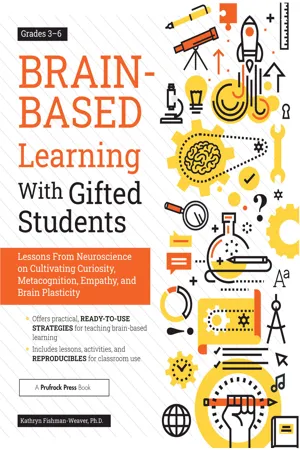
When students learn about cardiovascular health, they make choices that are healthier for their hearts and circulatory system. When they join an athletic team, coaches teach them the rules of the game and also how their muscles work and can grow stronger. Brain-Based Learning With Gifted Students offers similar research-based information for educators and students to explore how learning happens and how they can become more adept learners. Understanding how the brain works is a relevant and engaging topic of inquiry for the gifted education classroom.
Lessons from neuroscience give teachers a platform to better understand the particularities of giftedness, including asynchrony, affective development, emotional regulation, and talent development. This field also provides compelling interdisciplinary language to help students understand their unique brains. Imaging technology and research continue to show that the human brain is complex and individualized. Yeh and colleagues (2016) at Carnegie Melon used imaging technology to show that (1) every human brain is unique, (2) connections are very plastic, and (3) researchers can chart some changes in the brain due to social and environmental factors. They stated, “The specific brain characteristics that define an individual are encoded by the unique pattern of connections between the billions of neurons in the brain” (para. 1). In the words of neuroscientist Nicole Tetreault (2019), the brain is “as distinctive as a fingerprint” (para. 2). It is important and empowering for children to know that their brains are unique, special, and constantly developing over their lifetime.
How to Use This Book
Each chapter is organized around a specific neuroscience concept for educators and their students to explore together. This book is not a scripted curriculum; instead it provides research-based information and engagement opportunities aligned with big ideas in science. The activities and lessons in this book give students an opportunity to learn about neuroscience within the context of understanding and caring for their unique brains and those in their communities.
The chapters include three distinct sections:
- ■ A clear and concise research overview on why this concept works and matters. The research rationale gives educators important background information for the unit of study.
- ■ Specific activities and reproducibles for teaching this concept in your classroom. Each set of activities concludes with a synthesizing “make it stick” project.
- ■ Extension ideas and transfer notes. These are ways to stretch and deepen these activities based on the unique interests and needs of your students. This section includes a discussion of how to apply this brain-based concept to other content areas.
Big Ideas in Science
The Next Generation Science Standards (NGSS Lead States, 2013) identify a set of crosscutting concepts that connect scientific domains. Calling out crosscutting concepts helps students understand the interrelating knowledge between science fields as students build a worldview of observing and understanding phenomena scientifically. This book focuses students’ (and teachers’) attention on five Big Ideas in Science informed by the NGSS. These include: Patterns, Cause and Effect, Structure and Function, Stability and Change, and Interdependence.
Eight Essential Concepts
There are eight key neuroscience concepts in this book:
- ■ Concept 1: Brain Anatomy 101
- ■ Concept 2: Interrogative Inquiry
- ■ Concept 3: Maximizing Metacognitive Moments
- ■ Concept 4: Sparking Connection With Wonder
- ■ Concept 5: Social Cognition
- ■ Concept 6: Neuroplasticity
- ■ Concept 7: Emotional Regulation
- ■ Concept 8: Keeping the Brain Healthy
Although I was purposeful in designing a scope and sequence, I know readers may have different pressing needs in their classroom. For example, you might need background information and activities on social cognition right now. If so, start there and then return to the beginning and work through the units as intended with your students.
Gifted Programming Standards
The chapters in this book are presented for inquiry with gifted students. All activities are aligned to the updated National Association of Gifted Children (NAGC, 2019) Pre-K–Grade 12 Gifted Programming Standards. A chart listing the standards addressed in each chapter can be found in the NAGC Programming Standards Alignment at the end of the book.
A Few Introductory Notes
Brain-Based Learning
Whenever teachers engage students in learning, problem solving, critical thinking, or connecting their thoughts, feelings, and behaviors, they are also engaging the brain. Learning and the brain are integrally connected. Although classrooms are learning-rich spaces, are they brain-based spaces?
How much do educators know about the brain? How much professional development do teachers receive on cognition, affect, and neuroscience? Are teachers engaging in brain-based learning by chance, or are they building their practices on a body of well-vetted research about the brain? Classroom communities are deeply invested in learning, memory, emotional regulation, and decision making; therefore it makes sense for both students and teachers to know more about how this process happens in the brain.
I encourage educators to think of this as the intersection between brain science and classroom practice. In the last 10 years, brain-based learning has gained popularity as a high-interest topic for educators seeking to better understand and serve the diverse learners in their classrooms. Brain-based learning refers to instructional strategies grounded in the neuroscience of learning. Although teachers engage the brain whether or not they have in-depth knowledge of brain processes, won’t they engage students more effectively if they know more about how the brain functions and processes information? Those working in neuroeducation believe this is a worthy hypothesis. Throughout the following chapters, I invite you to test this hypothesis in your school community.
Democratizing Neuroscience
Embarking on this project sent me into a notable spiral of imposter syndrome. Before anyone found out I was working on such a project, I wanted to be sure that I could answer any question that might come up about the amygdala, hippocampus, or frontal cortex. I dove into highly technical texts on neurology, neuroscience, and neuroeducation. I took detailed notes and quizzed myself on the function of the thalamus, the occipital lobe, and reticular activating system.
My fascination with the brain wasn’t new. Diagnosed with chronic migraines as a toddler and identified as gifted in elementary school, I have long been interested in understanding both the brain at large as well as the particular functions of my own unique brain. In first grade I brought in an MRI scan of my brain for show-and-tell and then gave a presentation on magnetic imaging. During my graduate program in special education, I studied cognition as it related to learning disabilities and differences. My Ph.D. research explored the affective domain. All of this is to say: I had valid reasons for proposing this project, so why the hesitation to tell others?
I knew just enough about the brain to know how little I knew, and I was worried about being found out for my limitations. As professionals, we must stop doing this to ourselves. Although I certainly don’t have the same understanding of brain function that a neurologist or neuroscientist has, my experiences with how brain-based research impacts teaching and learning offers a valuable perspective for classroom practice. In fact, educators are among the best-suited professionals to shed light on how neuroscience can be translated to the classroom.
Teachers, particularly teachers of students who learn differently, including those in gifted programs and special education services, need and deserve access to the latest research in neuroscience. Given their professional work, these educators also have experiences and questions that could push brain-based research forward in new and exciting ways. Just as a teacher can appreciate a journal about a memory study, a neuroscientist can appreciate an academic paper on reading development. In fact, in both of these examples, cross-disciplinary connections strengthen what the reader brings to these texts. In this highly connected world, this book is, in part, a call to cultivate interdisciplinary conversations about the brain and learning.
It is my great hope that Brain Based Learning With Gifted Students sparks this same joy for discovery and exploration in your own classrooms, schools, and districts.
KEY TERMS FOR EDUCATORS
- • Brain-based learning: Instructional strategies grounded in the neuroscience of learning; the intersection between brain science and classroom practice.
- • Growth mindset: Dweck’s (2006/2016) applied theory on achievement and learning based on nurturing persistence and process while celebrating challenge and resilience.
- • National Association for Gifted Children (NAGC): National organization with strong state-level connection focused on education, advocacy, community building, and research around supporting gifted and talented students and educators working with these populations.
- • Neuroeducation: A division of neuroscience focused on brain processes that help or impede learning, cognition, retention, memory, sensory processing, learning disabilities, emotional regulation, and giftedness.
- • Neuroscience: Interdisciplinary field of science studying the brain.