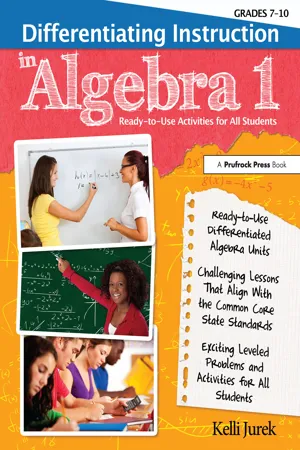
Teachers often have too little time to prepare differentiated lessons to meet the needs of all students. Differentiating Instruction in Algebra 1 provides ready-to-use resources for Algebra 1 students. The book is divided into four units: introduction to functions and relationships; systems of linear equations; exponent rules and exponential functions; and quadratic functions. Each unit includes big ideas, essential questions, the Common Core State Standards addressed within that section, pretests, learning targets, varied activities, and answer keys. The activities offer choices to students or three levels of practice based on student skill level. Differentiating Instruction in Algebra 1 is just the resource math teachers need to provide exciting and challenging algebra activities for all students!
Grades 7-10
eBook - ePub
Differentiating Instruction in Algebra 1
Ready-to-Use Activities for All Students (Grades 7-10)
- 234 pages
- English
- ePUB (mobile friendly)
- Available on iOS & Android
eBook - ePub
Differentiating Instruction in Algebra 1
Ready-to-Use Activities for All Students (Grades 7-10)
About this book
Information
Unit 4
QuadRatic Functions
DOI: 10.4324/9781003234180-5
The final unit focuses on quadratic functions. Students will continue their study of nonlinear functions by identifying quadratic functions in tables, graphs, and equations and identifying the characteristics of quadratics. Real-life applications introduced through story problems are included in most lessons. The final project, which could be used as an authentic assessment, is a catapult project.
This unit begins with a pretest and four real-life applications of quadratic functions that can be discussed in small groups and then as a larger group. Many of the activities will offer the students an opportunity to choose learning activities according to their learning style, personal interests, and readiness level.
What Do We Want Students to Know?
| Common Core State Standards Addressed: • A.SSE.3a, 3b • AAPR.3 • A.CED.2 • A.REI.4a, 4b • F.IF.4, 6, 7a, 8a, 9 • F.BF.1 | Big Ideas • Quadratics are parabolas and must have a 2 as their highest exponent. • The zeros/solutions are where the parabola crosses the x-axis. • There are different ways to solve quadratics. • Different forms of quadratics provide different key information. • Quadratics can model many real-world situations. |
| Essential Questions • What does it mean to find the zeros/solutions? • What is a parabola? • How do I determine the best method to solve a quadratic? • What information do I need to sketch a quadratic? |
Critical Vocabulary
| Parabola | Function | x-intercept |
| y-intercept | Zeros(roots) | Axis of symmetry |
| Maximum value | Minimum value | Vertex |
| Quadratic function | Quadratic formula | First differences |
| Second differences | Terms |
Unit Objectives
As a result of this unit, students will know:
- ➤ quadratic functions have an independent variable raised to a second power,
- ➤ when quadratic functions are graphed they are shaped like parabolas, and
- ➤ all quadratic functions have a vertex, a line or symmetry, and a minimum or maximum.
As a result of this unit, students will understand that:
- ➤ quadratic functions can be written in three different forms, and each form provides key information about the quadratic;
- ➤ quadratic functions can have zero, one, or two solutions;
- ➤ quadratic functions can be solved using various methods; and
- ➤ quadratic functions model real-life situations.
As a result of this unit, students will be able to:
- ➤ identify a quadratic relationship from a graph, table, or equation;
- ➤ find the vertex, axis of symmetry, and roots (zeros) from a graph, table, or equation;
- ➤ solve quadratic equations by graphing, factoring, completing the square, or using the quadratic formula; and
- ➤ interpret maximum and minimum points and intercepts in real-life applications.
Launch Scenarios
- ➤ After a soccer game, teammates shake hands to congratulate each...
Table of contents
- Cover
- Half Title
- Title Page
- Copyright Page
- Contents
- Acknowledgments
- IntRoduction
- Unit l IntRoduction to Functions and Relationships
- Unit 2 Systems of lineaR Equations
- Unit 3 Exponent Rules and Exponential Functions
- Unit 4 QuadRatic Functions
- AnsweR Key
- RefeRences
- About the AuthoR
- Common Core State standaRds Alignment
Trusted by 375,005 students
Access to over 1.5 million titles for a fair monthly price.
Study more efficiently using our study tools.
Frequently asked questions
Yes, you can cancel anytime from the Subscription tab in your account settings on the Perlego website. Your subscription will stay active until the end of your current billing period. Learn how to cancel your subscription
No, books cannot be downloaded as external files, such as PDFs, for use outside of Perlego. However, you can download books within the Perlego app for offline reading on mobile or tablet. Learn how to download books offline
Perlego offers two plans: Essential and Complete
- Essential is ideal for learners and professionals who enjoy exploring a wide range of subjects. Access the Essential Library with 800,000+ trusted titles and best-sellers across business, personal growth, and the humanities. Includes unlimited reading time and Standard Read Aloud voice.
- Complete: Perfect for advanced learners and researchers needing full, unrestricted access. Unlock 1.5M+ books across hundreds of subjects, including academic and specialized titles. The Complete Plan also includes advanced features like Premium Read Aloud and Research Assistant.
We are an online textbook subscription service, where you can get access to an entire online library for less than the price of a single book per month. With over 1.5 million books across 990+ topics, we’ve got you covered! Learn about our mission
Look out for the read-aloud symbol on your next book to see if you can listen to it. The read-aloud tool reads text aloud for you, highlighting the text as it is being read. You can pause it, speed it up and slow it down. Learn more about Read Aloud
Yes! You can use the Perlego app on both iOS and Android devices to read anytime, anywhere — even offline. Perfect for commutes or when you’re on the go.
Please note we cannot support devices running on iOS 13 and Android 7 or earlier. Learn more about using the app
Please note we cannot support devices running on iOS 13 and Android 7 or earlier. Learn more about using the app
Yes, you can access Differentiating Instruction in Algebra 1 by Kelli Jurek in PDF and/or ePUB format, as well as other popular books in Education & Teaching Mathematics. We have over 1.5 million books available in our catalogue for you to explore.