eBook - ePub
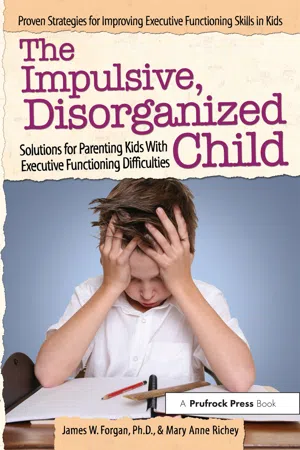
The Impulsive, Disorganized Child
Solutions for Parenting Kids With Executive Functioning Difficulties
- 280 pages
- English
- ePUB (mobile friendly)
- Available on iOS & Android
eBook - ePub
The Impulsive, Disorganized Child
Solutions for Parenting Kids With Executive Functioning Difficulties
About this book
Impulsive, scattered, lost, unfocused, unprepared, disorganized: These are just a few of the words used to describe kids with executive functioning deficits, which commonly affect many children already diagnosed with ADHD, learning disabilities, and autism. The Impulsive, Disorganized Child: Solutions for Parenting Kids with Executive Functioning Difficulties helps parents pinpoint weak executive functions in their children, then learn how to help their kids overcome these deficits with practical, easy solutions. Children who can't select, plan, initiate, or sustain action toward their goals are children who simply struggle to succeed in school and other aspects of life. Parents need the helpful, proven advice and interactive surveys and action plans in this book to empower them to take positive action to teach their disorganized, impulsive child to achieve independence, success, and a level of self-support.
Information
CHAPTER 1
The Big Deal About Executive Functioning
DOI: 10.4324/9781003238836-1
“Use what talents you possess;
The woods would be very silent
If no bird sang there except
Those who sing best.”—Henry Van Dyke
Self-Reflection Survey
Each self-assessment helps you reflect on your child and your parenting practices and is a preview to the chapter’s content.
- Up to this point, my knowledge about executive functioning skills is:
- very limited
- basic
- good but there are some gaps to fill
- extensive
- Eight-year-old Jenny waits until the last minute to complete assignments. She has executive functioning difficulty with:
- working memory
- planning
- self-regulation
- processing speed
- Sara is enthusiastic and fun to be around but she doesn’t always know when she is bothering others and when it’s time to tone things down. She has executive functioning difficulty with:
- working memory
- planning
- self-regulation
- time management
- Miguel is a 6-year-old charismatic boy (his classmates call him “the president”). When he arrives in the classroom, Miguel becomes so preoccupied with talking to others that he doesn’t complete his morning tasks. He has executive functioning difficulty with:
- self-regulation
- focusing
- goal setting
- inner talk
Answers: 2. b, 3. c, 4. b
Executive Functioning Skills Matter
Imagine you have a 7-year-old son, and everywhere he goes he leaves a path of destruction, as if a tornado has followed him. When he arrived home from school, his shoes were kicked off in the middle of the kitchen. His clothes were found strewn across the floor from the kitchen to his bedroom. His book bag was dropped in the middle of the hallway. And as if this were not enough, at some point he decided to make himself a peanut butter and jelly sandwich. The bread was left sitting open on the counter, the lid was off of the peanut butter jar, a sticky knife slathered with peanut butter was on the counter, and there were drips of jelly across the counter. Not to mention the jelly jar was also left open and teetering on the edge of the counter, at risk of falling over because it was left perched on top of a spoon. When you find your son watching TV, there’s a sea of crumbs on the couch where he is sitting and the family dog has licked his plate clean. This boy has executive functioning difficulties.
Executive function skills matter in everyday life as we decide what is important, determine how we are going to use our time, organize our materials, stay focused on a task until it is finished, monitor our progress, and regulate our emotions. Today we live in a fast-paced, pressure-filled, and ever-changing world where people are accustomed to giving, receiving, and processing information quickly, and schools are no exception. Although rapid access to information is useful, it often creates very significant challenges for school-age children with executive functioning difficulties. A child’s brain has to attend, take in all of this incoming information, decide whether it is useful, and if so, make sense of it and use it in some meaningful way.
Exactly What Is Executive Function?
There is ongoing discussion among researchers about exactly what is included in the term executive function. Generally speaking, it is an umbrella term for many different activities of the brain that orchestrate goal-directed action. “The term executive skills comes from the neuroscience literature and refers to the brain-based skills that are required for humans to execute or perform tasks” (Dawson & Guare, 2009, p. 13). One very simplified way to think of EF is that it is the management system of the brain. Executive function includes a person’s ability to:
- focus,
- decide what is important,
- set goals,
- use prior knowledge,
- initiate action,
- manage time,
- self-monitor performance,
- use self-restraint, and
- remain flexible.
Executive functions help modulate our attention, effort, and emotions so that we can plan, organize, and respond independently, consistently, and predictably. Having well-developed executive functions helps children regulate their behavior in social settings and their output on academic tasks.
Is There Some Agreement About What Executive Functioning Skills Are?
In our review of the literature, most authorities and researchers seem to agree EF is:
- the brain’s self-management system to organize behavior across time;
- an umbrella term for a number of different processes critical for day-to-day functioning;
- dependent on self-directed speech, rules, or plans;
- goal-directed and often involves delayed gratification;
- located primarily in the prefrontal cortex with connections to many other parts of the brain;
- developmental in nature with some abilities showing up in the first years of life;
- continuing to mature and develop into the teen and young adult years;
- more critical as organizational and independent functioning demands increase;
- impaired in many disorders, such as ADHD, learning disabilities, autism, and schizophrenia;
- not dependent on IQ, meaning some very bright children have EF dysfunction; and
- dependent on the situation, interest level for the task, as well as emotional/physical state.
If Executive Functions Are So Important, Why Haven’t You Heard This Term Before?
It has been a term familiar to neuroscientists for decades but has become a very “hot topic” in recent years among many professionals in the fields of mental health, medicine, child development, and education. EF has been the subject of numerous studies, books, and presentations as people in disciplines of psychology, education, and neurology try to understand how deficient executive functioning skills impact children’s development and ultimately their success as adults. Executive dysfunction is considered to be present in a number of disorders—ADHD, autism, schizophrenia, Obsessive-Compulsive Disorder, and dementia, to name a few, but can also occur alone. Knowledge about EF is changing the way people view and treat many of these disorders. For example, as a result of neuroimaging studies and extensive research into everyday functioning and learning, ADHD is no longer considered mainly a disruptive behavior disorder but a developmental neurological disorder related to the person’s self-management system. Coaching and assisting students in managing their EF difficulty has become a part of ongoing treatment for many.
What Causes Executive Dysfunction?
Difficulty with executive functioning is caused by faulty neural circuitry and can come from a variety of causes, including genetic or environmental factors. As noted above, it is present in a number of disorders shown to have a high degree of heritability, meaning their characteristics can be passed down from parent to child in some form or another. If your child has executive functioning problems, you did not intentionally cause it, but you can do lots of things to improve your child’s skills. Research has supported the plasticity of the brain and the potential for neural connections to be enhanced by experience. The purpose of this book is to teach you strategies to help any child presenting with impulsivity, poor organizational skills, weak memory, time management challenges, and other behaviors that relate to executive functioning.
EF is a very complex process involving brain structures and communication among the various regions via neural circuitry. It is not a unitary concept but involves communication and coordination among many different parts of the brain. Some executive functioning diffi-culties have been associated with structural/functional abnormalities in the interior prefrontal cortex. Malfunctioning synaptic connections among brain regions have also been implicated. Chronic stress, including abuse and neglect, has been shown to impact children’s developing neural structures. Research and history have shown that EF difficulties can also be induced by early trauma and serious head inju-ries (see later section on concussions in this chapter).
EF is a very complex process involving brain structures and communication among the various regions via neural circuitry.
EF skills are developmental and are thought to mature later in children with ADHD than in most others of the same age. Brown (2013) characterized the delay in development by saying,
They are highly heritable, and they are developmental in the sense that they do not unfold and “come on line” at the same time& as for most others of the same age. A number of imaging studies have demonstrated that children and adolescents with ADHD tend to show a lag of three to five years in the development of the brain infrastructure for executive functions relative to their peers. (p. 6)
Parenting styles don’t directly cause executive dysfunction. However, experiences involving opportunities to learn new things, thereby creating new and strengthening existing neural connections, and structured, secure environments providing opportunities for problem solving can enhance EF. Parents who have an understanding of their children’s EF difficulties can provide specific support in terms of breaking tasks down into smaller parts, providing visual supports in terms of lists, and other interventions that will be discussed at length in this book that can significantly improve functioning. Contextual variables, such as stress and illness can worsen a person’s EF. Recall a time when you were under stress—more than likely your planning, focus, and decision making were not as good as they usually are. It goes without saying that children exposed to constant stress and chaos will likely have difficulty attending, regulating behavior, and being task oriented.
Perspective on Concussions From a Neuropsychologist
Parents of children, especially those involved in youth sports, frequently read or hear about concussions in the popular press and wonder about the impact on executive functioning. We asked Dr. Jill Kelderman, Board Certified Clinical Neuropsychologist, to provide her perspective on concussions and their impact on children based on her review of the most current research and her practice.
A concussion, also called a mild traumatic brain injury (mTBI), is a blow to the brain that results in loss of consciousness of less than 30 minutes, minimal amnesia surrounding the event, and mild degrees of confusion. If a student loses consciousness for less than 30 minutes, or took a hard hit and was confused and/or disoriented but was not “knocked out,” he most likely sustained a concussion. A concussion can cause transient symptoms of executive dysfunction such as inattention and forgetfulness. Many people report headaches, irritability, fatigue, and feeling “foggy.” In isolation, a complete recovery from a concussion is expected within days to a few weeks, although some people report symptoms lingering for up to a month, or even longer. Symptoms can actually be prolonged or worsened when children, parents, and/or coaches worry excessively about the injury. Other factors, such as preexisting anxiety or stress, have also been associated with prolonged symptoms. Indeed, psychological, social, and motivational factors are better predictors of symptom duration in concussion than the actual severity of the concussion.
There is no scientific evidence to suggest a single, uncomplicated concussion has any long-term impact on executive functioning, or any other aspect of cognition. Sports-related concussion is currently a hot topic frequently mentioned in the popular media. There is no evidence that the physical contact that occurs in youth sports causes long-term problems with cognition. The likelihood that the average high school athlete will suffer brain damage from participating in sports is extremely low. Repeated concussions over the lifespan may have the potential to lead to psychiatric and neurological problems. Additional studies are needed, however, to fully understand this relationship.
Concussion management has evolved over the years. If an individual experiences a second concussion while he or she is still recovering from an initial concussion, there is concern the injury may be more substantive, as the brain is in a state of recovery. Currently, most doctors recommend a period of rest until the individual is asymptomatic. This may involve benching an athlete for several weeks or instructing a student to stay home to rest. These decisions must be weighed, however, with the cost of missing school and/or play for an extended period of time for each individual.
Complicated mTBI involves a concussion accompanied by a skull fracture or a small bleed in the brain. These injuries are more concerning, as the blow was substantial enough to cause observable injury to brain tissue. Recovery in these instances is expected to take longer and may require greater periods of rest. In some instances, complicated mTBI in childhood poses a risk for a long-term impact on neuropsychological functioning.
If your child sustains a simple concussion, understand the expectation is for a complete recovery within days to weeks. In the interim, he or she should rest and refrain from engaging in any activity that may place him or her at risk for another blow to the head. Heavy physical activity such as running or weightlifting should be avoided. Schools can provide excused absences and accommodations with proper documentation from a physician or neuropsychologist. If several weeks have passed and your child continues to complain of headaches, difficulty concentrating, or other symptoms, and/or appears lethargic, irritable, or groggy, consultation with a neuropsychologist or sports physician is warranted. If your child sustains a complicated mTBI, he or she will be referred for a neuropsychological evaluation, which will provide specific targeted interventions as needed.
What Areas of the Brain Are Involved in Executive Functions?
To build on Brown’s (2006) metaphor, the prefrontal cortex is considered to be the conductor of the brain’s orchestra. Its importance was highlighted by Dr. Christopher Kye (2014) in a recent presentation as he noted,
The prefrontal cortex is the area of the brain that is the most developed evolutionarily, the latest to mature developmentally, the most complex in its neural circuitry, the most sophisticated in the cognitive functions it mediates, and the most vuln...
Table of contents
- Cover
- Half Title
- Title Page
- Dedication
- Acknowledgements
- Copyright Page
- Table of Contents
- Introduction
- Chapter 1 The Big Deal About Executive Functioning
- Chapter 2 General Support for Executive Functioning Difficulties
- Chapter 3 Holding Back Impulses
- Chapter 4 Keeping Information in Working Memory
- Chapter 5 Shifting, Being Flexible, and Regulating Emotion
- Chapter 6 Focusing and Self-Monitoring
- Chapter 7 Not Just Ordinary Organizing
- Chapter 8 Managing Time
- Chapter 9 Taking Action
- Chapter 10 Sustaining Effort
- Chapter 11 Planning, Problem Solving, Goal Setting, and Using Critical Thinking
- Chapter 12 Children With Two Homes
- Chapter 13 Looking Forward
- References
- Appendix
- About the Authors
Trusted by 375,005 students
Access to over 1.5 million titles for a fair monthly price.
Study more efficiently using our study tools.
Frequently asked questions
Yes, you can cancel anytime from the Subscription tab in your account settings on the Perlego website. Your subscription will stay active until the end of your current billing period. Learn how to cancel your subscription
No, books cannot be downloaded as external files, such as PDFs, for use outside of Perlego. However, you can download books within the Perlego app for offline reading on mobile or tablet. Learn how to download books offline
Perlego offers two plans: Essential and Complete
- Essential is ideal for learners and professionals who enjoy exploring a wide range of subjects. Access the Essential Library with 800,000+ trusted titles and best-sellers across business, personal growth, and the humanities. Includes unlimited reading time and Standard Read Aloud voice.
- Complete: Perfect for advanced learners and researchers needing full, unrestricted access. Unlock 1.5M+ books across hundreds of subjects, including academic and specialized titles. The Complete Plan also includes advanced features like Premium Read Aloud and Research Assistant.
We are an online textbook subscription service, where you can get access to an entire online library for less than the price of a single book per month. With over 1.5 million books across 990+ topics, we’ve got you covered! Learn about our mission
Look out for the read-aloud symbol on your next book to see if you can listen to it. The read-aloud tool reads text aloud for you, highlighting the text as it is being read. You can pause it, speed it up and slow it down. Learn more about Read Aloud
Yes! You can use the Perlego app on both iOS and Android devices to read anytime, anywhere — even offline. Perfect for commutes or when you’re on the go.
Please note we cannot support devices running on iOS 13 and Android 7 or earlier. Learn more about using the app
Please note we cannot support devices running on iOS 13 and Android 7 or earlier. Learn more about using the app
Yes, you can access The Impulsive, Disorganized Child by James W. Forgan,Mary Anne Richey in PDF and/or ePUB format, as well as other popular books in Education & Education General. We have over 1.5 million books available in our catalogue for you to explore.