Children are fascinated by rocks. They enjoy digging in the ground and take pleasure in finding rocks of various types. The Earth Beneath Our Feet, an Earth science unit for high-ability third and fourth graders, builds on the excitement that students have by engaging them in hands-on scientific investigations about rocks. Students begin to explore and understand the major components of rocks, the rock cycle, and the important uses of rocks. The unit works to expand the students' content knowledge by including information about weathering and the impact that various natural and man-made processes have on the ground they walk on.
Grades 3-4
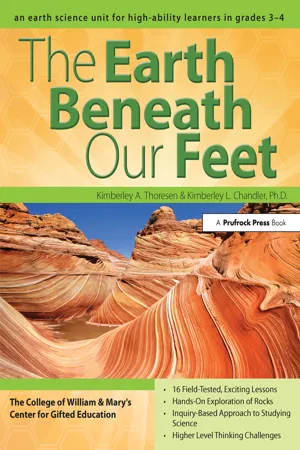
eBook - ePub
The Earth Beneath Our Feet
An Earth Science Unit for High-Ability Learners in Grades 3-4
- 140 pages
- English
- ePUB (mobile friendly)
- Available on iOS & Android
eBook - ePub
The Earth Beneath Our Feet
An Earth Science Unit for High-Ability Learners in Grades 3-4
About this book
Information
Part One: Unit Overview
DOI: 10.4324/9781003238775-1
Introduction to the Unit
DOI: 10.4324/9781003238775-2
The Earth Beneath Our Feet is a science unit designed to be used with high-ability third and fourth graders. Children are fascinated with soil. They enjoy digging in the ground and take pleasure in finding things like worms, insects, fossils, and rocks within the soil. This unit builds on the excitement that students have about investigating soil by engaging students in hands-on scientific investigations. Students in third and fourth grade begin to investigate and understand the major components of soil, its origin, and the important role it plays for humans. This unit works to expand on the content knowledge that students will develop by also including information about erosion and its impact on the land. Students participate in a variety of activities that expose them to the impact of natural and manmade processes on the weathering and erosion of rocks and soil. They also study the contemporary issue of fracking and why it is a controversial practice.
Curriculum Framework
The curriculum framework (see Table 1) is based on the Integrated Curriculum Model (ICM), which posits the relatively equal importance of teaching to high-level content, higher order processes and resultant products, and important concepts and issues. The model represents a research-based set of differentiated curricular and instructional approaches found appropriate for high-ability learners (VanTassel-Baska, 1986; VanTassel-Baska & Little, 2003). The framework serves several important functions:
- The curriculum framework provides scaffolding for the central concept of change, the scientific research process, and the content of the units.
- The curriculum framework also provides representative statements of advanced, complex, and sophisticated learner outcomes. It demonstrates how a single set of outcomes for all can be translated appropriately for high-ability learners yet can remain accessible to other learners.
- The curriculum framework provides a way for readers to get a snapshot view of the key emphases of the curriculum in direct relation to each other. The model also provides a way to traverse the elements individually through the continuum of grade levels.
- The curriculum framework provides information for students to be able to debate the potential advantages or disadvantages of the practice of hydraulic fracturing (fracking).
Standards Alignment
Each lesson was aligned to the appropriate Next Generation Science Standards (NGSS). Table 2 presents detailed information on the alignment between the NGSS and fundamental concepts within the unit lessons.
Macroconcept
The macroconcept for this unit is change. A concept paper on change is included in Appendix A. The second lesson in this unit introduces the concept of change. Students are asked to brainstorm examples of change, categorize their examples, identify "non
| Goal | Student Outcomes The student will be able to: |
|---|---|
| 1. Develop concepts related to understanding the world of science. | • Provide examples, illustrations, and salient features of important science and math concepts. • Categorize and/or classify various concepts. • Identify counterexamples of specific concepts. • Create definitions and generalizations about various concepts. |
| 2. Develop an understanding of the macroconcept of change as it relates to science content goals. | • Understand that change is everywhere. • Demonstrate the impact of time on change. • Articulate the nature of natural versus manmade change. • Evaluate the nature of change (predictable or random) in selected phenomena. |
| 3. Develop knowledge of selected content topics in Earth science. | • Understand how rocks are classified. • Understand the processes through which rocks can be changed from one type to another. • Describe and distinguish between weathering and erosion. • Articulate the factors that affect the formation of soil. • Articulate and describe the components of soil. • Name and describe the layers of soil. • Describe topsoil and articulate its importance. • Describe the negative and positive effects of erosion. • Describe why fracking is a controversial practice. |
| 4. Develop interrelated science process skills. | • Make observations. • Ask questions. • Learn more. • Design and conduct an experiment. • Create meaning. • Tell others what was found. |
| 5. Develop critical thinking skills. | • Describe problematic situations or issues. • Define relevant concepts. • Identify different points of view in situations or issues. • Describe evidence or data supporting a scientific question. • Draw conclusions based on data (making inferences). • Predict consequences. |
| 6. Develop creative thinking skills. | • Develop fluency when naming objects and ideas. • Develop flexible thinking. • Elaborate on ideas presented in oral or written form. • Create products that replicate and extend conceptual understanding. |
| 7. Develop curiosity and interest in the world of science. | • Express reactions about discrepant events. • Ask meaningful questions about science topics. • Articulate ideas of interest about science. • Demonstrate persistence in completing science tasks. |
| Lesson | Next Generation Science Standards Met |
|---|---|
| Preteaching Lesson | N/A |
| Lesson 1: Preassessment | N/A |
| Lesson 2: What Is a Scientist? | N/A |
| Lesson 3: The Concept of Change | N/A |
| Lesson 4: Becoming a Geologist | N/A |
| Lesson 5: Rock Detectives | MS-ESS2-1: Develop a model to describe the cycling of Earth's materials and the flow of energy that drives this process. |
| Lesson 6: Changing Rocks | 4-ESS2-1: Make observations and/or measurements to provide evidence of the effects of weathering or the rate of erosion by water, ice, wind, or vegetation. |
| Lesson 7: Soil Formation | 4-ESS2-1: Make observations and/or measurements to provide evidence of the effects of weathering or the rate of erosion by water, ice, wind, or vegetation. |
| Lesson 8: Components of Soil | 4-ESS2-1: Make observations and/or measurements to provide evidence of the effects of weathering or the rate of erosion by water, ice, wind, or vegetation. |
| Lesson 9: Soil Horizons | 4-ESS2-1: Make observations and/or measurements to provide evidence of the effects of weathering or the rate of erosion by water, ice, wind, or vegetation. |
| Lesson 10: Plants and Soil | 5-LS2-1: Develop a model to describe the movement of matter among plants, animals, decomposers, and the environment. |
| Lesson 11: Erosion | 4-ESS2-1: Make observations and/or measurements to provide evidence of the effects of weathering or the rate of erosion by water, ice, wind, or vegetation. |
| Lesson 12: Erosion as Change | 4-ESS2-1: Make observations and/or measurements to provide evidence of the effects of weathering or the rate of erosion by water, ice, wind, or vegetation. |
| Lesson 13: Erosion Prevention | 5-ESS3-1: Obtain and combine information about ways individual communities use science ideas to protect the Earth's resources and environment. |
| Lesson 14: Contemporary Issue: Fracking | 5-ESS3-1: Obtain and combine information about ways individual communities use science ideas to protect the Earth's resources and environment. |
| Lesson 15: Persuasive Writing | 5-ESS3-1: Obtain and combine information about ways individual communities use science ideas to protect the Earth's resources and environment. |
| Lesson 16: Putting It All Together | N/A |
| Lesson 17: Postassessment | N/A |
examples" of the concept, and make generalizations about the concept (Taba, 1962). The generalizations about change incorporated into this unit of study include:
- Change is everywhere.
- Change relates to time.
- Change can be natural or manmade.
- Change may be random or predictable.
The concept of change is integrated throughout the unit lessons and deepens students' understanding of natural resources and how resources may change. Students examine the relationship of important ideas and issues about natural resources through application of the concept generalizations. This higher level thinking enhances the students' ability to "think like a scientist." More information about concept development is provided in Appendix B: Teaching Models.
Before you begin, you may choose to use the preteaching lesson on safety in the science classroom, Science Safety (pp. 18-19), located prior to the preassessment lesson. Simulating the work of real scientists, students develop a systematic set of inquiry skills. As scientists, students must learn the basic safety precautions that are necessary while performing experiments of different natures. This optional lesson is designed to outline the importance of safety in the classroom. Science safety guidelines for teachers are also provided in this lesson.
Key Science Concepts
By the end of this unit, students will understand that:
- Rocks are classified into three general categories based on the process by which they were formed: igneous, metamorphic, and sedimentary. Through processes such as weathering, erosion, sedimentation, heat, and pressure, rocks can be changed from one type to ...
Table of contents
- Cover
- Half Title
- Title Page
- Copyright Page
- Contents
- Acknowledgements
- Part One: Unit Overview
- Part Two: Lesson Plans
- Part Three: Appendices
- Next Generation Science Standards Alignment
Trusted by 375,005 students
Access to over 1.5 million titles for a fair monthly price.
Study more efficiently using our study tools.
Frequently asked questions
Yes, you can cancel anytime from the Subscription tab in your account settings on the Perlego website. Your subscription will stay active until the end of your current billing period. Learn how to cancel your subscription
No, books cannot be downloaded as external files, such as PDFs, for use outside of Perlego. However, you can download books within the Perlego app for offline reading on mobile or tablet. Learn how to download books offline
Perlego offers two plans: Essential and Complete
- Essential is ideal for learners and professionals who enjoy exploring a wide range of subjects. Access the Essential Library with 800,000+ trusted titles and best-sellers across business, personal growth, and the humanities. Includes unlimited reading time and Standard Read Aloud voice.
- Complete: Perfect for advanced learners and researchers needing full, unrestricted access. Unlock 1.5M+ books across hundreds of subjects, including academic and specialized titles. The Complete Plan also includes advanced features like Premium Read Aloud and Research Assistant.
We are an online textbook subscription service, where you can get access to an entire online library for less than the price of a single book per month. With over 1.5 million books across 990+ topics, we’ve got you covered! Learn about our mission
Look out for the read-aloud symbol on your next book to see if you can listen to it. The read-aloud tool reads text aloud for you, highlighting the text as it is being read. You can pause it, speed it up and slow it down. Learn more about Read Aloud
Yes! You can use the Perlego app on both iOS and Android devices to read anytime, anywhere — even offline. Perfect for commutes or when you’re on the go.
Please note we cannot support devices running on iOS 13 and Android 7 or earlier. Learn more about using the app
Please note we cannot support devices running on iOS 13 and Android 7 or earlier. Learn more about using the app
Yes, you can access The Earth Beneath Our Feet by Clg Of William And Mary/Ctr Gift Ed in PDF and/or ePUB format, as well as other popular books in Education & Education General. We have over 1.5 million books available in our catalogue for you to explore.