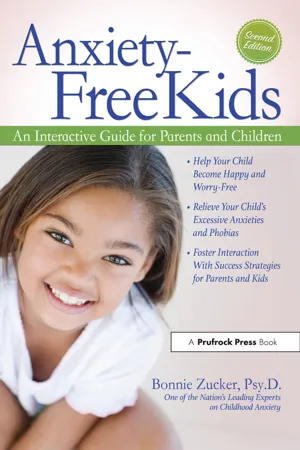
Anxiety-Free Kids (2nd ed.) offers parents strategies that help children become happy and worry-free, methods that relieve a child's excessive anxieties and phobias, and tools for fostering interaction and family-oriented solutions. Using a unique companion approach that offers two books in one—a practical, reader-friendly book for parents and a fun workbook for kids—this solutions-oriented guide utilizes the cognitive-behavioral approach to therapy and integrates the parent in the child's self-help process.
Research has shown that if left untreated, children with anxiety disorders are at higher risk to perform poorly in school, to have less-developed social skills, and to be more vulnerable to substance abuse. Covering the six most commonly occurring anxiety disorders—generalized anxiety, separation anxiety, specific phobias, social phobias, panic disorder, and obsessive-compulsive disorder—this book gives kids and parents successful strategies for achieving relaxation, conquering worries, challenging faulty thinking patterns, developing positive self-talk, and facing one's fears.
Educational Resource
- 216 pages
- English
- ePUB (mobile friendly)
- Available on iOS & Android
eBook - ePub
About this book
Information
CHAPTER 1
Anxiety
What It Is and What to Do About It
Don't forget to give your child Chapter 1 from the kids' book to read!
DOI: 10.4324/9781003233060-3
Ten-year-old Kimberly worries a lot. She worries about her homework, her dog, her house, and what other kids think about her. Kimberly has a hard time adjusting to unexpected changes. Last week when her mom picked her up from school and told her about her dentist appointment, Kimberly had a meltdown and became very upset because Mom didn't tell her about it the day before. The appointment had to be rescheduled. When doing homework, Kimberly often gets very nervous about not having enough time to finish it, even though it usually takes about an hour, and sometimes becomes so stressed that she cannot concentrate or organize her thoughts. She worries that someone will break into her house and possibly kidnap her, and each time she approaches her house, her heart starts to beat fast. For this reason, Kimberly refuses to be the first person to walk into the house and has her mom or dad go in first and check that no one has broken in. Kimberly also checks on her dog many times each day to make sure he is OK and didn't run out of the house. Kimberly gets a lot of stomachaches and headaches from all of her worrying.
KIMBERLY, and many children like her, suffers from an anxiety disorder. Her childhood is filled with worries and feelings of uneasiness. Kimberly's parents struggle to make her feel calm and comfortable and feel at a loss of what to do to help her. If your child has anxiety like Kimberly or has a different type of anxiety, then this book is for you. You and your child will receive guidance on how to become aware of what his anxiety symptoms are and how they can be addressed and overcome in a step-by-step fashion. You will soon discover that you and your child don't need to be organized and controlled by anxiety You and your child will overcome this and will be liberated.
In this chapter, your child will learn the following:
- common symptoms of anxiety
- how to differentiate normal versus problematic anxiety
- the three parts of anxiety and
- how to address each of the three parts of anxiety.
These topics will be addressed in this chapter, and the exercise that you will complete with your child after you each read Chapter 1 of your respective books will be reviewed. This chapter also will include descriptions of the different anxiety disorders, an explanation of the cognitive-behavioral therapy (CBT) approach to treating anxiety disorders, how best to use this program with your child and what to say to him or her when implementing it, and advice on determining if your child requires professional help and/or medication.
Anxiety: Its Symptoms and Disorders
Anxiety is the experience of feeling nervous, worried, scared, or afraid, and is the opposite of feeling relaxed. All children and adults feel anxious at times. Sometimes anxiety arises as a result of an event, such as when you are driving and almost hit the car in front of you. Sometimes it appears out of the blue. Our capacity for anxiety is a survival mechanism that allows us to react quickly in a threatening situation by providing a physical reaction known as the "flight or fight" response. In addition, anxiety can be a motivator and can help us get things done in a timely manner. For example, the anxiety associated with having to pass a test serves as a motivator for studying for it.
Anxiety involves three parts: physiological feelings (body), thoughts, and behavior. Typically, the behavior associated with anxiety is avoidance. When children and adults avoid anxiety-provoking situations, such avoidance breeds self-doubt. Over time, the repetitive practice of self-doubting impacts and even damages one's self-esteem.
The diagram in Figure 1 is included in your child's chapter to help him or her conceptualize the three parts of anxiety.
In order to understand and treat anxiety, we need to understand and address the three parts. Each part will be discussed in greater detail in later chapters. Common physical (body) symptoms of anxiety are:
- ► rapid heart rate,
- ► shallow breathing,
- ► muscle tension,
- ► sweating,
- ► restlessness,
- ► difficulty swallowing,
- ► choking sensations,
- ► dizziness,
- ► stomachaches,
- ► shaking, and
- ► feeling detached from one's body or from reality
Somatic complaints are physical symptoms that are psychological in nature (have no organic or medical cause) and include stomachaches, headaches, and general aches and pains. If your child displays what appear to be somatic complaints, I recommend that he or she receive a comprehensive physical exam to rule out any underlying physical problem even though you may feel the cause is psychological.
The cognitive (or thoughts) part of anxiety includes the following: worries, thinking errors, negative self-talk, and a perceived irrational threat. Anxious children often will use "what if's" when they worry about bad things happening to them or to their parents or loved ones. Worries also may center on performance in social situations, such as test anxiety and social anxiety. Examples of thinking errors, also known as cognitive distortions, include:

Figure 1. The three parts of anxiety.
- ► "Other kids will laugh at me if I raise my hand and give the wrong answer,"
- ► "I should get all As in school. Getting a B means that I am a failure,"
- ► "It happened to her so it will happen to me," and
- ► "What if someone breaks in and hurts us?"
As mentioned above, the behavior part of anxiety typically includes avoidance behavior. However, if the child does not avoid the anxiety-provoking situation, he or she will endure it with extreme distress. Examples of avoidance include:
- ► not going near the feared object (dogs, injections);
- ► refusing to separate from Mom or Dad;
- ► not sleeping alone;
- ► refusing to go over to a friend's house for a sleepover; and
- ► refusing to go to school.
Children with anxiety often display nervous behaviors, such as seeking reassurance (asking a parent or caregiver to tell them that they will be OK), checking behaviors (e.g., checking that doors are locked, checking that parents are OK), picking/pulling behaviors, crying, freezing up, and having a meltdown or tantrum.
Now let's look at the three parts again, taking into account what each entails. (See Figure 2.)
Anxiety goes from being "normal" to being a problem or disorder in need of treatment when it causes a significant interference in the child's life. This is the key factor in determining if your child needs help in dealing with her anxiety. If the anxiety interferes with your child's academic or social performance (e.g., it prevents your child from going to school, birthday parties, or sleepovers, or from sleeping alone at night, or if it renders her unable to concentrate at school due to focusing on worries), or interferes with your child's ability to enjoy life or feel good about herself (e.g., daily stomachaches or headaches, persistent worry, negative self-image), this is a good indication that her anxiety has become a disorder. A fear of something becomes a phobia when it involves avoidance of the feared object or situation or if exposure to the feared object or situation is endured with extreme distress and causes a significant impairment in her life.
Anxiety Disorders
Anxiety disorders are the most common form of psychological disorders in children and adults. Anxiety disorders occur in one in eight children (Anxiety Disorder Association of America, n.d.) and the lifetime prevalence of anxiety disorders in children

Figure 2. What each part of anxiety entails.
aged 13-18 is 25% (Merikangas et al., n.d.). Research has demonstrated that an untreated anxiety disorder in childhood often persists into adulthood. Anxiety is considered to be an internalizing disorder, meaning that its symptoms are not always evident from the perspective of an outsider. This is in contrast with externalizing disorders, such as disruptive or aggressive behaviors, which are hard to miss. It also is important to note that anxiety disorders (specifically generalized anxiety disorder) and Attention Deficit/ Hyperactivity Disorder (ADHD) have symptoms that overlap. For example, restlessness, difficulty concentrating, difficulty sustaining focus, and one's mind going blank are all symptoms of both disorders. Consider the difficulty associated with trying to balance your checkbook while fearing that at any moment, someone will break into your house and harm you. Thus, making a differential diagnosis is very important, as the treatments are different. In particular, the medication treatment typically used for ADHD (stimulant medication such as Ritalin and Adderall) may impair the treatment of anxiety disorders, as these medications can result in an increase in anxiety symptoms.
Several different anxiety disorders are listed in the American Psychological Association's (2013) Diagnostic and Statistical Manual of Mental Disorders, fifth edition (DSM-5; the Bible of psychiatric disorders). When an individual meets the criteria for one disorder and for another disorder, this is called comorbidity. The most common comorbid disorder for an anxiety disorder is another anxiety disorder, but many children also experience depression. In addition, children with other diagnoses can have a comorbid anxiety disorder; for example, a National Institute of Mental Health (NIMH; Jensen et ah, 2001) study found that about 30%-35% of children with ADHD have an existing anxiety disorder (CHADD, n.d.).
The six disorders that I most often see in children include:
- ► generalized anxiety disorder (GAD),
- ► separation anxiety disorder (SAD),
- ► social anxiety disorder (SoP),
- ► specific phobia (SP),
- ► obsessive-compulsive disorder (OCD), and
- ► panic disorder (PD).
In the DSM-V, OCD, which was previously classified as an anxiety disorder, became its own category along with other disorders including hoarding disorder and trichotillomania (hair pulling), now called Obsessive-Compulsive and Related Disorders. Unlike previous versions of the DSM, the DSM-V places categories of related conditions sequentially, so the Obsessive-Compulsive category naturally follows the Anxiety Disorders category, illustrating that OCD is related to Anxiety Disorders. Given that children with OCD often experience and present with anxiety, I have continued to include OCD in this book's second edition.
Each disorder is discussed in greater detail in Chapter 10, but a brief overview of the disorders below should help you as you work with your child. Remember that it also may be beneficial to read more about the disorder you suspect your child may have by turning to Chapter 10 before beginning the program. I provide guidance specific to the particular anxiety or issue your child is experiencing; reading Chapter 10 should be considered just as pertinent as Chapters 1-8 in helping your child through this program.
Generalized anxiety disorder (GAD) is characterized by excessive worry that occurs more days than not for at least 6 months and is difficult to contain. The symptoms include restlessness, being easily fatigued, difficulty concentrating, irritability, muscle tension, sleep disturbance, and physical complaints.
Separation anxiety disorder (SAD) involves excessive distress when the child is separated from home or from attachment figures or when separation is anticipated. The child often worries about harm befalling major attachment figures, like parents, and may refuse to go to school or elsewhere in efforts to avoid separation. Children with SAD often refuse to sleep in their own beds or without their parent(s) present and may exhibit physical symptoms or complaints when separation occurs or is anticipated.
Social anxiety disorder (SoP) is the fear of social or performance situations in which the child will be exposed to unfamiliar people or possible scrutiny by others. A child with social anxiety fears that he or she will act in a way that will be embarrassing or humiliating and tends to believe that there is a great likelihood that a negative event or outcome will occur in social or performance situations.
Specific phobias (SP) are pretty easy to identify. This is what people generally think of when they say someone has a phobia. Specific phobias involve marked and persistent fear that is excessive or unreasonable and occurs in the presence of, anticipation of, or exposure to a specific object or situation. Exposure to the phobic situation is either avoided or endured with extreme distress. The DSM-5 lists five subtypes of specific phobias: animal, natural environment (storms, heights, water), blood-injection-injury type, situational (flying, elevators, enclosed places), and other.
Obsessive-compulsive disorder (OCD) is characterized by the presence of obsessions or compulsions, but usually both occur. Obsessions are intrusive thoughts, images, or impulses. For example, contamination fears, harm to others, and symmetry urges (everything needs to be perfectly ordered and aligned) are all obsessions. Compulsions or rituals are repetitive intentional behaviors or mental acts per...
Table of contents
- Cover
- Half Title
- Title Page
- Copyright Page
- Dedication
- Table of Contents
- Acknowledgements
- Preface to the Second Edition
- Welcome to Anxiety-Free Kids
- Introduction: How to Use This Book
- A Note for Your Child's Therapist
- CHAPTER 1 Anxiety: What It Is and What to Do About It
- CHAPTER 2 Making Your Team and Team Goals
- CHAPTER 3 Relaxing the Body
- CHAPTER 4 Conquer Your Worries
- CHAPTER 5 Changing Your Thoughts
- CHAPTER 6 Changing Your Behaviors: Facing Your Fears
- CHAPTER 7 Keep Facing Your Fears and Build Confidence
- CHAPTER 8 Lessons Learned: Celebrate Yourself
- CHAPTER 9 Motivating Your Child
- CHAPTER 10 Special Sections
- CHAPTER 11 Anxiety at Bedtime: Improving Sleep Behavior
- CHAPTER 12 Parenting Your Anxious Child: Adopting a Resilience Mindset
- References
- Resources for Parents
- Appendix A: Overview of the Program
- Appendix B: Thinking Errors Quick Reference Page
- About the Author
- ANXIETY-FREE KIDS: "For Kids Only" Companion Guide
Trusted by 375,005 students
Access to over 1.5 million titles for a fair monthly price.
Study more efficiently using our study tools.
Frequently asked questions
Yes, you can cancel anytime from the Subscription tab in your account settings on the Perlego website. Your subscription will stay active until the end of your current billing period. Learn how to cancel your subscription
No, books cannot be downloaded as external files, such as PDFs, for use outside of Perlego. However, you can download books within the Perlego app for offline reading on mobile or tablet. Learn how to download books offline
Perlego offers two plans: Essential and Complete
- Essential is ideal for learners and professionals who enjoy exploring a wide range of subjects. Access the Essential Library with 800,000+ trusted titles and best-sellers across business, personal growth, and the humanities. Includes unlimited reading time and Standard Read Aloud voice.
- Complete: Perfect for advanced learners and researchers needing full, unrestricted access. Unlock 1.5M+ books across hundreds of subjects, including academic and specialized titles. The Complete Plan also includes advanced features like Premium Read Aloud and Research Assistant.
We are an online textbook subscription service, where you can get access to an entire online library for less than the price of a single book per month. With over 1.5 million books across 990+ topics, we’ve got you covered! Learn about our mission
Look out for the read-aloud symbol on your next book to see if you can listen to it. The read-aloud tool reads text aloud for you, highlighting the text as it is being read. You can pause it, speed it up and slow it down. Learn more about Read Aloud
Yes! You can use the Perlego app on both iOS and Android devices to read anytime, anywhere — even offline. Perfect for commutes or when you’re on the go.
Please note we cannot support devices running on iOS 13 and Android 7 or earlier. Learn more about using the app
Please note we cannot support devices running on iOS 13 and Android 7 or earlier. Learn more about using the app
Yes, you can access Anxiety-Free Kids by Bonnie Zucker in PDF and/or ePUB format, as well as other popular books in Education & Education General. We have over 1.5 million books available in our catalogue for you to explore.