Exploring the rupture between Wittgenstein's early and late phases, Michael Smith provides an original re-assessment of the metaphysical consistencies that exist throughout his divergent texts. Smith shows how Wittgenstein's criticism of metaphysics typically invoked the very thing he was seeking to erase. Taking an alternative approach to the inherent contradiction in his work, the 'problem of metaphysics', as Smith terms it, becomes the organizing principle of Wittgenstein's thought rather than something to overcome.
This metaphysical thread enables further reflection on the poetic nature of Wittgenstein's philosophy as well as his preoccupation with ethics and aesthetics as important factors mostly absent from the secondary literature. The turn to aesthetics is crucial to a re-assessment of Wittgenstein's legacy, and is done in conjunction with an innovative analysis of Nietzsche's critique of Kantian aesthetics and Kant's 'judgments of taste'. The result is a unique discussion of the limits and possibilities of metaphysics, aesthetics, ethics and the task of the philosopher more generally.
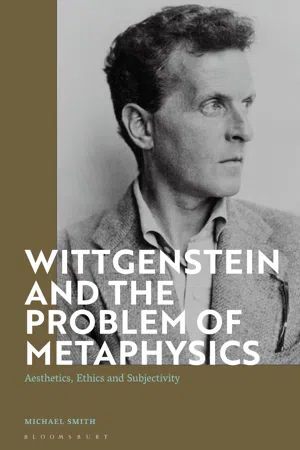
eBook - ePub
Wittgenstein and the Problem of Metaphysics
Aesthetics, Ethics and Subjectivity
- 224 pages
- English
- ePUB (mobile friendly)
- Available on iOS & Android
eBook - ePub
About this book
Information
1
Everything Can Be Otherwise Than It Is
The question of certainty and how to attain it is not a novelty in the history of philosophy. Just this kind of preoccupation was, from the outset, an implicit and fundamental aspect of the Socratic Method. When, for instance, Socrates asks his interlocutors in the first book of the Republic to produce a definition of justice, the foregone conclusion embedded within this query is that in fact, they do not know, but rather only think they do. The purpose, therefore, of this particular mode of inquiry is to demonstrate what Socrates already knew with certainty: “I know nothing”1—precisely the one thing his interlocutors did not know.
While this chapter is not itself an examination of how conceptions of certainty have changed and evolved over time, it does seek to shed light on the relationship between certainty and metaphysics, especially as it concerns aesthetics. As I discussed in the Introduction, the problem of metaphysics in Wittgenstein’s work is typified by his dual attraction to and repulsion from this most speculative branch of philosophy. This produces, Marie McGinn reminds us, something of a tension between “the idea that Wittgenstein is putting forward metaphysical doctrines whilst also claiming that philosophical propositions are ‘nonsensical’, and insisting that anyone who understands him will recognize that the propositions of TLP fall into this class.”2 One way in which Wittgenstein attempted to circumvent this conflict was by delineating between what can only be shown (e.g., ineffable truths about the nature of reality) and what can be meaningfully said (e.g., the propositions of natural science). Even if this solution is accepted, however, most would be willing to admit—McGinn included—that the distinction between saying and showing does not “fully discharge this tension”3 in Wittgenstein’s seemingly incoherent stance on metaphysics. Just because this solution may be “an unpalatable one” does not mean, McGinn acknowledges, “That Wittgenstein was not attracted by it.”4 Indeed, we can only fully understand the Tractatus, she goes on, if we assume that it accepts the idea “that there are ineffable truths about reality which are mirrored in language”5 while simultaneously accepting the claim that these very same “propositions are ‘nonsensical’ and to be ‘thrown away.’”6
McGinn suggests that a “more judicious response” to the feud between the therapeutic and the metaphysical reading would be “to look for a third interpretation, one which combines the advantages of both and has the disadvantages of neither.”7 On the first point, I find myself in complete agreement. A third interpretation of Wittgenstein’s work that splits the difference between the two others would surely be prudent, but I would like to take a moment to set out how my understanding of this task differs from the one put forward by her. McGinn’s method—which she terms as the “elucidatory, or clarificatory, interpretation”8—assents to a therapeutic understanding of Wittgenstein’s first book, but does not insist that such a reading shows the propositions of the Tractatus to be nonsensical. Rather, McGinn prefers to emphasize the way in which these remarks reveal a “certain order in the reader’s perception of … language.”9 Through elucidation, she contends, “Wittgenstein dissolves our sense of obligation to provide a philosophical foundation for logic” while simultaneously dispelling our need to establish a link between our “forms of description” and the “world as it really is.”10
It is difficult to fault the rationale behind the development of McGinn’s interpretation. Wittgenstein does indeed place some amount of emphasis on the idea that the propositions of the Tractatus are meant to serve as elucidations. Where I find myself in disagreement with her, however, is in the initial assumption that spurred her search for a third way of reading the early Wittgenstein. We do not, in fact, require an interpretation that ‘gets rid’ of the disadvantages and difficulties that dog the incessant conflicts between Tractarian disavowals of metaphysics on the one hand and the apparently inescapable metaphysical implications those cryptic remarks seem to advance. As I have already suggested, the way to read Wittgenstein (whether early or late) is to willingly accept this contradiction as an inseparable component of his thinking. This means, among other things, not jettisoning “the philosophical problems concerning the justification of logic and the relation between language and the world.”11 The question of justification is, I contend, exactly what is at issue where the problem of metaphysics in Wittgenstein’s philosophy is concerned. More precisely, it is the inevitable impossibility of producing a justification without making use of a metaphysical doctrine that is the source of the self-referentially incoherent stance on metaphysics Wittgenstein adopts throughout the various phases of his intellectual life.
Many of these issues will be revisited in Chapter 4 when On Certainty is submitted to a more rigorous examination, but for the time being, I would like to briefly consider a passage from that text—specifically §246—which I deem to be of particular importance for understanding the relationship between certitude and aesthetics in Wittgenstein’s thought: “‘Here I have arrived at a foundation of all my beliefs.’ ‘This position I will hold!’ But isn’t that, precisely, only because I am completely convinced of it?—What is ‘being completely convinced’ like?” As is often the case in much of his later work, Wittgenstein is much more likely to pose questions to his reader than answer them, and this is no exception. Although we can see Wittgenstein approaching several possible answers throughout the text, in true Socratic Method he never ultimately settles on a satisfactory one. The issue at stake is an important one, precisely because the answer to it reveals just how it is that Wittgenstein could legitimately hold two very opposing points of view on metaphysics. So while he never explicitly tells us what it is like to feel completely convinced of something, I propose that there is a profoundly aesthetic dimension to this sensation, one that does not shy away in the face of contradiction. More specifically, as we will see, a feeling of unshakable conviction has an element of the subjective universality that Kant attributed to judgments of taste, thus effecting a consolidating of the metaphysical and epistemological through the aesthetic. This strategy has the added benefit of aligning Wittgenstein’s aesthetic proclivity with much of his other writing and shows just how much of an affinity the problem of metaphysics has for what Nietzsche called the ‘metaphysics of art’ in The Birth of Tragedy. Addressing these interrelated topics will, however, necessitate that we set Wittgenstein to one side for now and focus on explicating the problem of metaphysics and its relationship to aesthetics in a broader sense.
In many respects, the problem of metaphysics is related to the ‘problem of the criterion’ in epistemology, but instead of contending with questions such as ‘What do we know?’ and ‘How do we know it?’ the problem of metaphysics deals with the separate but related questions, ‘What is the fundamental nature of reality?’ and ‘How do we devise a method for uncovering it?’ Philosophers throughout history have often been tempted to answer these questions by appealing to a first principle deemed self-evidently true and indisputable. These principles, of course, vary considerably, but whether we are discussing the Aristotelean unmoved mover or the Cartesian cogito, in every case, their function is to provide a point of origin, a grounding upon which an edifice of thought may be built without exposing it to the risk of infinite regress. The difficulty, however, with all such ‘self-evident’ metaphysical principles is that they resist the kind of universal agreement that seem to be required of them. This, then, is one aspect of the problem of metaphysics: the inability to give indubitable and universally agreed upon first principles coupled with the desire to avoid regress. It should also be stressed that this problem is fundamentally inseparable from the problem of the criterion. Every principle of metaphysics is always subject to epistemological consideration.
The problem of metaphysics—unlike the problem of the criterion—is not a phrase widely employed in philosophical parlance. One of the few instances of its use can be found in Hartley Burr Alexander’s 1902 dissertation The Problem of Metaphysics and the Meaning of Metaphysical Explanation: An Essay in Definitions.12 The “problem of metaphysics,” as he sees it,
May be variously stated: it may be a quest for the essence of things, or for a reality within things themselves, or for their truth. But in every case the real object of the inquiry is the discovery of a ground or raison d’être which shall seem to us a sufficient reason why reality is what it is. Such a ground … can only be satisfying when it embodies a motive or a purpose intelligible to us in terms of our motives and our purposes. It is only as revealing design that we consider any action to be reasonable.… The problem of metaphysics is thus par excellence the problem of teleology.13
While I am content with Alexander’s summation of the problem of metaphysics as the inquiry into why reality is what it is, I will differ from him by insisting that metaphysics can in no way be intelligible to us in terms of our motives or purposes. In fact, I will go so far as to suggest that metaphysics is what makes intelligibility possible and, as such, cannot be intelligible itself. Thus, instead of characterizing the problem of metaphysics as ‘the problem of teleology’ par excellence, I will prefer to designate it as ‘the problem of aesthetics.’
The term ‘aesthetics,’ as it is here being used, has a very specific and somewhat untraditional meani...
Table of contents
- Cover
- Half-Title Page
- Dedication
- Title Page
- Contents
- Acknowledgments
- Introduction: To Begin at the Beginning
- 1 Everything Can Be Otherwise Than It Is
- 2 The Rest Is Silence
- 3 The Humble Origin of Words
- 4 At the Foundation of Well-Founded Belief
- 5 To Tell a Riddle
- 6 Always an Elsewhere
- Bibliography
- Index
- Copyright
Trusted by 375,005 students
Access to over 1.5 million titles for a fair monthly price.
Study more efficiently using our study tools.
Frequently asked questions
Yes, you can cancel anytime from the Subscription tab in your account settings on the Perlego website. Your subscription will stay active until the end of your current billing period. Learn how to cancel your subscription
No, books cannot be downloaded as external files, such as PDFs, for use outside of Perlego. However, you can download books within the Perlego app for offline reading on mobile or tablet. Learn how to download books offline
Perlego offers two plans: Essential and Complete
- Essential is ideal for learners and professionals who enjoy exploring a wide range of subjects. Access the Essential Library with 800,000+ trusted titles and best-sellers across business, personal growth, and the humanities. Includes unlimited reading time and Standard Read Aloud voice.
- Complete: Perfect for advanced learners and researchers needing full, unrestricted access. Unlock 1.5M+ books across hundreds of subjects, including academic and specialized titles. The Complete Plan also includes advanced features like Premium Read Aloud and Research Assistant.
We are an online textbook subscription service, where you can get access to an entire online library for less than the price of a single book per month. With over 1.5 million books across 990+ topics, we’ve got you covered! Learn about our mission
Look out for the read-aloud symbol on your next book to see if you can listen to it. The read-aloud tool reads text aloud for you, highlighting the text as it is being read. You can pause it, speed it up and slow it down. Learn more about Read Aloud
Yes! You can use the Perlego app on both iOS and Android devices to read anytime, anywhere — even offline. Perfect for commutes or when you’re on the go.
Please note we cannot support devices running on iOS 13 and Android 7 or earlier. Learn more about using the app
Please note we cannot support devices running on iOS 13 and Android 7 or earlier. Learn more about using the app
Yes, you can access Wittgenstein and the Problem of Metaphysics by Michael Smith in PDF and/or ePUB format, as well as other popular books in Philosophy & Aesthetics in Philosophy. We have over 1.5 million books available in our catalogue for you to explore.