- 224 pages
- English
- ePUB (mobile friendly)
- Available on iOS & Android
eBook - ePub
Corruption from a Regulatory Perspective
About this book
This book seeks to enrich and, in some cases, reverse current ideas on corruption and its prevention. It is a long held belief that sanctions are the best guard against corrupt practice. This innovative work argues that in some cases sanctions paradoxically increase corruption and that controls provide opportunities for corrupt transactions. Instead it suggests that better regulation and responsive enforcement, not sanctions, offer the most effective response to corruption. Taking both a theoretical and applied approach, it examines the question from a global perspective, drawing on in particular a regulatory perspective, to provide a model for tackling corrupt practices.
Information
1
Rules, Corruption and Controls: Setting the Scene
1.1.Preliminary Remarks
The central idea of the book is that administrative corruption, like other kinds of illicit behaviour, presupposes both the existence and the ineffectiveness of rules, and it follows that a regulatory perspective may therefore help in preventing both corruption and infringements. The book builds upon research into rules, controls and corruption, topics which are usually studied in parallel, as distinct issues, by different epistemic communities. This parallel approach is still the prevalent feature of current academic contributions, at national as well as at international level, all over the world: there is a huge quantity of literature on legislation, drafting and quality of regulation;1 a further abundance of publications regarding enforcement, inspection and administrative controls;2 and an exponential number of books and articles from many fields of research, finally, concern corruption and anticorruption.3
However, in each of these fields of research, literature is multidisciplinary more than interdisciplinary4 and not so frequently have scholars and academics in all the three fields of research integrated their sectorial knowledge.5
The book builds upon a legal, administrative law background and has been written from a regulatory perspective – a perspective which takes into consideration rules and regulation during their whole life-cycle, from their proposal to their delivery, especially focusing on compliance and enforcement as drivers of regulatory effectiveness, because when rules are effective there is very limited space for infringements and administrative corruption. The novelty of the book is in systematic application6 of such a perspective to corruption and in the consideration of its important operational consequences. In fact, it aims to expand the logic of current anticorruption policies, which now focus on corruption (the symptom) and which should be reoriented to include rules, determinants of any corruption processes: in a state of law, without rules no public power is established, no public agents can be in charge of competences in any administrative procedures, and consequently no corruption can be carried out, at all. For this reason, from a regulatory perspective, rules can even be used to enrich the anticorruption toolkit, by affirming the centrality of the way in which rules are adopted, how the interests which move their adoption are considered during procedures, and how rules are implemented and enforced, via controls.
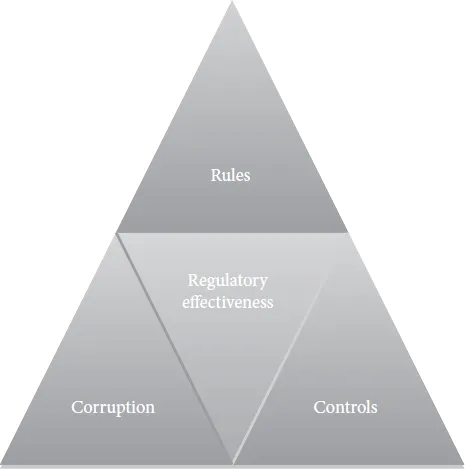
In short, rules, corruption and controls – which apparently are separate fields of research – will be considered as being strictly linked, as a whole system, as though they were the three points of a triangle: if we focus on one of them, we will unavoidably meet the others, because the three topics cannot be fully understood without keeping the others in mind. This quality of being interlinked is more easily understood in terms of regulatory effectiveness, which represents a point of unity, as the apex of a tetrahedron: rules need to be effective; controls are needed in order to make effective rules and they must in turn be effective to do so; corruption constitutes a special kind of side-effect and/or ineffectiveness of rules based very often on ineffective controls; finally, legal systems in which rules and controls are not so effective, and where corruption flourishes, are ineffective themselves and risk collapse.
Figure 1.1 Regulatory Effectiveness
In the light of effectiveness, concrete anticorruption policies may vary and have to be tailored to the context of individual countries and cultures.7 For this reason, the analysis will be developed with limited references to national anticorruption legislations by giving preference to a comprehensive analysis of the phenomenon (corruption) and of the regulatory environment in which it occurs. Therefore, this is not a book on the Italian anticorruption system.8 However, Italy is the paradigmatic case in the backstage of my research, being a sort of ‘perfect storm’ from a regulatory perspective: not only long-standing distrust in institutions9 and a wide presence of criminal organisations,10 but also legislative inflation, bad quality regulation, too rigid controlling, administrative tolerance and a tendency towards overwhelming bureaucracy have all together nurtured systemic corruption. On the other hand, Italy seems to be the country in which everything and its opposite are always possible: the National Recovery and Resilience Plan adopted in April 2021 in the framework of the Next Generation EU, introduced a very relevant Regulatory Anticorruption measure: in fact, among other ‘enabling reforms’, the Plan has required the repeal and revision of rules that fuel corruption.
Definitions are indispensable before moving deeper into the topic: it is crucial to agree about the notion and scope of rules, controls and corruption in a way in which the definition of each concept helps in preparing the ground for the understanding of the others.
1.2.Rules
1.2.1.Definition
Literature on legal normativity is huge and multidisciplinary. This is the reason way it is impossible to begin any reasoning without some preliminary clarifications. When people say ‘rules’, ‘norms’ or ‘legislation’ they refer to concepts perceived as connected with (or in the field of) ‘law’. However, distinctions among these terms are significant and their overlapping is limited. In order to make the whole discourse fit for the purpose of understanding and preventing corruption, the book has adopted a regulatory perspective which focuses on how rules can be concretely used to steer behaviour, achieve desired results and avoid unwanted side-effects (such as corruption) and how they work in practice, by briefly analysing their functioning and dysfunctions (such as when they produce occasions for infringements and corruption).
1.2.2.Law is More than Legislation
Despite the pervasive presence of law in everyone’s daily life, defining it is far from a simple task.11 It will suffice to say, in this context, that law is a social institution12 which simultaneously expresses an individual and a collective stance, being both the idea of ‘a binding custom or practice of a community’ and also ‘the whole body of such customs, practices, or rules’.13 In any case, law is deeply ingrained in society (ubi societas, ibi ius), indispensable to the organisation of social life and to the limitation of social conflicts,14 being characterised by coercion.
On the other hand, the concept of legislation requires the introduction of the question of the ‘great machine of legislation’15 because legislation is not only a product but also the factory,16 not only the final act but the whole procedure which prepares it. In any case, it constitutes the prevalent way to produce written law and to place it in the context of a formalised hierarchy of sources. Each single legislative act is qualified by the level of the ‘machine’ at which it has been produced, according to established procedures. However, the prevailing opinions of scholars and academics suggest that legislation should be considered in a broader sense, as a system17 including: constitutions; primary sources of law (such as statute law enacted by parliaments); sources of law enacted together by the parliament and the government or by the government (defined as regulation); multi-level legislation (such as EU legislation and legislation adopted by sub-national levels of government, for instance, Länder or regions).
In view of this, law is more than legislation:18 for instance, law may even take the form of customary (unwritten) law, which is a source of law especially relevant in some legal systems;19 law is constituted not only by rules but also by legal principles;20 moreover, law is also the product of regulation adopted by independent authorities (which are non-majoritarian institutions);21 law may take the form of soft regulation (which is written but outside – or at the boundary of – the sources of law).22 In other words, legislation is a very significant element in the contemporary discourse on law, but not the only one.
Alongside law and legislation, the term norm expresses a wider connotation, by evoking in general standardisation of something, not necessarily in the legal field. There are, in fact, technical standards or even social and ethical norms which operate without coercion, as legal norms usually do.23
1.2.3.Does Legislation Threaten the Law?
The relationship between law and legislation (to be intended in the above-mentioned wide sense) is characterised by a structural dialectic.
On one side, legislation is the most powerful driver for law because contemporary law is produced mainly via legislation, at different levels of government. Furthermore, legislation – long idolised in the past24 – has been even considered to be the perfect ‘box’ for rational law, resulting in the Enlightenment’s legolatry;25 nowadays it has also been seen as the perfect tool for political communication; not rarely politicians used to refer to legislation as if merely proposing and adopting it were their own task, independently from any possible impact and result.
On the other side, paradoxically, legislation can represent even a menace for law, in more than one way.
1.When single legislative acts are adopted exclusively for symbolic purposes (symbolic legislation, ‘in the worst sense of the word’26), producing ‘distortions ...
Table of contents
- Cover
- Dedication
- Title Page
- Acknowledgements
- Contents
- List of Figures
- List of Tables
- 1. Rules, Corruption and Controls: Setting the Scene
- 2. Anticorruption: Strategies and Risks
- 3. Anticorruption: Rules (Can Good Rules Reduce Opportunities for Corruption?)
- 4. Anticorruption: Controls (Can Controls Help in Reducing Corruption?)
- 5. Combating Corruption via Regulation and Controls: Which Formula?
- Index
- Copyright Page
Trusted by 375,005 students
Access to over 1.5 million titles for a fair monthly price.
Study more efficiently using our study tools.
Frequently asked questions
Yes, you can cancel anytime from the Subscription tab in your account settings on the Perlego website. Your subscription will stay active until the end of your current billing period. Learn how to cancel your subscription
No, books cannot be downloaded as external files, such as PDFs, for use outside of Perlego. However, you can download books within the Perlego app for offline reading on mobile or tablet. Learn how to download books offline
Perlego offers two plans: Essential and Complete
- Essential is ideal for learners and professionals who enjoy exploring a wide range of subjects. Access the Essential Library with 800,000+ trusted titles and best-sellers across business, personal growth, and the humanities. Includes unlimited reading time and Standard Read Aloud voice.
- Complete: Perfect for advanced learners and researchers needing full, unrestricted access. Unlock 1.5M+ books across hundreds of subjects, including academic and specialized titles. The Complete Plan also includes advanced features like Premium Read Aloud and Research Assistant.
We are an online textbook subscription service, where you can get access to an entire online library for less than the price of a single book per month. With over 1.5 million books across 990+ topics, we’ve got you covered! Learn about our mission
Look out for the read-aloud symbol on your next book to see if you can listen to it. The read-aloud tool reads text aloud for you, highlighting the text as it is being read. You can pause it, speed it up and slow it down. Learn more about Read Aloud
Yes! You can use the Perlego app on both iOS and Android devices to read anytime, anywhere — even offline. Perfect for commutes or when you’re on the go.
Please note we cannot support devices running on iOS 13 and Android 7 or earlier. Learn more about using the app
Please note we cannot support devices running on iOS 13 and Android 7 or earlier. Learn more about using the app
Yes, you can access Corruption from a Regulatory Perspective by Maria De Benedetto in PDF and/or ePUB format, as well as other popular books in Derecho & Derecho administrativo. We have over 1.5 million books available in our catalogue for you to explore.