This book builds on the scholarship of the law of state jurisdiction, engaging with fundamental questions about states' legislative competence, to respond to climate change. Considering general theory, the author advocates for a systemic analytical framework for the contested issue of 'extraterritoriality' in international law.
Exploring the crystallisation of 'climate change jurisdiction', the book provides a comprehensive exploration of the jurisdictional bases and limitations for unilateral climate protection measures. In doing so, cross-cutting issues of world trade law, international civil aviation law, the law of the sea, and importantly, the customary international law of state jurisdiction are considered.
Amidst the myriad of developing norms, a novel 'considerate design' tool is introduced to assist policymakers in finding a better balance between regulatory autonomy, development needs and the protection of common concerns.
eBook - ePub
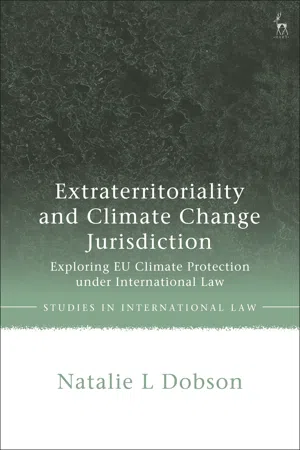
Extraterritoriality and Climate Change Jurisdiction
Exploring EU Climate Protection under International Law
- 328 pages
- English
- ePUB (mobile friendly)
- Available on iOS & Android
eBook - ePub
Extraterritoriality and Climate Change Jurisdiction
Exploring EU Climate Protection under International Law
About this book
Information
1
Introduction
A point has been reached in history when we must shape our actions throughout the world with a more prudent care for their environmental consequences. Through ignorance or indifference we can do massive and irreversible harm to the earthly environment on which our life and wellbeing depend.*
1.INTRODUCTORY REMARKS: THE DILEMMA OF AMBITIOUS UNILATERAL CLIMATE PROTECTION
In 1988, prompted by an initiative of Malta, the United Nations General Assembly (UNGA) passed resolution 43/53 on the protection of the global climate for present and future generations of mankind.1 The resolution recognised the climate as an ‘essential condition which sustains life on earth’, and expressed concern ‘that certain human activities could change global climate patterns, threatening present and future generations’.2 The resolution went on to declare climate change ‘a common concern of mankind’, calling upon states to ‘treat climate change as a priority issue’ and ‘collaborate in making every effort to prevent [its] detrimental effects’.3 Initially, the 1992 United Nations Framework Convention on Climate Change (UNFCCC) seemed to promise a swift international response, yet further progress soon stalled due to the complex conflict of interests that continues to plague multilateral efforts today.4 As a result, even after the 2015 Paris Agreement on Climate Change, we are left with a persistent ‘emissions gap’ between the reductions of greenhouse gas (GHG) emissions pledged by states and the overall reductions needed to prevent a ‘dangerous’ increase in global temperature calculated by scientists as a rise beyond 2°C above pre-industrial levels.5
With their different policy priorities, not all states, or groups of states, share the same level of climate ambition, with some taking a far more proactive approach than others. For proactive states, a key means of mitigating anthropogenic climate change is to regulate the production processes of goods and services to limit the GHGs emitted throughout their lifecycle.6 Importantly, in doing so, individual regulators have strong incentives to engage actors beyond their territory. From an environmental perspective, this is because climate change responses will achieve more effective results when they reduce the greatest possible amount of GHGs, all over the world.7 At the same time, regulators also have a strong economic motive to apply their legislation to foreign products and services so as to level the playing field, ensuring that their higher standards of climate protection do not disadvantage the competitive position of domestic producers.8 Although potentially more effective, such measures risk infringing the regulatory freedom of other states, which have, for their own reasons, chosen either not to regulate a certain issue or to do so in a different way. This creates tensions with the principle of sovereign equality, and raises important issues regarding the equitable distribution of climate change burdens.
It is within this context that questions then arise as to the limits of state competence to target GHG-emitting activities outside of their territories. In the face of fast-evolving policy and fragmented legal developments, this book seeks to provide a comprehensive exploration of the jurisdictional bases and limitations for unilateral climate protection measures.9 The overall picture of jurisdictional rules makes up what is termed here as ‘climate change jurisdiction’. Section 2 of this introductory chapter first turns to this book’s main case study, the European Union. With its consistently outward-reaching and ambitious policy, the EU is catalysing questions of climate change jurisdiction in the legal arena. Section 3 then defines the key conceptual parameters as they are employed in this study. Subsequently, the structure and approach to the jurisdictional analysis are briefly set out in section 4.
2.FOCUS OF THIS STUDY: THE EU AS A PROVOCATIVE CLIMATE LEADER
Over the past decade the EU has emerged as a global environmental actor and a self-proclaimed leader in the field of climate change.10 Its initial 40 per cent reduction target for 2030 under the Paris Agreement, has been surpassed by even greater ambition in the proposed European Climate Law.11 As will be seen in this book, the EU continues to take unilateral action, ‘integrated’ across various policy fields, which effectively seeks to engage actors beyond its territory.12 The EU Green Deal expresses explicit concern that ‘efforts to go climate-neutral by 2050 could be undermined by lack of ambition by our international partners’, necessitating, among other policies, a carbon border adjustment mechanism for goods from outside the EU.13
The EU’s extension of its measures beyond its borders has not been without controversy, a key example being the EU Aviation Directive 2008/101/EC, which extended the EU’s Emission Trading Scheme (ETS) to cover international aviation emissions for flights to and from EU territory.14 This led to the well-known Air Transport Association of America (ATAA) case before the Court of Justice of the European Union (CJEU), where appellants argued that the Aviation Directive was an extraterritorial measure for which the EU lacked jurisdiction under international law.15 The CJEU did not agree, finding that the EU had ‘unlimited jurisdiction’ to require the submission of emissions allowances for carbon dioxide (CO2) emitted outside its territory from aircraft landing in or departing from EU aerodromes.16
This finding did little to still the political controversy. Indeed, ultimately, threats of economic sanctions from other states pressured the EU to issue Regulation 421/2014 restricting the scope of the Aviation Directive to flights within the European Economic Area, ‘in view’ of the implementation of an international agreement on aviation emissions by 2020.17 Importantly, from a legal perspective the reasoning of the CJEU was also heavily criticised.18 Indeed, the ensuing reactions illustrate a lack of clarity in legal discourse on the jurisdictional framework applicable to unilateral measures seeking to target GHGs emitted abroad.
With its ample and explicit examples of unilateral climate protection measures, the EU is the central case study of this book. As the Union is not a state, it is necessary at the outset to address the question of the applicable jurisdictional rules. This study takes an international law perspective, conceiving of the EU as an international organisation, based on multilateral constituent treaties, and endowed with legal personality by virtue of the conferral of sovereignty from its member states.19 As noted by the International Court of Justice (ICJ), international organisations ‘are subjects of international law and, as such, are bound by any obligations incumbent upon them under general rules of international law’.20 This will clearly be the case where the EU is itself a party to a treaty, as it is for example to the UNFCCC and the Paris Agreement. Rules of another international organisation will further be ‘incumbent’ upon the EU when it becomes a member, as is the case with the World Trade Organization (WTO).21
Matters are more complex, however, when the EU is not a party to a treaty, or member of another international organisation, while all or most of its Member States are. This is, for example, evident in the case of the International Civil Aviation Organization (ICAO) and the International Maritime Organization (IMO), which are developing concurrent regulatory frameworks for international transport emissions. The applicability and jurisdictional implications of these competing multilateral schemes will be discussed further in part III of this book on the lex specialis regimes, and part IV on jurisdictional conditions.
Notably, there is also heated discussion as to whether customary international law binds international organisations, particularly given the latter’s lack of involvement in its formation.22 This relates to the broader debate on whether being a subject of international law with separate legal personality necessarily entails that one is bound by ‘general rules’ – itself a contested category.23 In this regard, Reinisch appealingly argues that ‘if the functionally limited personality of international organizations develops over time … they are in fact subject to [custom] when they act in a way capable of infringing it’.24 This aligns with ‘the legal premise that “subjects of international law” are usually “subject to international law”’.25 For its part, the CJEU has unequivocally recognised that custom binds the EU, and has indeed applied customary jurisdictional rules.26 In light of the forgoing, and the fact that the customary rules are binding upon all of the EU Member States, customary rules are considered here as being very relevant to the delimitation of EU jurisdictional competences.
3.CONCEPTUAL PARAMETERS: UNILATERAL JURISDICTION AND ‘EXTRATERRITORIALITY’
At the outset, it is valuable to briefly clarify the conceptual parameters central to this book. The first is that of unilateralism and ‘unilateral prescriptive jurisdiction’, discussed further in section 3.1. Where unilateral measures take into account foreign conduct or circumstances, they are likely to raise issues of ‘extraterritoriality’, introduced briefly in section 3.2. As will be explained, this is particularly relevant in the context of climate change, where measures are more effective when they target the full ‘carbon footprint’ of goods and services consumed at home.
3.1.Unilateral Jurisdiction
This study approaches ‘unilateralism’ and ‘unilateral acts’ in a legally neutral manner.27 ‘Unilateralism’ can be defined as a ‘generally individualistic’ approach to foreign affairs.28 As noted by Nollkaemper, this approach may encompass both decisions to act, and decisions not to act, an example of...
Table of contents
- Cover
- Title Page
- Acknowledgements
- Contents
- Abbreviations
- Table of Cases
- 1. Introduction
- PART I: REGULATING TO PROTECT THE GLOBAL CLIMATE: OBLIGATIONS AND RIGHTS
- PART II: JURISDICTIONAL BASES AND LIMITATIONS IN LEX SPECIALIS REGIMES
- PART III: LEX GENERALIS: THE CRYSTALLISATION OF ‘CLIMATE CHANGE JURISDICTION’ UNDER CUSTOMARY INTERNATIONAL LAW
- PART IV: JURISDICTIONAL LIMITATIONS AND ‘CONSIDERATE DESIGN’
- Selected Bibliography
- Index
- Copyright Page
Trusted by 375,005 students
Access to over 1.5 million titles for a fair monthly price.
Study more efficiently using our study tools.
Frequently asked questions
Yes, you can cancel anytime from the Subscription tab in your account settings on the Perlego website. Your subscription will stay active until the end of your current billing period. Learn how to cancel your subscription
No, books cannot be downloaded as external files, such as PDFs, for use outside of Perlego. However, you can download books within the Perlego app for offline reading on mobile or tablet. Learn how to download books offline
Perlego offers two plans: Essential and Complete
- Essential is ideal for learners and professionals who enjoy exploring a wide range of subjects. Access the Essential Library with 800,000+ trusted titles and best-sellers across business, personal growth, and the humanities. Includes unlimited reading time and Standard Read Aloud voice.
- Complete: Perfect for advanced learners and researchers needing full, unrestricted access. Unlock 1.5M+ books across hundreds of subjects, including academic and specialized titles. The Complete Plan also includes advanced features like Premium Read Aloud and Research Assistant.
We are an online textbook subscription service, where you can get access to an entire online library for less than the price of a single book per month. With over 1.5 million books across 990+ topics, we’ve got you covered! Learn about our mission
Look out for the read-aloud symbol on your next book to see if you can listen to it. The read-aloud tool reads text aloud for you, highlighting the text as it is being read. You can pause it, speed it up and slow it down. Learn more about Read Aloud
Yes! You can use the Perlego app on both iOS and Android devices to read anytime, anywhere — even offline. Perfect for commutes or when you’re on the go.
Please note we cannot support devices running on iOS 13 and Android 7 or earlier. Learn more about using the app
Please note we cannot support devices running on iOS 13 and Android 7 or earlier. Learn more about using the app
Yes, you can access Extraterritoriality and Climate Change Jurisdiction by Natalie L Dobson in PDF and/or ePUB format, as well as other popular books in Law & International Law. We have over 1.5 million books available in our catalogue for you to explore.