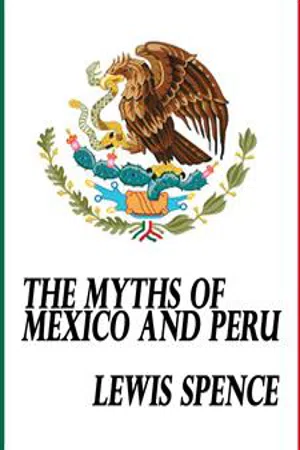
" The Myths of Mexico and Peru " (1913) is a compilation of myths and legends of South American cultures. James Lewis Thomas Chalmers Spence (25 November 1874 – 3 March 1955) was a Scottish journalist, poet, author, folklorist and occult scholar.
- English
- ePUB (mobile friendly)
- Available on iOS & Android
eBook - ePub
The Myths of Mexico and Peru
About this book
Information
Subtopic
AnthropologyIndex
Social SciencesThe Maya Race and Mythology
The Maya
It was to the Maya-the people who occupied the territory between the isthmus of Tehuantepec and Nicaragua-that the civilisation of Central America owed most. The language they spoke was quite distinct from the Nahuatl spoken by the Nahua of Mexico, and in many respects their customs and habits were widely different from those of the people of Anahuac. It will be remembered that the latter were the heirs of an older civilisation, that, indeed, they had entered the valley of Mexico as savages, and that practically all they knew of the arts of culture was taught them by the remnants of the people whom they dispossessed. It was not thus with the Maya. Their arts and industries were of their own invention, and bore the stamp of an origin of considerable antiquity. They were, indeed, the supreme intellectual race of America, and on their coming into contact with the Nahua that people assimilated sufficient of their culture to raise them several grades in the scale of civilisation.
Were the Maya Toltecs?
It has already been stated that many antiquarians see in the Maya those Toltecs who because of the inroads of barbarous tribes quitted their native land of Anahuac and journeyed southward to seek a new home in Chiapas and Yucatan. It would be idle to attempt to uphold or refute such a theory in the absolute dearth of positive evidence for or against it. The architectural remains of the older race of Anahuac do not bear any striking likeness to Maya forms, and if the mythologies of the two peoples are in some particulars alike, that may wellbe accounted for by their mutual adoption of deities and religious customs. On the other hand) it is distinctly noteworthy that the cult of the god Quetzalcoatl, which was regarded in Mexico as of alien origin, had a considerable vogue among the Maya and their allied races.
The Maya Kingdom
On the arrival of the Spaniards (after the celebrated march of Cortés from Mexico to Central America) the Maya were divided into a number of subsidiary states which remind us somewhat of the numerous little kingdoms of Palestine. That these had hived off from an original and considerably greater state there is good evidence to show, but internal dissension had played havoc with the polity of the central government of this empire, the disintegration of wh ch had occurred at a remote period. In the semi-historical legends of this people we catch glimpses of a great kingdom, occasionally alluded to as the "Kingdom of the Great Snake," or the empire of Xibalba, realms which have been identified with the ruined city-centres of Palenque and Mitla. These identifications must be regarded with caution, but the work of excavation will doubtless sooner or later assist theorists in coming to conclusions which will admit of nodoubt. The sphere of Maya civilisation and influence is prettywell marked,and embracesthe peninsula of Yucatan, Chiapas, to the isthmus of Tehuantepec on the north, and the whole of Guatemala to the boundaries of the present republic of San Salvador. The true nucleus of Maya civilisation, however, must be looked for in that part of Chiapas which skirts the banks of the Usumacinta river and in the valleys of its tributaries. Here Maya art and architecture reached a height of splendour unknown elsewhere, and in this district, too, the strange Maya system of writing had its most skilful exponents. Although the arts and industries of the several districts inhabited by people of Maya race exhibited many superficial differences, these are so small as to make us certain of the fact that the various areas inhabited by Maya stock had all drawn their inspiration toward civilisation from one common nucleus, and had equally passed through a uniform civilisation and drawn sap from an original culture-centre.
The Maya Dialects
Perhaps the most effectual method of distinguishing thevarious branches of the Maya people from one another consists in dividing them into linguistic groups. The various dialects spoken by the folk of Maya, origin, although they exhibit some considerable difference, yet display strongly that affinity of construction and resemblance in root which go to prove that they all emanate from one common mother-tongue. In Chiapas the Maya tongue itself is the current dialect, whilst in Guatemala no less than twenty-four dialects are in use, the principal of which are the Quiche, or Kiche, the Kakchiquel, the Zutugil, Coxoh Chol, and Pipil. These dialects and the folk who speak them are sufficient to engage our attention, as in them are enshrined the most remarkable myths and legends of the race, and by the men who used them were the greatest acts in Maya history achieved.
Whence came the Maya?
Whence came these folk, then, who raised a civilisation by no means inferior to that of ancient Egypt, which, if it had had scope, would have rivalled in its achievements the glory of old Assyria? We cannot tell. The mystery of its entrance into the land is as deep as the mystery of the ancient forests which now bury the remnants of its mighty monuments and enclose its temples in impenetrable gloom. Generations of antiquarians have attempted to trace the origin of this race to Egypt, Phœnicia, China, Burma. But the manifest traces of indigenous American origin are present in all its works, and the writers who have beheld in these likenesses to the art of Asiatic or African peoples have been grievously misled by superficial resemblances which could not have betrayed any one who had studied Maya affinities deeply.
Civilisation of the Maya
At the risk of repetition it is essential to point out that civilisation, which was a newly acquired thing with the Nahua peoples, was not so with the Maya. They were indisputably an older race, possessing institutions which bore the marks of generations of use, whereas the Nahua had only too obviously just entered into their heritage of law and order. When we first catch sight of the Maya kingdoms they are in the process of disintegration. Such strong young blood as the virile folk of Anahuac possessed did not flow in the veins of the people of Yucatan and Guatemala. They were to the Nahua much as the ancient Assyrians were to the hosts of Israel at the entrance of the latter into national existence. That there was a substratum of ethnical and cultural relationship, however, it would be impossible to deny. The institutions, architecture, habits, even the racial cast of thought of the two peoples, bore such a general resemblance as to show that many affinities of blood and cultural relationship existed between them. But it will not do to insist too strongly upon these. It may be argued with great probability that these relationships and likenesses exist because of the influence of Maya civilisation upon Mexican alone, or from the inheritance by both Mexican and Maya people of a still older culture of which we are ignorant, and the proofs of which lie buried below the forests of Guatemala or the sands of Yucatan.
The Zapotecs
The influence of the Maya upon the Nahua was a process of exceeding slowness. The peoples who divided them one from another were themselves benefited by carrying Maya culture into Anahuac, or rather it might be said that they constituted a sort of filter through which the southern civilisation reached the northern. These peoples were the Zapotecs, the Mixtecs, and the Kuikatecs, by far the most important of whom were the first-mentioncd. They partook of the nature and civilisation of both races, and were in effect a border people who took from and gave to both Maya and Nahua, much as the Jews absorbed and disseminated the cultures of Egypt and Assyria. They were, however, of Nahua race, but their speech bears the strongest marks of having borrowed extensively from the Maya vocabulary. For many generations these people wandered in a nomadic condition from Maya to Nahua territory, thus absorbing the customs, speech, and mythology of each.
The Huasteca
But we should be wrong if we thought that the Maya had never attempted to expand, and had never sought new homes for their surplus population. That they had is proved by an outlying tribe of Maya, the Huasteca, having settled at the mouth of the Panuco, river, on the north coast of Mexico. The presence of this curious ethnological island has of course given rise to all sorts of queer theories concerning Toltec relationship, whereas it simply intimates that before the era of Nahua expansion the Maya had attempted to colonise the country to the north of their territories, but that their efforts in this direction had been cut short by the influx of savage Nahua, against whom they found themselves unable to contend.
The Type of Maya Civilisation
Did the civilisation of the Maya differ, then, in type from that of the Nahua, or was it merely a larger expression of that in vogue in Anahuac? We may take it that the Nahua civilisation characterised the culture of Central America in its youth, whilst that of the Maya displayed it in its bloom, and perhaps in its senility. The difference was neither essential nor radical, but may be said to have arisen for the most part from climatic and kindred causes. The climate of Anahuac is dry and temperate, that of Yucatan and Guatemala is tropical, and we shall find even such religious conceptions of the two peoples as were drawn from a common source varying from this very cause, and coloured by differences in temperature and rainfall.
Maya History
Before entering upon a consideration of the art, architecture, or mythology of this strange and highly interesting people it will be necessary to provide the reader with a brief sketch of their history. Such notices of this as exist in English are few, and their value doubtful. For the earlier history of the people of Maya stock we depend almost whclly upon tradition and architectural remains. The net result of the evidence wrung from these is that the Maya civilisation was one and homogeneous, and that all the separate states must have at one period passed through a uniform condition of culture, to which they were all equally debtors, and that this is sufficient ground for the belief that all were at one time beneath the sway of one central power. For the later history we possess the writings of the Spanish fathers, but not in such profusion as in the case of Mexico. In fact the trustworthy original authors who deal with Maya history can almost be counted on the fingers of one hand. We are further confused in perusing these, and, indeed, throughout the study of Maya history, by discovering that many of the sites of Maya cities are designated by Nahua names. This is due to the fact that the Spanish conquerors were guided in their conquest of the Maya territories by Nahua, who naturally applied Nahuatlac designations to those sites of which the Spaniards asked the names. These appellations clung to the places in question; hence the confusion, and the blundering theories which would read in these place-names relics of Aztec conquest.
The Nucleus of Maya Power
As has been said, the nucleus of Maya power and culture is probably to be found in that part of Chiapas which slopes down from the steep Cordilleras. Here the ruined sites of Palenque, Piedras Negras, and Ocosingo are eloquent of that opulence of imagination and loftiness of conception which go hand in hand with an advanced culture. The temples and palaces of this region bear the stamp of a dignity and consciousness of metropolitan power which are scarcely to be mistaken, so broad, so free is their architectural conception, so full to overflowing the display of the desire to surpass. But upon the necessities of religion and central organisation alone was this architectural artistry lavished. Its dignities were not profaned by its application to mere domestic uses, for, unless what were obviously palaces are excepted, not a single exam ple of Maya domestic building has survived. This is of course accounted for by the circumstance that the people were sharply divided into the aristocratic and labouring classes, the first of which was closely identified with religion or kingship, and was housed in the ecclesiastical or royal buildings, whilst those of less exalted rank were perforce content with the shelter afforded by a hut built of perishable materials, the traces of which have long since passed away. The temples were, in fact, the nuclei of the towns, the centres round which the Maya communities were grouped, much in the same manner as the cities of Europe in the Middle Ages clustered and grew around the shadow of some vast cathedral or sheltering stronghold.
Early Race Movements
We shall leave the consideration of Maya tradition until we come to speak of Maya myth proper, and attempt to glean from the chaos of legend some veritable facts connected with Maya history. According to a manuscript of Kuikatec origin recently discovered, it is probable that a Nahua invasion of the Maya states of Chiapas and Tabasco took place about the ninth century, of our era, and we must for the present regard that as the starting-point of Maya history. The South-western portions of the Maya territory were agitated about the same time by race movements, which turned northward toward Tehuantepec, and, flowing through Guatemala, came to rest in Acalan, on the borders of Yucatan, retarded, probably, by the inhospitable and waterless condition of that country. This Nahua invasion probably had the effect of driving the more peaceful Maya from their northerly settlements and forcing them farther south. Indeed, evidence is not wanting to show that the warlike Nahua pursued the pacific Maya into their new retreats, and for a space left them but little peace. This struggle it was which finally resulted in the breaking up of the Maya civilisation, which even at that relatively remote period had reached its apogee, its several races separating into numerous city-states, which bore a close political resemblance to those of Italy on the downfall of Rome. At this period, probably, began the cleavage between the Maya of Yucatan and those of Guatemala, which finally resolved itself into such differences of speech, faith, and architecture as almost to constitute them different peoples.
The Settlement of Yucatan
As the Celts of Wales and Scotland were driven into the less hospitable regions of their respective countries by the inroads of the Saxons, so was one branch of the Maya forced to seek shelter in the almost desert wastes of Yucatan. There can be no doubt that the Maya did not take to this barren and waterless land of their own accord. Thrifty and possessed of high agricultural attainments, this people would view with concern a removal to a sphere so forbidding after the rich and easily developed country they had inhabited for generations. But the inexorable Nahua were behindl and they were a peaceful folk, unused to the horrors of savage warfare. So, taking their courage in both hands, they wandered into the desert. Everything points to a late occupation of Yucatan by the Maya, and architectural effort exhibits deterioration, evidenced in a high conventionality of design and excess of ornamentation. Evidences of Nahua influence also are not wanting, a fact which is eloquent of the later period of contact which is known to have occurred between the peoples, and which alone is almost sufficient to fix the date of the settlement of the Maya in Yucatan. It must not be thought that the Maya in Yucatan formed one homogeneous state recognising a central authority. On the contrary, as is often the case with colonists) the several Maya bands of immigrants formed themselves into different states or kingdoms, each having its own separate traditions. It is thus a matter of the highest difficulty to so collate and criticise these traditions as to construct a history of the Maya race in Yucatan. As may be supposed, we find the various city-sites founded by divine beings who play a more or less important part in the Maya pantheon. Kukulcan, for example, is the first king of Mayapan, whilst Itzamna figures as the founder of the state of Itzamal. The gods were the spiritual leaders of these bands of Maya, just as Jehovah was the spiritual leader and guide of the Israelites in the desert. One is therefore not surprised to find in the Popol Vuh, the saga of the Kiche-Maya of Guatemala, that the god Tohil (The Rumbler) guided them to the site of the first Kiche city. Some writers on the subject appear to think that the incidents in such migration myths, especially the tutelage and guidance of the tribes by gods and the descriptions of desert scenery which they contain, suffice to stamp them as mere native versions of the Book of Exodus, or at the best myths sophisticated by missionary influence. The truth is that the conditions of migration undergone by the Maya were similar to those described in the Scriptures, and by no means merely reflect the Bible story, as short-sighted collators of both aver.
The Septs of Yucatan
The priest-kings of Mayapan, who claimed descent from Kukulcan or Quetzalcoatl, soon raised their state into a position of prominence among the surrounding cities. Those who had founded Chichen-Itza, and who were known as Itzaes, were, on the other hand, a caste of warriors who do not appear to have cherished the priestly function with such assiduity. The rulers of the Itzaes, who were known as the Tutul Xius, seem to have come, according to their traditions, from the western Maya states, perhaps from Nonohualco in Tabasco. Arriving from thence at the southern cxtremity of Yucatan, they founded the city of Ziyan Caan, on Lake Bacalar, which had a period of prosperity for at least a couple of generations. At the expiry of that period for some unaccountable reason they migrated northward, perhaps because at that particular time the incidence of power was shifting toward Northern Yucatan, and took up their abode in Chichen- Itza, eventually the sacred city of the Maya, which they founded.
The Cocomes
But they were not destined to remain undisturbed in their new sphere. The Cocomes of Mayapan, when at the height of their power, viewed with disfavour the settlement of the Tutul Xius. After it had flourished for a period of about 120 years it was overthrown by the Cocomes, who resolved it into a dependency, permitting the governors and a certain number of the people to depart elsewhere.
Flight of the Tutul Xius
Thus expelled, the Tutul Xius fled southward, whence they had oriainally come, and settled in Poton-chan or Champoton, where they reigned for nearly 300 years. From this new centre, with the aid or Nahua mercenaries, they commenced an extension of territory northward, and entered into diplomatic relations with the heads of the other Maya states. It was at this time that they built Uxmal, and their power became so extensive that they reconquered the territory they had lost to the Cocomes. This on the whole appears to have been a period when the arts flourished under an enlightened policy, which knew how to make and keep friendly relations with surrounding states, and the splendid network of roads with which the country was covered and the many evidences of architectural excellence go to prove that the race had had leisure to achieve much in art and works of utility. Thus the city of Chichen-Itza was linked up with the island of Cozumel by a highway whereon thousands of pilgrims plodded to the temples of the gods of wind and moisture. From Itzamal, too, roads branched in every direction, in order that the people should have every facility for reaching the chief shrine of the country situated there. But the hand of the Cocomes was heavy upon the other Maya states which were tributary to, them. As in the Yucatan of to-day, where the wretched henequen-picker leads the life of a veritable slave, a crushing system of helotage obtained. The Cocomes made heavy demands upon the Tutul Xius, who in their turn sweated the hapless folk under their sway past the bounds of human endurance. As in all tottering civilisations, the feeling of responsibility among the upper classes became dormant, and they abandoned themselves to the pleasures of life without thought of the morrow. Morality ceased to be regarded as a virtue, and rottenness was at the core of Maya life. Discontent quickly spread on every hand.
The Revolution In Mayapan
The sequel was, naturally, revolution. Ground down by the tyranny of a dissolute oligarchy, the subject states rose in revolt. The Cocomes surrounded themselves by Nahua mercenaries, who succeeded in beating off the first wave of revolt, led by the king or regulus or Uxmal, who was defeated, and whose people in their turn rose against him, a circumstance which ended in the abandonment of the city of Uxmal. Once more were the Tutul Xius forced to go on pilgrimage, and this time they founded the city of Mani, a mere shadow of the splendour of Uxmal and Chichen.
Hunac Eel
If the aristocracy of the Cocomcs was composed of weaklings, its ruler was made of sterner stuff. Hunac Eel, who exercised royal sway over this people, and held in subjection the lesser principalities of Yucatan, was not only a tyrant of harsh and vindictive temperament, but a statesman of judgement and experience, who courted the assistance of the neighbouring Nahua, whom he employed in his campaign against the new assailant of his absolutism, the ruler of Chichen-Itza. Mustering a mighty host of his va...
Table of contents
- Cover
- The Myths of Mexico and Peru
- Table of contents
- Preface
- The civilization of Mexico
- Mexican Mythology
- Myths and Legends of the Ancient Mexicans
- The Maya Race and Mythology
- Myths of the Maya
- The Civilisation of Old Peru
- The Mythology of Peru
Trusted by 375,005 students
Access to over 1.5 million titles for a fair monthly price.
Study more efficiently using our study tools.
Frequently asked questions
Yes, you can cancel anytime from the Subscription tab in your account settings on the Perlego website. Your subscription will stay active until the end of your current billing period. Learn how to cancel your subscription
No, books cannot be downloaded as external files, such as PDFs, for use outside of Perlego. However, you can download books within the Perlego app for offline reading on mobile or tablet. Learn how to download books offline
Perlego offers two plans: Essential and Complete
- Essential is ideal for learners and professionals who enjoy exploring a wide range of subjects. Access the Essential Library with 800,000+ trusted titles and best-sellers across business, personal growth, and the humanities. Includes unlimited reading time and Standard Read Aloud voice.
- Complete: Perfect for advanced learners and researchers needing full, unrestricted access. Unlock 1.5M+ books across hundreds of subjects, including academic and specialized titles. The Complete Plan also includes advanced features like Premium Read Aloud and Research Assistant.
We are an online textbook subscription service, where you can get access to an entire online library for less than the price of a single book per month. With over 1.5 million books across 990+ topics, we’ve got you covered! Learn about our mission
Look out for the read-aloud symbol on your next book to see if you can listen to it. The read-aloud tool reads text aloud for you, highlighting the text as it is being read. You can pause it, speed it up and slow it down. Learn more about Read Aloud
Yes! You can use the Perlego app on both iOS and Android devices to read anytime, anywhere — even offline. Perfect for commutes or when you’re on the go.
Please note we cannot support devices running on iOS 13 and Android 7 or earlier. Learn more about using the app
Please note we cannot support devices running on iOS 13 and Android 7 or earlier. Learn more about using the app
Yes, you can access The Myths of Mexico and Peru by Lewis Spence in PDF and/or ePUB format, as well as other popular books in Social Sciences & Anthropology. We have over 1.5 million books available in our catalogue for you to explore.