eBook - ePub
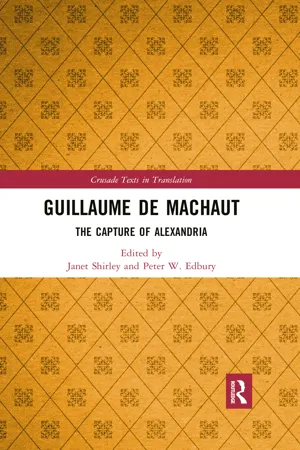
Guillaume de Machaut
The Capture of Alexandria
- 234 pages
- English
- ePUB (mobile friendly)
- Available on iOS & Android
eBook - ePub
Guillaume de Machaut
The Capture of Alexandria
About this book
Guillaume de Machaut, a man famous for both his poetry and his musical compositions, wrote his Prise d'Alexandrie (or Capture of Alexandria) just a few years after the death of his hero, King Peter I of Cyprus (1359-69). It is a verse history of Peter's reign, and was Machaut's last major literary work. Peter's ancestors had ruled the island of Cyprus since the 1190s, and in 1365 Peter gained notoriety throughout western Europe as leader of a crusading expedition which captured the Egyptian port of Alexandria. His forces, however, were unable to retain control, and Peter was left with a war against the Egyptian sultan. It was his increasingly desperate measures to continue the struggle and carry opinion with him that resulted in his murder in 1369. Machaut relied on information relayed by French participants in Peter's wars, but although he was not an eyewitness of these events, his account is independent of other narratives of the reign which were written in Cyprus apparently under the auspices of the king's heirs.
Part I
The Capture of Alexandria
By
Guillaume de Machaut
1. Prologue1
Here begins the book of the Capture of Alexandria
Gods once upon a time would fall in love
and goddesses would play those courteous games
tender, delicious, made for lovers’ use;
and it was then that the bright sun, fair moon,
the commune of the stars, all the twelve signs
that rule the zodiac, together with
the shining planets, clear and bright, agreed
to call a parliament.
Mighty, majestic, came the glorious gods,
came scores of goddesses, far more of both
than I have room to tell you; nymphs from woods,
from rivers; satyrs too of every sort;
women tragedians2 who humbly serve
the gods and offer sacrifice; and nymphs
of poetry, creatures of fairy kind.
One goddess stayed away. The noble task
did not appeal to Circe, wicked witch.
Mistress of powerful spells, she would have ruined
the meeting and their hopes.
Look at this lady – royally she comes!
Royal the throng of gods, but she, most fair,
Venus, outshines them all. With her comes Mars,
the god of war. How well she knows her worth,
decked out in all the splendour she deserves,
goddess and queen, ruler of hearts and souls,
of bodies and the wealth of all who love –
and yes, by God! of those as yet untouched.
No one breaks free whom Venus deigns to grasp.
The god of war spoke first.
‘I’ like to know’,
he said, ‘what you all think. I had dear friends,
but they’re all dead, alas, died wretchedly!
Good Alexander, he was one of them,
he conquered England, Flanders, all the world,
and sought incessantly by land and sea
for other realms and countries to subdue;
Hector and Caesar, Judas Maccabaeus,
King David, Joshua, great Charlemagne,
Arthur who suffered much, and the good duke
Godfrey of Bouillon, who invested all –
his gold, his wisdom, strength and courage, heart –
in his great task, and won the Promised Land,
or most of it, and there at last he died.
It falls to us now. We ought, all of us,
seek out a new Duke Godfrey, find a man
ready and able to defend his land.’3
‘Mars is quite right, that’s certain,’ said they all,
no deity dissenting. Then they begged
Nature to make a creature who should be
the best, most excellent, she could construct.
Into conjunction Nature brought two gods,
Venus and Mars. By Love and War she made
the creature that was needed, and so well
she did the work that everyone approved.
And God Himself, master and lord of all
who live and die, all that are, were, shall be,
God without end, the first and last, supreme
above all gods, He in His sovereign skill
placed life and soul within His creature. Soon,
guided and ruled by Nature, Venus bore
the fruit of that conjunction I described.
Vesta the priestess, lady of the nymphs,
of the tragediannes both old and young,
and of their holy temples, offered prayers
to every god and goddess, begging them
in noble generosity to give
a happy destiny to this new child.
Then she made sacrifice – heifer, ox, bull –
to every god and goddess who was there.
Gladly they took her offerings and so raised
the child to highest rank; and this is fact,
though, I don’t know, some of you may suppose
that it’s a pretty fable, nothing more.
Now ancient Saturn spoke. He talked good sense;
outranked by none, no god or goddess there
could claim more years.
‘Reason demands,’ he said,
‘that Courage place this child within a home
where Honour dwells. Quick now, let’s give him gifts;
this is appropriate, this we should do.’
Generous and prompt, each god hurried to give
the child fine gifts which would ensure his place
in Honour’s house.
And Fortune, was she there?
That I don’t know. We’ll have to wait and see
and find out how she treats him in the end.
Now our young child is born. God give him grace,
good life and honour! Which day did he come?
Nature and God created this new man
in the year twenty-nine, Saint Denis’ day,
as daylight faded and the evening fell.4
Good care and right companions must be found –
four goddesses they chose, famous, revered,
to cherish, rule, teach and instruct the boy.
Hebe, goddess of youth, as sweet and kind
as she is fair, the darling cup-bearer
to the great gods, would guard his infancy
till he reached understanding, and perhaps
if need be later still. The gentle girl
would do this duty well.
Minerva next
they asked to serve the boy, and she was glad
as he and she were cousins. Goddess, queen,
she’s mistress of all wisdom.
After her,
bedecked with glory, Juno – and the air
sparkled all round her as th...
Table of contents
- Cover
- Half Title
- Title Page
- Copyright Page
- Table of Contents
- Foreword
- Translator’s note
- Chronology
- Map
- Introduction
- Part I
- Part II
- Bibliography
- Index
Trusted by 375,005 students
Access to over 1.5 million titles for a fair monthly price.
Study more efficiently using our study tools.
Frequently asked questions
Yes, you can cancel anytime from the Subscription tab in your account settings on the Perlego website. Your subscription will stay active until the end of your current billing period. Learn how to cancel your subscription
No, books cannot be downloaded as external files, such as PDFs, for use outside of Perlego. However, you can download books within the Perlego app for offline reading on mobile or tablet. Learn how to download books offline
Perlego offers two plans: Essential and Complete
- Essential is ideal for learners and professionals who enjoy exploring a wide range of subjects. Access the Essential Library with 800,000+ trusted titles and best-sellers across business, personal growth, and the humanities. Includes unlimited reading time and Standard Read Aloud voice.
- Complete: Perfect for advanced learners and researchers needing full, unrestricted access. Unlock 1.5M+ books across hundreds of subjects, including academic and specialized titles. The Complete Plan also includes advanced features like Premium Read Aloud and Research Assistant.
We are an online textbook subscription service, where you can get access to an entire online library for less than the price of a single book per month. With over 1.5 million books across 990+ topics, we’ve got you covered! Learn about our mission
Look out for the read-aloud symbol on your next book to see if you can listen to it. The read-aloud tool reads text aloud for you, highlighting the text as it is being read. You can pause it, speed it up and slow it down. Learn more about Read Aloud
Yes! You can use the Perlego app on both iOS and Android devices to read anytime, anywhere — even offline. Perfect for commutes or when you’re on the go.
Please note we cannot support devices running on iOS 13 and Android 7 or earlier. Learn more about using the app
Please note we cannot support devices running on iOS 13 and Android 7 or earlier. Learn more about using the app
Yes, you can access Guillaume de Machaut by Janet Shirley, Peter W. Edbury, Janet Shirley,Peter W. Edbury in PDF and/or ePUB format, as well as other popular books in History & World History. We have over 1.5 million books available in our catalogue for you to explore.