Considering the ever-increasing global population and finite arable land, technology and sustainable agricultural practices are required to improve crop yield. This book examines the interaction between plants and microbes and considers the use of advanced techniques such as genetic engineering, revolutionary gene editing technologies, and their applications to understand how plants and microbes help or harm each other at the molecular level. Understanding plant-microbe interactions and related gene editing technologies will provide new possibilities for sustainable agriculture. The book will be extremely useful for researchers working in the fields of plant science, molecular plant biology, plant-microbe interactions, plant engineering technology, agricultural microbiology, and related fields. It will be useful for upper-level students and instructors specifically in the field of biotechnology, microbiology, biochemistry, and agricultural science.
Features:
Examines the most advanced approaches for genetic engineering of agriculture (CRISPR, TALAN, ZFN, etc.).
Discusses the microbiological control of various plant diseases.
Explores future perspectives for research in microbiological plant science.
Plant-Microbial Interactions and Smart Agricultural Biotechnology will serve as a useful source of cutting-edge information for researchers and innovative professionals, as well as upper-level undergraduate and graduate students taking related agriculture and environmental science courses.
1 Plant-Microbe Interaction for Sustainable Agriculture
Swati Tyagi, Robin Kumar, Baljeet Singh Saharan, and Ashok Kumar Nadda
DOI: 10.1201/9781003213864-1
Contents
1.1 Introduction
1.2 Beneficial Plant-Microbe Interactions
1.3 Harmful Plant-Microbe Interactions
1.4 Microbial Immunity against Host Plants
1.5 Plant Immunity against Invading Pathogens
1.6 Use of OMICS Techniques for Plant-Microbe Interaction Studies
1.7 Future Perspectives
Acknowledgement
Disclosure of Potential Conflicts of Interest
References
1.1 Introduction
The world’s population is growing exponentially, and, with this increasing population, the rate of urbanization/industrialization has also increased. This has increased the demand for food, which has accelerated the depletion of natural resources (Vejan et al. 2016). To meet this demand, an excessive and irrational use of agrochemicals, such as fertilizers, herbicides, and fungicides, has been adopted in the past, influencing agriculture practices and polluting soil, water, and ecosystems and causing an ecological imbalance. However, these practices cause more serious challenges rather than solving the demand; therefore, it is necessary to improve crop productivity organically or naturally in a sustainable manner in harmony with the ecosystem. These issues pushed agricultural scientists to look for alternative options and understand the underlying molecular mechanism of plant-microbe interactions that can provide fresh perspectives (Tyagi et al. 2021). In the natural environment, plants and microbes constantly interact with each other, and these interactions are highly diverse and can be broadly categorized as favourable, neutral, or harmful, depending on their effect on the plant health and development process (Tyagi, Lee et al. 2020). In past decades, many studies have been conducted to understand the important molecular players involved in plant-microbe interactions, and a lot of information has been discovered; however, this information is not enough, and many queries still need to be addressed. Microorganisms interacting with plants exhibit enormous potential to improve plant health and development as a natural catalyst or to trigger a negative response in the form of disease or stress (van de Mortel et al. 2012). Queries such as how do these microbes interact and exhibit different responses, what are the signalling pathways involved, what makes the interaction harmful or beneficial, what are the immune factors in plant and microbes that affect the overall response in both the interacting partners must be answered to understand the overall interaction process in plants and microbes and will provide the landmark information that can be used to identify and mark the pathogens or beneficial microbes and their interaction effect on the crop plants.
In this context, beneficial microorganisms such as plant growth-promoting rhizobacteria (PGPR) or plant growth-promoting fungi (PGPF) are considered potential elements to improve plant growth and development and, hence, can serve as natural and sustainable alternatives to fertilizers and pesticides (van Loon et al. 1998). In past decades, several PGPFs and PGPRs were identified, characterized, and found to improve plant growth and nutritional quality, soil health, and fertility in a sustained manner. For example, some members of the bacterial genera Bacillus, Trichoderma, and Fusarium prevent plant diseases by subduing plant pathogens, thereby serving as biocontrol agents (Tyagi et al. 2020). Application of PGPR and mycorrhizal fungi enhance plant growth under various stress conditions. Both fungal and bacterial endophytes are found to be active stress relievers of the host plant (Voisard et al. 1989). Studies with many microbial inoculants have demonstrated their beneficial role in plant growth through effective root colonization and induction of plant growth support mechanisms. Overall, the exploitation of beneficial microorganisms and their useful interactions with plants offer promising and eco-friendly strategies in the development of organic agriculture globally (Eckardt 2002). However, microbes can cause a serious threat to agricultural production by causing severe diseases and are considered to be phytopathogens (El-Tarabily et al. 2000). Plant-pathogen studies must be undertaken to identify new pathogens, how they affect plant health, and how the already reported pathogens are developing resistance and evolving. All this information about plant-microbe interaction, whether it is beneficial or harmful, lies in the genetic material, and, thus, the genes involved in these interactions must be identified, characterized, and annotated. There is an urgent need to link the plant studies with “OMICS” to address these questions and provide some useful gene quantitative trait loci (QTLs) controlling specific traits to the breeders that can be used in breeding programs and thus improve the crop varieties in terms of productivity or quality.
1.2 Beneficial Plant-Microbe Interactions
With the start of the green revolution, the use of chemical fertilizers, insecticides, and pesticides increased dramatically to improve agricultural yield and productivity. However, despite several studies reporting their negative impact on the ecosystems, soil health, and humans, they are still in use (Tyagi et al. 2021). To overcome these potential hazards, the use of microorganisms for crop improvement has been proposed and, over the years, this proposal has been widely accepted by innovative farmers and agriculturists. Several plant growth-promoting microorganisms (PGPM) – including PGPRs, PGPFs, arbuscular mycorrhizae (AMF), and endophytes (bacteria/fungi) – have been reported to influence plant growth positively (Tyagi et al. 2021). These PGPMs either directly secrete plant growth-promoting compounds in the form of volatile organic compounds (VOCs), plant hormones, siderophores, etc. to boost the plant health or use indirect mechanisms such as the release of lytic enzymes, antibiotics, and other defence molecules which antagonise the pathogen growth and promote the plant growth as well as develop resistance against the plant pathogens (Asari et al. 2016). VOCs are compounds with a high vapour pressure that makes them highly diffusible in soil and the plant canopy, thus, making them an ideal molecule for crosstalk between plants and microbes (Asari et al. 2016). VOCs generated by plants and microorganisms can act as signalling molecules activating a series of molecular events that ultimately regulate a wide range of physiological processes of plants and microorganisms (Tyagi et al. 2019). VOCs released by plants determine the type of microbiota that can live in the phytosphere and prime the plant defensive system to upcoming stresses (Tyagi et al. 2018; Tyagi et al. 2019; Tyagi, Lee et al. 2020). Microbes also emit VOCs in response to environmental conditions and can stimulate plant growth and induce resistance/tolerance to biotic/abiotic anxious factors (Tahir et al. 2017; Tahir et al. 2017). Thus, biogenic VOCs represent a rich and complex chemical vocabulary that can help to uncover the hidden secrets that can be used for modern sustainable agriculture. On the other hand, metal-resistant siderophore-producing bacteria help a plant to thrive under heavy metal stress by alleviating the metal toxicity. Heavy metals, being noxious in nature, enter the food chain and result in the toxicity of plants and animals (Chen et al. 2016). With the expansion of industries, the pollution of these toxic metals is increasing at a very fast pace. The removal of these heavy metals by natural means is the need of the hour. The toxication of soil by these metals can be removed through phytoremediation, mycoremediation, and microbial remediation (Chen et al. 2016). One such way of microbial remediation includes the application of siderophores that are synthesized naturally by microbes and are helpful in forming a complex with heavy metal. Siderophores have been used mostly for clinical studies but have the potential to play a critical role in cleaning the environment (Rajkumar et al. 2010). Siderophores provide heavy-metal detoxification and cleaning of the environment by natural means. Some microbes improve the growth of the plants and serve as biofertilizers (Rajkumar et al. 2010). These microbes form spores and provide a competitive environment for other microbes. Many PGPR/F(s) secrete lytic enzymes such as chitinase, cellulase that can degrade the insoluble organic polymers into soluble compounds that can be utilized by the plants (Tyagi, Lee et al. 2020). Additionally, microbes induce systemic resistance in plants and provide protection against biotic and abiotic stress. Several reports have been published that show the potential and mechanism of action of how microbes secrete different molecules that induce resistance against fungal/bacterial pathogens as well as improve the plant growth and development process (Tyagi et al. 2021). Also, the secondary metabolites released by microbes are taken by plants to resist the abiotic stresses such as drought, salt, etc. These interactions among plants and different classes of microbes are much more important to understand so that they can be utilized as alternatives for chemical based agri-products and to ensure the plant health under unfavourable conditions.
1.3 Harmful Plant-Microbe Interactions
In plant-microbe interaction studies, it is reported that fungi are more likely to cause more yield losses than other phytopathogens because of their highly evolving nature. Usually, the fungal phytopathogens are host specific, but survival on alternative hosts has also been reported for many of them, which helps the invading pathogen to breach the plant’s immune system and develop resistance (Tyagi, Lee et al. 2020). Other phytopathogens, such as bacteria, viruses, and nematodes, also negatively impact plant health and decrease productivity. These pathogens interact with the plant host, breach the plant’s immune system, and develop disease in the host, which, later in the course of infection, kills the plant or reduces productivity. Pathogens secrete effector proteins that interact with plant proteins and initiate the infection process. Also, pathogens secret toxins that shut down the expression of defence-related genes, making them vulnerable to infection. Though previous studies provide informative insights regarding these interactions, much still remains unknown and needs to be addressed (Tyagi et al. 2021).
1.4 Microbial Immunity against Host Plants
To initiate infection in the host plant, microbes must fight against the plant’s defence system. Microbes use different virulence-related biomolecules that interact with the host. In the case of bacteria, type II, III, and IV secretion systems release virulence-related biomolecules that interact with the host to initiate and progress the infection (Tyagi et al. 2021). Similarly, fungi secrete enzymes that degrade the host cell wall/membrane-related molecules and allow the pathogens to enter into the host. On the other hand, viruses’ particles enter the host through mechanical and chemical injury caused by external factors or by biological vectors (Tyagi et al. 2021). Once the viral particle enters the host, it can replicate itself and induce the infection response. It is very important to understand the mechanism of how pathogens enter the host and what molecules are involved in infection progression as well as how they initiate the infection. Understanding this molecular crosstalk between plant and microbes will help us to develop resistant or less susceptible plant/crop varieties (Tyagi et al. 2021).
1.5 Plant Immunity against Invading Pathogens
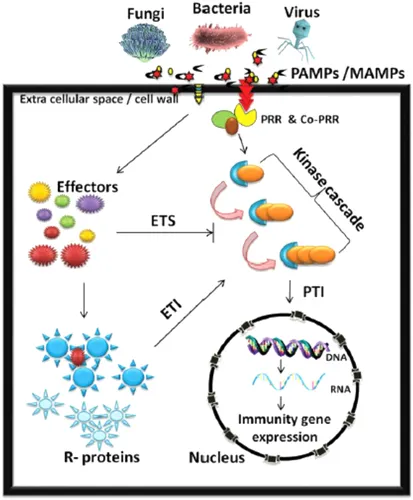
In nature, plants, as a defending host, and microbes, as infecting pathogen, are constantly racing to initiate/mitigate infection. Several microbes, including bacteria, fungi, and viruses, cause a number of diseases in plants, and plants have to deal with these invading pathogens to survive (Tyagi et al. 2020). The success rate of any infection is dependent on the susceptibility of the host and the environmental conditions favouring the establishment of infection. To fight invading pathogens, plants have two layers of defence: 1) constitutive and 2) induced. The constitutive defence system includes the physical and chemical barriers that are uniformly present in all plant species and act as the first line of defence (Tyagi et al. 2021). On the other hand, the induced defence system is activated when the pathogen attacks the host and either tries to breach or has breached the first line of defence (Figure 1.1).
FIGURE 1.1 Plant immune system: The figure illustrates the interaction between plant microbes and the underlying mechanism involved in plant defence.
Over time, different research groups have introduced different models of plant-microbe interaction to explain plant immunity and response toward the invading pathogens. The most accepted model among them is the zig-zag model (Tyagi et al. 2021). The plant defence system is activated by cell-to-cell communication followed by a complex series of events between the host plant and pathogen or its component. Depending upon the type (bacteria, fungi, virus, etc.) and nature (biotrophic, necrotrophic, etc.) of invading pathogen, the immune system employs different biomolecules (Tyagi et al. 2018). Generally, plants’ cell walls or cell membranes have a dif...
Table of contents
Cover
Half-Title
Series
Title
Copyright
Contents
Preface
Editors
Contributors
Chapter 1 Plant-Microbe Interaction for Sustainable Agriculture
Chapter 2 Beneficial Microorganisms in Crop Growth, Soil Health, and Sustainable Environmental Management: Current Status and Future Perspectives
Chapter 3 Environmental Control of Plant-Microbe Interaction
Chapter 4 Vocabulary of Volatile Compounds (VCs) Mediating Plant-Microbe Interactions
Chapter 5 Role of Microorganisms in Mitigating Plant Biotic and Abiotic Stresses
Chapter 6 Plant-Microbial Interactions in Natural/Organic Cultivation of Horticultural Plants
Chapter 7 Seed Defense Biopriming
Chapter 8 Molecular Communications between Plants and Microbes
Chapter 9 CRISPR/Cas9: An Efficient Tool for Improving Biotic Stress in Plants
Chapter 10 Plant-Microbe Interaction and Recent Trends in Biotechnology for Secondary Metabolite Production in Medicinal Plants
Chapter 11 Overview of Bioactive Compounds from Endophytes
Chapter 12 Nanomaterials Augmenting Plant Growth-Promoting Bacteria and Their: Potential Application in Sustained Agriculture
Chapter 13 Siderophores and Their Applications in Heavy Metal Detoxification
Index
Trusted by 375,005 students
Access to over 1.5 million titles for a fair monthly price.
Study more efficiently using our study tools.
Frequently asked questions
Yes, you can cancel anytime from the Subscription tab in your account settings on the Perlego website. Your subscription will stay active until the end of your current billing period. Learn how to cancel your subscription
No, books cannot be downloaded as external files, such as PDFs, for use outside of Perlego. However, you can download books within the Perlego app for offline reading on mobile or tablet. Learn how to download books offline
Perlego offers two plans: Essential and Complete
Essential is ideal for learners and professionals who enjoy exploring a wide range of subjects. Access the Essential Library with 800,000+ trusted titles and best-sellers across business, personal growth, and the humanities. Includes unlimited reading time and Standard Read Aloud voice.
Complete: Perfect for advanced learners and researchers needing full, unrestricted access. Unlock 1.5M+ books across hundreds of subjects, including academic and specialized titles. The Complete Plan also includes advanced features like Premium Read Aloud and Research Assistant.
Both plans are available with monthly, semester, or annual billing cycles.
We are an online textbook subscription service, where you can get access to an entire online library for less than the price of a single book per month. With over 1.5 million books across 990+ topics, we’ve got you covered! Learn about our mission
Look out for the read-aloud symbol on your next book to see if you can listen to it. The read-aloud tool reads text aloud for you, highlighting the text as it is being read. You can pause it, speed it up and slow it down. Learn more about Read Aloud
Yes! You can use the Perlego app on both iOS and Android devices to read anytime, anywhere — even offline. Perfect for commutes or when you’re on the go. Please note we cannot support devices running on iOS 13 and Android 7 or earlier. Learn more about using the app
Yes, you can access Plant-Microbial Interactions and Smart Agricultural Biotechnology by Swati Tyagi, Robin Kumar, Baljeet Saharan, Ashok Kumar Nadda, Swati Tyagi,Robin Kumar,Baljeet Saharan,Ashok Kumar Nadda in PDF and/or ePUB format, as well as other popular books in Technology & Engineering & Biotechnology. We have over 1.5 million books available in our catalogue for you to explore.