Although most teacher education programs offer classes on special education and English language learners, teachers often do not receive any training in the needs of high-ability students or gifted education practices. This book:
eBook - ePub
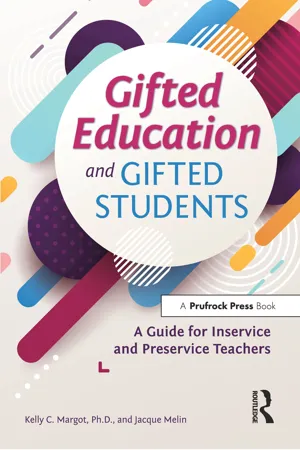
Gifted Education and Gifted Students
A Guide for Inservice and Preservice Teachers
- 96 pages
- English
- ePUB (mobile friendly)
- Available on iOS & Android
eBook - ePub
Gifted Education and Gifted Students
A Guide for Inservice and Preservice Teachers
About this book
Information
CHAPTER 1
Gifted Learners: Research, Theories, and Models
DOI: 10.4324/9781003235330-2
DRIVING QUESTION
What key philosophies, theories, models, and research support education for gifted learners?
LEARNING TARGETS
- What specific research-based models exist to explain gifted learners?
- What is known about intelligence that can help gifted learners?
- What theories and research concerning creativity apply to gifted learners?
- How do educators identify gifted learners for school programs?
In order to teach high-ability students, educators first have to better understand them. This chapter will summarize the work of Gagné (2015) and Renzulli (2012), along with research findings about advanced curriculum. Additionally, some background from the field of intelligence will set the stage for the remainder of the book. These theories and models should guide teachers in their practice with advanced learners.
Research-Based Models
Gagné’s (2015) Differentiating Model of Giftedness and Talent clearly distinguishes gifts (those things people are naturally born with) from talents (gifts that have been systematically developed). Intrapersonal and environmental catalysts act within the model to either help or hinder the development of gifts into talents. Additionally, Gagné included chance as a factor in talent development. Teachers have many roles within this model. They can provide an environment conducive to this developmental process as well as opportunities for students to explore new activities or programs. They can also help students better understand themselves and learn to manage their behaviors in a positive way. Conversely, teachers can also hinder the development of talent by stifling students’ ability to develop their gifts.
Renzulli (2012) used a Three-Ring model to explain giftedness. One ring contains high cognitive ability, another contains creativity, and the last contains task commitment (i.e., determination, willpower, perseverance). Gifted behaviors occur within the overlap of all three rings. Renzulli believed the word gifted should be used as an adjective to describe behaviors, like a “gifted mathematician,” instead of as a noun. Renzulli felt that educators should not label students as gifted or not gifted, but instead should examine behaviors that manifest as gifted and encourage the growth of these behaviors. To do this, teachers should focus on teaching creativity and encouraging task commitment. Students should be given time and space to explore a particular subject or skill. Teachers also need to engage students by using teaching methods like inductive instruction (i.e., knowledge gained from investigation and exploration with topics), enriching activities that challenge students, and a learning environment that encourages intellectual pursuit.
Intelligence
Intelligence is often measured using standardized tests. Various aspects of intelligence may be measured depending on the assessment and how many dimensions are utilized. The Wechsler Intelligence Scale for Children (WISC-V; Wechsler, 2014) is a common assessment in schools. It measures the verbal (vocabulary and comprehension) and the performance (matrix reasoning and picture completion) aspects of intelligence. Because it takes 65–80 minutes to administer, sometimes an even shorter assessment, like the Naglieri Nonverbal Ability Test (NNAT; Naglieri, 2018), will be given to determine which students should qualify for gifted programming. Because the NNAT is a nonverbal assessment, it has been used to eliminate assessment bias with English language learners (ELLs) and students from diverse cultural and economic backgrounds. Children are asked to solve a series of increasingly difficult puzzles, which yields a nonverbal cognitive ability score. Another common assessment is the Cognitive Abilities Test (CogAT), which includes a battery of verbal, quantitative, and nonverbal test items.
Research indicates the importance of a teacher’s perception of a student’s intelligence. This perception links to teacher expectations, student academic identity development, and school inequities (Hatt, 2012). Teachers’ pedagogical practices and discourse with students will be influenced by their beliefs about the intelligence of each student. Expectations are often higher when a teacher believes a student is smarter (Sternberg, 2007). Students begin to develop an identity as either “smart” or “dumb” in school based on these pedagogical practices and discourse occurring in their classrooms (Hatt, 2012). School inequities, such as limited access to advanced coursework and teachers rewarding students who are seen as more intelligent, must be vigilantly prevented.
The bell curve of intelligence is a normal curve, meaning there are as many people on the right (high intelligence) as there are on the left (low intelligence). Statistically, in any given general education classroom, there are just as many students with high intelligence as there are with cognitive impairment.
Creativity
Creativity is an important part of gifted education. Some definitions of gifted include creativity as a dimension (Renzulli, 2012). Creative production helps to bring genius ideas into the world. Sometimes teachers think of creativity as a “fuzzy” concept that they cannot define, which makes it difficult to teach or incorporate into classes. In fact, the creative process can be explained in eight stages that are easily reproduced in class activities (Sawyer, 2012):
- Find the problem: Students must identify an ill-defined problem that has many possible solutions/answers and is not easily solved.
- Acquire knowledge relevant to the problem: Students must practice before they can create by learning everything about the problem.
- Gather all potentially related information: Often creativity happens when seemingly unrelated information is connected in a new way.
- Incubation: Allow time for the unconscious mind to process all of the information and search for new combinations and creative solutions to the problem.
- Generate a large variety of ideas: Create a conclusive list of potential solutions to the problem, based on all knowledge gained (sometimes called brainstorming).
- Combine ideas in unexpected ways: Encourage students to construct combinations from different domains or disciplines to generate original ideas to solve the problem.
- Select the best ideas: Have students carefully evaluate each idea to determine its merit in solving the problem and then choose the strongest possibilities.
- Externalize the idea: Students can share their solution with others digitally (e.g., website, blog, application), concretely (e.g., poster, display board, mobile, model, etc.), or in an entirely new way.
By allowing students to complete the creative process in the classroom, educators teach students that creativity can be developed and that students are capable of generating new ideas.
The learning environment also plays an important role in student learning and students’ ability to produce creatively (Beghetto, Kaufman, & Baer, 2015). In order to support standards-based learning and creativity simultaneously, teachers need to send a positive message that makes students feel supported and motivated to learn and create. Teachers can do this by integrating students’ interests and passions into lessons. Teachers should give students freedom to generate messy ideas and take intellectual risks in the classroom. Students can focus on their individual improvement of goals, which encourages them to only compete against themselves and not worry about how they measure up to others. This will also help students take pride in their work, solutions, and ideas (Beghetto et al., 2015).
Identifying Gifted Learners
Many theoretical and psychological factors should be considered when determining how students will be identified for gifted services. Categorizing students as gifted or not gifted is an arduous task wrought with complexities and a few problems. Many programs start with a referral process. Assessing students can be costly and time-consuming, so referrals allow the school to pinpoint which students need a closer look. Often teachers and/or parents are asked to refer students for gifted testing. Sometimes community member referrals, peer referrals, and self-nomination are also encouraged. Another option is to screen all students of a particular group (e.g., all kindergarteners might take the NNAT). Screening all students may eliminate some of the bias associated with nominating students. A more inclusive approach that allows equitable access to gifted programming is always recommended. One approach is to use multiple types of data in the initial screening phase (see Figure 1).
When considering students for gifted programs, educators must ensure that instruments and protocols include both qualitative and

Figure 1. Screening example with multiple types of data.

Figure 2. Gifted identification matrix.
quantitative data collection. Many quantitative assessments are available to measure various constructs (e.g., subject areas, cognitive ability, creativity). These are often valid and reliable, but still contain measurement error. Qualitative data may lower this error by adding flexibility for both the examiner and examinee (Kettler & Margot, 2015). These data can be collected through interviews, portfolios, and performance task assessments. Once all data are collected, no one source of data should be weighted more heavily than others. The use of cut scores (e.g., students must score at least 125 on a cognitive ability test to qualify for a gifted program) is not considered best practice. One way to make decisions about gifted placement based on the collection of data is through the use of a matrix. Each piece of data can be given a number of points, and then the total points can be added up to make a decision. Points can be added for students with disabilities, twice-exceptional (2e) students, students from poverty, or students who are otherwise disadvantaged. Figure 2 is an example of this type of matrix.
Perhaps most importantly, there must be alignment between identification procedures and gifted program services. Teachers must establish and then deconstruct the goals of the gifted program or course, and then look for students who are capable of achieving those goals. Likely giftedness should be identified in increasingly domain-specific ways as children get older. As schools start to offer advanced courses in specific subject areas, they should seek students who are performing at those levels or have the potential to perform at those levels in that particular subject/domain (Kettler & Margot, 2015). In other words, if looking for students to participate in an advanced mathematics course, it would not be prudent to use their verbal skills/scores. Instead educators would take a closer look at how students are currently performing in math and/or their potential ability to do well in an advanced mathematics course.
Reflection Questions
- ➣ What can you do in a classroom to help students be more task-committed?
- ➣ How can you incorporate the creative process into something you will teach in your class?
- ➣ How do you think the two identification profiles (Figures 1 and 2) would work in a school or district? What challenges can you foresee? What can you do to help alleviate those challenges?
Opportunities for Practice
- ➣ Create or modify a lesson that will encourage students to work harder on a particular set of standards.
- ➣ Create an activity for a class that has students complete the steps of the creative process using standards you teach (see Online Resources for an example).
- ➣ Develop or modify a profile page (with multiple pieces of qualitative and quantitative data) for identifying gifted learners that would fit a district or school.
CHAPTER 2
Underrepresented Populations in Gifted Education
DOI: 10.4324/9781003235330-3
DRIVING QUESTION
What role does culture, ethnicity, or socioeconomic status play in the identification and instruction process?
LEARNING TARGETS
- How are students in underrepresented populations identified for services?
- What are best practices for ensuring equitable identification and programming for traditionally underrepresented gifted populations?
Identification of Underrepresented Populations
Students from certain populations have bee...
Table of contents
- Cover
- Half Title
- Title Page
- Copyright Page
- TABLE OF CONTENTS
- INTRODUCTION Intentionally Teaching Gifted Learners
- CHAPTER 1 Gifted Learners: Research, Theories, and Models
- CHAPTER 2 Underrepresented Populations in Gifted Education
- CHAPTER 3 Social-Emotional Factors for the Gifted and Talented
- CHAPTER 4 Twice-Exceptional Learners
- CHAPTER 5 Grouping and Acceleration Options for Gifted Students
- CHAPTER 6 Differentiating Curriculum, Assessment, and Instruction for Gifted Learners
- References
- About the Authors
Trusted by 375,005 students
Access to over 1.5 million titles for a fair monthly price.
Study more efficiently using our study tools.
Frequently asked questions
Yes, you can cancel anytime from the Subscription tab in your account settings on the Perlego website. Your subscription will stay active until the end of your current billing period. Learn how to cancel your subscription
No, books cannot be downloaded as external files, such as PDFs, for use outside of Perlego. However, you can download books within the Perlego app for offline reading on mobile or tablet. Learn how to download books offline
Perlego offers two plans: Essential and Complete
- Essential is ideal for learners and professionals who enjoy exploring a wide range of subjects. Access the Essential Library with 800,000+ trusted titles and best-sellers across business, personal growth, and the humanities. Includes unlimited reading time and Standard Read Aloud voice.
- Complete: Perfect for advanced learners and researchers needing full, unrestricted access. Unlock 1.5M+ books across hundreds of subjects, including academic and specialized titles. The Complete Plan also includes advanced features like Premium Read Aloud and Research Assistant.
We are an online textbook subscription service, where you can get access to an entire online library for less than the price of a single book per month. With over 1.5 million books across 990+ topics, we’ve got you covered! Learn about our mission
Look out for the read-aloud symbol on your next book to see if you can listen to it. The read-aloud tool reads text aloud for you, highlighting the text as it is being read. You can pause it, speed it up and slow it down. Learn more about Read Aloud
Yes! You can use the Perlego app on both iOS and Android devices to read anytime, anywhere — even offline. Perfect for commutes or when you’re on the go.
Please note we cannot support devices running on iOS 13 and Android 7 or earlier. Learn more about using the app
Please note we cannot support devices running on iOS 13 and Android 7 or earlier. Learn more about using the app
Yes, you can access Gifted Education and Gifted Students by Kelly Margot,Jacque Melin in PDF and/or ePUB format, as well as other popular books in Education & Inclusive Education. We have over 1.5 million books available in our catalogue for you to explore.