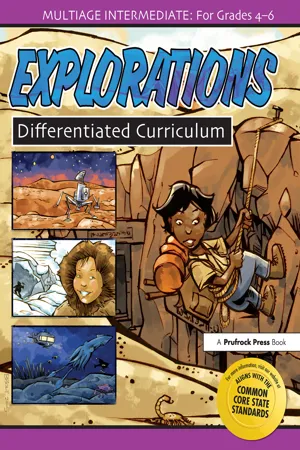
Explorations
  1. 96 pages
  2. English
  3. ePUB (mobile friendly)
  4. Available on iOS & Android
eBook - ePub

About this book

Explorations, a book in the Multiage Differentiated Curriculum Kit for Grades 4-6, gives students the opportunity to explore our world. The books in Prufrock's new Differentiated Curriculum Kits employ a differentiated, integrated curriculum based on broad themes. This all-in-one curriculum helps teachers save planning time, ensure compliance with national standards, and most importantly, pique their students' natural excitement and interest in discovery.By participating in the wide variety of activities in the Multiage Differentiated Curriculum Kit for Grades 4-6, students will explore the world around them and gain a lifelong desire to learn. From the mysterious depths of the ocean, to the craters of Mars, students will be challenged to go a step beyond the explorers who came before them. In one activity, students will act as explorers and examine the culture they live in. Students then will take characteristics from their discoveries and try to adapt them to another civilization. Social inequality and the effects of nutritional habits on the heart will be examined. Students also will explore winter survival tactics and retrace the steps of some famous explorers, such as Marco Polo. Explorations, along with the other books in the Multiage Differentiated Curriculum Kit for Grades 4-6 ( Balances, Choices, Questions, and Viewpoints ), makes teaching advanced learners easier! Grades 4-6This curriculum unit makes use of the following great children's literature books:

  • Marco Polo: A Journey Through China by Fiona MacDonald;
  • Brian's Winter by Gary Paulsen;
  • How Do You Lift a Lion? by Robert E. Walls (optional) and;
  • The Magic of M.C. Escher by M.C. Escher et al. (optional).

Tools to learn more effectively

Saving Books

Saving Books

Keyword Search

Keyword Search

Annotating Text

Annotating Text

Listen to it instead

Listen to it instead

Information

Publisher
Routledge
Year
2021
eBook ISBN
9781000492804

Activity 1 - Pre-Assessment

DOI: 10.4324/9781003235057-1

Differentiation Strategies

Knowledge and Skills

  • Attributes
  • Classifying

Innovation and Application

  • Fluency
  • Flexibility

Multiple Perspectives

  • Shared Inquiry
  • Brainstorming

Instructional Materials

  • 5 blank transparencies
  • overhead projector
  • 5 dry-erase markers
  • journals
  1. Write the word Explorations on the chalkboard. Challenge students to brainstorm and record all the things that can be explored. (They can use existing journals, spiral notebooks or create one using Attachment 1.) After 2 minutes of quiet, individual work, have students draw a line below the last brainstormed item
  2. Have teams of four discuss their lists. Allow 2 minutes for discussion, then 5 minutes for students to add to their lists.
  3. Invite students to share with the group all the things that can be explored. Record the items on the chalkboard.
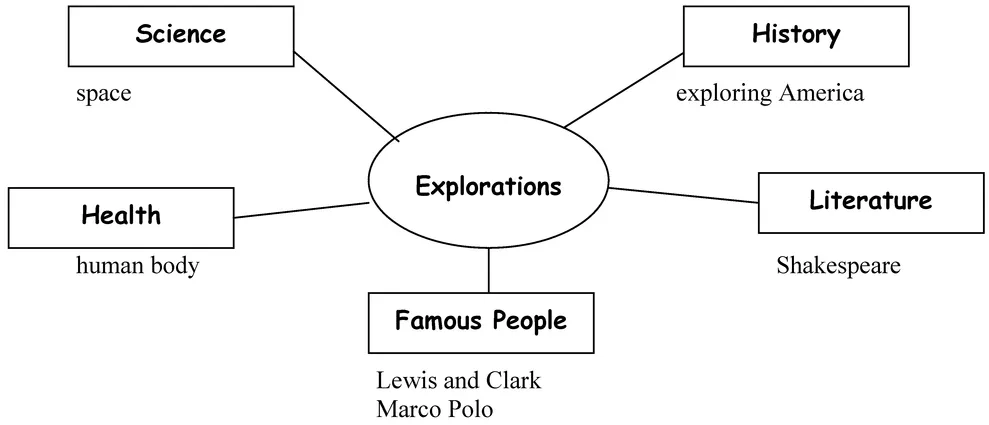
  4. Have students form five teams. Provide each team with a transparency and dry-erase marker. Challenge teams to create a word web that categorizes the list on the chalkboard. See example on the next page. Encourage students to develop their own categories.
  5. Have each team develop a presentation using the transparency as a visual.
  6. After teams categorize the list, invite them to present their graphic organizers to the class. Encourage teams to discuss how they selected the categories and separated the topics.
  7. Keep the original papers and the transparencies from the presentations for comparison after the Post-Assessment.

Activity 2 - The Path of Marco Polo

DOI: 10.4324/9781003235057-2

Differentiation Strategies

Knowledge and Skills

  • Visualization
  • Research

Analysis and Synthesis

  • Evaluate Situations
  • Draw Conclusions
  • SCAMPER

Relevance and Significance

  • Group Consensus
  • Field Lesson
Enduring Understanding
Explorers may transfer parts of their culture to other cultures.
Guiding Questions
  • (F) What things can be explored?
  • (F) Who was Marco Polo?

Instructional Materials

  • multiple matching copies of Marco Polo: A. Journey Through China book, by Fiona MacDonald
  • atlas and/or globe
  • butcher paper, construction paper, and markers
  • copies of Attachment 2

Background Information

Marco Polo (1254-1324) was the first European to cross Asia and leave a record of what he saw and heard while exploring the continent.
Polo was born in Venice, Italy. His mother died shortly thereafter, and his father saw him for the first time when he was 15 years old. Marco Polo was raised by his aunts and uncles.
Polo's father and uncle were Venetian merchants and business partners. When they finally returned to Venice to see the family, they were on a missionfor the Mongolian emperor Kublai Khan. They stayed in Venice for two years before continuing on their mission and their final destination, China. Polo, at age 17, joined them.
Marco Polo entered Kublai Khan's diplomatic service, acting as his agent on missions to many parts of the empire and serving as a governor for three years. The Polos stayed in China until 1292. Then they left to escort a Mongol princess traveling to Iran. They arrived in Venice in 1295.
Marco Polo was taken prisoner in 1298 when he was captain of a Venetian galley that participated in a battle between the fleets of Venice and Genoa. During his imprisonment in Genoa, he dictated the detailed account of his travels to a fellow prisoner. He was released in 1299 and returned to Venice.
Marco Polo's story, The Travels of Marco Polo, is the most famous and influential travel book in history. It has a wealth of vivid detail and gave medieval Europe its first real knowledge of China and other Asian countries, including Thailand, Japan, Java, Vietnam, Sri Lanka, Tibet, India, and Burma. For a long time it was the only source in Europe for information on the geography and life in the Far East. The book became the basis for some of Europe's first accurate maps of Asia. It helped to arouse Christopher Columbus' interest in the Orient, which culminated in his discovery of America in 1492 while attempting to reach the Far East. He took a copy of Marco Polo's book on his voyage.
  1. Share the Background Information and discuss whether Polo's childhood was typical of today or unique to the times. Discuss what effect Polo's early childhood, without his parents, could have had on his development.
  2. Have students read in pairs if multiple copies of Marco Polo: A Journey Through China are available. If this is not possible, have students take turns reading aloud, or read the book to the class.
  3. Challenge students to record locations where Marco Polo traveled.
  4. Guide students through a SCAMPER experience. You may choose to make copies of the next page if you like.
Teacher Tip
SCAMPER can be used to help students develop new thoughts and ideas and aids the creative thinking process. SCAMPER is an acronym for: substitute, combine, adapt, modify/magnify/minify, put to other uses, eliminate, reverse/rearrange.
S: Substitute
What do you think might have happened if Marco Polo had been raised by his parents instead of his aunts and uncles?
C: Combine
What might have happened if Marco Polo had been afraid of the ocean and been raised by a wealthy merchant?
A: Adapt
How might the story have changed if Marco Polo had had a younger brother or sister to look after while he was growing up?
M: Modify
What might have happened if Marco Polo's first voyage had ended in complete failure?
P: Put to other uses
What if Marco had only been interested in exploration so he could become wealthy?
E: Eliminate a feature of the story
How might the story of Marco Polo have changed if he had not been imprisoned and written his book?
R: Rearrange or reverse the sequence of the story.
How would the story of Marco Polo's exploration change if Marco Polo had been born a girl?
E. Ask students to work as partners to draw a map of the Eastern Hemisphere. Have them make symbols to attach to the map at various points that illustrate what Marco Polo found or experienced there. For example, a tiny prison cell could be the symbol in Genoa.
Closure

Instruct students to draw a line, tiny footprints, or other directional marks on the map to trace Polo's travels.

Extensions

  1. Have students create a skit or play that illustrates Marco Polo's travels.
  2. Ask students to complete the Time Traveling Logic Problem on Attachment 2.
  3. Have students create their own logic problem following the example on Attachment 2.
  4. Invite students to use a map, atlas, or globe to estimate the distance Marco Polo traveled between destinations.

Assessment

Check for the accuracy of the route on the map.

Activity 3 - Civilized or Not?

DOI: 10.4324/9781003235057-3

Differentiation Strategies

Knowledge and Skills

  • Etymology
  • Classifying

Innovation and Application

  • Flexibility
  • Fluency

Multiple Perspectives

  • Shared inquiry
  • Brainstorming
Enduring Understanding
Explorers may transfer parts of their culture to other cultures.
Guiding Questions
  • (F) What is a culture?
  • (F) What is civilization?

Instructional Materials

  • journals
  • computer with Internet access

Background Information

Culture is part of every person's life. It is everything a person believes, learns, and does as a member o...

Table of contents

  1. Cover
  2. Title Page
  3. Copyright Page
  4. Table of Contents
  5. Planning Materials
  6. Activities
  7. Attachments
  8. Checklists

Frequently asked questions

Yes, you can cancel anytime from the Subscription tab in your account settings on the Perlego website. Your subscription will stay active until the end of your current billing period. Learn how to cancel your subscription
No, books cannot be downloaded as external files, such as PDFs, for use outside of Perlego. However, you can download books within the Perlego app for offline reading on mobile or tablet. Learn how to download books offline
Perlego offers two plans: Essential and Complete
  • Essential is ideal for learners and professionals who enjoy exploring a wide range of subjects. Access the Essential Library with 800,000+ trusted titles and best-sellers across business, personal growth, and the humanities. Includes unlimited reading time and Standard Read Aloud voice.
  • Complete: Perfect for advanced learners and researchers needing full, unrestricted access. Unlock 1.4M+ books across hundreds of subjects, including academic and specialized titles. The Complete Plan also includes advanced features like Premium Read Aloud and Research Assistant.
Both plans are available with monthly, semester, or annual billing cycles.
We are an online textbook subscription service, where you can get access to an entire online library for less than the price of a single book per month. With over 1 million books across 990+ topics, we’ve got you covered! Learn about our mission
Look out for the read-aloud symbol on your next book to see if you can listen to it. The read-aloud tool reads text aloud for you, highlighting the text as it is being read. You can pause it, speed it up and slow it down. Learn more about Read Aloud
Yes! You can use the Perlego app on both iOS and Android devices to read anytime, anywhere — even offline. Perfect for commutes or when you’re on the go.
Please note we cannot support devices running on iOS 13 and Android 7 or earlier. Learn more about using the app
Yes, you can access Explorations by Debbie Keiser Triska,Brenda McGee,Mary Hennenfent in PDF and/or ePUB format, as well as other popular books in Education & Teaching Social Science. We have over one million books available in our catalogue for you to explore.