The Ultimate Sales Framework for Achieving Business SuccessSales enablement is no longer the new kid on the block. Having grown rapidly in recent years, it's now considered a best practice at many sales organizations. But there's little alignment across the sales profession on what sales enablement is or how to achieve it, nor is there a formalized strategy on what a sales enablement practice is or requires.In his new book The Building Blocks of Sales Enablement, sales enablement expert Mike Kunkle addresses these issues and presents a proven approach that both supports sales talent and achieves true business results. Kunkle lays out an easy-to-follow structure through the concept of building blocks, interconnected by systems thinking and supported by a consistent cadence of training, coaching, and content. Comprehensive and versatile, this book is for senior sales leaders and sales enablement leaders who are starting or evolving a sales enablement function as well as for struggling sales practitioners to use as a diagnostic tool and road map. Chapters detail how to use each building block, with reflective questions and guidance for creating your own analysis and tools. The book also includes a chapter on sales onboarding, separate chapters on how to integrate communication and support services, and recommended resources. Impactful sales enablement projects are basically change management initiatives in disguise. Use the building blocks framework to navigate challenges, measure successes, and determine a path forward to improving business outcomes.
- English
- ePUB (mobile friendly)
- Available on iOS & Android
eBook - ePub
The Building Blocks of Sales Enablement
About this book
Information
Subtopic
Human Resource ManagementIndex
Business1
The Building Blocks of Sales Enablement
A Formal Approach With Systems Thinking
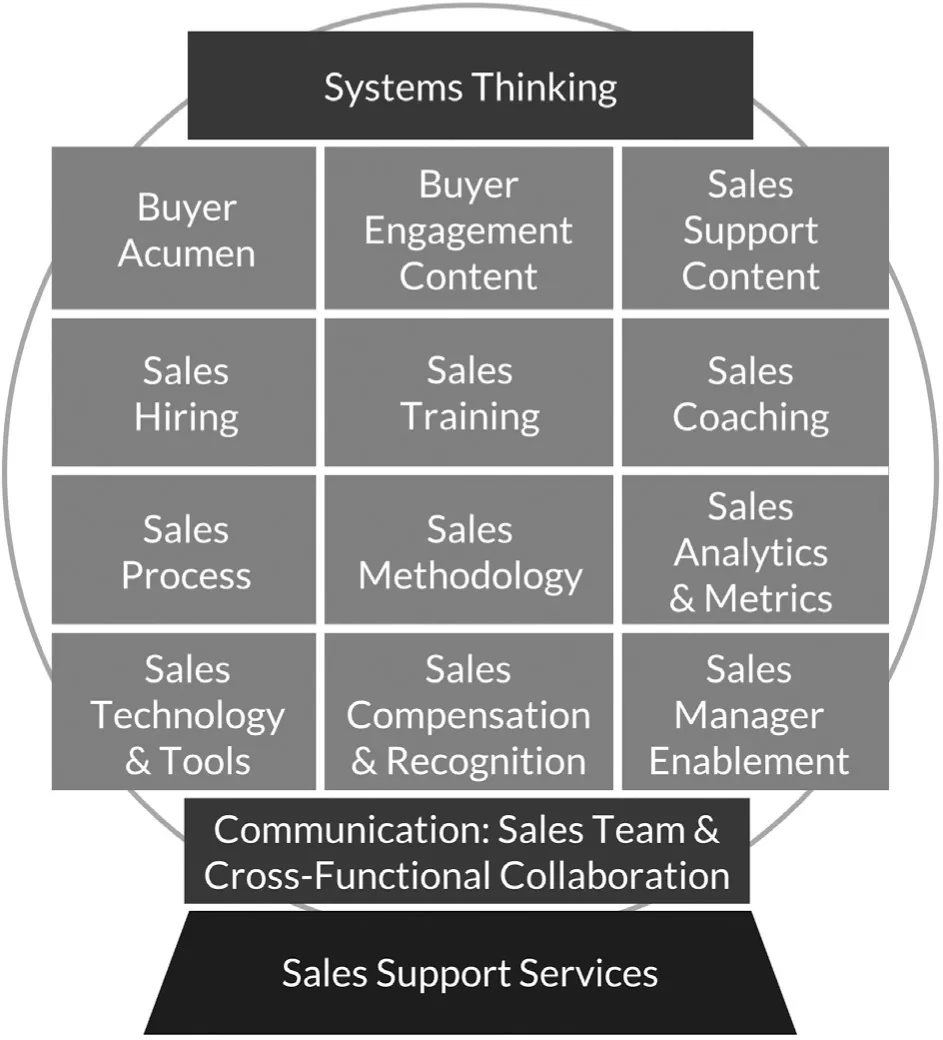
To help senior sales leaders and sales enablement leaders effectively start or evolve a sales enablement function that delivers business results, I focus on a formal maturity model, with the sales enablement building blocks, supported by systems thinking (Figure 1-1).
Here is a description of each block in the building blocks framework:
• Buyer acumen: In this building block you identify your buyer personas and their COIN-OP (challenges, opportunities, impacts, needs, objectives, and priorities), the problems they are trying to solve, what outcomes are they trying to achieve, and what metrics matter to each. This also covers their typical buying process, including objectives, tasks, and exit criteria per process stage.
• Buyer engagement content: There are two types of buyer engagement content:

• Sales support content: This includes the playbooks, materials, job aids, cheat sheets, and tools that support your sales force in selling as your leadership team intends (using your sales process and sales methodology).
• Sales hiring: In this building block, you collaborate to create a plan and process to source, recruit, hire, and promote sales reps and managers who succeed in their chosen role.
• Sales training: Here, you build a training and development plan to support your sales force. This includes sales onboarding and ongoing training that supports business objectives, teaching sales process and sales methodology, developing ongoing training to close sales competency gaps, and training and enabling sales managers. For best results, you will use a Sales Training System to train, sustain knowledge, practice and develop skills, transfer those skills, and coach to mastery.
Figure 1-1. Sales Enablement Building Blocks With Sales Support Services
• Sales coaching: This is a known performance enhancer. You select a sales coaching model and implement a competency development framework, remove obstacles, enable managers, and engage reps and managers in an ongoing process to identify and close sales competency gaps to increase organizational sales mastery and performance.
• Sales process: In this building block, you work with others to align your sales process to the buying process, and document the process objectives, tasks, and exit criteria for buyers and sellers in each stage.
• Sales methodology: In this building block, you collaborate to select appropriate sales methodologies for prospecting, opportunity management, and strategic account management. You work to develop sales competencies by role, from a top-producer analysis whenever possible or proven best practices.
• Sales analytics and metrics: Here you benchmark your sales metrics, such as conversion ratios, average sales price, cross-sell, ramp-up times for onboarding, sales velocity, sales productivity, quota attainment, content sharing, or key performance indicators (KPIs)—whatever is important for your business. You collaborate to track results pre- and post-training as well as following your sales onboarding and learning metrics, which will allow you to analyze everything. Using whatever tools are available, you can analyze customers, territories, purchase patterns, and more to understand your business and improve performance.
• Sales technology and tools: Here, you work with others to select and implement sales technology to support your sales force, create efficiency, increase time spent selling, and support sales effectiveness.
• Sales compensation and recognition: In this building block, you collaborate to ensure you have sales compensation, incentive, recognition, and reward plans that encourage the behaviors your senior leaders expect and the results they want.
• Sales manager enablement: This is deep enough to be a separate book, but it must be included in any sensible sales enablement plan. Here, you train managers to support their reps in achieving their quota, including how to analyze performance, select appropriate interventions, and coach effectively. You develop a coaching culture and implement a framework for sales competency development. You also determine your sales management operating system and the management disciplines you want to instill, train managers on them, and hold them accountable for executing your cadence.
The building blocks are supported by communication (both being the point-of-contact for communication to the sales team and fostering cross-functional communication and collaboration) and systems thinking.
Lastly, as applicable and desired, you can choose to provide a variety of sales support services, which includes things like coaching services, RFP support, and research support, often using a services level agreement (SLA) with the sales force.
In the following chapters I detail each building block, giving you the information you need to implement them effectively to start or evolve your sales enablement function and achieve the business results you and your executive team want. But first, we need to address systems thinking.
What Is Systems Thinking?
Daniel H. Kim, author of numerous books on systems thinking and co-founder of Pegasus Communications and the MIT Center for Organizational Learning, offers the following definition for systems thinking: “A system is any group of interacting, interrelated, or interdependent parts that form a complex and unified whole that has a specific purpose.”
He continues: “The key thing to remember is that all of the parts are interrelated and interdependent in some way. Without such interdependencies, we have just a collection of parts, not a system.”
Let’s think about this in a different way. A car, for example, has many systems that work together so that it runs smoothly. These major systems include the engine, fuel system, exhaust system, cooling system, lubrication system, electrical system, transmission, and the chassis. Further, the chassis includes the wheels and tires, the brakes, the suspension system, and the body. If there’s a problem with the drive train, the electrical system (such as the starter, battery, or alternator), or if several of the cylinders aren’t firing (a fuel system problem), the car won’t run very well.
The human body has systems too. Each system—respiratory, cardiovascular, pulmonary, skeletal, endocrine, or digestive—plays its part in a healthy, well-functioning body.
It’s the same in an organization.
Some systems exist externally, like the political environment, socio-economic conditions, and micro- and macroeconomic factors. Others are internal to the organization. I like to focus on internal systems and figure out the moving parts to make sure they’re not only healthy independently, but also working well together. Systems occur at the organizational, functional (department), position (role), and task levels. Of the many possible organizational systems, I’ve found that four produce the best results:
• The Sales Hiring System
• The Sales Readiness System
• The Sales Training System
• The Sales Management System
I haven’t always called those systems by these names. Before “sales readiness” was a common term, I called that system “sales support.” The Sales Training System is technically a subset of readiness, but it’s important enough with enough moving parts to call it out separately; it also includes a subsystem, which is the 5 Stages of Sales Mastery and Behavior Change.
Every system has a purpose, and for systems to produce the best results, all parts must be present and functioning at optimal levels. We have an opportunity to use critical thinking to analyze the relationships between each part of our organizational system to understand them more fully and make better decisions about how to improve business outcomes.
Summary
In this chapter I introduced the 12 building blocks, describing each one and how they fit together as a whole. But it’s also important to recognize at this stage that you can use the building blocks as your situation allows and dictates; that is, they are by no means suggested as sequential steps. This will become clearer in the following chapters, and you will be able to better see which blocks require your attention.
I also showed how I use systems thinking to create interdependencies, and how the four sales systems I use—hiring, readiness, training, and management—support the building blocks and create cross-functional collaboration.
We’re now ready to discuss the first building block, buyer acumen.
2
Buyer Acumen
The shift to a buyer-centric perspective is long overdue in the sales profession. The concept certainly isn’t new. Thought leaders and progressive sales professionals have been implementing it for years. Unfortunately, it’s far from pervasive. Over the past several years, B2B buying research has consistently indicated buyers’ dissatisfaction with seller behavior.
As sales enablers, if our role is to guide our sales forces to higher levels of sales effectiveness, this is a crucial building block. I call this deeper understanding of our market and buyers “buyer acumen.” While it’s helpful to include perspectives from marketing and your front-line sellers and managers, your personas should not be created solely from an inside-out perspective. Instead, it’s best to base this acumen and your personas on market research and discussions with your real buyers or others like them. If you don’t have the internal expertise to conduct the necessary market research, you should hire someone who does.
Personas With Roles and Goals and Defining COIN-OP
There are more in-depth perspectives elsewhere about the different approaches to building buyer personas (I’ve learned the most from the work of Tony Zambito and Adele Revella), but I’ll provide some guidance here. Useful personas include so much more than a simple profile of your buyers, but that concept helps most people grasp what a persona is.
As opposed to the ideal customer profile (ICP), which is a profile of the company, a buyer persona is a detailed description of your target buyers for each role that is typically involved in the purchase of your company’s products and services.
Here are the things to consider as you research and build your personas.
• Roles and Goals:
Relative to your solutions and the problems you solve, let’s use my acronym COIN-OP, which represents the challenges, opportunities, impacts, needs, outcomes, and priorities that matter most to your buyers:
• C/O: What challenges do they face or what opportunities might they capitalize on?
• I: What are the risks and impacts of the status quo? What happens if they fail to address the challenges or capitalize on the opportunities?
• N: Based on these assessments, what are their needs and wants (relative to the problems you can solve)?
• O/P: Because of the COIN, what are the outcomes they’ve set (or should set), and how do they prioritize their needs and desired outcomes? What are the upsides for them...
Table of contents
- Cover
- Title Page
- Copyright
- Contents
- Foreword to Sales Leaders By David Brock
- Foreword to Sales Enablement Leaders By Tamara Schenk
- Introduction
- 1 The Building Blocks of Sales Enablement
- 2 Buyer Acumen
- 3 Buyer Engagement Content
- 4 Sales Support Content
- 5 Sales Hiring
- 6 Sales Training
- 7 Sales Coaching
- 8 Sales Process
- 9 Sales Methodology
- 10 Sales Analytics and Metrics
- 11 Sales Technology and Tools
- 12 Sales Compensation
- 13 Sales Manager Enablement
- 14 Communication Management
- 15 Sales Support Services
- 16 How to Get Started
- 17 A Performance-Based Approach to Sales Onboarding
- A Look to the Future: Evolving to Sales Performance Consulting
- References and Recommended Resources
- Index
- About the Author
- Back Cover
Trusted by 375,005 students
Access to over 1.5 million titles for a fair monthly price.
Study more efficiently using our study tools.
Frequently asked questions
Yes, you can cancel anytime from the Subscription tab in your account settings on the Perlego website. Your subscription will stay active until the end of your current billing period. Learn how to cancel your subscription
No, books cannot be downloaded as external files, such as PDFs, for use outside of Perlego. However, you can download books within the Perlego app for offline reading on mobile or tablet. Learn how to download books offline
We are an online textbook subscription service, where you can get access to an entire online library for less than the price of a single book per month. With over 1.5 million books across 990+ topics, we’ve got you covered! Learn about our mission
Look out for the read-aloud symbol on your next book to see if you can listen to it. The read-aloud tool reads text aloud for you, highlighting the text as it is being read. You can pause it, speed it up and slow it down. Learn more about Read Aloud
Yes! You can use the Perlego app on both iOS and Android devices to read anytime, anywhere — even offline. Perfect for commutes or when you’re on the go.
Please note we cannot support devices running on iOS 13 and Android 7 or earlier. Learn more about using the app
Please note we cannot support devices running on iOS 13 and Android 7 or earlier. Learn more about using the app
Yes, you can access The Building Blocks of Sales Enablement by Mike Kunkle in PDF and/or ePUB format, as well as other popular books in Business & Human Resource Management. We have over 1.5 million books available in our catalogue for you to explore.