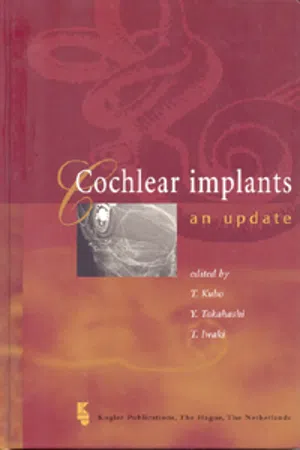
eBook - PDF
Cochlear Implants - An Update
- 615 pages
- English
- PDF
- Available on iOS & Android
eBook - PDF
Cochlear Implants - An Update
Trusted by 375,005 students
Access to over 1.5 million titles for a fair monthly price.
Study more efficiently using our study tools.
Information
Topic
MedicineSubtopic
Ear, Nose & Throat MedicineTable of contents
- Contents
- Foreword
- I. Basic studies
- Chronic monopolar high rate stimulation of the auditory nerve - Physiological and histopathological effects
- Comparison of promontory and round window stimulation electrical auditory brainstem response in cats
- Topographical relationship between the facial nerve, chorda tympani nerve and round window with reference to the surgical approach
- Blood flow in ears receiving cochlear implants
- Extrusion of a cochlear implant possibly due to silicone allergy - A case report
- II. Biocompatibility / Imaging
- Specific considerations for determining safety with MRI use in cochlear implant patients
- Three-dimensional images of the inner ear for preoperative evaluation of cochlear implants
- SPECT image analysis using statistical parametric mapping in postlingually deafened adults with cochlear implants
- Auditory cortex activation during electrical ear canal stimulation in subjects with severe hearing loss - Preliminary results of a functional magnetic resonance imaging evaluation
- Regional cerebral activation during electrical auditory stimulation using a tympanic electrode
- III. Electrophysiological testing
- Auditory neuropathy - The use of electrophysiological tests
- Examination of EAP thresholds (NRT thresholds) during Nucleus cochlear implant operations
- Electrically evoked compound action potentials in cochlear implant users from the National Taiwan University Hospital
- The characteristics of neural response telemetry of the normal cochlea and cochlear malformation
- Comparison between promontory and tympanic electrodes in electrical auditory stimulation
- Postoperative measurement of neural response telemetry
- Changes in electrically evoked compound action potential thresholds after implantation of the Nucleus CI24M device
- IV. New approaches for mapping
- A strategy for neural response telemetry capable of approaching the subjective threshold
- Reliability of intraoperative tests in cochlear implant fitting
- Device programming for a child based on neural response telemetry measurements
- The relationship between EABR and EAP thresholds and behavioral T/C levels in pediatric cochlear implantation
- Comparison of ECAP threshold with T and C levels in children after Nucleus 24 implantation
- Optimization of mapping parameters with neural response telemetry
- Intraoperative measurement of electrically evoked compound action potentials in Nucleus CI24M cochlear implant users - Their relationship to psychophysical performance
- Within-subject comparison between NRT predicted MAP and behaviorally measured MAP in Nucleus 24 cochlear implant children using the ACE strategy
- Electrically evoked stapedial reflex in cochlear implantation
- Considerations for mapping children with limited electrodes
- Investigation of the advantages of program selectability in speech processors
- V. Speech codings
- Comparison of speech coding strategies in Cantonese children with cochlear implants
- Comparison of tone detection in Mandarin-speaking cochlear implant recipients using SPEAK and ACE strategies
- Digisonic ® cochlear implant signal processing for speech intelligibility improvement in noise
- The effect of speech rate to speech recognition in cochlear implant users and elderly adults
- Perceptual ability of synthesized speech by cochlear implant patients
- VI. General evaluations
- Utility analysis of cochlear implantation in congenitally deaf children
- Quality-of-life study of adult cochlear implantees in a Cantonese-speaking population by a close-set questionnaire - A pilot launch of a quality-of-life Cantonese scale
- Hearing aid optimization in the evaluation of cochlear implant candidacy
- The usefulness of intraoperative switch-on with facial nerve monitoring in cochlear implantation
- The usefulness of supportive listening devices for cochlear implant users
- A computer-assisted instruction system for testing and training voice pitch discriminability through cochlear implants
- Development of a Japanese version of the Hearing in Noise Test
- VII. Surgical issues
- Use of a standard postauricular incision in cochlear implantation in young children
- Surgical issues in exchanging a Nucleus CI22M cochlear implant for a Nucleus CI24M cochlear implant
- Surgical aspects of cochlear implantation in young and very young children
- Problem cases after cochlear implantation - Update
- Preliminary results using a two-staged technique for cochlear implant insertion in a patient with bilateral fenestration cavities
- Results of tympanoplasty for chronic otitis media in cochlear implant candidates
- Cochlear implantation in chronic suppurative otitis media
- Cochlear implantation in chronic otitis media
- VIII. Implantation for malformed cochlea
- Cochlea implants in abnormal cochlea
- A case report of an implanted child with common cavity malformation
- Cochlear implantation in a child with a common cavity - A case report
- A case of cochlear implantation in a child with a congenital malformation
- Two cases of transmastoid labyrinthotomy for common cavity malformation using neural response telemetry
- Four cases of cochlear implantation in large vestibular aqueduct syndrome
- Cochlear implantation following bilateral temporal bone fracture
- Case report of cochlear implantation in a totally plugged cochlea
- IX. Evaluations for perimodiolar electrode
- Contour electrodes- Surgical approach and results
- The insertion of a curve electrode array into normal and ossified cochlea
- The Clarion electrode positioner - Radiological, electrophysiological and neurotological evaluations
- Preliminary results with the Nucleus Contour cochlear implant system - A radiological and neurophysiological correlation study
- Examination of the implant electrical auditory brainstem response threshold with and without the positioner for the Clarion 16 cochlear implant
- Comparison of proximity to the modiolus of various electrodes
- X. Speech reception and language development in children
- Rationale for early cochlear implantation in congenitally deaf children
- Cochlear implantation in very young deaf children - Monitoring progress
- Cochlear implantation in severe to profound hearing loss in children
- Speech recognition ability and satisfaction with cochlear implants in young children using IT-MAIS
- Factors affecting connected speech comprehension in Cantonese-speaking children after cochlear implant
- Speech perception of Mandarin Chinese speaking young children after multichannel cochlear implantation
- The development of speech perception in children with cochlear implants at Kanazawa University
- Cochlear implantation in post-meningitic children
- The development of auditory performance in children with cochlear implants
- Language development in congenitally deaf, implanted children - Hearing aids versus cochlear implants
- Acquisition of articulation in congenitally deaf children with cochlear implants
- Predictor variables of speech intelligibility in prelingually deafened children with cochlear implants
- Language skills of prelingually deaf children with cochlear implants
- Comparison of grammar comprehension of deaf children after cochlear implantation with that of normally hearing children
- An experimental study on the speech reading ability of children with cochlear implants
- Pediatric cochlear implantation in Nagasaki
- Results of cochlear implants in post-lingual children
- The significance of a cochlear implant on the development of ‘auditory emotional cognition’ in a child with profound hearing loss
- Application of electroglottography in tone production training
- XI. Rehabilitation issues in children
- A new method of consonant classification and a new strategy of speech correction for congenitally deaf implantees
- An individual educational program trial for infant cochlear implant users
- Mapping and rehabilitation of a prelingually deaf and blind child after cochlear implantation - A catastrophe or a clinical challenge?
- Influence of educational setting and communication mode on speech production in children with multichannel cochlear implants
- Using parent and teacher reports to assess the vocabulary knowledge of Cantonese-speaking hearing-impaired children
- Evaluation of the effectiveness of an educational program for children with cochlear implants
- XII. Outcomes in adults
- Residual hearing and Clarion cochlear implantation
- Correlation of speech and music perception in Combi 40/40+ users
- Effective discrimination of competing stimulus features in cochlear implantees
- The results of cochlear implantation in the elderly
- Speech discrimination in post-lingually deaf adult patients using SPECTRA 22
- Surgical results and effectiveness of cochlear implantation
- The effect of auditory feedback on the production of vowels after cochlear implantation
- The effect of auditory feedback on the production of fricatives and sentence duration after cochlear implantation
- Errors in consonant recognition in post-lingually deafened patients with cochlear implants
- Tone production performance in tonal-language-speaking cochlear implantees
- Speech performance of cochlear implant patients with GJB2-related deafness
- Cochlear implantation in a patient with type 1 Usher’s syndrome - A case report
- Cochlear implantation in a patient with mitochondrial encephalopathy, lactic acidiosis, and stroke-like episodes (MELAS) syndrome - A case report
- XIII. Binaural or bimodal hearing
- Distance, localization and speech perception pilot studies with bilateral cochlear implants
- Multicenter study on bilateral cochlear implantation
- Binaural cochlear implantation in the deaf-blind
- Hearing performance of a bilateral cochlear implant user
- Concurrent use of cochlear implants and hearing aids
- Speech recognition between bilaterally and unilaterally cochlear implanted and hearing-aid fitted users
- XIV. Auditory brainstem implant / Implantation after acoustic tumor removal
- Neurofibromatosis II and the 24-channel auditory brainstem implant - Experience in Hong Kong
- A Nucleus CI8+1 channel auditory brainstem implant in a staged operation
- Cochlear implantation in a patient with an acoustic tumor - Case report
- Auditory nerve integrity after translabyrinthine acoustic tumor removal
- XV. New devices / Implantable hearing aids
- Fundamental aspects and first results of the clinical application of combined electric and acoustic stimulation of the auditory system
- Evaluation of a differential floating mass type transducer for a middle ear implant system
- Comparison of measurements to determine transducer performance of an active middle ear implant
- Four years’ experience with the Symphonix Vibrant ® soundbridge - Clinical results
- Index of authors
Frequently asked questions
Yes, you can cancel anytime from the Subscription tab in your account settings on the Perlego website. Your subscription will stay active until the end of your current billing period. Learn how to cancel your subscription
No, books cannot be downloaded as external files, such as PDFs, for use outside of Perlego. However, you can download books within the Perlego app for offline reading on mobile or tablet. Learn how to download books offline
Perlego offers two plans: Essential and Complete
- Essential is ideal for learners and professionals who enjoy exploring a wide range of subjects. Access the Essential Library with 800,000+ trusted titles and best-sellers across business, personal growth, and the humanities. Includes unlimited reading time and Standard Read Aloud voice.
- Complete: Perfect for advanced learners and researchers needing full, unrestricted access. Unlock 1.5M+ books across hundreds of subjects, including academic and specialized titles. The Complete Plan also includes advanced features like Premium Read Aloud and Research Assistant.
We are an online textbook subscription service, where you can get access to an entire online library for less than the price of a single book per month. With over 1.5 million books across 990+ topics, we’ve got you covered! Learn about our mission
Look out for the read-aloud symbol on your next book to see if you can listen to it. The read-aloud tool reads text aloud for you, highlighting the text as it is being read. You can pause it, speed it up and slow it down. Learn more about Read Aloud
Yes! You can use the Perlego app on both iOS and Android devices to read anytime, anywhere — even offline. Perfect for commutes or when you’re on the go.
Please note we cannot support devices running on iOS 13 and Android 7 or earlier. Learn more about using the app
Please note we cannot support devices running on iOS 13 and Android 7 or earlier. Learn more about using the app
Yes, you can access Cochlear Implants - An Update by T. Kubo,Y. Takahashi,T. Iwaki, T. Kubo, Y. Takahashi, T. Iwaki in PDF and/or ePUB format, as well as other popular books in Medicine & Ear, Nose & Throat Medicine. We have over 1.5 million books available in our catalogue for you to explore.