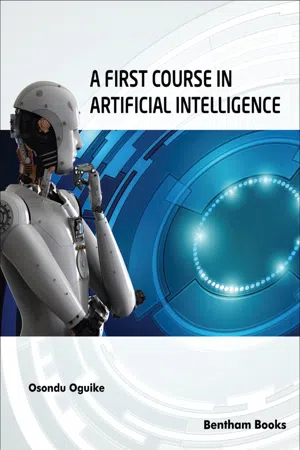
The importance of Artificial Intelligence cannot be over-emphasised in current times, where automation is already an integral part of industrial and business processes. A First Course in Artificial Intelligence is a comprehensive textbook for beginners which covers all the fundamentals of Artificial Intelligence. Seven chapters (divided into thirty-three units) introduce the student to key concepts of the discipline in simple language, including expert system, natural language processing, machine learning, machine learning applications, sensory perceptions (computer vision, tactile perception) and robotics. Each chapter provides information in separate units about relevant history, applications, algorithm and programming with relevant case studies and examples. The simplified approach to the subject enables beginners in computer science who have a basic knowledge of Java programming to easily understand the contents. The text also introduces Python programming language basics, with demonstrations of natural language processing. It also introduces readers to the Waikato Environment for Knowledge Analysis (WEKA), as a tool for machine learning. The book is suitable for students and teachers involved in introductory courses in undergraduate and diploma level courses which have appropriate modules on artificial intelligence.
- English
- ePUB (mobile friendly)
- Available on iOS & Android
eBook - ePub
A First Course in Artificial Intelligence
About this book
Information
Machine Learning
Osondu Oguike
Abstract
All discoveries made by man in any discipline, like physical sciences, biological sciences, social sciences, engineering, etc., are based on past experiences or collected data. This means that human beings solve the problem by using past experiences or collected data. Therefore, since one aspect of Artificial Intelligence, as pointed out in chapter 1, unit 1, is to design systems that act like man, it becomes necessary that computer systems should be designed to solve the problem the way human beings solve a problem. This means that computer systems should be designed to solve the problem using past experience or previously stored data. The data are called training data because they are used to train the computer to learn the trend or pattern of the training data. Learning the pattern or trend of the training data as a rule, it uses the learnt rule to solve a subsequent problem using test data that has the same structure as the training data. The vast amount of data in machine learning is divided into two sets, which are the training set and the test set. The training set is used to develop a model, while the test set is used to evaluate the performance of the model. Data splitting technique in machine learning refers to the technique used to split the data into a training set and test set. The aim is to avoid poor generalization, i.e., overfitting or overtraining. Using more training sets improves the accuracy of the model, while using more test data improves the accuracy of the error estimate. An appropriate training/test set ratio of 70:30 is considered appropriate. Machine learning, therefore, is an aspect of Artificial Intelligence that deals with the design of systems that uses a large set of data called training data to solve a particular problem. Machine learning is a broad area in Artificial Intelligence, which will be considered in the various units of this chapter.
Keywords: Classification algorithm, Data pre-processing, Decision tree algorithm, Feature engineering, K-means clustering algorithm, Learner’s input, Learner’s output, Naive Bayes algorithm, Regression algorithm.
1. INTRODUCTION TO MACHINE LEARNING
Human beings possess the ability to adapt, i.e., convert experience (data) into knowledge (output). In this context, data refers to the basic facts, while knowledge refers to the ability to use the basic fact to solve problems. God created human beings with a well-developed ability to turn experience (data) into knowledge. Therefore, in order to program computers to convert experience (data)
into knowledge, you need to understand some fundamental concepts involved in converting data into knowledge. These fundamental learning concepts are discussed in this unit.
1.1. Fundamentals of Machine Learning
A formal definition of mac...
Table of contents
- Welcome
- Table of Content
- Title
- BENTHAM SCIENCE PUBLISHERS LTD.
- PREFACE
- Introduction to Artificial Intelligence
- Expert System
- Natural Language Processing
- Machine Learning
- Machine Learning Applications
- Sensory Perception
- Robotics
Trusted by 375,005 students
Access to over 1.5 million titles for a fair monthly price.
Study more efficiently using our study tools.
Frequently asked questions
Yes, you can cancel anytime from the Subscription tab in your account settings on the Perlego website. Your subscription will stay active until the end of your current billing period. Learn how to cancel your subscription
No, books cannot be downloaded as external files, such as PDFs, for use outside of Perlego. However, you can download books within the Perlego app for offline reading on mobile or tablet. Learn how to download books offline
Perlego offers two plans: Essential and Complete
- Essential is ideal for learners and professionals who enjoy exploring a wide range of subjects. Access the Essential Library with 800,000+ trusted titles and best-sellers across business, personal growth, and the humanities. Includes unlimited reading time and Standard Read Aloud voice.
- Complete: Perfect for advanced learners and researchers needing full, unrestricted access. Unlock 1.5M+ books across hundreds of subjects, including academic and specialized titles. The Complete Plan also includes advanced features like Premium Read Aloud and Research Assistant.
We are an online textbook subscription service, where you can get access to an entire online library for less than the price of a single book per month. With over 1.5 million books across 990+ topics, we’ve got you covered! Learn about our mission
Look out for the read-aloud symbol on your next book to see if you can listen to it. The read-aloud tool reads text aloud for you, highlighting the text as it is being read. You can pause it, speed it up and slow it down. Learn more about Read Aloud
Yes! You can use the Perlego app on both iOS and Android devices to read anytime, anywhere — even offline. Perfect for commutes or when you’re on the go.
Please note we cannot support devices running on iOS 13 and Android 7 or earlier. Learn more about using the app
Please note we cannot support devices running on iOS 13 and Android 7 or earlier. Learn more about using the app
Yes, you can access A First Course in Artificial Intelligence by Osondu Oguike in PDF and/or ePUB format, as well as other popular books in Computer Science & Artificial Intelligence (AI) & Semantics. We have over 1.5 million books available in our catalogue for you to explore.