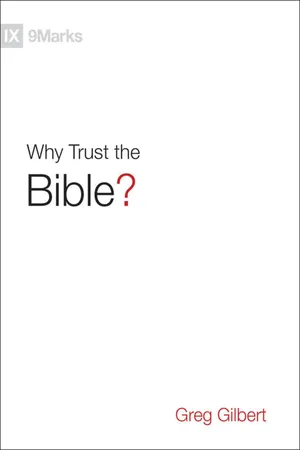
The Bible stands at the heart of the Christian faith. But this leads to an inescapable question: why should we trust the Bible? Written to help non-Christians, longtime Christians, and everyone in between better understand why God's Word is reliable, this short book explores the historical and theological arguments that have helped lead millions of believers through the centuries to trust the Bible, from Genesis to Revelation. Written by pastor Greg Gilbert, author of the popular books What Is the Gospel? and Who Is Jesus?, this volume will help Christians articulate why they trust the Bible when it comes to who God is, who we are, and how we're supposed to live.
- 149 pages
- English
- ePUB (mobile friendly)
- Available on iOS & Android
eBook - ePub
Why Trust the Bible?
About this book
Information
Topic
Theology & ReligionSubtopic
Christian Theology1
Don’t Believe Everything You Read
Don’t believe everything you read. Everybody knows that.
Especially in our age of the Internet, only a misguided person takes as absolute truth everything he or she reads. From newspapers and magazines to tabloids and click-bait online “news” services, one of the most valuable skills we can learn is telling the difference between fact and fiction, truth and fabrication. We don’t want to be dupes, and we’re right not to want that.
In my own family, my wife and I are trying very hard to teach our children exactly that—the skill of reading and listening carefully, of not accepting everything they read or hear at face value but rather putting it to the test and seeing if it seems trustworthy. Even with our five-year-old daughter, we’re working on trying to teach her to recognize the difference between things that are real and things that are “just a story.” She’s gotten pretty good at it too:
- George Washington was the first president of the United States. “That’s real, Dad.”
- Uncle Matt got a new job and moved to a different city. “That’s real too.”
- Batman chased down the Joker and threw him in jail. “No, that’s just a story.”
- Elsa built an ice castle with her special power of freezing thin air. “Just a story.”
- Superman flew into the air? “Story.”
- A long time ago, in a galaxy far, far away . . . ? “Story!”
But then imagine I throw her a curveball. A man named Jesus was born to a virgin about two thousand years ago, claimed to be God, did miracles like walking on water and raising people from the dead, was crucified on a Roman cross, and then rose from the dead and ascended into heaven, where he now reigns as King of the universe.
How is she supposed to answer that one? “Um, real?”
If you’re a Christian, then I’m sure you’d answer it with a firm “That’s real.” But let’s be honest. Most people in our culture think it very strange for normal, seemingly well-adjusted individuals to take that story seriously. And if they had the chance, they’d probably smile politely and ask, “Okay, but wouldn’t it make more sense—wouldn’t it be slightly less ridiculous—for everyone to admit that those fantastical stories about Jesus are just that—stories? Isn’t it just unreasonable to think those stories are meant to be taken seriously, to be thought of as real?”
In my experience as a Christian and pastor, it’s encouraging to me to see how firmly Christians really do seem to trust the Bible. They believe it, they stake their lives on it, and they try to obey it. When it says something that challenges their beliefs or behavior, they try to submit to it. In short, they allow the Bible to function as the foundation of their lives and faith. For all these hopeful signs, though, my experience also tells me that a good number of Christians can’t really explain why they trust the Bible. They just do.
Oh, they give lots of reasons. Sometimes they’ll say that the Holy Spirit has convinced them of it. Other times they’ll suggest that the best evidence for the Bible’s truth is its work in their lives or that it simply has “the ring of truth” about it. Some will point to data about how archaeology corroborates some of the Bible’s statements. Others, when pressed, will throw up their hands and say, “Well, you just have to accept it on faith.”
Now, in their own way, all these points represent legitimate reasons for Christians to trust the Bible, but whatever else we might say about these answers, none of them will likely go very far in convincing someone who doesn’t yet trust the Bible to start trusting it. Quite to the contrary, when a Christian replies to challenges against the Bible with an answer like, “You just have to accept it on faith,” the challenger will most likely hear that as confirming all his doubts and walk away declaring victory. Oh, he thinks, there we are. You really don’t have any reason at all for believing the Bible. You just . . . do. Because of faith.
So if you’re a Christian, let me put it to you straight: Why do you trust the Bible? How would you explain to someone who doesn’t believe the Bible why you trust it? By the end of this book, I hope you’ll be able to give an answer to that question, not just one that will make you feel good while the other guy is quite sure he has won the argument but rather one that will at least convince him that he needs to think about it a little more. The apostle Peter wrote in 1 Peter 3:15 that we as Christians should “always [be] prepared to make a defense” for the hope that is in us. In our day, that defense has to go all the way to the first question, because long before we even get to questions like who is Jesus? or what is the gospel?, another question vexes many people around us, a question they want to ask but (if they’re honest) doubt we can answer: Why do you trust the Bible in the first place?
Turtles All the Way Down
Before we go any farther, let me admit something right up front, something that probably won’t surprise you in the least. I am a Christian, a sold-out, convinced, everything-your-mother-told-you-to-watch-out-for Christian. I believe the Bible is true, I believe the Red Sea split in half, I believe the walls of Jericho fell down and that Jesus walked on water and healed some people and threw demons out of others. I believe God flooded the world and saved Noah, I believe Jonah was swallowed by a gigantic fish, and I believe Jesus was born of a virgin. And above all, I believe Jesus died and then got up from the dead—not in some spiritual or metaphorical sense but bodily and historically and for real. I believe all that.
In fact, there’s no use pretending otherwise: The main reason that I believe the Bible is true is precisely because I believe Jesus was resurrected from the dead. Now whether or not you agree with me about the resurrection, you can probably see why believing that would quickly and strongly lead me to trust the Bible. If Jesus really was raised from the dead, then the only possible, intellectually honest conclusion one can reach is that he really is who he claimed to be. If Jesus actually got up from the grave in the way the Bible says he did, then he really is the Son of God, the King of kings and Lord of lords, the Way, the Truth, the Life, and the Wisdom of God, just like he said. And if that’s true, then it makes sense (doesn’t it?) that he probably knows what he’s talking about, and therefore, we ought to listen to him.
Now, one thing that is beyond any reasonable doubt is that Jesus believed the Bible. When it comes to the Old Testament, the point is very straightforward; over and over in his teaching, Jesus authenticated and endorsed it as the Word of God. And as for the New Testament, even though it was written years after his days on earth, it too rests ultimately on Jesus’s own authority, and the early Christians knew it. In fact, the two main criteria they used to recognize authoritative books were (1) that those documents had to be authorized by one of Jesus’s apostles and (2) that they had to agree in every particular with Jesus’s own teaching. We’ll talk more about all that later, but the point is pretty clear. Once you decide that Jesus really did rise from the dead, the truth and authority of the Bible follow quickly, naturally, and powerfully.
Now that’s a quick and impressive case, I know, but here’s the question: How exactly do you get it started? In other words, how do you get to the point of believing that Jesus really did rise from the dead in the first place? I mean, you can’t just say you believe in the resurrection because the Bible says it happened, and you believe what the Bible says because Jesus rose from the dead, and you believe Jesus rose because you believe the Bible, and you believe the Bible because. . . . You probably get the point there, right? That whole thing would become just hopelessly and ridiculously circular. It reminds me of the little boy whose teacher asked him why the world doesn’t just fall into space. “Because it’s sitting on a turtle’s back,” the boy answered.
“And why doesn’t the turtle fall?” the teacher asked.
“Because it’s standing on another turtle’s back,” the boy insisted.
“And why doesn’t that turtle fall?” the teacher pressed.
“Well,” said the little boy thoughtfully, “obviously, it’s turtles all the way down!”
Now before we go any farther, we should acknowledge that in one way or another, it’s turtles all the way down for all of us, no matter what you take as your final authority for knowledge. So this issue affects everyone, not just Christians. If you ask a rationalist why he trusts reason, he’ll say, “Because it’s reasonable.” If you ask a logician why she trusts logic, she’ll say, “Because it’s logical.” If you ask a traditionalist why he trusts tradition, he’ll say, “Because everyone has always trusted tradition.” In all these cases, we’re left crying out for more; why does one trust reason, logic, or tradition in the first place? Some may argue that reason is more reliable than spiritual explanations because you can see and touch the evidence in support of various claims. But even that argument rests on certain presumptions about what kind of evidence is or is not legitimate—that is, reasonable. You see? One way or another, you end up with turtles, all the way down, for everyone. In fact, I think that’s probably one way God reminds us that we’re finite—written deep in the logic of what it means to be human is an inescapable reminder that we can’t figure it all out.
Even so, that doesn’t mean we should give up all hope of knowing anything. Even if it’s true in some philosophical, epistemological sense that we all ultimately have to stand on circular thinking, that doesn’t mean we can’t come to some confident conclusions about the nature of reality. Sure, some overzealous philosophers have at times thrown up their hands and said, “Well, that’s it then! I guess we can’t know anything!” But that kind of thinking tends to drop you into an epistemological solitary-confinement cell (we can’t know anything or anybody) that very few of us will find either inviting or necessary. So most of us simply start with a few presuppositions—for example, reason is reasonable, logic is logical, our senses are trustworthy, the world and we ourselves really exist and are not just “brains in a vat”—and then we proceed from those presuppositions to draw confident conclusions about ourselves, about history, about the world around us, about all sorts of things.
But hold on. The fact that we necessarily have to presuppose some things doesn’t mean we can presuppose anything we want. For example, you can’t just presuppose that you’re the president of the United States and work from there. Nor can you just presuppose that you’re a god and that everything you happen to believe is therefore the case. Nor can you presuppose that the latest issue of the National Enquirer is the Word of God and that it therefore gives you an accurate picture of reality. These would be completely unwarranted presuppositions, and people would mock you for believing them—and perhaps lock you up as well! But here’s the thing: More than a few people would say that’s exactly what Christians have done with the Bible. We have, without any good reason whatsoever, simply presupposed that it is the Word of God, that everything it says is therefore true, and that Jesus therefore rose from the dead.
But what if the alleged foul is not quite that flagrant? What if there’s a way to come to a good and confident conclusion that Jesus really did rise from the dead without simply presupposing that the Bible is the Word of God? If we could do this, then we’d be able to avoid the charge of unwarranted circularity. We’d be able to say that, even before concluding that the Bible is the Word of God, we came to a confident conclusion that Jesus did in fact rise from the dead, and then, on the basis of that confident conclusion, we followed him in accepting the Bible as the Word of God. This kind of belief would differ markedly from one that simply relied on a “leap of faith.” Not only could it be defended against skeptics’ objections; it could also challenge skeptics in their unbelief. It would be, as Peter wrote, a formidable “reason for the hope that is in [us]” (1 Pet. 3:15).
Christianity as History
The question, of course, is whether there really is a way to do that. To cut right to the chase, I think there is, and I think it is by doing history. In other words, let’s approach the documents that make up the New Testament not first as the Word of God but simply as historical documents, and then on that basis, let’s see if we can arrive at a confident conclusion that Jesus rose from the dead. Even someone who’s not a Christian should have no objection to this. After all, to approach the New Testament simply as a collection of historical documents involves no special pleading, no special status, no special truth claims. Let’s let them speak for themselves in the “court of historical opinion,” as it were.
Moreover, to approach the New Testament as historical shouldn’t raise any particular objections among Christians. After all, it’s not as if that would be to treat it as something other than what it is. The New Testament documents themselves claim to be historical; their authors intended them to be historical. Take Luke, for example. He began his Gospel by saying that he aimed to give his reader “an orderly account” of the life and teachings of Jesus (Luke 1:3). However you slice that, and whatever else you think Luke was doing, he was most certainly writing history. Of course, the method of writing history in the ancient world differed from our own method of doing so, but the basic idea was still the same—the authors were writing accounts of events that they believed really happened. So given that Luke and the other authors were doing that kind of work, surely there’s nothing inappropriate about letting his books, and the others, stand and speak as what they were intended to be all along.
Even more, though, than the religions of the world, Christianity presents itself as history. It’s not primarily just a list of ethical teachings or a body of philosophical musings or mystical “truths” or even a compendium of myths and fables. At its very heart, Christianity is a claim that something extraordinary has happened in the course of time—something concrete and real and historical.
A Chain of Reliability
But even if that’s so, another question arises at this point, and we’ll spend most of this book trying to answer it: Are the New Testament documents—and especially, for our purposes, the four Gospels—truly reliable as historical witnesses? That is to say, can we trust them to give us good, dependable information about the events of Jesus’s life, especially concerning his resurrection, such that we can end up saying, “Yes, I’m pretty confident that actually happened”? For my part, I think we can trust the New Testament documents, but getting to that conclusion will take some work, precisely because, as with any historical document, we can raise many questions at many different points about their reliability.
To understand what I mean by that, think of it like this. If you’re reading, say, Matthew’s Gospel about any particular event in the life of Jesus, you can count at least three different people who have put their hands on the biblical account you are reading and have therefore affected it in some way. First, and most obviously, the account originates with the author who wrote it down. Second, at least one person, and likely more, copied that original writing and thereby transmitted it, so to speak, through the centuries into our hands. Third, someone (or some committee) translated that copy from its original language into your native language so you can now read it. At each step in that process, questions arise that bear heavily on whether you can really trust the story you’re reading to give a reliable account of what actually happened. So, moving backward in time from yourself to the event itself, you end up with a chain of five big questions:
- Can we be confident that the translation of the Bible from its original language into our language accurately reflects the original, or is it saying things the original never did?
- Can we be confident that copyists accurately transmitted the original writing to us, or did they (deliberately or not) add, subtract, or change things so much that what we have is no lon...
Table of contents
- Cover Page
- Title Page
- Copyright
- Dedication
- Contents
- 1 Don’t Believe Everything You Read
- 2 Lost in Translation?
- 3 Copies of Copies of Copies of Copies?
- 4 Are These Really the Books You’re Looking For?
- 5 But Can I Trust You?
- 6 So Did It Happen?
- 7 Take It on the Word of a Resurrected Man
- A Final Word: The Next Question
- Appendix: Resources for Further Exploration
- General Index
- Scripture Index
- About the Series
Trusted by 375,005 students
Access to over 1.5 million titles for a fair monthly price.
Study more efficiently using our study tools.
Frequently asked questions
Yes, you can cancel anytime from the Subscription tab in your account settings on the Perlego website. Your subscription will stay active until the end of your current billing period. Learn how to cancel your subscription
No, books cannot be downloaded as external files, such as PDFs, for use outside of Perlego. However, you can download books within the Perlego app for offline reading on mobile or tablet. Learn how to download books offline
Perlego offers two plans: Essential and Complete
- Essential is ideal for learners and professionals who enjoy exploring a wide range of subjects. Access the Essential Library with 800,000+ trusted titles and best-sellers across business, personal growth, and the humanities. Includes unlimited reading time and Standard Read Aloud voice.
- Complete: Perfect for advanced learners and researchers needing full, unrestricted access. Unlock 1.5M+ books across hundreds of subjects, including academic and specialized titles. The Complete Plan also includes advanced features like Premium Read Aloud and Research Assistant.
We are an online textbook subscription service, where you can get access to an entire online library for less than the price of a single book per month. With over 1.5 million books across 990+ topics, we’ve got you covered! Learn about our mission
Look out for the read-aloud symbol on your next book to see if you can listen to it. The read-aloud tool reads text aloud for you, highlighting the text as it is being read. You can pause it, speed it up and slow it down. Learn more about Read Aloud
Yes! You can use the Perlego app on both iOS and Android devices to read anytime, anywhere — even offline. Perfect for commutes or when you’re on the go.
Please note we cannot support devices running on iOS 13 and Android 7 or earlier. Learn more about using the app
Please note we cannot support devices running on iOS 13 and Android 7 or earlier. Learn more about using the app
Yes, you can access Why Trust the Bible? by Greg Gilbert in PDF and/or ePUB format, as well as other popular books in Theology & Religion & Christian Theology. We have over 1.5 million books available in our catalogue for you to explore.