The Vanished Days
eBook - ePub

The Vanished Days

'An engrossing and deeply romantic novel' RACHEL HORE

  1. 400 pages
  2. English
  3. ePUB (mobile friendly)
  4. Available on iOS & Android
eBook - ePub

The Vanished Days

'An engrossing and deeply romantic novel' RACHEL HORE

About this book

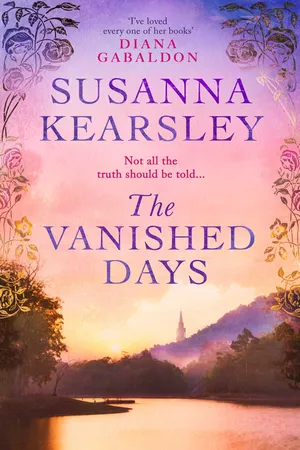
A sweeping love story set against the Jacobite revolution. Told in dual timelines, The Vanished Days is a captivating story of intrigue, adventure, endurance, romance - and the bold courage to hope when it seems all hope is lost. 
 
'An engrossing and deeply romantic novel' RACHEL HORE
‘Fascinating and immersive’ DIANA GABALDON
‘An absolute tour de force of historical storytelling, tender and dramatic, gripping and authentic’ JANE JOHNSON
‘A beautiful and nuanced deep dive into Scottish history’ LAUREN WILLIG
‘Perfect for fans of Outlander’ WOMAN & HOME
‘Absolutely fantastic . . . Immersive, fabulous, terrific!’ HANK PHILLIPPI RYAN

He is tasked with the most dangerous of missions. She is only there from duty. But in the face of treachery and injustice, might they need each other more than they could know…?

1613: Scotland and England, unified under one crown, are reeling from the sudden death of King James’ popular eldest son, Henry, as rumours swirl that the prince was poisoned. Andrew Logan, one of the King’s Messengers, is sent north with secret orders to find and arrest the man the king suspects.

Phoebe Westaway cannot abide Andrew Logan. But when her ageing father is tasked with helping Logan, Phoebe finds herself with no choice but to join them in their quest to capture Sir David Moray, once Prince Henry’s trusted courtier, and carry him to London to stand trial for the prince’s murder.

It’s a journey rife with complications. Sir David has no intention of allowing himself to be delivered to London, and as he draws them deeper into the dark web of court alliances and rivalries, Phoebe realises she might have more need of Logan than she believes.

A story of justice, honour, truth and love – and survival against impossible odds…
Frequently asked questions

Yes, you can cancel anytime from the Subscription tab in your account settings on the Perlego website. Your subscription will stay active until the end of your current billing period. Learn how to cancel your subscription.
No, books cannot be downloaded as external files, such as PDFs, for use outside of Perlego. However, you can download books within the Perlego app for offline reading on mobile or tablet. Learn more here.
Perlego offers two plans: Essential and Complete
  • Essential is ideal for learners and professionals who enjoy exploring a wide range of subjects. Access the Essential Library with 800,000+ trusted titles and best-sellers across business, personal growth, and the humanities. Includes unlimited reading time and Standard Read Aloud voice.
  • Complete: Perfect for advanced learners and researchers needing full, unrestricted access. Unlock 1.4M+ books across hundreds of subjects, including academic and specialized titles. The Complete Plan also includes advanced features like Premium Read Aloud and Research Assistant.
Both plans are available with monthly, semester, or annual billing cycles.
We are an online textbook subscription service, where you can get access to an entire online library for less than the price of a single book per month. With over 1 million books across 1000+ topics, we’ve got you covered! Learn more here.
Look out for the read-aloud symbol on your next book to see if you can listen to it. The read-aloud tool reads text aloud for you, highlighting the text as it is being read. You can pause it, speed it up and slow it down. Learn more here.
Yes! You can use the Perlego app on both iOS or Android devices to read anytime, anywhere — even offline. Perfect for commutes or when you’re on the go.
Please note we cannot support devices running on iOS 13 and Android 7 or earlier. Learn more about using the app.
Yes, you can access The Vanished Days by Susanna Kearsley in PDF and/or ePUB format, as well as other popular books in Literature & Literature General. We have over one million books available in our catalogue for you to explore.

Information

I

I WAS A YOUNGER MAN when I first met her. I should tell you this in fairness, not because the years have dulled my recollection of that moment, for in truth I could still lead you to the spot where I was standing when she looked in my direction. I’ve forgotten many things. That is not one of them. I’m telling you because even the wisest man, when young, is ruled by other things than wisdom when he meets with such a woman. And when I met Lily Aitcheson, I knew I was in trouble.
There are many who believe they know what happened, but they do not know the whole of it. The rumours spread, and grow, and take their hold, and so to end them I have been persuaded now to take my pen in hand and tell the story as it should be told – both in the parts that are my own and in those pieces that were hers, as they were told to me by others and as I came to discover them.
You may ask how closely you can trust my narrative, when I have waited until now to set it down, and when those days must surely seem so distant to me, like a magic lantern show of memories played against the coming darkness. I can only reassure you we kept notes from our enquiries – Gilroy’s and my own – and I have those beside me here now in my study, for my reference.
As to memory, you may understand this better for yourself, when you are old, but there are some corners of the mind imprinted so indelibly with what we have experienced that, long after the less important things have slipped away and we have lost the simple function of recalling where we last set down our spectacles, those deeper memories yet remain. The slightest thing may make them stir – a wafting scent, a few notes of a song half-sung, the darkness of a passing cloud.
Most evenings in my armchair by the fireside I drift now to those memories and assure you they are every bit as clear as when I lived them.
Me at fourteen in the scorching bright sunlight, the day I was taught how to fire a musket.
A turn, and I’m deep in the jungles of Darien, fighting the Spaniards, and Lieutenant Turnbull, my friend and commander, is urging me onwards in spite of the shot to his shoulder that’s just made him fall. ā€˜Go,’ he says. ā€˜Do not stop. Go!’
Turn again, and it’s several years on and I’m once again following Turnbull’s directions, his letter inviting me to come and visit him tucked in my pocket as I climb the worn stones of Edinburgh’s High Street in search of his door.
He lived, that year, in Caldow’s Land – the term land being commonly applied in that town to those great, high tenements in which each floor was, of itself, a separate dwelling, serviced by a common stair. It was a narrow building, and an old one, and the evening I arrived in mid-September under skies that threatened rain it looked unwelcoming. The hollow shadows lying deeply in the arched shop booths at street level, the several looming storeys of dark windows, and the jagged roofline cutting at the sky all seemed to warn me not to stay.
But I was stubborn, I was weary, and I did not heed the warning.
So, for what came next, I’ve no one but myself to blame.

CHAPTER 1 MONDAY, 22 SEPTEMBER, 1707

MACDOUGALL WAS WATCHING ME. It was unsettling to waken and find him half-shielded by shadow, an arm’s-length away from my bed. For a sick moment I thought I was still in the grip of the trembling fever that had been my curse these past years and that had, as it always did, struck without warning, the same night I’d set foot in Caldow’s Land.
Making things worse, my friend, Turnbull, was not even here in town.
Instead, on his threshold, I’d found myself facing his wife, great with child, who had offered apologies. ā€˜But do come in. You can sup with us, surely?’
He’d written to me that he’d married and that they were well matched, but this was my proof – for few women, upon opening their door to find me standing there, a stranger, would have welcomed me inside. And fewer still, when I had shown that night the first signs of my fever, would have brushed aside my protests and insisted that I stay.
I should have protested more strongly. But before I could collect my wits I’d found myself installed within a bedchamber, attended by the Turnbulls’ rough-edged and rough-handed manservant, MacDougall.
He was not pleased by my presence.
ā€˜It’s not right,’ he told me one evening. ā€˜Ye should not be here when the master’s away.’
I’d have gladly obliged him by leaving, but I had no choice. There was naught to be done for an ague like mine but to faithfully drink my infusion of Jesuits’ powder and wait while the hot fevers cycled their course.
At the peak of my delirium, I’d watched MacDougall search the pockets of my coat, remove the letter I had brought from Turnbull, and unfold it. In my outrage, with my lips too dry to form the words, I told him, ā€˜Leave that!’
He’d ignored me. Reading it, he’d held the letter closer to the light to see the signature, refolded it along its seams, and with a frown, replaced it.
What else he’d searched while I was sleeping, I knew not, but from the first, he had determined I was not a man to trust.
This morning, as I woke, he watched me. Setting down my washbasin, he said, ā€˜Terrible things, tertian fevers.’
His tone had a purpose I couldn’t unravel, so when there was no need to make a reply I kept silent. What was there to say? The fevers were a nuisance I’d been plagued with now for several years. The first infection, starting in the full heat of the jungle and continuing on shipboard, had been worst of all. Since then the agues cycled round at random, striking when they pleased, and disappearing till the next attack. I’d learned the way to live with them.
MacDougall told me, ā€˜ā€™Tis what happens when men muck about in foreign lands. The master, thanks tae God, does have a stronger constitution and brought none of that foul sickness home with him.’ He looked at me directly. ā€˜Ye must find it inconvenient, falling ill in other people’s houses.’
ā€˜I don’t make a habit of it.’
ā€˜Do ye not?’
I found his open insolence uncommon for a servant, and a contrast to the timid housemaid who kept closely to the kitchen like a shadow and was scarcely ever seen, but my hostess had already warned me that MacDougall was a law unto himself.
ā€˜You will forgive him,’ she’d apologized. ā€˜He’s served my husband’s family since he was a lad, as did his father before him, and he considers it a calling. He is overly protective, more so now I am with child, but he does mean well, and is harmless.’
I was not so sure. MacDougall, for his life of service, had the hardened look of one who knew how to do violence.
I preferred to meet him on my feet. I stood, but taking up the gauntlet he’d cast down I said, ā€˜I’m here by invitation. As you know. You’ve read my letter.’
ā€˜Aye. Ye must have telt a sad tale for the master tae have written ye those lines, for him tae offer ye his outstretched hand. He is a giving man, the master. He’d turn out his pockets for ye, let ye use his name and his connections tae advance yerself, and ask for naething. But I’m sure that’s not why ye came back.’
He said that last sarcastically, and while I felt my blood heat from the insult, I held back my temper.
I owed this man no explanation. Someone like MacDougall, who had never strayed from Scotland’s shores, could never know what drove a man like me. He’d never feel the pull that made a soldier like myself, after the lonely years of hiring my sword to foreign princes under foreign skies, turn homeward once again to seek a face I recognized, a hearth that I could call my own, a wife to build a future with. He’d never understand.
I turned my back, dismissively, and reached for a clean shirt.
MacDougall said, ā€˜The master has troubles enough of his own, without looking tae yours. In the Earl of Mar’s regiment, he should by now be a captain commanding a company of his own men, and he’s written tae the earl himself saying so, as have the mistress’s high-flung relations, but he’s held back as a lieutenant while other, more cunning men rise – younger men, with less time in the army.’ Men like you, he might have said, from the fierce burn of the gaze I knew well that MacDougall had aimed at my back. ā€˜With a wife and a bairn on the way, he’s no time tae be burdened with such as yerself. Ye’re not even a gentleman.’
I turned then. Met his eyes. ā€˜Then we are equal, you and I.’
There was a moment when I thought he might forget his station altogether and return the challenge in my tone with a strike of his fist. But he did not. Instead, he carefully laid out the towel he had brought, beside the basin.
Looking down, he commented, ā€˜That’s three days with no fever.’
ā€˜Aye.’
ā€˜It’s finished, then. Ye’re better.’
ā€˜Aye.’
ā€˜Good,’ he said, and turned away. ā€˜Time ye were gone.’

ā€˜We must find you a wife while you’re here,’ Turnbull’s wife said, at breakfast. ā€˜No, you may smile, but a bachelor of your age—’
ā€˜Of my age? I’m not yet five and thirty. Still a few years younger than your husband, and I hope you will agree he’s hardly ancient.’
With a blush she laid a hand upon her rounded belly, in awareness that it proved the man she’d married was yet virile. But her wit would not be bested. ā€˜And my husband was a few years younger than he is now when he met me, so my point stands. What sort of woman do you favour? I have several friends in mind who might do well for you.’
ā€˜My dear Mrs Turnbull—’
ā€˜Please do call me Helen.’
MacDougall cut in to serve our morning porridge. He gently set Helen’s bowl down, but set mine down hard, with a glower.
I’d had time while finishing dressing to think on his words without passion, and now that I knew my friend Turnbull was having his own struggles climbing the ranks, I agreed that my being here would only add to the weight Turnbull carried. I could not do that to my friend.
I replied, ā€˜My dear Helen, then. You’re very kind, but I’ve been in your care these ten days and I cannot impose on you longer, not now that I’m well.’ I glanced at MacDougall, who narrowed his eyes as I told Helen lightly, ā€˜ā€™Tis time I was gone.’
She looked at me, surprised. ā€˜You will not leave, I hope, until my husband has returned? He’d not forgive me if he learned that you’d been here and gone and he had missed your company.’
No more than I’d miss his, I knew, as I would miss the comforts of this house that I’d been able to explore these past few days since my last fevers had subsided and I had regained my strength.
As stern and forbidding as Caldow’s Land might have appeared from the street on the evening that I had arrived, on the inside it was full of life, the floors above taken by an interesting mix of people I had heard about but not yet met, from the former Latin master to the spinster merchant sisters who together kept the shop below.
The Turnbulls’ dwelling occupied the whole of the first floor, made warm and charming by its painted walls and ceiling beams. We passed most of the day in this front chamber – the long drawing room, with its row of bright windows along the end wall looking out onto the bustle of the Landmarket.
The merchant sisters were already up and at their business. I’d discovered it was common, when we breakfasted, to hear the daily noises of their trade – the muffled movements as they set their wares in place within the alcoves, and the greetings they exchanged with passing customers – but it was rare to hear a footstep at this hour of morning climb the curved stone forestair leading to the front door of the house, and rarer still to hear those footsteps pause within the common stairwell, at the door of Turnbull’s lodgings.
My own attention was then fixed on trying to decide how best to answer Helen, but the footsteps broke my concentration, and the brisk rap at the door that followed made me look, with Helen, at MacDougall, who had crossed now to admit the early caller.
I might not have recognized the gentleman who entered, ducking through the doorway in a practised movement that both saved his high wig from a knock against the lintel while appearing at the same time to be more or less a bow of greeting, but he was no stranger to the others.
Helen stood and dropped so quickly to a curtsey that my first thought was she might have done her unborn child an injury.
Apparently I wasn’t alone in that thought. Our visitor hastily moved forward, taking her elbow and guiding her back to her seat. ā€˜Madam, please. I do fear for your health.’
Helen smiled. ā€˜My lord, I am perfectly healthy, I promise you. My doctors assure me it will be at least two m...

Table of contents

  1. Cover
  2. Title Page
  3. Dedication
  4. Epigraph
  5. Graeme Family Tree
  6. Map of Endiburgh, 1647
  7. Part I
  8. Part II
  9. Part III
  10. Part IV
  11. Part V
  12. Part VI
  13. Part VII
  14. Part VIII
  15. About The Characters
  16. A Word About Accuracy
  17. A Note of Thanks
  18. ā€˜The Winter Sea’ Teaser
  19. Copyright