- English
- ePUB (mobile friendly)
- Available on iOS & Android
eBook - ePub
Basic Board Governance
Information
Topic
CommerceSubtopic
Gouvernance d'entrepriseChapter 1. What is Governance and Why Do You Care?
Every person is responsible for his or her own actions. We all know that if we do something wrong that we will suffer the consequences. You are involved in governance all of the time, you just may not have thought of it that way. When you follow the rules—you are being governed. When you make the rules you are governing.
Governance often comes up when we talk about groups such as corporations and societies, but governance is everywhere. It is not just applicable to groups. Throughout this book we are going to use the term organization to refer to corporations, societies, trusts, charities, partnerships, proprietorships, and estates.
Governance is defined as the process used to direct and manage the operations of an organization. You see that this organization could be a business, a non-profit organization (NPO), a charity, a club, or a family.
Organizations are not real people (with the exception of partnerships and proprietorships), so a real person must be responsible for the actions of an organization. That real person is generally called a director. It is very important to understand that only directors are responsible; not members, not shareholders, and not donors. So the decision to become a director is not one to be taken lightly.
Since there must be a real person who is responsible for the activities of every entity, these responsible people need to have a plan to reduce their risk of being sued or held financially liable. So governance is the process used to direct and manage the operations of an organization to reduce risk.
Governance works a little differently depending on the kind of organization we are talking about.
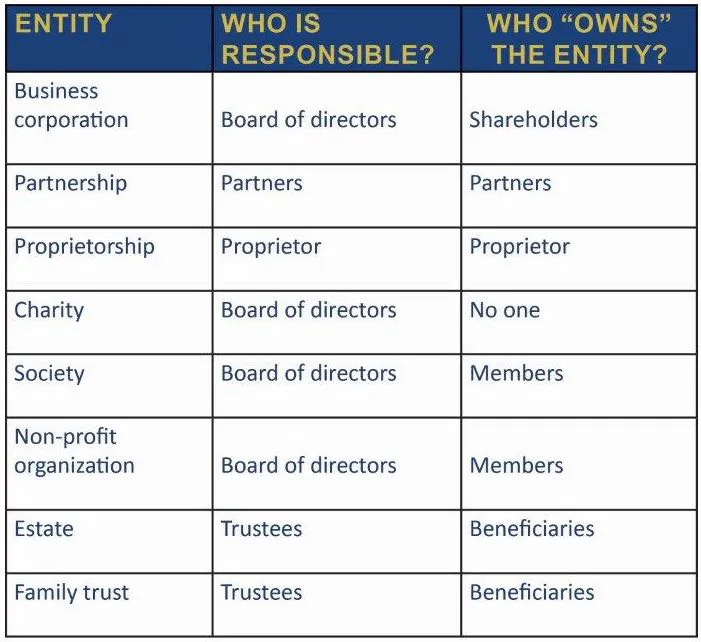
Table 1 illustrates who owns each type of organization and who is responsible. This is a handy way for you to think about the differences between ownership and accountability.
Table 1. Responsibility and “ownership” for organizations
Businesses
If a business is not incorporated, it is known as a proprietorship or a partnership. The owners of this business are the ones who are responsible for that business's activities. There is no separation of liability when a business is not incorporated; the business is the same legal entity as the owner. Governance is still very impor...
Table of contents
- Cover
- Contents
- Copyright
- WHY I WROTE THIS BOOK
- Chapter 1. What is Governance and Why Do You Care? Every
- Chapter 2. An Introduction to Boards Organizations
- Chapter 3. Stakeholders—Who Are These People
- Chapter 4. What Could Go Wrong? Directors’ Liabilities
- Chapter 5. Framework of Board of Directors’ Obligations
- Chapter 6. Duty of Care and Loyalty
- Chapter 7. Duty of Knowledge
- Chapter 8. Duty of Skill
- Chapter 9. Fiduciary Duty
- Chapter 10. Duty to Manage
- Chapter 11. Duty to Act in Scope of Authority
- Chapter 12. Directors’ Rights
- Chapter 13. Individual Board Members—What Should You
- Chapter 14. Reduce Your Risk—Understand Financial Statements
- Chapter 15. Generally Accepted Accounting Principles
- Chapter 16. Generally Accepted Accounting Principles
- Chapter 17. Spread the Blame—Rely on Professionals
- Chapter 18. Internal Control
- Chapter 19. Goods and Services Tax Issues
- Chapter 20. Budgets
- Chapter 21. Income Tax Filing Issues
- Chapter 22. Ten Steps to Reviewing a Set of Financial
- Chapter 23. Personal Guarantees and Insurance
- Chapter 24. Strategic Planning
- Chapter 25. Why Does Your Organization Exist
- Chapter 26. Strategic Plan Template
- Chapter 27. Successful Goal-Keeping System
- Chapter 28. Succession Planning
- Chapter 29. Key Metrics
- Chapter 30. Policy (or Governance) Manual in General
- Chapter 31. Running an Effective Board Meeting
- Chapter 32. Privacy Policies
- Chapter 33. Social Media Policy Considerations
- Chapter 34. Board Evaluation
- Chapter 35. Investment Policy
- Chapter 36. Term Limits
- Chapter 37. Conflicts of Interest
- Chapter 38. Financial Policy—Corporate Tax Filing A
- Chapter 39. Financial Policy—Purchasing
- Chapter 40. Financial Policy—Cash Controls
- Chapter 41. Financial Policy—Cheque Signing
- Chapter 42. Financial Policy—Capital Assets
Trusted by 375,005 students
Access to over 1.5 million titles for a fair monthly price.
Study more efficiently using our study tools.
Frequently asked questions
Yes, you can cancel anytime from the Subscription tab in your account settings on the Perlego website. Your subscription will stay active until the end of your current billing period. Learn how to cancel your subscription
No, books cannot be downloaded as external files, such as PDFs, for use outside of Perlego. However, you can download books within the Perlego app for offline reading on mobile or tablet. Learn how to download books offline
Perlego offers two plans: Essential and Complete
- Essential is ideal for learners and professionals who enjoy exploring a wide range of subjects. Access the Essential Library with 800,000+ trusted titles and best-sellers across business, personal growth, and the humanities. Includes unlimited reading time and Standard Read Aloud voice.
- Complete: Perfect for advanced learners and researchers needing full, unrestricted access. Unlock 1.5M+ books across hundreds of subjects, including academic and specialized titles. The Complete Plan also includes advanced features like Premium Read Aloud and Research Assistant.
We are an online textbook subscription service, where you can get access to an entire online library for less than the price of a single book per month. With over 1.5 million books across 990+ topics, we’ve got you covered! Learn about our mission
Look out for the read-aloud symbol on your next book to see if you can listen to it. The read-aloud tool reads text aloud for you, highlighting the text as it is being read. You can pause it, speed it up and slow it down. Learn more about Read Aloud
Yes! You can use the Perlego app on both iOS and Android devices to read anytime, anywhere — even offline. Perfect for commutes or when you’re on the go.
Please note we cannot support devices running on iOS 13 and Android 7 or earlier. Learn more about using the app
Please note we cannot support devices running on iOS 13 and Android 7 or earlier. Learn more about using the app
Yes, you can access Basic Board Governance by Debi J Peverill in PDF and/or ePUB format, as well as other popular books in Commerce & Gouvernance d'entreprise. We have over 1.5 million books available in our catalogue for you to explore.