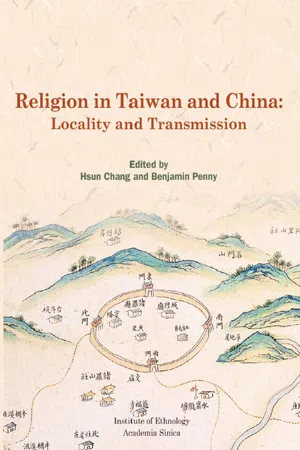
eBook - ePub
Religion in Taiwan and China: Locality and Transmission
台灣與中國之宗教:地方性與傳承(國際英文版)
- English
- ePUB (mobile friendly)
- Available on iOS & Android
eBook - ePub
Religion in Taiwan and China: Locality and Transmission
台灣與中國之宗教:地方性與傳承(國際英文版)
Information
Inside and Outside the British Settlement at Shanghai
Benjamin Penny ᇤᏗ
Abstract
Within the broad f ield of the st udy of religion, the idea of locality has ty pically been the focus of either anthropological or sociological st udies of delimited communities: villages or tribes on the one hand, or communities based on shared religious aff iliation on the other. St udies in the histor y of religions, on the other hand, have tended to concentrate more on large- scale religious traditions, often with script ures and instit utions, rit ual codes and lineages. Historical st udies of how religion was act ually experienced on the quotidian local scale in the past are diff icult since the ordinar y is ver y often not documented – people tend to write about what (for them) is unusual, striking, and notable rather than what they obser ve each day. Nonetheless, the st udy of “ever yday life” has become increasingly popular in the humanities and social sciences.
“Locality” and “the ever yday” can usef ully be brought together analy tically. Such an approach can help to illuminate the nat ure of religious life in a par ticular place at a par ticular time; people doing religion are always from somewhere and always do it at some time and in some place. In this essay, I focus on the British settlement at Shanghai in the middle of the nineteenth cent ur y. I f irst introduce the settlement: its origins, its gover nance, and its population and the place of the London Mission within it. Then, focusing on a sur viving collection of letters from the late 1850s, I describe the lives of the missionaries: their homes, the religious environment, and their mission work. Finally I sur vey the nat ure of the missionaries’ itinerations; the jour neys beyond the settlement.
Keywords: Everyday Life, Shanghai, Christianity, London Missionary Society, Gender
Within the broad field of the study of religion, the idea of locality has typically been the focus of either anthropological or sociological studies of delimited communities: villages or tribes on the one hand, or communities based on shared religious affiliation on the other. Studies in the history of religions, on the other hand, have tended to concentrate more on large-scale religious traditions, often with scriptures and institutions, ritual codes and lineages. Historical studies of how religion was actually experienced on the quotidian local scale in the past are difficult; this constitutes what the historian of early modern France David Bell has called “ordinary” (as opposed to extraordinary) history (Bell 2002:262-276). Cultural historian of Britain, John Brewer glosses this distinction as being between “studies of a remarkable event that enable us to open up an otherwise obscure social world, and those that painstakingly reconstruct day to day transactions” (Brewer 2010:3). One of the chief methodological conundrums for the historian of the small-scale is that the ordinary is very often not documented – people tend to write about what (for them) is unusual, striking, and notable rather than what they observe each day. By contrast, scholars who work in the field rather than the archive are able to elicit this ordinary information in the present, and in verbal interaction. In other words, they can quiz their subjects about those areas of life their informants themselves find uninteresting, the stuff of their everyday lives.
The study of “everyday life” has become increasingly popular in the humanities and social sciences, although precisely what is meant by the everyday, and what subjects are appropriate to study under this rubric have been the subject of lengthy discussions in different fields – discussions that seldom engage beyond their own sub-discipline or with each other.1 Thus, there are now several different varieties of the study of everyday life, with different methodologies, different theoretical bases and different politics. For the purposes of this paper I adopt a straightforward interpretation: in John Brewer’s phrase the everyday refers to, “the experiences, actions and habits of ordinary people” and that its historians “concern themselves with the lives, beliefs and practices of those who had previously been ‘hidden’ from history… The scale or focus of such writing is often small, personal and intimate” (Brewer 2010:3).
“Locality” and “the everyday” then can usefully be brought together analytically. Such an approach can help to illuminate the nature of religious life in a particular place at a particular time; people doing religion are always from somewhere and always do it at some time and in some place. By limiting the geographical focus of research, it is possible to appreciate the religious environment in detail: which families on which streets went to which temples on which days, say. Such a focus can elucidate whether business or clan or gender affiliation had strong or weak effects on religious behaviour. It can help to answer questions about what happened in a locality when outside forces intruded, whether through occupation, government regulation, Christian revivalism, or evangelism by a “redemptive society”. Who was it who converted? In other words, what was (or were) ordinary, everyday, religion (or religions), like?
In this essay, I focus on the British settlement at Shanghai in the middle of the nineteenth century. I first introduce the settlement: its origins, its governance, and its population and the place of the London Mission within it. Then, focusing on a surviving collection of letters from the late 1850s, I describe the lives of the missionaries: their homes, the religious environment, and their mission work. Finally I survey the nature of the missionaries’ itinerations; the journeys beyond the settlement.
The British Establish the Settlement
In December 1843, Rev. Walter Medhurst (1796-1857) of the London Missionary Society (LMS) and his medical colleague Dr. William Lockhart (1811-1896) arrived in the newly opened port of Shanghai to establish the first Protestant mission in that city. The Treaty of Nanking between the Chinese and British governments that brought an end to the First Opium War (1839-1842) had been signed in August of the previous year. One of the main features of the treaty was the ceding of Hong Kong Island to the British as a crown colony and the granting of rights of residence and trade to foreigners in five Chinese cities, the so-called Treaty Ports: Canton (Guangzhou), Amoy (Xiamen), Fuzhou, Ningbo and Shanghai (Wakeman 1978:163-212). On hearing this news, “a missionary” is reported to have said that while “the prowess of the warrior” had contributed to this result, the true author was “the hand of God”. “The treaty is something like an emancipation act,” he wrote, “I thought myself happy to live in the day when the chains of the negro were broken, but thrice happy to live in the day when five ports, on the very coast itself, are open to the Church of Christ” (Jones 1850:492).
The signing of the treaty did not signal the first landfall of Protestant missionaries on Chinese soil. Since 1807 when Robert Morrison of the LMS had arrived at Macau, and had subsequently taking up work with the East India Company in Canton in 1809, members of the LMS, and from 1830 the American Board of Commissioners for Foreign Missions (ABCFM), had been working assiduously to propagate the word of God (Tiedemann 2010). Until 1842 missionaries and other foreigners were legally confined to the so-called thirteen factories, or trading establishments, in Canton and to Macau, which had been a Portuguese settlement since the mid-sixteenth century, but during this period they had occasionally gone beyond these territories. Opium traders had sometimes sailed further up the coast before 1842, doing their business with local dealers from anchorages off-shore and some missionaries controversially chose to make use of this means of transport to spread their message. For example, the Prussian missionary who worked with the LMS, Charles (originally Karl) Gützlaff (1803-1851) made three voyages to distribute tracts in 1830-1833, going as far north as Tianjin and stopping in at Shanghai, Ningbo and Taiwan (Gützlaff 1834; see also Lindsay and Gützlaff 1834. On Gütslaff, see Lutz 2008). Medhurst himself, in
1835, hired a brig and its crew and sailed north to the Shandong peninsula visiting Shanghai, the Zhoushan islands (including the Buddhist pilgrimage centre of Putuo shan), the Nanri islands off Putian in Fujian, and Dongshan near Chaozhou, with the same purpose. He noted in the published record of this voyage that, “Protestant missionaries are perpetually attempting to diffuse their principles, by landing on the coast, and deluging the maritime districts with Scriptures and tracts.” (Medhurst 1838: 406). When he was in Shanghai engaging in this “deluging” activity while returning from Shandong, Medhurst was not unduly harassed by the local officials but he was not allowed into what is now known as the “old city”, the site of the city government. The old city was then walled, as were most traditional Chinese urban centres. Shanghai’s walls were demolished in 1912.
A month before Medhurst and Lockhart took up residence in Shanghai at the end of 1843, Lockhart had visited with Captain George Balfour to begin negotiations with Chinese officials on the establishment of a consular office, and to open Shanghai formally to trade in accordance with the Treaty. Thus when they came to live there permanently, both missionaries had some familiarity with the place. In 1838, after his voyage up the coast, Medhurst had noted in his China: Its State and Prospects that although Shanghai was “a city of the third rank,” it was “one of the greatest emporiums of commerce, on the east coast of China,” and that “the trade of this place is equal, if not superior to that of Canton”( Medhurst 1838:450). This view of the city was somewhat undercut by Lockhart when he wrote to the Rev. Arthur Tidman, long-time Foreign Secretary of the LMS on 20 November 1843 to present his first impressions of the city in which he was to establish their mission. After noting its f leet of junks and its population of about 300,000, he remarked laconically that, “all Chinese cities are very filthy, and in this respect Shanghae [Shanghai] does not differ from others, it has about the average proportion of filth about it” (Lockhart 1843). When Medhurst and Lockhart returned to Shanghai in December to stay, they rented a house outside the walled city near the East Gate, “sufficient for the accommodation of any family”, as he reported to Tidman in May 1844. He added that it had “rooms below that could be used as a printing office and bindery” (Lockhart 1844).
Lockhart was a medical missionary and founded the first western hospital in Shanghai in 1844 near the Great East Gate of the Chinese city. In 1846 it moved to the compound of the London Mission, now on Shandong Middle Road. It still exists although the original buildings are no more; it became the Lester Chinese hospital and is now known as the Renji hospital. Like the London Mission, the British Consulate also soon moved from the Chinese city to new buildings, on the southern side of the conf luence of the Huangpu River and Suzhou Creek (or the Wusong River as it was also known). Most early building activity in Shanghai was focused on the river along what is now known as the Bund. Early western pictures of the city that were often painted from the Pudong side looking back to the British settlement present a changing vista of impressive buildings from the British consulate in the north to the French Consulate in the south. Between the two are the Chinese Customs House and various buildings belonging to trading companies such as Jardine, Matheson and Co and Dent & Co. This impression of a growing city is in some ways deceptive as building activity did not extend very far back from the river. Indeed, as George Lanning and Samuel Couling wrote in their The History of Shanghai from 1921, “For some years after the first comers arrived, men considered themselves ‘in the country’ once they had got past the west of what is now Szechuen Road. The Bund was a towing path and little more, with a foreshore many yards wide uncovered and covered as the tide ebbed and f lowed” (Lanning and Couling 1921:277). Szechuan (or Sichuan) Road was originally Bridge Street and is the first road inland from the Bund.
In 1844 the Americans signed their own treaty and established a concession on the north bank of the Suzhou Creek, followed by the French between the British Settlement and the Chinese city in 1848. The division between the British and French Concessions was the Yangjingbang 㲳㴯㴄 canal, which was filled in over 1914 and 1915 becoming, in turn, Avenue Edward VII, Great Shanghai Road (under Japanese Occupation), Zhongzheng Road East (under the Guomindang government from 1945; Zhongzheng was Chiang Kai-shek’s alternative given name), and finally Yan’an Road East in 1950 after the Communist victory.
The legal framework of the settlement in the early years rested on agreement between the British Consul and the Taotai 忻⎘, the senior Chinese official in the city. In fact, the details of this legal code that became known as the “Land Regulations” were negotiated between the Taotai and Medhurst and promulgated in 1845. Most sections dealt with matters of road building, the condition and upkeep of the Bund and jetties, right of access to land, including Chinese graves, rent, building, etc. Behind the “Land Regulations”, in a legal sense, was the Treaty of Nanking itself. Under the terms of this treaty, according to Lanning and Couling, “‘Wandering’ [that is leaving the settlement itself ] was forbidden. But the question soon arose, What constituted wandering?” (Lanning and Couling 1921:293) This was of fundamental importance to the missionary community for whom face to face contact with the millions of heathen Chinese was the very reason they were in China. In practice, it appears that this stipulation was often ignored. In the early period going so far beyond the British settlement as to necessitate sleeping overnight seems to have been the test of whether “wandering” had occurred, but it appears that missionaries had de facto free run of any territory they could reach from Shanghai. The trips they took to convert the people of the region were known by the term common to missions around the world: itinerations.
...Table of contents
- Acknowledgments
- Introduction
- Table of Contents
- Religion in Taiwan and China: Locality and Transmission
- Inside and Outside the British Settlement at Shanghai
- The British Establish the Settlement
Trusted by 375,005 students
Access to over 1.5 million titles for a fair monthly price.
Study more efficiently using our study tools.
Frequently asked questions
Yes, you can cancel anytime from the Subscription tab in your account settings on the Perlego website. Your subscription will stay active until the end of your current billing period. Learn how to cancel your subscription
No, books cannot be downloaded as external files, such as PDFs, for use outside of Perlego. However, you can download books within the Perlego app for offline reading on mobile or tablet. Learn how to download books offline
Perlego offers two plans: Essential and Complete
- Essential is ideal for learners and professionals who enjoy exploring a wide range of subjects. Access the Essential Library with 800,000+ trusted titles and best-sellers across business, personal growth, and the humanities. Includes unlimited reading time and Standard Read Aloud voice.
- Complete: Perfect for advanced learners and researchers needing full, unrestricted access. Unlock 1.5M+ books across hundreds of subjects, including academic and specialized titles. The Complete Plan also includes advanced features like Premium Read Aloud and Research Assistant.
We are an online textbook subscription service, where you can get access to an entire online library for less than the price of a single book per month. With over 1.5 million books across 990+ topics, we’ve got you covered! Learn about our mission
Look out for the read-aloud symbol on your next book to see if you can listen to it. The read-aloud tool reads text aloud for you, highlighting the text as it is being read. You can pause it, speed it up and slow it down. Learn more about Read Aloud
Yes! You can use the Perlego app on both iOS and Android devices to read anytime, anywhere — even offline. Perfect for commutes or when you’re on the go.
Please note we cannot support devices running on iOS 13 and Android 7 or earlier. Learn more about using the app
Please note we cannot support devices running on iOS 13 and Android 7 or earlier. Learn more about using the app
Yes, you can access Religion in Taiwan and China: Locality and Transmission by Institute of Ethnology Academia Sinica,Hsun Chang,Benjamin Penny in PDF and/or ePUB format, as well as other popular books in Social Sciences & Sociology of Religion. We have over 1.5 million books available in our catalogue for you to explore.