eBook - ePub
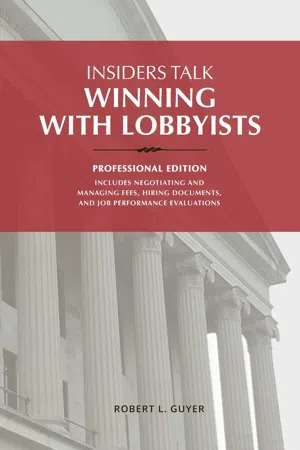
Insiders Talk: Winning with Lobbyists, Professional Edition
The "Client's Bible"
- English
- ePUB (mobile friendly)
- Available on iOS & Android
eBook - ePub
Information
Chapter 1
Overview of Lobbying
Lobbying Defined
Lobbying may be defined as, “trying to influence or gain goodwill.”3 One seeks to influence and gain goodwill in order to sell. You sell to your boss, your lover, and to anyone else who can give you what you want. This book is about selling laws. Lobbying is legislative sales.
Reasons to Lobby
Lobbying is driven mostly by self-interest. James Madison considered economic self-interest to be the most powerful political motivator.4 His views may be summarized as self-interest is the engine of government, a theme which runs throughout this book. Groups advancing self-interests in Madison’s day were called factions; today we call them special-interest groups or simply special interests. Special interests try to achieve nine goals:
1-4. Gain better laws, protect favorable laws, repeal unfavorable laws, and stop adverse bills;
5. Instruct the Governor and courts as to the state’s public policy;
6. Affect state executive agencies’ rulemaking and enforcement;
7. Build lawmaking momentum among states;
8. Build lawmaking momentum to affect Congress; and
9. Fill holes in Federal law.
Gain better laws, protect favorable laws, repeal unfavorable laws, and stop adverse bills. Using general bills and the proposed state budget, the legislature creates laws regulating individuals and businesses. For all practical purposes, the legislature can do anything it wants to do, either for you or to you, good or ill.
Instruct the Governor and courts as to the state’s public policy. The state constitution authorizes the legislature by means of statute to assign to the executive, that is, the Governor, and judicial branches broad guiding principles of statutory interpretation and application.
Affect executive agencies’ rulemaking and enforcement. The Governor’s executive agencies are constitutionally required to implement faithfully laws enacted by the legislature. The legislature directs them by enacting or repealing agency authority and by budget appropriations. However, in practice, legislative authority over agencies may be much less significant than the constitution suggests. See Chapter 18, Lobbying Legislators, section “The Budget.”
Build lawmaking momentum among states. States fall into genres of interest; that is, they have similar policy views on a particular topic. When I lobbied environmental bills, California, Florida, Massachusetts, Minnesota, and New Jersey were the “cutting edge” of environmental regulation. Their executive agencies had informal collaborations on policy initiatives for legislative and agency action, thereby creating a momentum for states in this genre to implement similar laws.
Build lawmaking momentum to affect Congress. Favorable state action is an incentive for states’ federal delegations to support similar lawmaking in Congress. Persuading enough states to adopt your law becomes an upward pressure for Congress to adopt a national law on your topic.
Fill holes in Federal law. States plug “holes” in already existing federal regulations. For example, federal regulations may not affect activities below a certain size, dollar amount, number of employees, and the like, thereby leaving states free to regulate these activities—in effect, to plug holes in the regulatory framework.
Who May Lobby
“Everybody” is the answer. The First Amendment to the United States Constitution states, “Congress shall make no law . . . abridging the right of the people to . . . petition the government for a redress of grievances.” This means the U.S. system of government is designed to allow the people to lobby resulting in a procedurally transparent system. Limits to political transparency are discussed later herein.
Further, for the health of the United States, the Founders expected the people to keep their eyes on their rulers. Thomas Jefferson said, “If once the people become inattentive to the public affairs, you and I, and Congress and Assemblies, Judges and Governors, shall all become wolves. It seems to be the law of our general nature, in spite of individual exceptions.”5
The legislative branch is so accessible that W. Allen Moore said, “Do not hire a professional lobbyist unless all else fails. A great deal of money is wasted on lobbyists to open doors that are already open. Senators and their staffs like to help the ‘little guy’ with a good cause.”6 While legislatures are open to everyone, lawmakers’ supporters, voters, and constituents are especially welcome.
However, in exchange for government benefits—especially tax benefits—organizations may choose to accept limitations on their right to lobby, or they may voluntarily surrender advocacy opportunities altogether. States also may limit certain individuals from lobbying. These persons typically include recently retired legislators, certain felons, and persons banned from the legislature for bad conduct.
Why You Need to Know Lobbying’s Ethics Laws
Violations of lobbying related ethics laws can have awful legal, political, and reputational consequences for you, your principal, and your lobbyist. Even an innocent failure can harm you, especially if your opponents seek to discredit you. To illustrate, a Lobby School participant, an employee of a large utility, told his class, he was instructed by his management to testify on behalf of his employer on a bill before the Colorado House of Representatives. While making his presentation, an opponent pointed out to the chair he was not registered as a lobbyist. The chair interrupted his testimony asking, “Are you registered as a lobbyist pursuant to the rules of the state of Colorado?” He responded, “No, I didn’t know I had to register when speaking on behalf of my employer.” The chair said, “Please sit down, sir; you likely are in violation of Colorado law.” Although not prosecuted legally, he and his principal were humiliated, their reputations were compromised, and legislators became less likely to trust them. Surprisingly, although his employer had many contract lobbyists working for it, nobody told him of the state’s ethics law, and the damage was done.
When You Need to Register as a Lobbyist
An attempt to influence government directly or indirectly, orally or in writing, may be statutorily defined as lobbying. However, although you are lobbying you won’t need to register as a lobbyist until reaching the statutory threshold. Money is the most common, but not the only, trigger. When your principal—that is, the entity on whose behalf you are working on a bill—spends money, including hiring a contract lobbyist, or pays you to influence lawmakers, there is a good chance both you and your principal must register.
Do not presume because your lobbyist is registered, you or your principal doesn’t need to register. As a general principle, you are better off registering as a lobbyist than not registering. This is because your ability to contribute to your lobbying project is severely curtailed by being unregistered. For example, you may be legally barred from even talking to lawmakers or staff. However, by being a registered lobbyist, you can fully participate in moving your bill into law. As a registered lobbyist, you enhance your capital reputation for seriousness, credibility, a...
Table of contents
- Foreword
- Preface
- Chapter 1
- Chapter 2
- Chapter 3
- Chapter 4
- Chapter 5
- Chapter 6
- Chapter 7
- Chapter 8
- Chapter 9
- Chapter 10
- Chapter 11
- Chapter 12
- Chapter 13
- Chapter 14
- Chapter 15
- Chapter 16
- Chapter 17
- Chapter 18
- Chapter 19
- Chapter 20
- Chapter 21
- Appendices
- Appendix 1
- Appendix 2
- Appendix 3
- Appendix 4
- Appendix 5
- Appendix 6
- Appendix 7
- About the Author
- Endnotes
Trusted by 375,005 students
Access to over 1.5 million titles for a fair monthly price.
Study more efficiently using our study tools.
Frequently asked questions
Yes, you can cancel anytime from the Subscription tab in your account settings on the Perlego website. Your subscription will stay active until the end of your current billing period. Learn how to cancel your subscription
No, books cannot be downloaded as external files, such as PDFs, for use outside of Perlego. However, you can download books within the Perlego app for offline reading on mobile or tablet. Learn how to download books offline
Perlego offers two plans: Essential and Complete
- Essential is ideal for learners and professionals who enjoy exploring a wide range of subjects. Access the Essential Library with 800,000+ trusted titles and best-sellers across business, personal growth, and the humanities. Includes unlimited reading time and Standard Read Aloud voice.
- Complete: Perfect for advanced learners and researchers needing full, unrestricted access. Unlock 1.5M+ books across hundreds of subjects, including academic and specialized titles. The Complete Plan also includes advanced features like Premium Read Aloud and Research Assistant.
We are an online textbook subscription service, where you can get access to an entire online library for less than the price of a single book per month. With over 1.5 million books across 990+ topics, we’ve got you covered! Learn about our mission
Look out for the read-aloud symbol on your next book to see if you can listen to it. The read-aloud tool reads text aloud for you, highlighting the text as it is being read. You can pause it, speed it up and slow it down. Learn more about Read Aloud
Yes! You can use the Perlego app on both iOS and Android devices to read anytime, anywhere — even offline. Perfect for commutes or when you’re on the go.
Please note we cannot support devices running on iOS 13 and Android 7 or earlier. Learn more about using the app
Please note we cannot support devices running on iOS 13 and Android 7 or earlier. Learn more about using the app
Yes, you can access Insiders Talk: Winning with Lobbyists, Professional Edition by Robert L Guyer in PDF and/or ePUB format, as well as other popular books in Politics & International Relations & Public Law. We have over 1.5 million books available in our catalogue for you to explore.