- English
- ePUB (mobile friendly)
- Available on iOS & Android
eBook - ePub
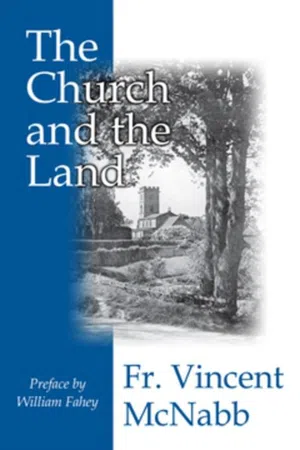
The Church and the Land
Information
Topic
Theology & ReligionSubtopic
ReligionA Call to Contemplatives
WE HAVE PLACED this chapter at the beginning of the book because we could not place it also at the end. Nevertheless, we wish our readers to place this chapter at the beginning and also at the end of their reading of the book. If the thoughts and hopes that have inspired it do not inspire some of our readers, the book will have been written in vain.
Indeed, not only will the writing of the book, but even the many years of life and thought behind the book, have been in vain. To find no one answering our Call to Contemplatives will seem to give the lie to one of our deepest and most matured convictions. If there is one truth more than another which life and thought have made us admit, against our prejudices and even against our will, it is that there is a little hope of saving civilization or religion except by the return of contemplatives to the land!
As in these matters of matured conviction the chronological order is often identical with the logical order, our readers will pardon what seems auto-biography, but is an effort after condensed economics and mysticism.
*****
The present writer has had opportunities for observation which few of his contemporaries even in the priesthood have equalled. Drawn from childhood by the dream of helping in the conversion of England, the Master whom he served has led him, during a life-time, into contact with almost every sphere of Catholic and social activity. It has been his privilege to know most of the foremost Catholics in the country. Many have been his friends, and his teachers. His debt towards them is insolvent bankruptcy.
Gradually, and almost in spite of his youthful convictions, it was borne in upon him that – apart from sin – the main evil in the body politic and ecclesiastic was a displaced centre of gravity. The great industrial town which had naturally fascinated his eyes of youth and dimmed his vision to the land, coming at last into focus, was seen to be not the flower and scent of social life but the scurf and putrescence of decay. Scarcely had industrialism run two hundred years than the great towns were reduced to such a state of economic bankruptcy – and here was the call to an apostle – that race suicide could be made the only practical agenda for the people.
Whilst his conviction was growing from the mere sight of a religious crisis out of an economic crisis, he was increasingly conscious of a verification of his almost unwillingly admitted conviction. For over a century there had been a concentration of ecclesiastical effort in the industrial town rather than in the country. Indeed, there had been something akin to intense cultivation of the town and something like under-cultivation of the country. Yet ecclesiastical statistics seemed quite decisive that, in spite of the numerous growth of people and churches, the Catholic population of the great industrial town was not keeping pace with the growth of the population. In contrast with this scanty yield for our intense cultivation of a rural industrialized people was the fact that Catholic people on the land could hardly yield anything but a dogged and devoted Catholic faith. It was not Ireland, but industrial Ireland that was Protestant; it was not France, but industrialised France that was free-thinking. If there was a crisis in the fortunes of the Church it was because the economic centre of gravity had become misplaced by a subtle avarice which was endeavouring to serve God and Mammon.
The call to fulfil our apostolic duty by telling our contemporaries these discomforting facts would have found us dismayed had not a papal command made sloth high-treason. The Rerum Novarum1 of Pope Leo XIII had said: “Every minister of holy religion must bring to the struggle the full energy of his ‘mind’ and all his powers of endurance.” And the programme demanding this energy of mind and power of endurance was outlined in these simple words: “The law therefore should favour ownership and its policy should be to induce as many as possible to become owners.”
*****
Thereupon came the great lesson from Exodus; which after much disjointed thinking finally took this form. “No people has ever left the town for the land, or remained on the land when it could have gone to the town, except under the motive of religion.” In other words, by a sheer exercise of economic and ethical induction we had stumbled upon the great principle of Jesus Himself, “Be not solicitous therefore, saying, What shall we eat? or, What shall we drink? or, Wherewith shall we be clothed? For after all these things do the heathens seek. For your Father knoweth that you have need of all these things.
“SEEK YE THEREFORE FIRST THE KINGDOM OF GOD AND HIS JUSTICE, and all these things shall be added unto you.”† And the principle of the Master became all the more moving because it was recorded by that disciple who had quitted the counting-house to follow Jesus of Nazareth.
*****
This divine confirmation of a truth which we had culled in meditation upon the widowed land of England and the crowded slums of St Pancras seemed to grow – against our will – into the conviction that all our apostolic work in which we had spent, and intended to spend, our life would be useless without some order of contemplative men going back to the land.
Gradually we seemed to think that what our apostolic thinking had concluded to be a necessity, some of those who loved Church and Motherland might accept as a challenge and a vision. We even went so far as to outline some of the things our apostolic thirst for truth would say to the youths who might be moved by the challenge and the vision. Here are disjointed fragments of our soul.
…SEEK…FIRST the Kingdom of God, and His justice. First things first, for God’s sake; or you will crash at once. Let your Exodus be after the coming out of Egypt. Leave the garden cities and the flesh pots, not in order to scorn suburbia or to lead a simple life, but to worship God.
Quit most of your fellowmen not because you hate them or despise them, but because you love them so much as to hate the conditions which degrade and enslave them. Do not leave Babylon2 as hating the Babylonians, but as hating Babylon, which kills the Babylonians. Leave St Pancras3 because you love every one of those thirty thousand families living each in one or two rooms in St Pancras.
Quit Babylon for love of the Babylonians. And do not seek ease or security you can obtain by using Babylon. What will it avail you to cease living in Babylon if you do not also cease living on Babylon?
If God allows you a plot of soil, and hands for toil, why should you be solicitous to have your revenues from Babylonian brickworks – your meat from Babylonian cold-storage – your drink from Babylonian waterworks – your clothes from Babylonian cloth-factories? Is there no clay in Sussex soil – are there no cattle in Sussex meadows – is there no water in Sussex wells – is there no wool on Sussex sheep? Be a monastery then – a MONK – a thing apart, aloof from the world; indeed, be a world apart, a self-sufficient, self-supporting kingdom; and though you surround yourselves, your lands with a high wall of brick and a higher wall of silence, your sermon will be the heart and hope of all the sermons we apostles will preach in the daily exercise of our craft of apostle.
Seek…First…His Justice
Study not merely to give God His due by worship, but to give man his due by justice. Let not individual poverty beget, as uncurbed it will beget, collective riches. What is superfluous to your poor estate distribute. This is distributive charity; a virtue so sacred that crimes against it are the forerunner of inevitable doom.
Measure your lands by your needs. Measure your needs not by the world’s measures, but by the ell or by the King’s Arm. Let your standard be not Babylon, or Thebes, or Paris, or New York, or London – but Bethlehem, Nazareth, Capharnaum, Calvary.
Go forth, Christian soul, to the unfallen earth, and there amidst the tares and briars sing the song of work that is worship. Soon around your croft will gather a sheaf of homes and homesteads, where the GREAT SACRAMENT may prepare the ploughman for the furrow, the monk for the choir, the priest for the Altar.
DIEU LE VEUT.4
FIAT.5
† St Matt. vi 31–33.
First Things First
A DISCUSSION in The Times6 on unemployment has not been without its aspects of wisdom. Not that the contributions have always been a display of wisdom itself, but rather a stimulus to the wise. The suggestions made by the disputants have often been so frankly foolish that the wisdom of some alternative course became apparent. Thus Mr. George Lansbury7 begins his letter with his wise saying, “We want to stop the system by which one section of the nation lives on the labour of the rest.” But his letter ends with the threat, “Labour will go on with its campaign – work or maintenance, with emphasis on work.” How a demand for more and more work will end the system of one section working for the other non-working section we are at a loss to see.
But we see that the policy advocated by Mr. George Lansbury and others will tend to perpetuate instead of destroying the system which has given rise to this evil of unemployment and under-employment, now such a national epidemic. To see this tendency we must remember that unemployment or under-employment as such is not an evil, except insofar as some kind of work is a necessary worship of the good God, and is therefore good. Nor is the modern epidemic of unemployment an evil because those who lack work lack wages, seeing that wages or token-wealth is not a good except insofar as it can obtain life’s goods. Unemployment, then, is only an evil insofar as it creates for the unemployed a dearth of goods.
It is admitted that in this or that particular epidemic of unemployment the evil flowing from the epidemic may be met by providing employment and therefore wages. It is in this sense that Mr. George Lansbury looks to more “work,” and therefore more wages, as the local treatment which will soothe, if not cure, the particular epidemic of unemployment now rife in London. It is in this sense that we understand the action of the authorities of Cork who have recently given citizenship to Mr. Patrick Ford because he has built a large motor factory on “the pleasant waters of the river Lee”!
But the cure of particular outbreaks of an epidemic sometimes perpetuates the epidemic, by blinding men to the real cure. A Wage System which is engaged in the creation not of primary wealth, but of secondary wealth, will do nothing to cure the evil of Unemployment, insofar as it is an evil. Labour as such should be first employed in making things of first importance. When these primary needs are supplied, then may labour go on to supply secondary needs,
It would be well to enumerate these primary needs if only for the sake of realizing how far we are from finding them provided by the present Industrial System. Our primary economic necessities are: (1) Food – i.e., bread, vegetables, milk, meat, malted liquors, etc.; (2) Clothing – i.e., woollen, linen, and cotton stuffs, well tanned or untanned leather; (3) Housing – i.e., a home of sufficient rooms, a homestead, fresh air, etc.; (4) Fuel; wood, coal, etc. All other things belong to man’s secondary needs.
Now it may be startling to some men to be reminded that the present Factory System of Industrialism produces none of the primary needs of human existence. The land and the land alone gives us the simplicities of Food, Clothing, Housing, Fuel. Factory methods cannot give us these necessities of life; but they can give them a quality which makes them controllable by a small group of men who wish to make money by controlling them. Thus milk when doctored with boracic preparations, or sterilised, can be controlled by a milk combine. Even fish can be so treated by cold storage as to be always as controllable and indestructible as wheat.
Hence when poor Mr. Lansbury (now in jail!) clamours for Work, he wants primarily not work but a wage; and he does not seem to realize that the work he and his fellow-workers want will produce none of the necessities of life. The 25,000 unemployed in his district of Poplar,8 if given employment, would pass into the manufacture of furniture, or motors, or into the road or rail transport system, or some other system for producing things of secondary need and value.
As I write this in N.W.5,9 within a stone’s throw of some of the worst slums in the world, two trams or buses, brilliantly lighted, have passed through these slums in one minute. Each of these has cost enough to build almost half a dozen homes for working-men! Yet few propositions issuing from the Labour Party consider any other proposition than that of carrying on the present bankruptcy system of neglecting our land and of producing only secondary needs. Is it more than significant that the Triple Alliance of Coal Miners, Railwaymen and Transport Workers belong to the three main secondary industries?
It will become clear that the unfortunate employees of these great (parasitic?) industries in seeking by Trade Union action to stabilize the w...
Table of contents
- Cover
- Dedication
- Title Page
- Copyright
- Table of Contents
- Reflections on Fr. Vincent McNabb, O.P Hilaire Belloc
- Introduction Dr. William Fahey
- Preface Fr. Vincent McNabb
- Chapter 1 - A Call to Contemplatives
- Chapter 2 - First Things First
- Chapter 3 - Form A1
- Chapter 4 - The Cry of the English
- Chapter 5 - “The Voice of the Irish”
- Chapter 6 - Why Satan Wins
- Chapter 7 - St. Thomas Aquinas on Town Planning
- Chapter 8 - A Tale of Two Cities
- Chapter 9 - The Problem of Unemployment
- Chapter 10 - A Challenge to Modern Industrial Methods
- Chapter 11 - The Decay of Dancing
- Chapter 12 - The Economics of a Riot
- Chapter 13 - The Economics of the Exodus
- Chapter 14 - The End of the Wage System
- Chapter 15 - Do It Ourselves
- Chapter 16 - The British Association and the Wage System
- Chapter 17 - The Incubus of Industrialism
- Chapter 18 - Looking Towards the East
- Chapter 19 - The Modern Town and Birth Control
- Chapter 20 - Nazareth Measures
- Chapter 21 - Nature and Unemployment
- Chapter 22 - The New Industrial Charter
- Chapter 23 - A Grammar of Unemployment
- Chapter 24 - Authority and Property
- Chapter 25 - The Arrival of a Fact
- Chapter 26 - Rights of the Parent
- Chapter 27 - Agricultural Mass Production
- Chapter 28 - A Window in Wisbech
- Chapter 29 - Wisdom at Cardiff
- Chapter 30 - The Widowed Land
- Chapter 31 - Souls and the Land
- Chapter 32 - The Social Need of Flying the Occasions of Sin
- Chapter 33 - Is It Socialism?
- Chapter 34 - The Joy of Poverty
- Chapter 35 - The Land and Unemployment
- Chapter 36 - Land-Work and Hand-Work
- Chapter 37 - Industrialization of Land
- Chapter 38 - What Wilt Thou Have Me Do?
- Chapter 39 - The Two Kings
- Chapter 40 - To the Child in the Manger
- Chapter 41 - The Adventure of the Land
- Notes
- Some Thoughts on Reading Fr. McNabb Dr. William Fahey
- About IHS Press
Trusted by 375,005 students
Access to over 1.5 million titles for a fair monthly price.
Study more efficiently using our study tools.
Frequently asked questions
Yes, you can cancel anytime from the Subscription tab in your account settings on the Perlego website. Your subscription will stay active until the end of your current billing period. Learn how to cancel your subscription
No, books cannot be downloaded as external files, such as PDFs, for use outside of Perlego. However, you can download books within the Perlego app for offline reading on mobile or tablet. Learn how to download books offline
Perlego offers two plans: Essential and Complete
- Essential is ideal for learners and professionals who enjoy exploring a wide range of subjects. Access the Essential Library with 800,000+ trusted titles and best-sellers across business, personal growth, and the humanities. Includes unlimited reading time and Standard Read Aloud voice.
- Complete: Perfect for advanced learners and researchers needing full, unrestricted access. Unlock 1.5M+ books across hundreds of subjects, including academic and specialized titles. The Complete Plan also includes advanced features like Premium Read Aloud and Research Assistant.
We are an online textbook subscription service, where you can get access to an entire online library for less than the price of a single book per month. With over 1.5 million books across 990+ topics, we’ve got you covered! Learn about our mission
Look out for the read-aloud symbol on your next book to see if you can listen to it. The read-aloud tool reads text aloud for you, highlighting the text as it is being read. You can pause it, speed it up and slow it down. Learn more about Read Aloud
Yes! You can use the Perlego app on both iOS and Android devices to read anytime, anywhere — even offline. Perfect for commutes or when you’re on the go.
Please note we cannot support devices running on iOS 13 and Android 7 or earlier. Learn more about using the app
Please note we cannot support devices running on iOS 13 and Android 7 or earlier. Learn more about using the app
Yes, you can access The Church and the Land by Fr. Vincent McNabb in PDF and/or ePUB format, as well as other popular books in Theology & Religion & Religion. We have over 1.5 million books available in our catalogue for you to explore.