
- English
- ePUB (mobile friendly)
- Available on iOS & Android
eBook - ePub
Information
chapter 1
Reflective Practice
Leadership agility is about continuously learning, and one way to approach this is through reflective practice.
Reflective practice is so important I have made it a rule of thumb (number 6). It involves learning from your experiences and applying the insights you gain to similar or different experiences. A simple but effective definition I like to use is: ‘Reflective practice encompasses intentionally reflecting on your actions and experiences, making sense of them, and implementing changes with a view to continuously learn and grow.’
There are a number of different models or frameworks that help us understand reflective practice. In this chapter, I will focus on a standard approach to reflective practice. In Chapter 3, titled ‘Reflection in Action’, I will focus on a dynamic real-time approach using the metaphor of ‘The Balcony and Dancefloor’ – a concept developed by leadership expert Ron Heifetz.
Each day is filled with experiences – some of them small (sending emails or taking phone calls), some of them big (losing a contract with a longstanding client or winning a new job). In our personal life it is the same.
In each of these experiences, there are opportunities for growth. Some of us, however, let those opportunities pass. Some of us are happy to simply live the experience rather than reflect on how that experience could help us learn and grow.
There are three types of learners that I come across in my work, each with a different approach to reflective practice:
- Blocked. Blocked learners resist learning from experiences. They tend to make the same mistakes repeatedly. They often blame factors that are external to themselves if things go wrong, but are happy claiming responsibility when things go well. They either lack the willingness or the capacity to learn from their experiences.
- Passive. Passive learners have some degree of reflective practice but don’t translate their reflections into actions. I see many passive learners in my leadership programs. They have great intentions to take their learning back into the workplace but, when they get there, the busyness takes over and not much changes.
- Active. Active learners embody reflective practice. They are open to new experiences and see them as an opportunity to learn. Their learning radars are always making observations and identifying insights, and, most importantly, they put their insights and learnings into practice. In my workshops, feedback sessions and coaching, active learners demonstrate qualities such as self-awareness, curiosity, a questioning mindset, and a willingness to take ownership of their learning.
In my work, I spend time helping those who are ‘passive’ learners to become ‘active’ learners. Implementing good reflective practice is a way of doing this.
So, what does this reflective practice look like?
My approach to reflective practice is based closely on Kolb’s learning cycle.4 There are four stages in the reflective practice:
- Experience. This is the active involvement in a task or activity. It can include any type of experience, such as an email exchange with a peer, a presentation to a leadership team or a conflict with a key stakeholder in the organisation.
- Observations. This step involves developing awareness of your experience, stepping back and reviewing what is working and what is not working. It may include talking with others about what happened in your experience, identifying your behaviours as well as your emotional reactions to the experience. There is no judgement in the observation stage, just an objective collection of data.
- Sense making. This step involves making sense of, or taking meaning from, your observations. In this stage, individuals look for insights and learning, with a focus on developing new ways of thinking and behaving. They learn to identify patterns, connect the dots and better understand what happened in their experience. An example might be a pattern you identify from multiple experiences that suggests you withdraw from conflictual experiences. Knowing this is a pattern allows you to do something about it. Without sense making the experience becomes an intellectual exercise. A little like winning the lottery and not knowing what money is! I discuss sense making further in Chapter 2, which includes an example from my coaching.
- Experimentation. The final stage is when you try using your new thinking and new behaviours in similar or different experiences. For example, if you have identified a pattern of withdrawing from conflictual experiences, you might experiment by having a conversation with someone who you have conflict with, but who is also supportive of you. It might be easier than experimenting with someone who is extremely difficult. I also discuss experiments in more detail in Chapter 23.
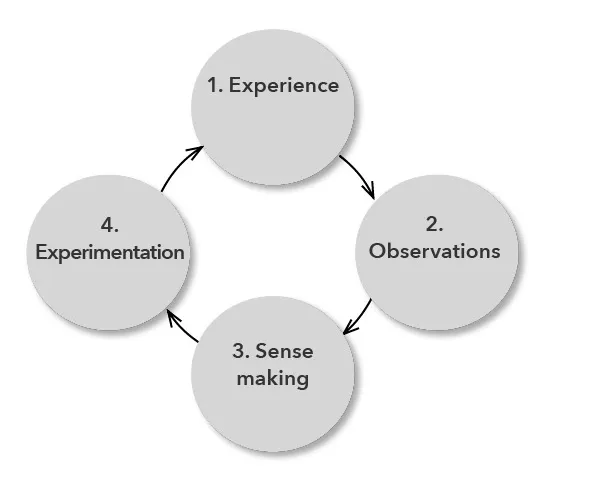
Each of these four stages of reflective practice are important, and you need to work through each stage rather than rush to an experiment. Making observations and identifying insights are a vital part of the reflective practice process.
Agile leaders make reflective practice an integral part of the daily practice. Without reflective practice and a commitment to learning, adaptability and agility are virtually impossible.
Ideas for developing your reflective practice
Journaling
One great way to develop your reflective practice is to journal your experience. In fact, you might like to go beyond that and keep a journal where you document daily your experiences, your observations and your insights. Since I started my improv comedy classes I’ve been keeping a journal, and after every class and performance I document my observations, learning and feedback from my teacher. I have noticed my confidence building as I start to experiment and action the feedback I am given. Journaling helps you get out of your linear and sequential thinking, and enables you to take a big picture view of your feelings, observations and insights. It allows you to identify patterns in your behaviour from a detached perspective.
You don’t have to be a world-class writer to keep a journal. Just start writing. Step back and, with a third-person perspective, look for insights and learning. When you run your experiments, document your results. You might be pleasantly surprised by the results.
So, don’t hesitate; start a journal! You can use a nice moleskin, or a playful diary from Typo, or even the notes section or an app on your phone.
Peer coaching
I ask peers to help with my reflective practice, particularly when I am in the sense-making stage. I spend time sharing my experiences and observations, and I encourage them to challenge me around making sense of them. This third-person view helps me to see things that I may not if I am working through the process by myself. Identify a couple of peers who you trust and who think differently to you, and ask them to help you make sense of your experiences. The most important thing is to be open to being challenged by the person.
Commit to the practice
My experience of people who are very good learners is that they commit to the practice of reflection. This is a signature skill of the active learners that I mentioned earlier in this chapter. I suggest carrying around your journal (or your phone if you use the notes section or an app) at all times and using on-the-go opportunities, such as commuting or walking to your next meeting, to reflect on your experience. What is important is that you integrate those on-the-go notes into your more formal practice. One practice that I adopt is taking time each evening to document my observations and insights from the day, as well as what I am grateful for. You may not want to do it every day, but having a regular practice will ensure a noticeable difference in how you see the world.
Chapter 2
Enhance Your Sense Making
In the previous chapter, I discussed the importance of reflective practice. Consisting...
Table of contents
- Title page
- Imprint
- CONTENTS
- introduction
- chapter 1 - Reflective Practice
- Chapter 2 - Enhance Your Sense Making
- Chapter 3 - Reflection in Action (The Balcony and the Dancefloor)
- Chapter 4 - Adopt a Growth Mindset
- Chapter 5 - Understand Your Context
- Chapter 6 - Make Conflictual Interpretations of Your Context
- Chapter 7 - Become a Systems Thinker
- Chapter 8 - Embrace Dualities
- Chapter 9 - Demonstrate Curiosity
- Chapter 10 - Practice Mindfulness
- Chapter 11 - Manage Your Cognitive Biases
- Chapter 12 - Build Leadership Density
- Chapter 13 - Creating Psychological Safety
- Chapter 14 - Deep Listening
- Chapter 15 - Be Trustworthy
- Chapter 16 - Develop Empathy
- Chapter 17 - Embrace a Different Perspective
- Chapter 18 - Embrace Productive Conflict
- Chapter 19 - Embrace your Vulnerability
- Chapter 20 - Engage with Generative Dialogue
- Chapter 21 - Understand your Stakeholders’ World
- Chapter 22 - Move Out of Your Comfort Zone and Into Your Learning Zone
- Chapter 23 - Be an Experimenter
- Chapter 24 - Let Simple Rules Guide You
- Chapter 25 - Know Your Purpose
- Chapter 26 - Don’t Overuse Your Strengths
- Chapter 27 - Give Up (Some) Control
- Chapter 28 - Diversify Your Experiences
- Chapter 29 - Increase Your Understanding of Self . . . Through the Eyes of Others
- Chapter 30 - Open Yourself Up to Feedback
- Chapter 31 - Make Progress On Your Own Personal Adaptive Challenge
- Chapter 32 - Institute Your Own 90-Day Plan (And Weekly Plan)
- Chapter 33 - Understand Your Emotional Triggers
- Chapter 34 - Manage Your Emotions
- Chapter 35 - Unleash Your Creativity
- Chapter 36 - Decision Agility
- Final Thoughts
- Acknowledgements
- About the Author
- Reference List
Trusted by 375,005 students
Access to over 1.5 million titles for a fair monthly price.
Study more efficiently using our study tools.
Frequently asked questions
Yes, you can cancel anytime from the Subscription tab in your account settings on the Perlego website. Your subscription will stay active until the end of your current billing period. Learn how to cancel your subscription
No, books cannot be downloaded as external files, such as PDFs, for use outside of Perlego. However, you can download books within the Perlego app for offline reading on mobile or tablet. Learn how to download books offline
Perlego offers two plans: Essential and Complete
- Essential is ideal for learners and professionals who enjoy exploring a wide range of subjects. Access the Essential Library with 800,000+ trusted titles and best-sellers across business, personal growth, and the humanities. Includes unlimited reading time and Standard Read Aloud voice.
- Complete: Perfect for advanced learners and researchers needing full, unrestricted access. Unlock 1.5M+ books across hundreds of subjects, including academic and specialized titles. The Complete Plan also includes advanced features like Premium Read Aloud and Research Assistant.
We are an online textbook subscription service, where you can get access to an entire online library for less than the price of a single book per month. With over 1.5 million books across 990+ topics, we’ve got you covered! Learn about our mission
Look out for the read-aloud symbol on your next book to see if you can listen to it. The read-aloud tool reads text aloud for you, highlighting the text as it is being read. You can pause it, speed it up and slow it down. Learn more about Read Aloud
Yes! You can use the Perlego app on both iOS and Android devices to read anytime, anywhere — even offline. Perfect for commutes or when you’re on the go.
Please note we cannot support devices running on iOS 13 and Android 7 or earlier. Learn more about using the app
Please note we cannot support devices running on iOS 13 and Android 7 or earlier. Learn more about using the app
Yes, you can access Survive and Thrive by Andrew Williams in PDF and/or ePUB format, as well as other popular books in Business & Knowledge Capital. We have over 1.5 million books available in our catalogue for you to explore.