- English
- ePUB (mobile friendly)
- Available on iOS & Android
eBook - ePub
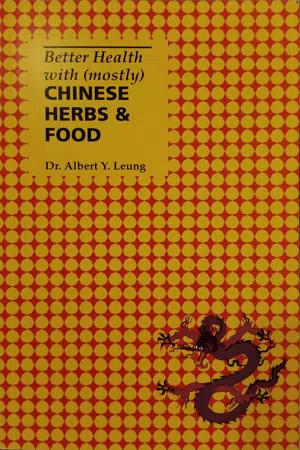
Better Health with (Mostly) Chinese Herbs and Foods
Information
Topic
MedicineLIST OF HERBS AND FOODS
Alfalfa | Honeysuckle |
Aloe Vera | Job's Tears |
Angelica | Jujube, Common |
Astragalus | Juniper |
Baizhu | Kudzu |
Bee Pollen | Licorice |
Cangzhu | Ligustrum |
Capsicum | Luffa |
Celery Seed | Lycium |
Cherokee Rosehip | Magnolia |
Chicory | Mume |
Chrysanthemum | Mung bean |
Codonopsis | Passion flower |
Dandelion | Peony, Red and White |
Danggui | Poria |
Eleuthero | Purslane, Common |
Fenugreek | Red Sage |
Foti, Raw and Cured | Rehmannia, Raw and Cured |
Forsythia | Royal Jelly |
Ganoderma | Safflower |
Garlic | Sarsaparilla |
German Chamomile | Saw Palmetto |
Giant Knotweed | Schisandra |
Ginger | Sesame |
Ginseng, Asian and | Sour Jujube Kernel |
American | Thyme |
Gotu-kola | Turmeric |
Hawthorn, Western and | Watercress |
Chinese |
ALFALFA (Syn. LUCERNE)
Plant Source: Medicago sativa L. (Family Leguminosae)
Part Used: Leaves and flowering tops
Properties: Appetizer, diuretic, tonic
Most Common Traditional Uses: To promote appetite and weight gain, to stop bleeding, to treat bladder stones and fluid retention
Other Advocated Uses: Arthritis, diabetes, peptic ulcer, alcoholism, to prevent absorption of cholesterol
Alfalfa is rich in nutrients, including proteins, antioxidant flavonoids, vitamins (A, B1, B6, B12, C, E and K), amino acids, minerals, sterols and fibers; it also contains saponin glycosides and coumarins. It is one of the commercial sources for chlorophyll production and is also a source for leaf protein production. Its extracts are used as flavor ingredients in many processed foods.
The popularity of alfalfa is quite recent, perhaps only a couple of decades. Although much chemical and pharmacological research has been performed on alfalfa, there is still no clear-cut evidence to support the benefits of alfalfa's advocated medicinal uses in humans. In addition, there is preliminary evidence that ingestion of large quantities of alfalfa (especially seeds or sprouts) may produce blood abnormalities and reactivate systemic lupus erythematosus in persons in whom this condition has been clinically inactive. Nevertheless, alfalfa does contain a wide variety of nutrients (both conventional and non-conventional) and ingestion of its leaves and sprouts in moderation can be quite nutritious. One thing to bear in mind is that nothing is absolutely safe, especially if done in excess. Also, it is your body, you know it the best. Continue to listen to it
References: FOSTER AND DUKE; JIANGSU; LEUNG; LEUNG AND FOSTER; RICHARDSON; TYLER
ALOE VERA
Plant Source: Aloe barbadensis Miller (Family Liliaceae)
Part Used: Leaf gel
Properties: Healing, pain-relieving, emollient, soothing, anti-inflammatory
Most Common Traditional Uses: Internal – General tonic, cleanser, detoxifier. External – Minor burns, sunburn, skin irritations, insect bites, minor cuts, scratches and wounds
Other Advocated Uses: Too numerous to list
The external healing and pain-relieving properties of fresh aloe vera gel have been well established. The polysaccharides are believed to be the active principles. However, its other properties, especially internal, are still open to debate.
The internal uses of aloe gel appear to be only of recent origin, and lack long documented use history. Despite the controversy, aloe vera drinks (also called juices) have been consumed in tremendous quantities by the public for dozens of conditions, or for "whatever ails you." And there is no lack of testimonials to aloe vera's marvelous benefits. However, aloe vera is probably the most adulterated product on the world market, because most of the aloe drinks sold to consumers contain only a fraction of the claimed content of aloe vera gel. One fairly widely advertised "award-winning" brand claims to have no taste, contains no preservatives and keeps for years without spoiling; it actually tastes like water and looks like water, and probably is water!
Aloe vera is probably also the plant product that has produced the most millionaires in the United States, thanks to its name recognition and to the lack of testing methods to determine its quality. Greedy suppliers, brokers and manufacturers frequently stretch one gallon or one pound of genuine aloe vera gel liquid or powder to literally tens or hundreds of gallons or pounds of finished aloe drink reaping outrageous profits. The taste of the aloe juice or drink you experience is mostly due to citric acid and preservatives. Genuine, fresh aloe gel tastes bland and slimy.
Aloe vera cosmetics are no better, because most of the time aloe vera gel is there just for a "label claim." This means that the product manufacturer merely puts in a minimum quantity of aloe so that its presence can be indicated on the label to entice you to buy it. The amount present is often so small that it imparts no benefit to the product (or consumer) whatsoever. You might have to try different brands until you find the right one that may contain enough aloe gel to do something for you.
Aloe vera gel normally contains no laxative ingredients (anthraglycosides). These laxative compounds are only present in special cells immediately beneath the skin of the leaf. After the leaf is cut crosswise, the yellow bitter latex containing these compounds drains out of the leaf. When this latex is dried, a dark resinous mass is produced which is commonly called simply "aloe." This aloe is a drug; it is used in many laxative preparations. A milder form of laxative is also produced from the aloe vera plant by splitting the whole leaf, drying it and then milling it to a powder. Since this product contains considerably lower amounts of anthraglycosides, and high concentrations of the gel, its laxative action is considered much less harsh than the concentrated aloe latex.
References: LEUNG; LEUNG AND FOSTER; LUST; ODY; TYLER
ANGELICA
Plant Source: Angelica archangelica L. and other related Angelica spp. (Family Apiaceae)
Part Used: Root
Properties: Tonic, appetizer, carminative, expectorant, stimulant, stomachic, diuretic, diaphoretic, emmenagogic
Most Common Traditional Uses: Bronchial ailments, colds, coughs, stomach troubles, indigestion, flatulence, nervous conditions, insomnia, menstrual difficulties (cramps, pain, irregular menses, etc.), arthritis
Most Common Traditional Uses: Bronchial ailments, colds, coughs, stomach troubles, indigestion, flatulence, nervous conditions, insomnia, menstrual difficulties (cramps, pain, irregular menses, etc.), arthritis
In addition to a volatile oil, plant acids, sterols, flavonoids and other common constituents (starch, sugars, resin, etc.), angelica contains large amounts of coumarins some of which (e.g., bergapten and xanthotoxin) have strong phototoxic properties. Individuals who are sensitive to these compounds should exercise caution in handling angelica, as dermatitis may result if their skin comes in contact with these compounds and is then exposed to the sun.
Unlike the Chinese angelica (danggui), Western angelica does not have the long rich history and record of extensive use. However, angelica extracts are now used as a flavor ingredient in many types of foods, especially alcoholic beverages such as bitters, liqueurs, gin and vermouth.
References: LEUNG AND FOSTER; LUST; TYLER
ASTRAGALUS (Syn. HUANQI)
Plant Source: Astragalus membranaceus (Fisch.) Bge, and other Astragalus spp. (Family Leguminosae)
Part Used: Root (raw and cured)
Properties: Qi (energy) tonic, healing, antiviral, anti-inflammatory, antioxidant, immunomodulating, diuretic
Most Common Traditional Uses: Raw root – Spontaneous/night sweating, edema, painful joints, chronic sores/abscesses, nonhealing wounds and ulcers. Cured root – General weakness, fatigue, lack of appetite, diarrhea due to Spleen deficiency, rectal prolapse, uterine bleeding
Modern/Recent Uses: Colds and flu, diabetes, stomach ulcer, neurodermatitis, AIDS
Documented use of astr...
Table of contents
- Title Page
- PREFACE
- Introduction
- LIST OF HERBS AND FOODS
- REFERENCES
- Color Plates
- GLOSSARY
- Biographies
- Back Cover
Trusted by 375,005 students
Access to over 1.5 million titles for a fair monthly price.
Study more efficiently using our study tools.
Frequently asked questions
Yes, you can cancel anytime from the Subscription tab in your account settings on the Perlego website. Your subscription will stay active until the end of your current billing period. Learn how to cancel your subscription
No, books cannot be downloaded as external files, such as PDFs, for use outside of Perlego. However, you can download books within the Perlego app for offline reading on mobile or tablet. Learn how to download books offline
Perlego offers two plans: Essential and Complete
- Essential is ideal for learners and professionals who enjoy exploring a wide range of subjects. Access the Essential Library with 800,000+ trusted titles and best-sellers across business, personal growth, and the humanities. Includes unlimited reading time and Standard Read Aloud voice.
- Complete: Perfect for advanced learners and researchers needing full, unrestricted access. Unlock 1.5M+ books across hundreds of subjects, including academic and specialized titles. The Complete Plan also includes advanced features like Premium Read Aloud and Research Assistant.
We are an online textbook subscription service, where you can get access to an entire online library for less than the price of a single book per month. With over 1.5 million books across 990+ topics, we’ve got you covered! Learn about our mission
Look out for the read-aloud symbol on your next book to see if you can listen to it. The read-aloud tool reads text aloud for you, highlighting the text as it is being read. You can pause it, speed it up and slow it down. Learn more about Read Aloud
Yes! You can use the Perlego app on both iOS and Android devices to read anytime, anywhere — even offline. Perfect for commutes or when you’re on the go.
Please note we cannot support devices running on iOS 13 and Android 7 or earlier. Learn more about using the app
Please note we cannot support devices running on iOS 13 and Android 7 or earlier. Learn more about using the app
Yes, you can access Better Health with (Mostly) Chinese Herbs and Foods by Albert Y. Leung in PDF and/or ePUB format, as well as other popular books in Medicine & Alternative & Complementary Medicine. We have over 1.5 million books available in our catalogue for you to explore.