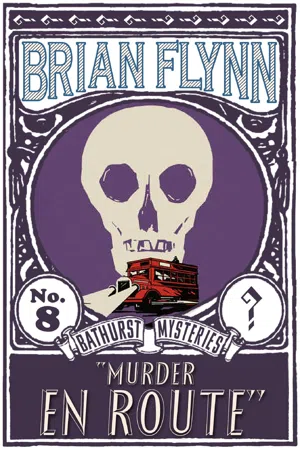
- English
- ePUB (mobile friendly)
- Available on iOS & Android
eBook - ePub
Information
CHAPTER I
THE NIGHT IN NOVEMBER
It was a cold, wet and unutterably cheerless night in mid-November—a night when the mordant dog of Lear’s enemy would have found shelter beside the blind king’s fire. The thick fog that had held possession of the coastal line for several hours had given way at last to heavy rain—rain which positively seemed to revel in its falling. The last motor-bus at this particular season of the year was due to leave the seaside town of Esting at 8.33. It ran to its destination of Raybourne in the scheduled time of one hour and five minutes, and, in addition to a number of small villages, passed through on its way the coast towns of Lanning, Northlynn, Sladenham and Kirve, all of which were on the regular route of the Southbrooke Motor Services Company. Whereas from the beginning of April to the second week in October, in due allegiance to Summer Time, an augmented service was in being, with a last journey from Esting at five minutes past eleven, at the time of the year when this history opens the service along the coast to Raybourne was restricted to a mere dozen motor-buses per day.
On the night in question the exigencies of the English climate were the primary cause of the vehicle being almost empty when it left Esting and commenced its fourteen-mile journey. It was an open-decker, and the few people it carried huddled together inside. Frederick Whitehead, the conductor, joyless and cadaverous, gave his driver the necessary signal on the bell at the back and solemnly entered the inside of his bus for the purpose of collecting the fares. He was carrying, he discovered, only five people, two of whom were comparatively well known to him. They were a Mr. and Mrs. Jupp, of Sladenham. The remaining three people were strangers. Two of these three, a man and a woman, booked for as far as the bus travelled—the Tower Square terminus at Raybourne; the other, a young girl somewhere in the early twenties, asked for Northlynn. When questioned later on by the coroner who conducted the inquest, Whitehead was able to remember these particulars perfectly. At this stage of the journey there was nobody on top whatever, which was, as has been stated, entirely uncovered and completely exposed to the savagery of the elements.
Whitehead passed a melancholy remark to his two passengers who had booked to Sladenham Corner, and returned disconsolately to his platform. Thank heaven it was his last journey that night! He crouched against the bend of the staircase as much as he comfortably could, for by this time the rain had come on even worse than before and was beating on to his face and shoulders with pitiless severity. The bus made good pace from Esting, and as they approached the dark arch of the railway bridge half a mile or so from Lanning, Whitehead temporarily forsook his inadequate shelter and went to the extreme edge of his square platform. He did so from no whim or chance movement, but from an intention born of habit. He peered out into the almost impenetrable darkness. The rain lashed his face, but for a moment or two he was content to endure it, for he was looking for somebody—a passenger—a man who had caught this 8.33 motor-bus from Esting at this particular spot every night for a month or more. Whitehead did not have to look out for very long. His customary passenger was waiting as usual in the shelter and shadow of the bridge. Whitehead gave the signal for the bus to slow down, and the man who had been waiting in the rain, with the collar of his heavy overcoat turned right up to the ridge of his jaw, swung himself alertly on to the platform.
“No bon for you on top tonight, sir,” called the conductor.
“The man addressed laughed and shook his head as he put his foot on the second stair and stood there for a second or two. His voice travelled down to Whitehead:
“Did you ever know me care two hoots for weather? They wouldn’t call this rain in the country where I’ve come from,” he declared; “they’d only call it ‘heat-drops’. I’ll ride tonight, conductor, where I always ride—in the open air.” He ascended two more steps, and then he called down again: “Inside a bus? Me? Not yet awhile, my man. Not while I’m hale and hearty. It’s only fit for old women—of both sexes.”
Whitehead grinned to the occupants inside in appreciation of the last allusion, and jerked his head in the direction of the man as he ascended. “He’s mustard, he is, and no mistake. But it’s a solid fact he’s consistent—I’ll say that for ’im and give ’im ’is due. Always on top, no matter what the elements is like. In fact, the worse the weather is the better it seems to suit ’im. I never knew ’im so talkative as ’e is tonight.”
What the conductor said was certainly true. For the passenger of our notice that had gone upstairs had never been known to ride inside. Whitehead clattered upstairs to take the fare.
“Who is he, Fred?” inquired Jupp, when he returned. “I’ve been seein’ ’im a lot lately. I’m an old inhabitant of these ’ere parts, and he’s a stranger to me. Where’s he to?”
“Gets off at the Tower Square every night,” replied Whitehead, “and has done for four or five weeks now. That’s all I know about him. I’ve been picking him up at the Lanning railway bridge every night. There’s one thing: you could pick him out anywhere, couldn’t you? There’s no mistaking him.”
Jupp nodded agreement. “You’re right there, surely. Besides his appearance, there’s the matter of his education.” He nodded again sagaciously.
“Education’s like murder—it will out. I’ve seen him half a dozen times on this ’ere bus. ’E’s got the hallmark about ’im. Anybody can see that. You can always tell it, and there’s more than one sign of it, if you want to know, Fred, my boy.”
Mrs. Jupp nodded her head in vigorous corroboration of her husband’s statement, although the action was by no means a habit of hers.
Whitehead smiled. “More than one?” he questioned.
“Ay, Fred. And it’s not everybody knows the signs—either—come to that. But I’ll tell you ’em, if you’d care to listen.” He leant forward in his seat towards Whitehead on the platform in his eagerness to explain his meaning. “I’ve knocked about a good bit longer than you, Fred Whitehead, as you’d be the first to admit, and I’ve kept my two eyes open. When you’re married you have to—take it from me, my boy! If you didn’t your own share of what’s worth having ’ud be less than nothing. There are three signs that mark the gentry out from us common folk.” He proceeded to emphasize his remarks with the tips of his fingers. “First—the way they’ve got of pronunciation of their words. Second—the kind o’ clothes they wear, and how they all blend together so to speak. For instance, to illustrate my point, you’d never see one of ’em in a bowler hat and open-neck tennis shirt. Or with brown shoes under black trousers. And third—their way of doin’ the ’air.” In his ardour of triumphant explanation Mr. Jupp lost his aspirate most flagrantly. He concluded: “Him as went upstairs just now is a gentleman, and anybody as can’t recognize it has lived with his eyes shut, which I’ve never done.”
At this point conversation in the bus slackened. At the parish church of St. Philip, Northlynn, one of the inside passengers alighted—the young girl, dark-haired and distinctly pretty, who had been seated opposite Mr. and Mrs. Jupp. As she left the step of the bus Whitehead looked ahead and murmured: “Fog now.” He was right. From here the vehicle crept at a snail’s pace through the narrow, twisting and winding street that did duty as the main street of Northlynn. Here the fog held sway, thick and impenetrable, for Northlynn lay in the valley of the Linner, and the gale had not reached it. The shops were closed and the street itself deserted save for a few shadowy figures hardly discernible in the blanket of fog. The bus made its customary halt a dozen yards or so from the “Blue Boar”, and then after a few minutes’ wait carried on in the direction of Sladenham.
It is worthy of record here that it picked up no more passengers until between this point and destination at Tower Square, Raybourne. Mr. and Mrs. Jupp were deposited at the foot of the hill that lay on the Kirve side of Sladenham, and faced the journey to their farm on the top of Pyloran Hill, that it was necessary for them to encompass, with an ill grace. There was no fog here, but it was raining hard. By this time it was exactly nine minutes past nine, and as Mr. and Mrs. Jupp ascended the hill to Pyloran Hill Farm, the rain and accompanying gale had reached a stage of almost merciless ferocity. The remaining two passengers, the middle-aged couple, to all obvious evidences man and wife, finished their journey at Droskyn Corner, Kirve, despite the fact that their tickets would have taken them to Raybourne. The time was now nineteen minutes past nine, and the bus, according to time-table, was three minutes late. But the roads were deserted of traffic, and people were only abroad in mere handfuls. The driver, in an attempt to recapture his lost three minutes, made good pace from the Kirve Public Offices, and, not being again hailed by anybody, succeeded in his desire and ran into the Tower Square, Raybourne, promptly to schedule at 9.38. Whitehead waited on his platform for his upstairs passenger to descend. He did this invariably before collecting his box, ticket-holder and journey way-bills preparatory to paying in his cash takings.
It was still pouring in pitiless torrents. To the conductor’s intense surprise, especially when he considered the conditions of the weather, there was no descending step to be heard on the staircase after the bus had come to a standstill. Whitehead decided to call out. “Tower Square, sir!” he shouted up the stairway from his platform. To this elocutionary effort also there was no response. Muttering an impatient exclamation that embraced not only the English climate but the vagaries of passengers in addition, the conductor ascended five stairs. This eminence gave him a sight of the seats on the top. His passenger was there in his usual place—asleep, no doubt! Whitehead essayed a second warning shout: “We’re there, sir,” he called. “Raybourne! Tower Square. All change! And my kipper’ll be proper spoiled unless you make a move, sir!”
But this delicate reference to the evening meal was as unsuccessful in its immediate object as his two previous efforts had been. Whitehead went up another step and stared hard at the man seated in front of him. Then for the first time since the bus had stopped and he had thought of this “fare” riding outside, a wave of doubt and suspicion engulfed him. He sensed something unusual—abnormal. He quickly ascended the remaining stairs and reached the top flooring. There was still no movement from the man at whom he looked. Whitehead walked quickly forward and placed a hand on the man’s shoulder. As he did so, and despite the strange and almost entirely dominating thought that had by this time taken possession of his mind, he was definitely conscious of the noise and severity of the wind and rain. The latter was still beating down on the top deck of the bus with relentless persistence. The full realization of it came home to the conductor with redoubled force as he felt the soaked sleeve of the passenger’s greatcoat, and noticed the rain-drops drip regularly from the brim of his soft felt hat.
Without saying another word, and with a whitening face, Whitehead shook the man by the shoulder. There was no intelligent response. On the contrary, the head lurched forward helplessly and the body sagged in the middle. Then it seemed to tumble forward more like a filled sack than a body, and half slide, half topple to the floor. The man was dead! As he realized this, Whitehead turned with a cry of horror, descended his staircase in record time, and ran round open-mouthed to the front of the bus. The driver, muffled to the chin, was on the point of departure.
“Bill,” cried the conductor, “we’re a blinking hearse—not a bus! We’ve been carrying a corpse—a stiff ’un!”
“What the blazes are you talking about?” demanded the driver. “Ain’t this weather bad enough without you—?”
Whitehead stabbed a shaking finger in the direction of the deck. “Upstairs,” he answered. “It’s the gentleman that gets on every night just before we run into Lanning—you know ’im. If you don’t believe me, Bill—come and have a dekko for yourself. Seein’s believin’, isn’t it?”
“Nice game,” muttered Sturgess, the driver, impressed even against his will by his conductor’s earnestness. “Nice little interlood for a night like this. Why can’t people die in their homes—decently?”
He clattered up the stairs and made his way along the deck to the heap huddled on the floor. A moment’s glance was sufficient to tell him that his “mate’s” diagnosis was correct. He had seen too many dead men “over the other side” to be in any doubt over this man. Then, as he pressed forward into the darkness, illuminated partly by the range of lights that served the Tower Square, he caught sight of something that made him start and reach forward even more intently.
“Fred,” cried Sturgess, “come here! This bloke’s more than dead,” he went on, somewhat ambiguously. “He’s been murdered!”
“Murdered!” gasped Whitehead incredulously. “Impossible! Try something else on me. He’s been alone on top ever since he got on at Lanning.”
“That’s as may be,” replied Sturgess with solid obstinacy. “I don’t know anything about that—but all the same, I sticks to my point. He’s been murdered—come here and look for yourself, man—look at the marks on his throat!” Then he turned suddenly, as he realized the necessity for quick decision and action. “Fred—get over there to the police station as fast as you can pelt. I’ll stay here with the body. This is murder, and I ain’t taking no risks. You and me ’ave got to think of ourselves. Get a move on, man!”
Whitehead turned and ran with all his might to Raybourne police station. Murder!
CHAPTER II
MURDER
Within a matter of five to six minutes the conductor was back—accompanied by Inspector Curgenven, of the Glebeshire County Police. The rain had begun to abate a little, although it was still very heavy, but the wind, if anything, had increased in violence and howled round the corners of the streets in a manner that made Whitehead feel even colder than ever. The time was now eight minutes to ten. As he ascended the steps of the stairway of the bus, Curgenven glanced at his watch. Like Whitehead and Sturgess, who had preceded him, he discovered that there was ample light from the various public illuminations of the Square for him to see quite well.
“H’m,” he muttered, as he bent down to the corpse on the floor of the deck. “There’s no doubt he’s dead enough. Is this as you found him, Conductor?” He looked at Whitehead intently.
The latter shook his head—nervously. “N-no, Inspector. When I came up first he was sitting, as it were, on the seat in the usual sort of way, you know. I called out to ’im to tell him where he was, but of course ’e give me no answer. Then something came over me all of a sudden, and I seemed to realize what was the matter with ’im. I can’t tell you ’ow it was, Inspector—or even why—it just come over me, that was all. So I took a step or two forward to ’im and touched ’im on the shoulder. I think as how I wanted to make sure like. Like this ’ere.” Whitehead made a suitable action of explanation. “As I did so, Inspector, ’e seemed to go all flabby like, and fair collapsed—slid down on to the floor as you see ’im now.”
“Who is he—any idea?” The inspector put the question without hesitation.
“Don’t know ’is name—if that’s what you mean,” replied Whitehead, “but I know a little bit about ’im. I should say he lives ’ere in Raybourne somewhere, and has come from abroad. How I know is because of this: ’E’s caught this bus every night for a month and more. My mate, Bill Sturgess ’ere, can confirm that! That’s so, Bill, wot I say, ain’t it?”
Sturgess nodded. “Quite right, Inspector. We’ve picked him up outside Lanning regular. Just by the railway arch.”
“Lanning,” echoed Curgenven, with a frown. “Do you think he worked there or something and came home this way?”
Whitehead shrugged his shoulders non-committally. “I reckon ’e was a gentleman—so I don’t know about ’im working there. Like as not ’e was retired. But ’e got on the bus every night just by the Lanning railway arch—same as Bill says.”
Curgenven stared at the motionless figure in front of them. Then he came to a sudden decision.
“Well, men, I’m not going to ask you any more questions now. I’m soaked to the skin standing here as it is. I’m going to give you orders, Sturgess, to run the bus into the yard of the police station. When you get it inside run it straight under the drill-shelter. Then we shall be under cover, and I’ll get the Divisional Surgeon, Dr. Wilcox, to come along and have a look at him. I ’phoned to him about it before I came over here. When he tells us what’s what I’ll start doing the questioning, and run through this chap’s belongings. Personally, I’m not sure yet what has killed him.”
“Very good, Inspector. I’ll get her moving at once.” Sturgess scuttled down the staircase, clambered to his driving-seat and quickly got the engine under way. Inspector Curgenven and Whitehead went downstairs in the wake of the driver and seated themselves inside. By this time the disconsolate conductor had resigned himself to the inevitable and comfortless truth that his supper was irretrievably ruined. Sturgess ran the vehicle into the station yard and under the covered space as Curgenven had directed him. Then he descended, and joined the other two men as they alighted.
“Go inside,” said the inspector to Whitehead, “and find Sergeant Oliver. He can’t be far away. Tell him to bring Dr. Wilcox down to us as soon as the doctor comes in. I’m going to stay here.”
Whitehead buttoned up his coat and dashed across the station yard.
“Dr. Wilcox ought to be here within a few minutes,” explained Curgenven to Sturgess. “I had the luck to find him in when I ’phoned just now.”
The inspector’s optimism proved to be well founded, for Whitehead’s return to the omnibus was very soon followed by the arrival of Dr. Wilcox.
“...
Table of contents
- Cover
- Title Page/About the Book
- Contents
- Introduction by Steve Barge
- CHAPTER I THE NIGHT IN NOVEMBER
- CHAPTER II MURDER
- CHAPTER III THE DEAD MAN’S WRISTS
- CHAPTER IV THE NARRATIVE OF THE RECTOR OF KIRVE ST. LAUDUS
- CHAPTER V THE LETTERS ON THE PROGRAMME (From the Rector’s MSS. Continued.)
- CHAPTER VI THE FIRST IDENTIFICATION (From the Rector’s MSS. Continued.)
- CHAPTER VII BATHURST GOES OVER THE GROUND (From the Rector’s MSS. Continued.)
- CHAPTER VIII WHAT THE BUS TOLD BATHURST (From the Rector’s MSS. Continued.)
- CHAPTER IX THE PROBLEM (From the Rector’s MSS. Continued.)
- CHAPTER X MR. BATHURST’S FIRST THEORY (From the Rector’s MSS. Continued.)
- CHAPTER XI EILEEN TREVOR BEGINS TO WONDER
- CHAPTER XII THE WALSINGHAM INHERITANCE
- CHAPTER XIII THE WARNING
- CHAPTER XIV MR. BATHURST AND THE CHORUS (From the Rector’s MSS. Continued.)
- CHAPTER XV BATHURST PLAYS THE CORPSE (From the Rector’s MSS. Continued.)
- CHAPTER XVI NEAR THE “BLUE BOAR”—NORTHLYNN (From the Rector’s MSS. Continued.)
- CHAPTER XVII A PHOTOGRAPH OF TWO MEN (From the Rector’s MSS. Continued.)
- CHAPTER XVIII LINKING UP (From the Rector’s MSS. Continued.)
- CHAPTER XIX MR. BATHURST TESTS HIS THEORY (From the Rector’s MSS. Continued.)
- CHAPTER XX THE USEFULNESS OF MALLINSON (From the Rector’s MSS. Continued.)
- CHAPTER XXI THE HOTEL IN GULLIVER STREET (From the Rector’s MSS. Continued.)
- CHAPTER XXII THE SECOND IDENTIFICATION (From the Rector’s MSS. Continued.)
- CHAPTER XXIII OLD ORLANDO (From the Rector’s MSS. Continued.)
- CHAPTER XXIV MORE SCENTS THAN ONE (From the Rector’s MSS. Continued.)
- CHAPTER XXV SUSPENSE (From the Rector’s MSS. Continued.)
- CHAPTER XXVI IN THE NIGHT (From the Rector’s MSS. Continued.)
- CHAPTER XXVII THE CAMPAIGN DEVELOPS (From the Rector’s MSS. Continued.)
- CHAPTER XXVIII THE FIRST OFFICER OF THE “GIGANTIC”
- CHAPTER XXIX THE BLOW FALLS
- CHAPTER XXX THE PERIL OF EILEEN
- CHAPTER XXXI ON MALLINSON’S HEELS
- CHAPTER XXXII IN THE NICK OF TIME
- CHAPTER XXXIII WHAT HAPPENED IN THE PLANTATION
- CHAPTER XXXIV ANTHONY BATHURST UNTIES THE KNOT
- About The Author
- Titles by Brian Flynn
- Copyright
Trusted by 375,005 students
Access to over 1.5 million titles for a fair monthly price.
Study more efficiently using our study tools.
Frequently asked questions
Yes, you can cancel anytime from the Subscription tab in your account settings on the Perlego website. Your subscription will stay active until the end of your current billing period. Learn how to cancel your subscription
No, books cannot be downloaded as external files, such as PDFs, for use outside of Perlego. However, you can download books within the Perlego app for offline reading on mobile or tablet. Learn how to download books offline
Perlego offers two plans: Essential and Complete
- Essential is ideal for learners and professionals who enjoy exploring a wide range of subjects. Access the Essential Library with 800,000+ trusted titles and best-sellers across business, personal growth, and the humanities. Includes unlimited reading time and Standard Read Aloud voice.
- Complete: Perfect for advanced learners and researchers needing full, unrestricted access. Unlock 1.5M+ books across hundreds of subjects, including academic and specialized titles. The Complete Plan also includes advanced features like Premium Read Aloud and Research Assistant.
We are an online textbook subscription service, where you can get access to an entire online library for less than the price of a single book per month. With over 1.5 million books across 990+ topics, we’ve got you covered! Learn about our mission
Look out for the read-aloud symbol on your next book to see if you can listen to it. The read-aloud tool reads text aloud for you, highlighting the text as it is being read. You can pause it, speed it up and slow it down. Learn more about Read Aloud
Yes! You can use the Perlego app on both iOS and Android devices to read anytime, anywhere — even offline. Perfect for commutes or when you’re on the go.
Please note we cannot support devices running on iOS 13 and Android 7 or earlier. Learn more about using the app
Please note we cannot support devices running on iOS 13 and Android 7 or earlier. Learn more about using the app
Yes, you can access Murder en Route by Brian Flynn in PDF and/or ePUB format, as well as other popular books in Literature & Crime & Mystery Literature. We have over 1.5 million books available in our catalogue for you to explore.