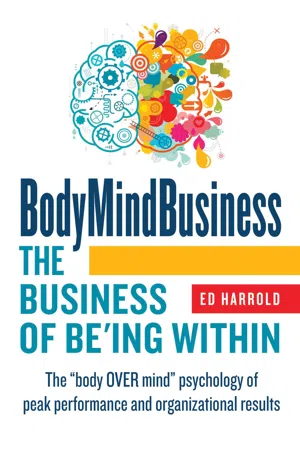
- English
- ePUB (mobile friendly)
- Available on iOS & Android
eBook - ePub
Information

Part One

The Physiology and Biochemistry of Peak Performance
Work Like an Endurance Athlete
IN 1994, I COMPETED IN the twenty-two-and-a-half-mile Around the Island Swim in Atlantic City, New Jersey. The only amateur in a field of twenty-seven professional swimmers, I finished fourteenth. This was the turning point for me. I had put my body and mind through my most grueling, competitive challenge to date, but as grueling as it was, I was in my element — in my body and immersed in Mother Nature’s bounty.
The Atlantic City Around the Island Swim is a combination ocean and bay marathon at a time of year when the water temperature is fifty-nine degrees on average. Swimmers encounter changes in temperature, tides, and currents. For me, the first seven miles of the race were great. I was swimming effortlessly, without any perceived problems. It was the next ten miles of the race that were truly debilitating and ultimately life-changing. I can’t count how many times my mind encouraged me to stop during those ten miles while my body violently revolted against the demands of such a difficult swim. I was vomiting and very cold. I was hallucinating. My body temperature had dropped, and I was experiencing the early-to-middle stages of hypothermia. My body and mind were breaking and separating me from my heart, my body was in the worst pain I’ve ever experienced, and I was stuck in my head.
Around mile seventeen, something shifted in my mind and my body. Something took over me, or should I say something let go of me — my ego temporarily died. When the battle within my mind finally seemed to cease, I became super empowered. I started to swim like I never had in my life. A warm, bright energy rose from my pelvic basin. It felt like a bottomless source of energy that I had never experienced before. I swam at eighty-five to ninety strokes a minute for the last five-and-a-half miles. Actually, I wasn’t swimming anymore — something greater than me had begun to swim for me, and I was on the ride of my life.
I didn’t want it to end. I felt invincible. I had become one with the water molecules of the ocean in those moments. I wasn’t moving my arms against the water like I did when my ego was in charge; the water was now moving my arms. I was in “flow” or “the zone,” as the phenomenon is commonly called in athletics. And I never experienced that space again until my introduction to Yoga a few years later.
Yes, I said the word “Yoga.” I began my exploration into Yoga and yoga breathing as a stressed-out business owner and broken athlete with lower-back and knee injuries sustained from years of individual and team sports. I’d been a competitive athlete in everything from football to surfing since the age of nine, and by my midthirties, I was feeling the effects of overtraining and injury. Not only could I not touch my toes, but I also could barely reach my knees. But damn, I looked good in the mirror! Thank goodness for expensive suits and exercise. They can hide a myriad of physical, mental, emotional, and spiritual issues on the outside.
As an athlete, I wondered why we were never taught the importance of linking breath with movement, or that different breathing techniques facilitate different physiologic functions in the body. I was immediately drawn to the breathing and meditation limbs of Yoga as I felt my mind and body reconnecting like they had when I was a young child.
In therapeutic yoga applications, we’re concerned with balancing the flow of energy and awareness, and raising prana (life force) energy. Pranayama creates this balance by linking the body with the mind through breath. Without the breath, Yoga isn’t Yoga — it’s a mindless exercise. When I willfully move my body into yoga poses, that’s my ego. My ego forces and pushes and cares what I look like in the posture. This is not a union of the body and the mind. This is my ego creating suffering for my mind and body. The breath is what “yokes” the body-mind. It stills the ego, calms the mind, relaxes the body, and guides us safely.
When combined with any of the Western exercises or any meditative movements, pranayama breath control is one of the highest forms of purification and discipline, as the physical sensation of heat (or tapas) is produced in an effort to purify the body. The longer we stay in the posture, the more detoxifying heat is brought to the surface. As the tapas builds, focusing on the breath keeps us present and provides the space for comfort within the discomfort. In the heat is a deeper awareness of ourselves and our purpose in life. In the heat is the healing.
We can apply these same strategies in the workplace. The body doesn’t understand whether it’s at work, at home, in the gym, or at the mall. It’s designed to focus on maintaining health and removing foreign invaders by any means necessary. The mind, on the other hand, is running at a subconscious level, replaying the past, and projecting the future . . . with utmost certainty, I might add.
As I mentioned, the breath is what unites the body with the mind. When these are working in unity, we are creating a state of heart-brain coherence, which is central to the teachings in this book.

Chapter One
Defining BodyMindBusiness
IN TODAY’S CHALLENGING business environment, high-performing executives have been adopting multidisciplinary approaches to becoming more productive and effective under pressure — and to achieve it without compromising their personal health and happiness.
The skills involved in high performance produce the same physiology and psychology both at work and in athletic competition. We find basically the same levels of brainwave activity, blood pressure, and lactic acid build-up. There is stress on the mind-body to perform and live the way we’re living. We’re working longer hours, multitasking in ways we’ve never done before and surrounded by digital media. All of this puts the same demands on the body as an athlete competing in a race.
It’s a common occurrence to see a client walk in out of breath, exhausted, and burned out, experiencing aches and pain and more. You see, the heart and brain don’t understand the difference. They’re just responding to our physical and mental demands. Mental stress, physical stress, emotional stress: it’s all the same stress to the heart and brain.
Our bodies live in the feeling of the thinking mind. That means the body is responding to everything we’re thinking and feeling. In BodyMindBusiness, we incorporate tools and strategies to operate from a “body OVER mind” philosophy, using the body to create a flow state in the mind to operate at high levels without feeling stress. Stress is a perception of the mind. When we remove old thoughts and emotions around what’s happening in the present moment, we operate in euphoric states. The more we incorporate these practices, the more we shift old patterns of behavior and enjoy the restorative qualities of the parasympathetic nervous system.
In the most simplistic terms, here’s how it works: We have five nervous systems in the body. The central nervous system (CNS) consists of the brain and spine. The peripheral nervous system (PNS) works with the CNS and is broken down into two branches: 1) somatic and 2) autonomic. The autonomic nervous system (ANS) has three branches: 1) sympathetic, 2) parasympathetic, and 3) enteric or gut/brain. You may also hear this referred to as the “second brain,” although many believe it’s really our primary brain.
I’d like you to think of the autonomic nervous system as a hot-and-cold energy system. The sympathetic system is our fight-or-flight system, which is adrenaline- and cortisol-based. Think of this as “hot.” Our parasympathetic system is our cooling system, based in serotonin and dopamine.
The fight-or-flight system is designed only for life’s emergency situations. As a culture, we have trained our brains to live in a fight-or-flight modality 24/7. There isn’t any real threat of danger, but our mind convinces the brain that there is. Every time we “feel” stressed, we trigger our HPA axis. This is an “old brain” system that connects the hypothalamus to the pituitary gland and to the adrenals, sitting on top of the kidneys. It’s designed to get food and not become food! This is the brain in full survivor mode. Digestion slows, and all available energy is diverted to the bones and muscles to fight or run. It’s super powerful and takes anywhere from 90 to 120 minutes to shift out of — and, that’s if we’re doing things to communicate with the brain to shift into the parasympathetic system. If we just are operating in the stress state, we teach the brain that we’re in a constant state of threat, and it keeps deploying the body to operate in this fashion. Inflammation thrives in this state. Nothing changes in this inflammatory state, except that we get tired and sick.
In fact, researchers have uncovered a link between inflammation and cognition, which explains why people struggling with chronic stress often feel mental fatigue, often called “brain fog.” Their findings were that “Inflammation appears to have a specific negative effect on the brain’s readiness to reach and maintain an alert state.” The results show that inflammation specifically affected brain activity related to executive control, as it has an effect on attention and staying alert.
The fastest, most effective way to shift from sympathetic to parasympathetic is by controlled breathing. As breathing rates and patterns improve, heart rates improve, and we signal the brain to shift from the HPA axis to HPS. In this state, the hippocampus in the brain rewrites and creates new awareness around old patterns. The hippocampus signals the pineal gland to send relaxation neurochemistry through the brain, such as serotonin, and we create the environment to rewrite the event or events. This reduces inner conflict and allows you to be a more enlightened, calmer human being, feeling like you’re the CEO of your mind and its perceptions. This rewiring of the brain begins with the ability to control the breathing rate to keep the heart rate down and turn off the “war department” in ourselves unless or until there is a real threat to our safety.
Another important aspect of the parasympathetic nervous system is the vagus nerve which is the tenth cranial nerve. The vagus nerve runs all the way from the brain through the face, throat area, thru the heart and solar plexus, and down through the diaphragm muscle and abdomen. It’s responsible for heart rates, respiratory rates, and digestive function; and it’s the means by which thoughts and emotions get transferred from the gut to the brain. Because the vagus nerve “wanders” through the diaphragm muscle, nasal diaphragmatic breathing is one of the most effective ways to stimulate and strengthen vagal tone.
In BodyMindBusiness, we aim to remain deeply connected to our body and breathing, so that, when we feel emotions like anxiety, anger, frustration, or fear coming on, we automatically begin to control the length, depth, and pace (or LDP) of our breathing. This will immediately manage the heart rate and brain function to overcome the stress intruder in a healthy way. In doing so, we strengthen the vagus nerve, contributing to resilience and the mitigation of mood and anxiety symptoms. The more control we have of our breathing, the more the brain can adapt and be neuroplastic to evolve the narrative.
In a nutshell, I want you to learn to go to your body first. We can’t fix the mind with the mind. Einstein said, “No problem can be solved from the same consciousness that created it.” In BodyMindBusiness, we go to the body first, ...
Table of contents
- Cover Page
- Title Page
- Copyright
- Contents
- Acknowledgments
- Introduction
- Part One: The Physiology and Biochemistry of Peak Performance
- Part Two: The Thirty-Day BodyMindBusiness Program
- Closing Note
- About the Author
- References
- Back Cover
Trusted by 375,005 students
Access to over 1.5 million titles for a fair monthly price.
Study more efficiently using our study tools.
Frequently asked questions
Yes, you can cancel anytime from the Subscription tab in your account settings on the Perlego website. Your subscription will stay active until the end of your current billing period. Learn how to cancel your subscription
No, books cannot be downloaded as external files, such as PDFs, for use outside of Perlego. However, you can download books within the Perlego app for offline reading on mobile or tablet. Learn how to download books offline
Perlego offers two plans: Essential and Complete
- Essential is ideal for learners and professionals who enjoy exploring a wide range of subjects. Access the Essential Library with 800,000+ trusted titles and best-sellers across business, personal growth, and the humanities. Includes unlimited reading time and Standard Read Aloud voice.
- Complete: Perfect for advanced learners and researchers needing full, unrestricted access. Unlock 1.5M+ books across hundreds of subjects, including academic and specialized titles. The Complete Plan also includes advanced features like Premium Read Aloud and Research Assistant.
We are an online textbook subscription service, where you can get access to an entire online library for less than the price of a single book per month. With over 1.5 million books across 990+ topics, we’ve got you covered! Learn about our mission
Look out for the read-aloud symbol on your next book to see if you can listen to it. The read-aloud tool reads text aloud for you, highlighting the text as it is being read. You can pause it, speed it up and slow it down. Learn more about Read Aloud
Yes! You can use the Perlego app on both iOS and Android devices to read anytime, anywhere — even offline. Perfect for commutes or when you’re on the go.
Please note we cannot support devices running on iOS 13 and Android 7 or earlier. Learn more about using the app
Please note we cannot support devices running on iOS 13 and Android 7 or earlier. Learn more about using the app
Yes, you can access BodyMindBusiness by Ed Harrold in PDF and/or ePUB format, as well as other popular books in Business & Leadership. We have over 1.5 million books available in our catalogue for you to explore.