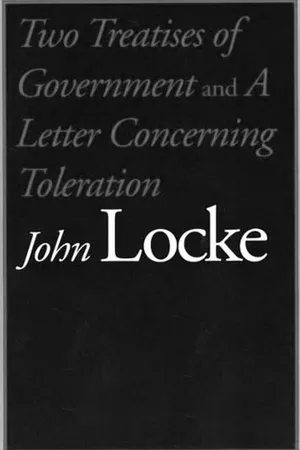
- English
- ePUB (mobile friendly)
- Available on iOS & Android
eBook - ePub
A Letter Concerning Toleration
Information
Topic
PhilosophySubtopic
Aesthetics in PhilosophyIntroduction
A Letter Concerning Toleration by John Locke was originally published in 1689. Its initial publication was in Latin, though it was immediately translated into other languages.
John Locke, (born August 29, 1632, Wrington, Somerset, England—died October 28, 1704, High Laver, Essex), English philosopher whose works lie at the foundation of modern philosophical empiricism and political liberalism. He was an inspirer of both the European Enlightenment and the Constitution of the United States. His philosophical thinking was close to that of the founders of modern science, especially Robert Boyle, Sir Isaac Newton, and other members of the Royal Society. His political thought was grounded in the notion of a social contract between citizens and in the importance of toleration, especially in matters of religion. Much of what he advocated in the realm of politics was accepted in England after the Glorious Revolution of 1688–89 and in the United States after the country’s declaration of independence in 1776.
Locke’s family was sympathetic to Puritanism but remained within the Church of England, a situation that coloured Locke’s later life and thinking. Raised in Pensford, near Bristol, Locke was 10 years old at the start of the English Civil Wars between the monarchy of Charles I and parliamentary forces under the eventual leadership of Oliver Cromwell. Locke’s father, a lawyer, served as a captain in the cavalry of the parliamentarians and saw some limited action. From an early age, one may thus assume, Locke rejected any claim by the king to have a divine right to rule.
After the first Civil War ended in 1646, Locke’s father was able to obtain for his son, who had evidently shown academic ability, a place at Westminster School in distant London. It was to this already famous institution that Locke went in 1647, at age 14. Although the school had been taken over by the new republican government, its headmaster, Richard Busby (himself a distinguished scholar), was a royalist. For four years Locke remained under Busby’s instruction and control (Busby was a strong disciplinarian who much favoured the birch). In January 1649, just half a mile away from Westminster School, Charles was beheaded on the order of Cromwell. The boys were not allowed to attend the execution, though they were undoubtedly well aware of the events taking place nearby.
The curriculum of Westminster centred on Latin, Greek, Hebrew, Arabic, mathematics, and geography. In 1650 Locke was elected a King’s Scholar, an academic honour and financial benefit that enabled him to buy several books, primarily classic texts in Greek and Latin. Although Locke was evidently a good student, he did not enjoy his schooling; in later life he attacked boarding schools for their overemphasis on corporal punishment and for the uncivil behaviour of pupils. In his enormously influential work Some Thoughts Concerning Education (1693), he would argue for the superiority of private tutoring for the education of young gentlemen (see below Other works).
In the autumn of 1652 Locke, at the comparatively late age of 20, entered Christ Church, the largest of the colleges of the University of Oxford and the seat of the court of Charles I during the Civil Wars. But the royalist days of Oxford were now behind it, and Cromwell’s Puritan followers filled most of the positions. Cromwell himself was chancellor, and John Owen, Cromwell’s former chaplain, was vice-chancellor and dean. Owen and Cromwell were, however, concerned to restore the university to normality as soon as possible, and this they largely succeeded in doing.
Locke later reported that he found the undergraduate curriculum at Oxford dull and unstimulating. It was still largely that of the medieval university, focusing on Aristotle (especially his logic) and largely ignoring important new ideas about the nature and origins of knowledge that had been developed in writings by Francis Bacon (1561–1626), René Descartes (1596–1650), and other natural philosophers. Although their works were not on the official syllabus, Locke was soon reading them. He graduated with a bachelor’s degree in 1656 and a master’s two years later, about which time he was elected a student (the equivalent of fellow) of Christ Church. At Oxford Locke made contact with some advocates of the new science, including Bishop John Wilkins, the astronomer and architect Christopher Wren, the physicians Thomas Willis and Richard Lower, the physicist Robert Hooke, and, most important of all, the eminent natural philosopher and theologian Robert Boyle. Locke attended classes in iatrochemistry (the early application of chemistry to medicine), and before long he was collaborating with Boyle on important medical research on human blood. Medicine from now on was to play a central role in his life.
The restoration of the English monarchy in 1660 was a mixed blessing for Locke. It led many of his scientific collaborators to return to London, where they soon founded the Royal Society, which provided the stimulus for much scientific research. But in Oxford the new freedom from Puritan control encouraged unruly behaviour and religious enthusiasms among the undergraduates. These excesses led Locke to be wary of rapid social change, an attitude that no doubt partly reflected his own childhood during the Civil Wars.
In his first substantial political work, Two Tracts on Government (composed in 1660 but not published until 1967), Locke defended a very conservative position: in the interest of political stability, a government is justified in legislating on any matter of religion that is not directly relevant to the essential beliefs of Christianity. This view, a response to the perceived threat of anarchy posed by sectarian differences, was diametrically opposed to the doctrine that he would later expound in Two Treatises of Government (1689).
In 1663 Locke was appointed senior censor in Christ Church, a post that required him to supervise the studies and discipline of undergraduates and to give a series of lectures. The resulting Essays on the Law of Nature (first published in 1954) constitutes an early statement of his philosophical views, many of which he retained more or less unchanged for the rest of his life. Of these probably the two most important were, first, his commitment to a law of nature, a natural moral law that underpins the rightness or wrongness of all human conduct, and, second, his subscription to the empiricist principle that all knowledge, including moral knowledge, is derived from experience and therefore not innate. These claims were to be central to his mature philosophy, both with regard to political theory and epistemology.
Association with Shaftesbury
In 1666 Locke was introduced to Lord Anthony Ashley Cooper, later 1st earl of Shaftesbury, by a mutual acquaintance. As a member and eventually the leader of a group of opposition politicians known as the Whigs, Ashley was one of the most powerful figures in England in the first two decades after the Restoration. Ashley was so impressed with Locke at their first meeting that in the following year he asked him to join his London household in Exeter House in the Strand as his aide and personal physician, though Locke did not then have a degree in medicine. Politically, Ashley stood for constitutional monarchy, a Protestant succession, civil liberty, toleration in religion, the rule of Parliament, and the economic expansion of England. Locke either shared or soon came to share all these objectives with him, and it was not long before a deep—and for each an important—mutual understanding existed between them. Locke drafted papers on toleration, possibly for Ashley to use in parliamentary speeches. In his capacity as a physician, Locke was involved in a remarkable operation to insert a silver tube into a tumour on Ashley’s liver, which allowed it to be drained on a regular basis and relieved him of much pain. It remained in place for the remainder of Ashley’s life. Locke also found a suitable bride for Ashley’s son.
By 1668 Locke had become a fellow of the Royal Society and was conducting medical research with his friend Thomas Sydenham, the most distinguished physician of the period. Although Locke was undoubtedly the junior partner in their collaboration, they worked together to produce important research based on careful observation and a minimum of speculation. The method that Locke acquired and helped to develop in this work reinforced his commitment to philosophical empiricism. But it was not only medicine that kept Locke busy, for he was appointed by Ashley as secretary to the lords proprietors of Carolina, whose function was to promote the establishment of the North American colony. In that role Locke helped to draft The Fundamental Constitutions for the Government of Carolina (1669), which, among other provisions, guaranteed freedom of religion for all save atheists.
Throughout his time in Exeter House, Locke kept in close contact with his friends. Indeed, the long gestation of his most important philosophical work, An Essay Concerning Human Understanding (1689), began at a meeting with friends in his rooms, probably in February 1671. The group had gathered to consider questions of morality and revealed religion (knowledge of God derived through revelation). Locke pointed out that, before they could make progress, they would need to consider the prior question of what the human mind is (and is not) capable of comprehending. It was agreed that Locke should prepare a paper on the topic for their next meeting, and it was this paper that became the first draft of his great work.
Exile in France
In 1672 Ashley was raised to the peerage as the 1st earl of Shaftesbury, and at the end of that year he was appointed lord chancellor of England. He was soon dismissed, however, having lost favour with Charles II. For a time Shaftesbury and Locke were in real danger, and it was partly for this reason that Locke traveled to France in 1675. By this time he had received his degree of bachelor of medicine from Oxford and been appointed to a medical studentship at Christ Church.
Locke remained in France for nearly four years (1675–79), spending much time in Paris and Montpelier; the latter possessed a large Protestant minority and the most important medical school in Europe, both of which were strong attractions for Locke. He made many friends in the Protestant community, including some leading intellectuals. His reading, on the other hand, was dominated by the works of French Catholic philosophers. But it was his medical interests that were the major theme of the journals he kept from this period. He was struck by the poverty of the local population and contrasted this unfavourably with conditions in England and with the vast amounts that the French king (Louis XIV) was spending on the Palace of Versailles. From time to time Locke turned to philosophical questions and added notes to his journal, some of which eventually found a place in An Essay Concerning Human Understanding.
Back in England, Shaftesbury had been imprisoned for a year in the Tower of London but was released in February 1678. By the time Locke returned to England in 1679, Shaftesbury had been restored to favour as lord president of the Privy Council. The country, however, was torn by dissension over the exclusion controversy—the debate over whether a law could be passed to forbid (exclude) the succession of Charles II’s brother James, a Roman Catholic, to the English throne. Shaftesbury and Locke strongly supported exclusion. The controversy reached its apex in the hysteria of the so-called Popish Plot, a supposed Catholic conspiracy to assassinate Charles and replace him with James. The existence of the plot was widely accepted and resulted in the execution of many innocent people before its fabricator, the Anglican priest Titus Oates, was discredited.
Two Treatises of Government
When Shaftesbury failed to reconcile the interests of the king and Parliament, he was dismissed; in 1681 he was arrested, tried, and finally acquitted of treason by a London jury. A year later he fled to Holland, where in 1683 he died. None of Shaftesbury’s known friends was now safe in England. Locke himself, who was being closely watched, crossed to Holland in September 1683.
Out of this context emerged Locke’s major work in political philosophy, Two Treatises of Government (1689). Although scholars disagree over the exact date of its composition, it is certain that it was substantially composed before Locke fled to Holland. In this respect the Two Treatises was a response to the political situation as it existed in England at the time of the exclusion controversy, though its message was of much more lasting significance. In the preface to the work, composed at a later date, Locke makes clear that the arguments of the two treatises are continuous and that the whole constitutes a justification of the Glorious Revolution, which brought the Protestant William III and Mary II to the throne following the flight of James II to France.
It should be noted that Locke’s political philosophy was guided by his deeply held religious commitments. Throughout his life he accepted the existence of a creating God and the notion that all humans are God’s servants in virtue of that relationship. God created humans for a certain purpose, namely to live a life according to his laws and thus to inherit eternal salvation; most importantly for Locke’s philosophy, God gave humans just those intellectual and other abilities necessary to achieve this end. Thus, humans, using the capacity of reason, are able to discover that God exists, to identify his laws and the duties they entail, and to acquire sufficient knowledge to perform their duties and thereby to lead a happy and successful life. They can come to recognize that some actions, such as failing to care for one’s offspring or to keep one’s contracts, are morally reprehensible and contrary to natural law, which is identical to the law of God. Other specific moral laws can be discovered or known only through revelation—e.g., by reading the Bible or the Qurʾān.
The essentially Protestant Christian framework of Locke’s philosophy meant that his attitude toward Roman Catholicism would always be hostile. He rejected the claim of papal infallibility (how could it ever be proved?), and he feared the political dimensions of Catholicism as a threat to English autonomy, especially after Louis XIV in 1685 revoked the Edict of Nantes, which had granted religious liberty to the Protestant Huguenots.
The first treatise
The first treatise was aimed squarely at the work of another 17th-century political theorist, Sir Robert Filmer, whose Patriarcha (1680, though probably written in the 1630s) defended the theory of divine right of kings: the authority of every king is divinely sanctioned by his descent from Adam—according to the Bible, the first king and the father of humanity. Locke claims that Filmer’s doctrine defies “common sense.” The right to rule by descent from Adam’s first grant could not be supported by any historical record or any other evidence, and any contract that God and Adam entered into would not be binding on remote descendants thousands of years later, even if a line of descent could be identified. His refutation was widely accepted as decisive, and in any event the theory of the divine right of kings ceased to be taken seriously in England after 1688.
The second treatise
Locke’s importance as a political philosopher lies in the argument of the second treatise. He begins by defining political power as a
right of making Laws with Penalties of Death, and consequently all less Penalties, for the Regulating and Preserving of Property, and of employing the force of the Community, in the Execution of such Laws and in defence of the Common-wealth from Foreign Injury, and all this only for the Publick Good.
Much of the remainder of the Treatise is a commentary on this paragraph.
The state of nature and the social contract
Locke’s definition of political power has an immediate moral dimension. It is a “right” of making laws and enforcing them for “the public good.” Power for Locke never simply means “capacity” but always “morally sanctioned capacity.” Morality pervades the whole arrangement of society, and it is this fact, tautologically, that makes society legitimate.
Locke’s account of political society is based on a hypothetical consideration of the human condition before the beginning of communal life. In this “state of nature,” humans are entirely free. But this freedom is not a state of complete license, because it is set within the bounds of the law of nature. It is a state of equality, which is itself a central element of Locke’s account. In marked contrast to Filmer’s world, there is no natural hierarchy among humans. Each person is naturally free and equal under the law of nature, subject only to the will of “the infinitely wise Maker.” Each person, moreover, is required to enforce as well as to obey this law. It is this duty that gives to humans the right to punish offenders. But in such a state of nature, it is obvious that placing the right to punish in each person’s hands may lead to injustice and violence. This can be remedied if humans enter into a contract with each other to recognize by common consent a civil government with the power to enforce the law of nature among the citizens of that state. Although any contract is legitimate as long as it does not infringe upon the law of nature, it often happens that a contract can be enforced only if there is some higher human authority to require compliance with it. It is a primary function of society to set up the framework in which legitimate contracts, freely entered into, may be enforced, a state of affairs much more difficult to guarantee in the state of nature and outside civil society.
Property
Before discussing the creation of political society in greater detail, Locke provides a lengthy account of his notion of property, which is of central importance to his political theory. Each person, according to Locke, has property in his own person—that is, each person literally owns his own body. Other people may not use a person’s body for any purpose without his permission. But one can acquire property beyond one’s own body through labour. By mixing one’s labour with objects in the world, one acquires a right to the fruits of that work. If one’s labour turns a barren field into crops or a pile of wood into a house, then the valuable product of that labour, the crops or the house, becomes one’s property. Locke’s view was a forerunner of the labour theory of value, which was expounded in different forms by the 19th-century economists David Ricardo and Karl Marx (see also classical economics).
Clearly, each person is entitled to as much of the product of his labour as he needs to survive. But, according to Locke, in the state of nature one is not entitled to hoard surplus produce—one must share it with those less fortunate. God has “given the World to Men in common…to make use of to the best advantage of Life, and convenience.” The introduction of money, while radically changing the economic base of society, was itself a contingent development, for money has no intrinsic value but depends for its utility only on convention.
Locke’s account of property and how it comes to be owned faces difficult problems. For example, it is far from clear how much labour is required to turn any given unowned object into a piece of private property. In the case of a piece of land, for example, is it sufficient merely to put a fence around it? Or must it be plowed as well? There is, nevertheless, something intuitively powerful in the notion that it is activity, or work, that grants one a property right in something.
Organization of government
Locke returns to politic...
Table of contents
- (Untitled)
- (Untitled)
- Introduction
Trusted by 375,005 students
Access to over 1.5 million titles for a fair monthly price.
Study more efficiently using our study tools.
Frequently asked questions
Yes, you can cancel anytime from the Subscription tab in your account settings on the Perlego website. Your subscription will stay active until the end of your current billing period. Learn how to cancel your subscription
No, books cannot be downloaded as external files, such as PDFs, for use outside of Perlego. However, you can download books within the Perlego app for offline reading on mobile or tablet. Learn how to download books offline
Perlego offers two plans: Essential and Complete
- Essential is ideal for learners and professionals who enjoy exploring a wide range of subjects. Access the Essential Library with 800,000+ trusted titles and best-sellers across business, personal growth, and the humanities. Includes unlimited reading time and Standard Read Aloud voice.
- Complete: Perfect for advanced learners and researchers needing full, unrestricted access. Unlock 1.5M+ books across hundreds of subjects, including academic and specialized titles. The Complete Plan also includes advanced features like Premium Read Aloud and Research Assistant.
We are an online textbook subscription service, where you can get access to an entire online library for less than the price of a single book per month. With over 1.5 million books across 990+ topics, we’ve got you covered! Learn about our mission
Look out for the read-aloud symbol on your next book to see if you can listen to it. The read-aloud tool reads text aloud for you, highlighting the text as it is being read. You can pause it, speed it up and slow it down. Learn more about Read Aloud
Yes! You can use the Perlego app on both iOS and Android devices to read anytime, anywhere — even offline. Perfect for commutes or when you’re on the go.
Please note we cannot support devices running on iOS 13 and Android 7 or earlier. Learn more about using the app
Please note we cannot support devices running on iOS 13 and Android 7 or earlier. Learn more about using the app
Yes, you can access A Letter Concerning Toleration by John Locke in PDF and/or ePUB format, as well as other popular books in Philosophy & Aesthetics in Philosophy. We have over 1.5 million books available in our catalogue for you to explore.