eBook - ePub
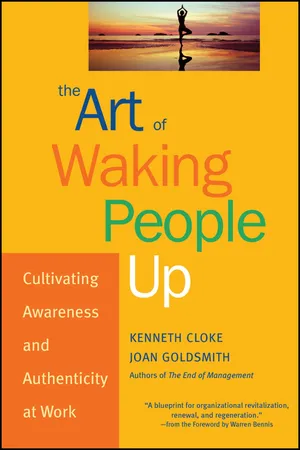
The Art of Waking People Up
Cultivating Awareness and Authenticity at Work
- English
- ePUB (mobile friendly)
- Available on iOS & Android
eBook - ePub
The Art of Waking People Up
Cultivating Awareness and Authenticity at Work
About this book
In The Art of Waking People Up authors Kenneth Cloke and Joan Goldsmith draw on more than thirty years of practical experience with hundreds of organizations-- from Fortune 500 companies to government agencies, schools, and nonprofits-- to reveal new ways of giving and receiving feedback that maximize personal and organizational change and foster lifelong learning. They show how organizations can develop the systems, processes, techniques, and relationships that affirm, rather than undermine, the intelligence and humanity of their employees. This important resource is filled with the necessary tools, interventions, and strategies managers can use to encourage their employees to speak, hear, absorb, and use the information they need to improve the way they work.
Information
Part I
Context: Cultivating Awareness and Authenticity
1
An Orientation to Awareness and Authenticity
I consider many adults (including myself) are or have been, more or less, in a hypnotic trance, induced in early infancy: we remain in this state until—when we dead awaken . . . we shall find that we have never lived.R. D. Laing
We have all encountered employees who seem barely awake, who squander their work lives, who blind themselves to what is taking place within and around them, who speak and act inauthentically, who do not care about what they do, how they do it, to whom, or why. Indeed, many of our workplaces seem populated with the living dead, zombies who wrap themselves in a hypnotic trance, as psychiatrist R. D. Laing described, only to find that they have numbed themselves so thoroughly that they are unable to really live.
This indolent, apathetic, somnolent state has countless faces. It can be found in preoccupations with the past and unrealistic expectations for the future; in attitudes of denial, defensiveness, and disregard for the present; in frustration over failed change efforts; in reduced enthusiasm due to hierarchical privilege, bureaucratic indifference, and autocratic contempt; in a variety of mesmerizing relationships, processes, cultures, systems, structures, and attitudes that limit the capacity to perceive and act based not only on what is taking place within and around us and diminish who we are as human beings.
This zombification and atrophication of work life happens incrementally whenever people are punished for being aware and authentic and, as a result, become frustrated, give up, cease caring, and stop trying. It occurs when managers stop telling the truth and lie or keep silent about things that matter. It occurs when feedback is no longer oriented to how employees can succeed but to how they have failed—not just in their work but as human beings. It occurs when performance assessments become judgmental and hierarchical rather than supportive and participatory; when organizations separate honesty from kindness, integrity from advancement, and respect from communication.
Numbing oneself to experience is a natural response to unfulfilled expectations, unprocessed pain, unfinished grieving, unresolved conflict, and repetitive disappointment. When employees experience repeated losses, pain, conflicts, and disappointments, they often withdraw, shut down, or defend themselves from bruised feelings and unhappy thoughts. In doing so, they deaden themselves to experience and to the pain they would otherwise feel if they were fully awake. The extreme forms of this emotional state are catatonia and schizophrenia, but more familiar examples include apathy, distracted behavior, superficiality, equivocation, isolation, substance abuse, recurring illness, stress-related injuries, cynicism, excessive absenteeism, hypersensitivity, and unresolved conflicts.
When employees defend themselves against awareness and authenticity even in small ways, they diminish their capacity for growth, cease being fully alive and slip into a kind of unfulfilling stupor. How, in this state, is it possible for them to learn or change? What could conceivably motivate them to continue developing, sharpening, and expanding their skills? How do they ever overcome their tragedies or learn to celebrate their triumphs? How do they become responsible team members, improve the quality of their work, or risk changing what is not working?
In truth, their only real option in the face of these disabling experiences is to wake up and change their attitude toward what they have experienced. As they wake up, they increase their awareness, become more authentic, discover where their organization is not congruent with its professed values, and commit to improve their work processes, organizations, relationships, communities, and environments—not once or in isolation, but continually and collaboratively with others. This is how they actually transform their work lives.
As people wake up, they become increasingly conscious of the dysfunctional elements in their work environments and relationships and can see what is not working or might work better. They can then abandon the destructive patterns, adversarial attitudes, injured feelings, upsetting memories, and addictive behaviors that keep them mired in the past. They can release unrealistic expectations for the future and attitudes of defensiveness and denial regarding the past. They can take responsibility for what they do and who they are, for their behaviors and the results they produce. They can then assume the arduous task of transforming their personal, organizational, social, political, and economic lives and creating more satisfying, sustainable, and supportive work environments.
Resistance to Change
In spite of these possibilities, or perhaps because of them, it is rare that anyone welcomes opportunities to wake up, gladly seeks ways of stretching beyond what is safe, or enthusiastically embraces fundamental changes. We are often reluctant to push to the edge of our capacities, to experiment or try out new things. Instead, we resist, avoid, rationalize, and bolster our self-deception that things are fine as they are. As poet W. H. Auden poignantly noted:
We would rather be ruined than changed,We would rather die in our dreadThan climb the cross of the momentAnd let our illusions die.
Many of us resist change even when it is critical to our well-being; when the need to change is presented gently, empathetically, and with the best of intentions; when we understand that it could dramatically improve our lives. Instead, we become self-protective, accusatory, and suspicious and would rather retreat with our false ideas intact than climb “the cross of the moment” and let our comforting illusions die. Why? What are we so frightened of losing?
We may be frightened that change will deprive us of jobs or income, or eliminate our role or source of identity, or undercut our self-confidence, or unsettle a precarious idea about who we are. We may be convinced that we will never be understood or appreciated for who we are. We may distrust our organizational environments so much that we cannot imagine anything ever changing, except by getting worse. We may have unresolved insecurities or doubts from our families of origin that keep us locked in unhappy relationships and feeling doubtful about our capacities. We may simply lack the personal skills or organizational supports we need to risk doing something that could radically change our lives.
In fact, it is not change that we resist, but what change implies. We resist the loss of what is familiar, the uncertainty surrounding anything new, the insecurity about who we are when the things with which we have identified no longer define us. Waking up and cultivating awareness and authenticity reduce this resistance by revealing a deeper identity that is not bound up in the past or future, or in what is constantly changing.
The Limitations of Roles and Expectations
When we become frightened of these aspects of change, we defend ourselves against learning, resist receiving honest feedback, hide behind roles, become inauthentic, cease being fully awake, and grow insensitive to what is happening around and inside us. We fight to preserve what is familiar, thinking we are protecting our power or image. Yet in doing so, we diminish our capacity for honesty and empathy with ourselves and others. Eventually we become stuck and unable to grow. Whatever our role, at a subtle level, power, ego, and resistance to change are increased by identifying personally with it, while honesty, authenticity, and openness to change are diminished.
In truth, these self-defining roles do not exist—nor, at a human level, do organizations, job titles, hierarchies, or status. They are figments of our imaginations—constructs, hypnotic images, mirages, phantoms, fetishes, and hallucinations that distance us from what is real and from each other. Every role is inauthentic, simply because it captures only a part of what we do and largely ignores who we are. Yet we invest these images with the power to control our lives, twisting them gradually into conformity with other people’s expectations and losing our capacity for self-definition.
In Fraud, a novel by Anita Brookner, a woman tells a friend, “Fraud was what was perpetrated on me by the expectations of others. They fashioned me in their own image, according to their needs.” People become inauthentic and fraudulent by hiding the most interesting, human parts of themselves behind masks and roles, revealing only what they hope others will find acceptable. This is a kind of sleep from which anyone can awaken at any time, even after years of accommodation. To do so requires cultivating awareness, authenticity, congruence, and commitment in ourselves, in others, and in organizations.
However we describe ourselves, whatever roles we assume, they do not touch the deepest parts of ourselves. In addition, in all our descriptions, there is an “I” that is describing “Myself.” Yet the one describing is not the same as the one described. If “I” am able to observe and describe “Myself” as though from outside, which one am “I”? Every role or description we use to describe ourselves seems solid, yet beneath it lies a thought, and beneath the thought lies a thinker. Waking up means discovering the thinker. As we do so, we accept responsibility for our choices and recognize that our power lies there, rather than in our roles and self-definitions.
Why Organizations Create Roles
Traditional organizations use roles to define and reinforce rigid hierarchies of power. They do little to support people in changing or acting in ways that are authentic, honest, immediate, collaborative, and democratic, because to do so would invite a rearrangement of power relationships. Hierarchical, bureaucratic, and authoritarian organizational models permit—and in some cases actively encourage—role rigidity and hypocrisy. These organizations are unwilling to admit or examine their faults publicly. They discourage honest communication, suppress creativity, and undermine teamwork and self-confidence. In the process they put people to sleep.
In the absence of honest feedback and continuous scrutiny, these organizations desperately seek to defend and perpetuate themselves, causing them to undermine the values they publicly proclaim. They espouse creativity yet reward bureaucracy, conservatism, and defensiveness. They urge risk taking but celebrate only those who increase or preserve their financial bottom line. They call for change yet reward caution, stasis, and denial. They advocate equality but radically limit the possibilities for personal and organizational ...
Table of contents
- Cover
- Table of Contents
- Title Page
- Copyright
- Foreword
- Preface
- The Authors
- Part I Context
- Part II Processes
- Part III Techniques
- Part IV Relationships
- Index
- End User License Agreement
Trusted by 375,005 students
Access to over 1.5 million titles for a fair monthly price.
Study more efficiently using our study tools.
Frequently asked questions
Yes, you can cancel anytime from the Subscription tab in your account settings on the Perlego website. Your subscription will stay active until the end of your current billing period. Learn how to cancel your subscription
No, books cannot be downloaded as external files, such as PDFs, for use outside of Perlego. However, you can download books within the Perlego app for offline reading on mobile or tablet. Learn how to download books offline
Perlego offers two plans: Essential and Complete
- Essential is ideal for learners and professionals who enjoy exploring a wide range of subjects. Access the Essential Library with 800,000+ trusted titles and best-sellers across business, personal growth, and the humanities. Includes unlimited reading time and Standard Read Aloud voice.
- Complete: Perfect for advanced learners and researchers needing full, unrestricted access. Unlock 1.5M+ books across hundreds of subjects, including academic and specialized titles. The Complete Plan also includes advanced features like Premium Read Aloud and Research Assistant.
We are an online textbook subscription service, where you can get access to an entire online library for less than the price of a single book per month. With over 1.5 million books across 990+ topics, we’ve got you covered! Learn about our mission
Look out for the read-aloud symbol on your next book to see if you can listen to it. The read-aloud tool reads text aloud for you, highlighting the text as it is being read. You can pause it, speed it up and slow it down. Learn more about Read Aloud
Yes! You can use the Perlego app on both iOS and Android devices to read anytime, anywhere — even offline. Perfect for commutes or when you’re on the go.
Please note we cannot support devices running on iOS 13 and Android 7 or earlier. Learn more about using the app
Please note we cannot support devices running on iOS 13 and Android 7 or earlier. Learn more about using the app
Yes, you can access The Art of Waking People Up by Kenneth Cloke,Joan Goldsmith in PDF and/or ePUB format, as well as other popular books in Business & Leadership. We have over 1.5 million books available in our catalogue for you to explore.